wheel CADILLAC ELDORADO 1997 10.G Owner's Guide
[x] Cancel search | Manufacturer: CADILLAC, Model Year: 1997, Model line: ELDORADO, Model: CADILLAC ELDORADO 1997 10.GPages: 361, PDF Size: 22.85 MB
Page 222 of 361
Downloaded from www.Manualslib.com manuals search engine Hold the bottom of the steering wheel with one hand.
Then, to move the trailer to the left, just move that hand
to the left. TQ move the trailer to the right, move your
hand
to the right. Always back up slowly and, if
possible,
have someone guide you. When
you tow a trailer, your vehicle may need
a
different turn signal flasher andor extra wiring. Check
with your Cadillac dealer. The green
arrows on your
instrument panel will flash whenever you signal a turn
or lane change. Properly hooked up, the trailer lamps
will also flash, telling other drivers you’re about to turn,
change lanes or stop.
When towing
a trailer, the green arrows on your
instrument
panel will flash for turns even if the bulbs on
the trailer are burned out. Thus, you may think drivers
Making very sharp turns while trailerring could
cause
the trailer to come in contact with the
vehicle.
Your vehicle could be damaged. Avoid
behind you are seeing your signal wheithey are mot. It’s
important to check occasionally to be sure the trailer
bulbs are still working.
-
making very sharp turns while traillering.
Reduce speed and shift to a lower gear before you start
When you’re turning with a trailer, make wider turns down a long or steep downgrade. If you don’t shift
than normal. Do this so your trailer won’t strike soft down, you might have to use your brakes so much that
shoulders, curbs, road
signs, trees or other objects. they would get hot and no longer work well.
Avoid jerky
or sudden maneuvers. Signal well
in advance. speed to around
45 mph (70 kdh) or less to reduce the
On
a long
uphill grade, shift down and reduce your
possibility
of engine and transaxle overheating.
Page 223 of 361
Downloaded from www.Manualslib.com manuals search engine You really should not park your vehicle, with a trailer
attached,
on a hill. If something goes wrong, your rig
could start
to move. People can be injured, and both
your vehicle and the trailer can be damaged.
But if
you ever have to park your rig on a hill, here’s
how to do it:
1. Apply your regular brakes, but do not shift into
PARK (P).
2. Have someone place chocks under the trailer wheels.
3. When the wheel chocks are in place, release the
regular brakes until
the chocks absorb the load.
PARK (P) firmly and apply your parking brake.
4. Reapply the regular brakes. Then shift into
Release the regular brakes.
1. Apply your regular brakes and hold the pedal down
while you:
Start your engine;
e Shift into a gear; and
Be sure the parking brake has released.
2. Let up on the brake pedal.
3. Drive slowly until the trailer is clear of the chocks.
4. Stop and have someone pick up and store the chocks.
Your vehicle will need service
more often when you’re
pulling
a trailer. See the Maintenance Schedule for more
on this. Things that are especially important in trailer
operation are automatic transaxle fluid (don’t overfill),
engine oil, belt, cooling system and brake adjustment.
Each of these is covered in this manual, and
the Index
will help
you find them quickly. If you’re trailering, it’s
a good idea to review these sections before you start
your trip.
Check periodically to see that all hitch nuts
and bolts
are tight.
Page 234 of 361
Downloaded from www.Manualslib.com manuals search engine 13. Remove the cables in reverse order to prevent
electrical
shorting. Take care that they don’t touch
each other or any other metal.
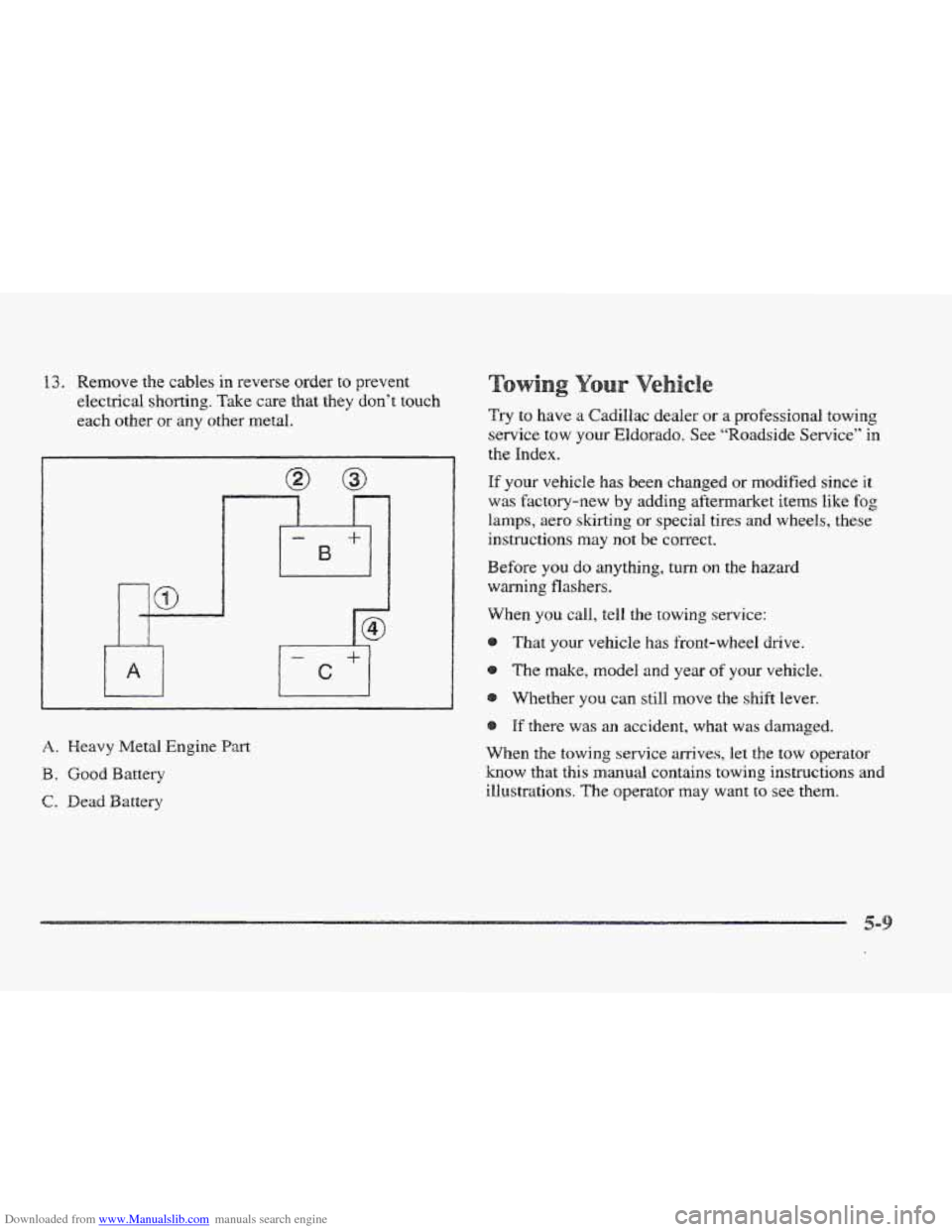
A. Heavy Metal Engine Part
B. Good Battery
C. Dead Battery
Try to have a Cadillac dealer or a professional towing
service tow
your Eldorado. See “Roadside Service” in
the Index.
If your vehicle has been changed or modified since it
was Factory-new by adding aftermarket items like fog
lamps, aero skirting or special tires and wheels, these
instructions
may not be correct.
Before
you do anything, turn on the hazard
warning flashers.
When you call, tell the towing service:
That
your vehicle has front-wheel drive.
The make, model and year of your vehicle.
Whethef you can still move the shift lever.
If there was an accident, what was damaged.
When the towhg service arrives, let the tow operator
know that this manual contains towing instructions and
illustrations. The operator may
want to see them.
Page 236 of 361
Downloaded from www.Manualslib.com manuals search engine ..
CA,U
.. .. . ,
A vehicle ran fall from a car-carrier if it isn’t
adequately secured. This can cause a ccollisiora,
serious
personal injury and vehicle damage. The
vehicle should
be tightly secured with chains or
steel cabIes before it is transported.
Donst
use substitutes (ropes, leather straps,
canvas webbing, etc.) that can be cut by sharp
edges underneath the towed vehicle. Always use
2’-hooks inserted in the front T-h~ok slots or
Ha-hooks inserted in the rear R-hook slots. Never
use J-lho~ks~
They will damage drivetrain and
suspension components.
When your vehicle is being towed, have the ignition
key turned
to the OFF position. The steering wheel
should be clamped in a straight-ahead position, with
a clamping device designed for towing service. Do not
use the vehicle’s steering column lock for this. The
transaxle should be
in NEUTRAL (N) and the parking
brake released.
Don’t have your vehicle towed on the drive wheels
unless you must. If the vehicle must be towed on the
drive wheels,
be sure to follow the speed and distance
restrictions later
in this section or your transaxle will be
damaged. If these limitations must be exceeded, then the
drive wheels
have to be supported on a dolly.
Page 237 of 361
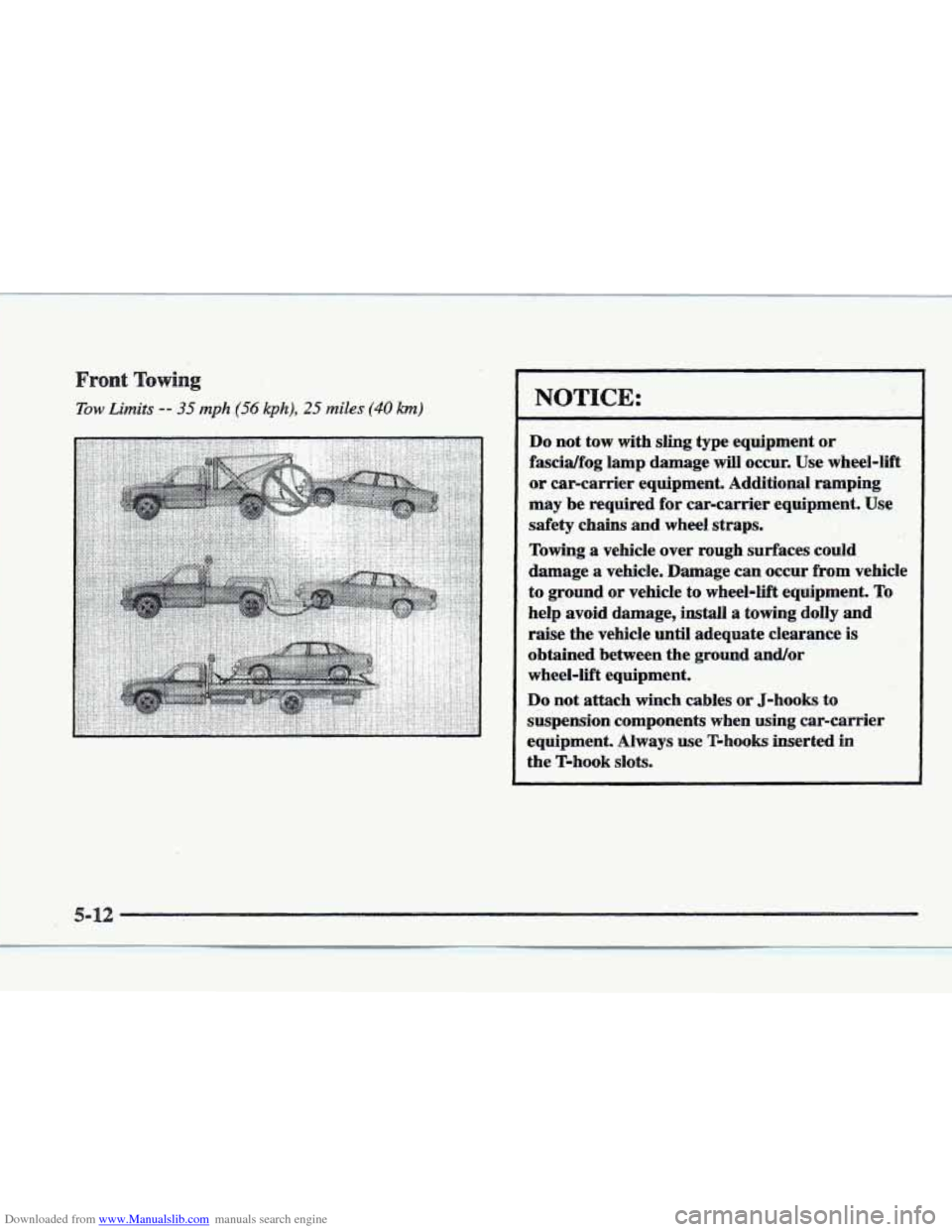
Downloaded from www.Manualslib.com manuals search engine FrOne TQ
Tow Limits -- 35 mph .(56 kph), 25 miles (40 km) NOTICE:
Do not tow with sling type equipment or
fascidfog lamp damage will occur. Use wheel-lift
or car-carrier equipment. Additional ramping
may
be required for car-carrier equipment. Use
safety chains and wheel straps.
Towing a vehicle over rough surfaces could
damage a vehicle. Damage can occur from vehicle
to ground or vehicle to wheel-lift equipment. To
help avoid damage, install a towing dolly and
raise the vehicle until adequate clearance is
obtained between the ground and/or
wheel-lift equipment.
Do not attach winch cables or J-hooks to
suspension components when using car-carrier
equipment. Always use T-hooks inserted
in
the T-kook slots.
Page 238 of 361
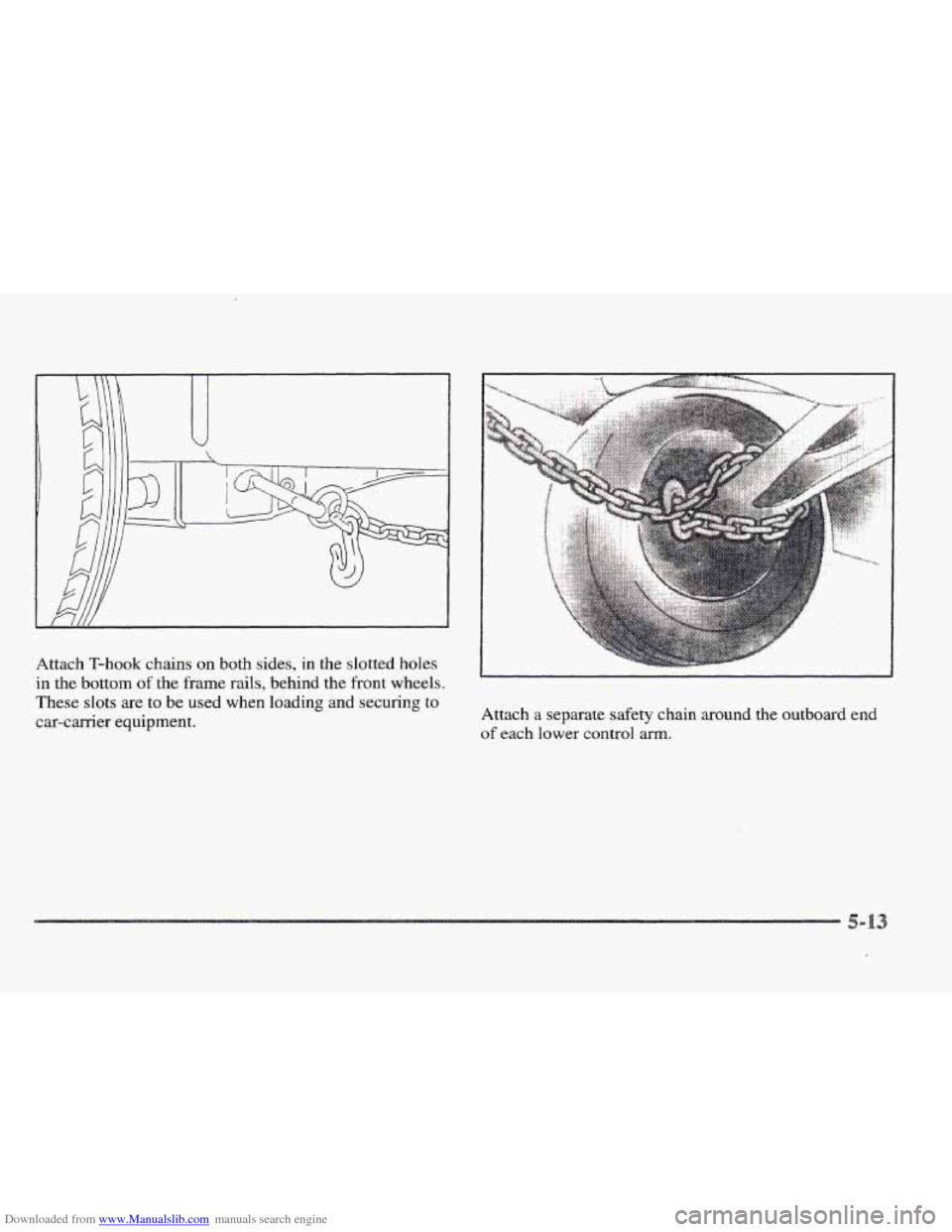
Downloaded from www.Manualslib.com manuals search engine Attach T-hook chains on both sides, in the slotted holes
in the bottom of the frame rails, behind the front wheels.
These slots are
to be used when loading and securing to
car-carrier equipment. Attach a separate safety chain around the outboard end
of each bwer control arm.
Page 239 of 361
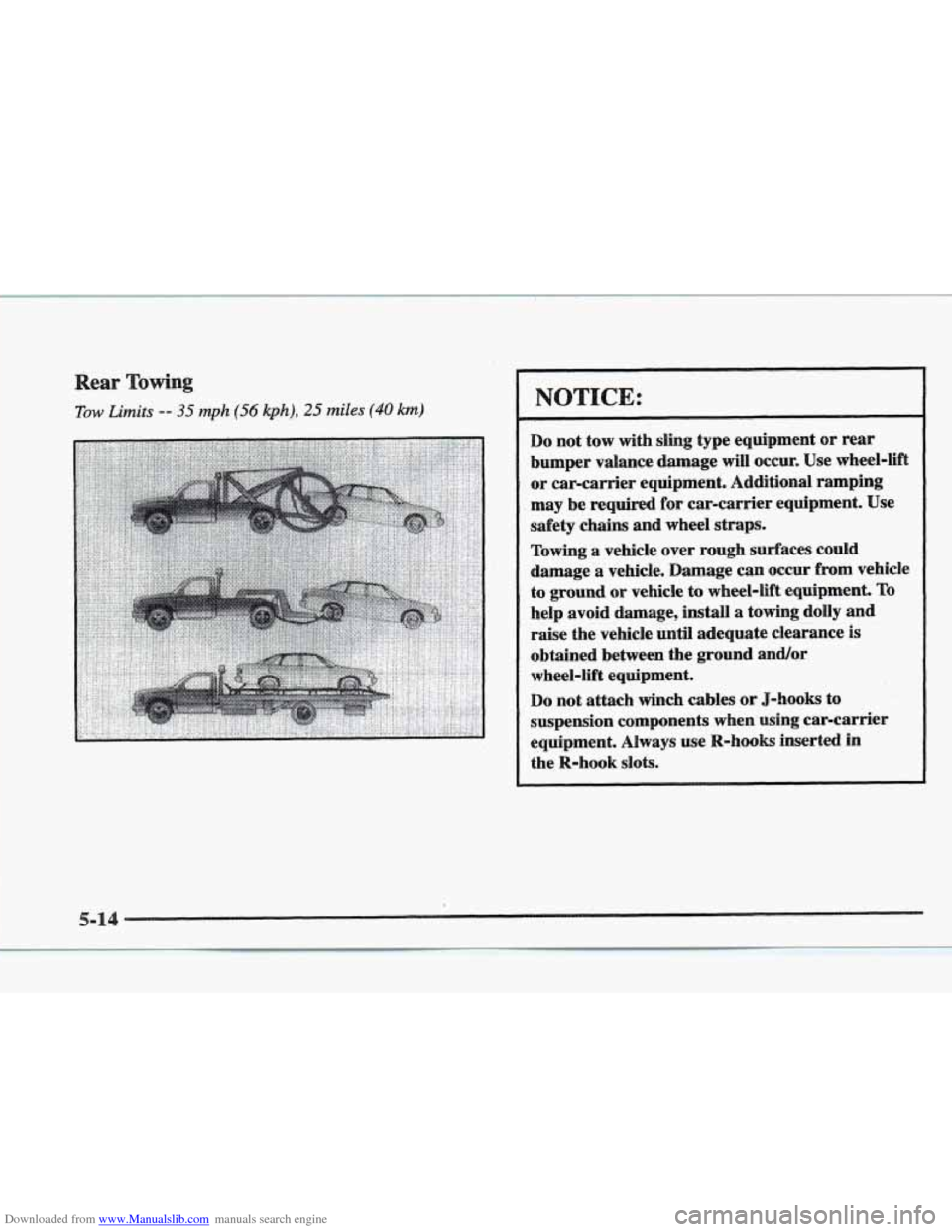
Downloaded from www.Manualslib.com manuals search engine NOTICE:
Do not tow with sling type equipment or rear
bumper valance damage will occur. Use wheel-lift
or car-carrier equipment. Additional
ramping
~ may be required for car-carrier equipment. Use
safety chains and wheel straps.
Towing
a vehicle over rough surfaces could
damage a vehicle. Damage can occur
from vehicle
to ground
or vehicle to wheel-lift equipment. To
help avoid damage, install
a towing dolly and
raise the vehicle until adequate clearance is
obtained between the
ground and/or
wheel-lift equipment.
..ti P J y..;
Do not attach winch cables or J-hooks to
suspension components when using car-carrier
equipment. Always use
W-hooks inserted in
the R-hook slots.
j
~
Page 240 of 361
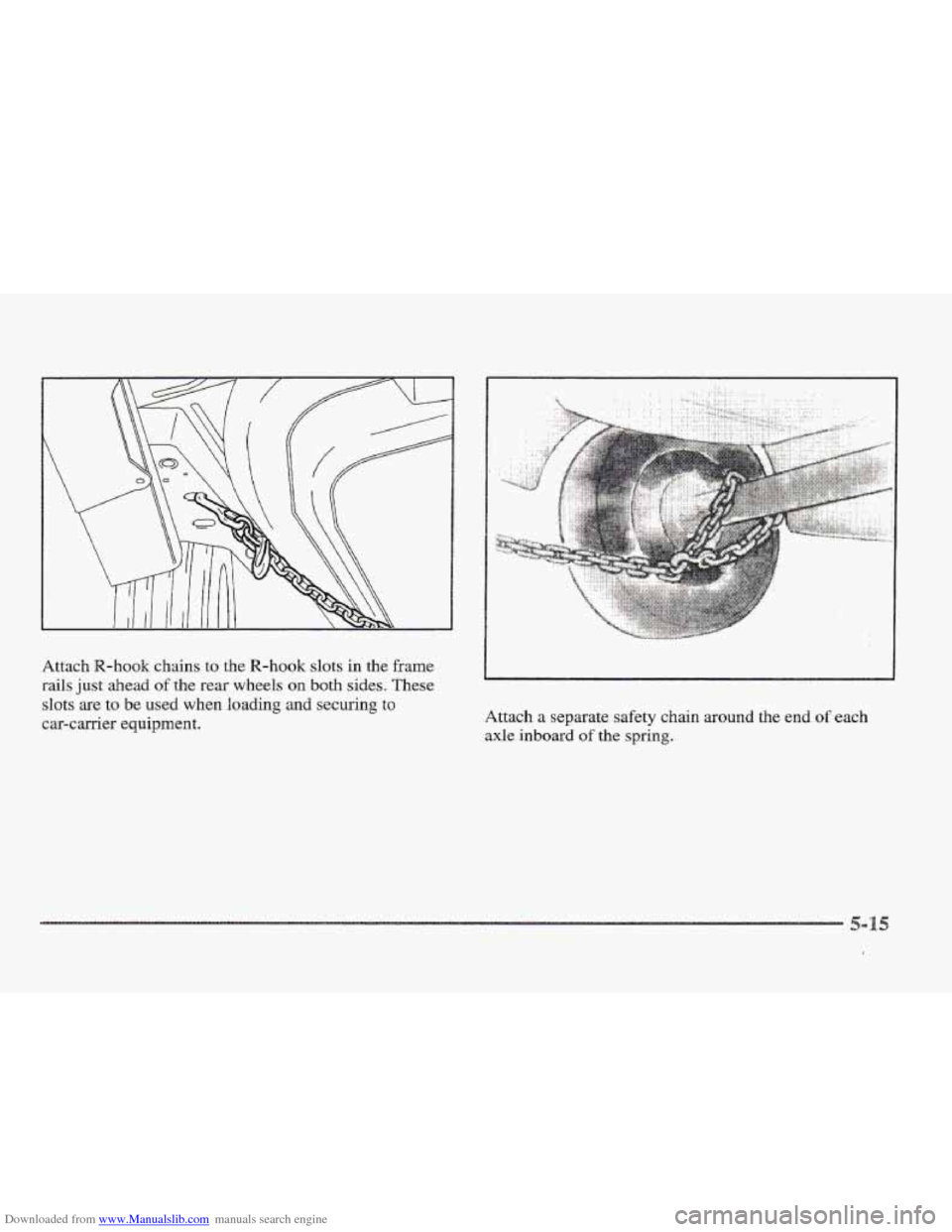
Downloaded from www.Manualslib.com manuals search engine Attach R-hook chains to the R-hook slots in the frame
rails just ahead of the rear wheels on both sides. These
slots are to be used when loading and securing to
car-carrier equipment. Attach a separate safety chain around the end of each
axle inboard of the spring.
Page 251 of 361
Downloaded from www.Manualslib.com manuals search engine ir s
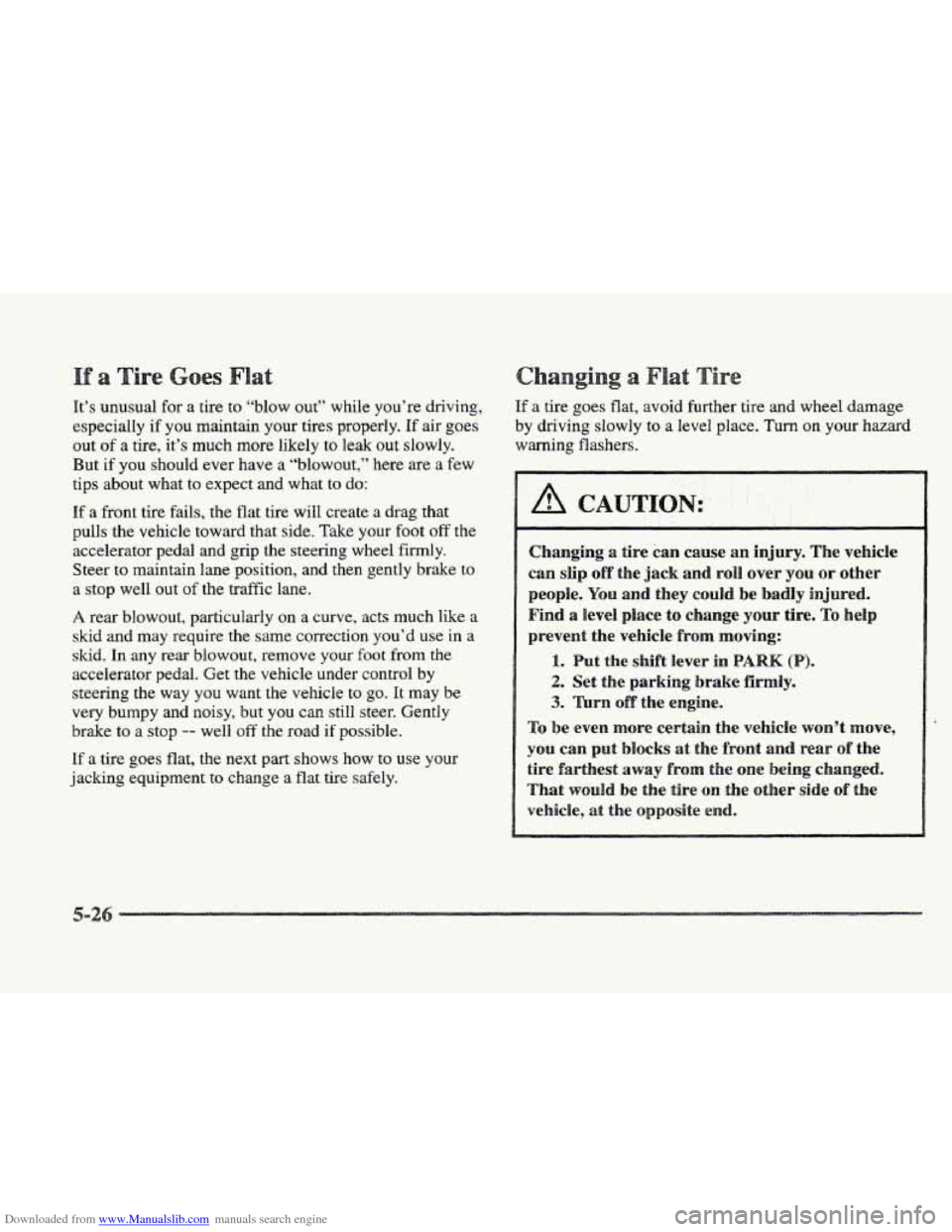
It’s unusual for a tire to “blow out’’ while you’re driving,
especially if you maintain your tires properly.
If air goes
out of a tire, it’s much more likely to leak out slowly.
But if you should ever have a ”blowout,” here
are a few
tips about what to expect and what to
do:
If a front tire fails, the flat tire will create a drag that
pulls the vehicle toward that side. Take your foot off the
accelerator pedal and grip the steering wheel firmly.
Steer to maintain lane position, and
then gently brake to
a stop well out of the traffic lane.
A rear blowout, particularly on a curve, acts much like a
skid and may require the same correction you’d use in a
skid. In any rear blowout, remove your foot from the
accelerator pedal. Get the vehicle under control by
steering the way you want the vehicle to go. It may be
very bumpy and noisy, but you can still steer. Gently
brake to a stop -- well off the road if possible.
Hf a tire goes flat, the next part shows how to use your
jacking equipment
to change a flat tire safely. If
a tire
goes flat, avoid further tire and wheel damage
by driving slowly to a level place.
Turn on your hazard
warning flashers.
-2
Page 254 of 361
Downloaded from www.Manualslib.com manuals search engine e.
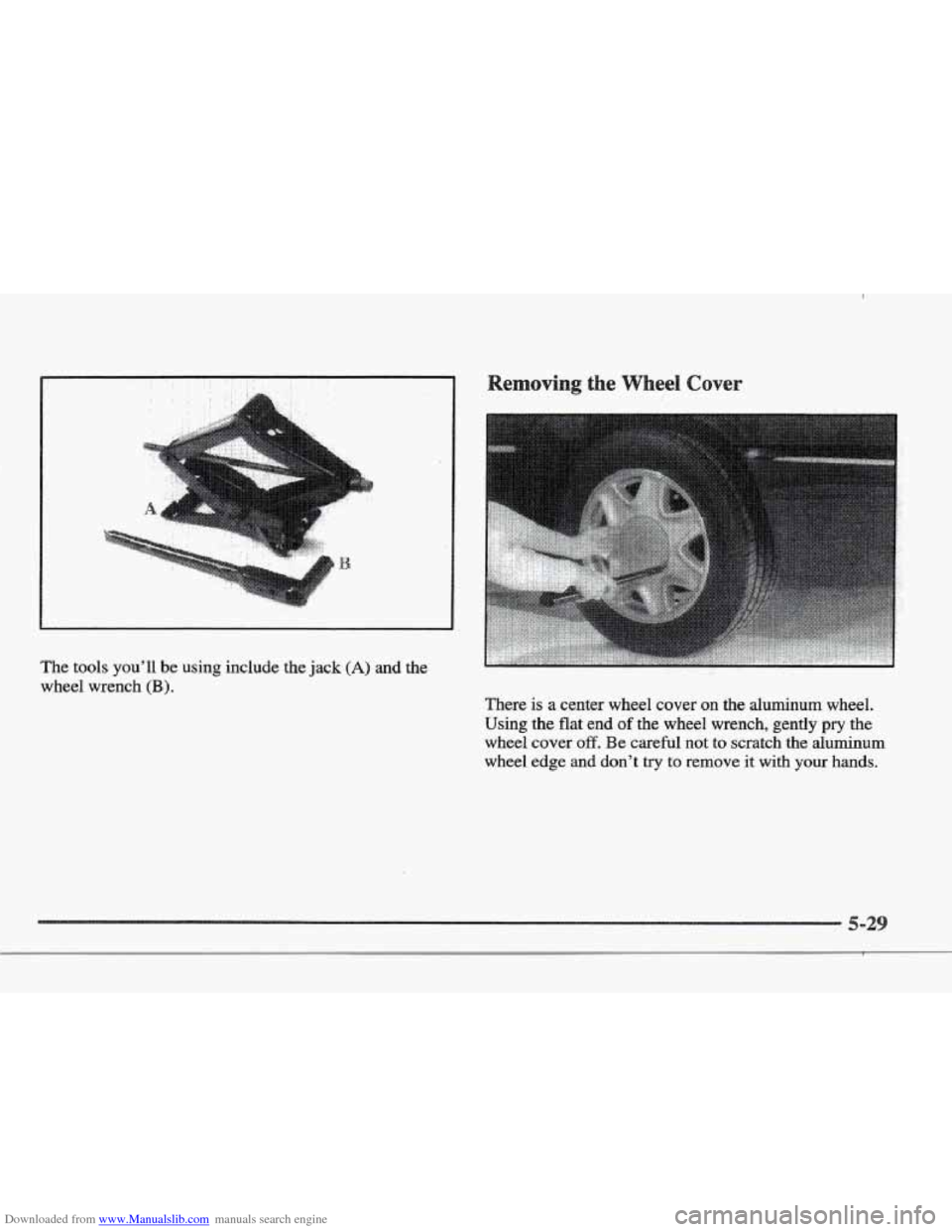
The tools you'll be using include the jack (A) and the
wheel wrench
(B).
There is a center wheel cover on the aluminum wheel.
Using the flat end
of the wheel wrench, gently pry the
wheel cover
off. Be careful not to scratch the aluminum
wheel edge and don't
try to remove it with your hands.
-2