ignition CADILLAC ELDORADO 1997 10.G Owner's Manual
[x] Cancel search | Manufacturer: CADILLAC, Model Year: 1997, Model line: ELDORADO, Model: CADILLAC ELDORADO 1997 10.GPages: 361, PDF Size: 22.85 MB
Page 92 of 361
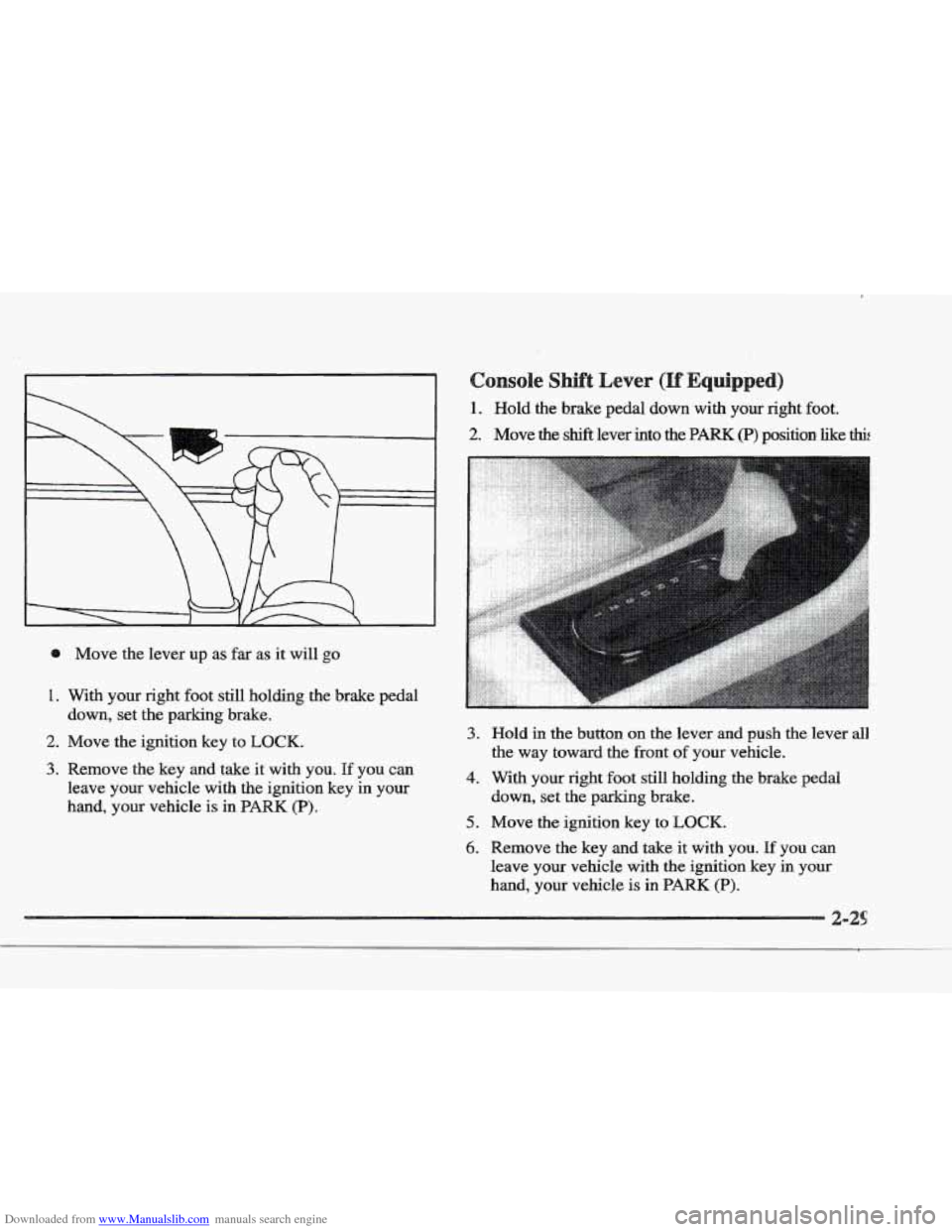
Downloaded from www.Manualslib.com manuals search engine 6 Move the lever up as far as it will go
1. With your right foot still holding the brake pedal
down, set the parking brake.
2. Move the ignition key to LOCK.
3. Remove the key and take it with you. If you can
leave your vehicle with the ignition key in your
hand, your vehicle
is in PARK (P).
1. Hold the brake pedal down with your right foot.
2. Move the shift lever into the PARK (P) position like thi:
3.
4.
5.
6.
Hold in the button on the lever and push the lever all
the way toward the front of your vehicle.
With your right foot still holding the brake pedal
down, set the parking brake.
Move the ignition key to
LOCK.
Remove the key and take it with you. If you can
leave your vehicle with the ignition key in your
hand, your vehicle
is in PARK (P).
Page 94 of 361
Downloaded from www.Manualslib.com manuals search engine Your Cadillac has a Brake-Transaxle Shift Interlock
(BTSI).
You have to fully apply your regular brakes
before you can shift from PARK (P) when the ignition
is in
the RUN position. See “Automatic Transaxle” in
the Index.
If you cannot shift out of PARK (P), ease pressure on
the shift lever -- push the shift lever all the way into
BARK (P) and also release the shift lever button on floor
shift models as YOU maintain brake application. Then
move the shift lever into
the gear you want. (Press the
shift lever button before moving the shift lever.) If
you
ever hold the brake pedal down but still can’t shift out of
PARK (P), try this:
1. Turn the key to OFF. Open and close the driver’s
2. Apply and hold the brake until the end of Step 4.
door to turn off the RAP feature.
3. Shift to N-ErnRAE (N).
4. Start the vehicle and then shift to the drive gear
you want.
5. Have the vehicle fixed as soon as you can.
II
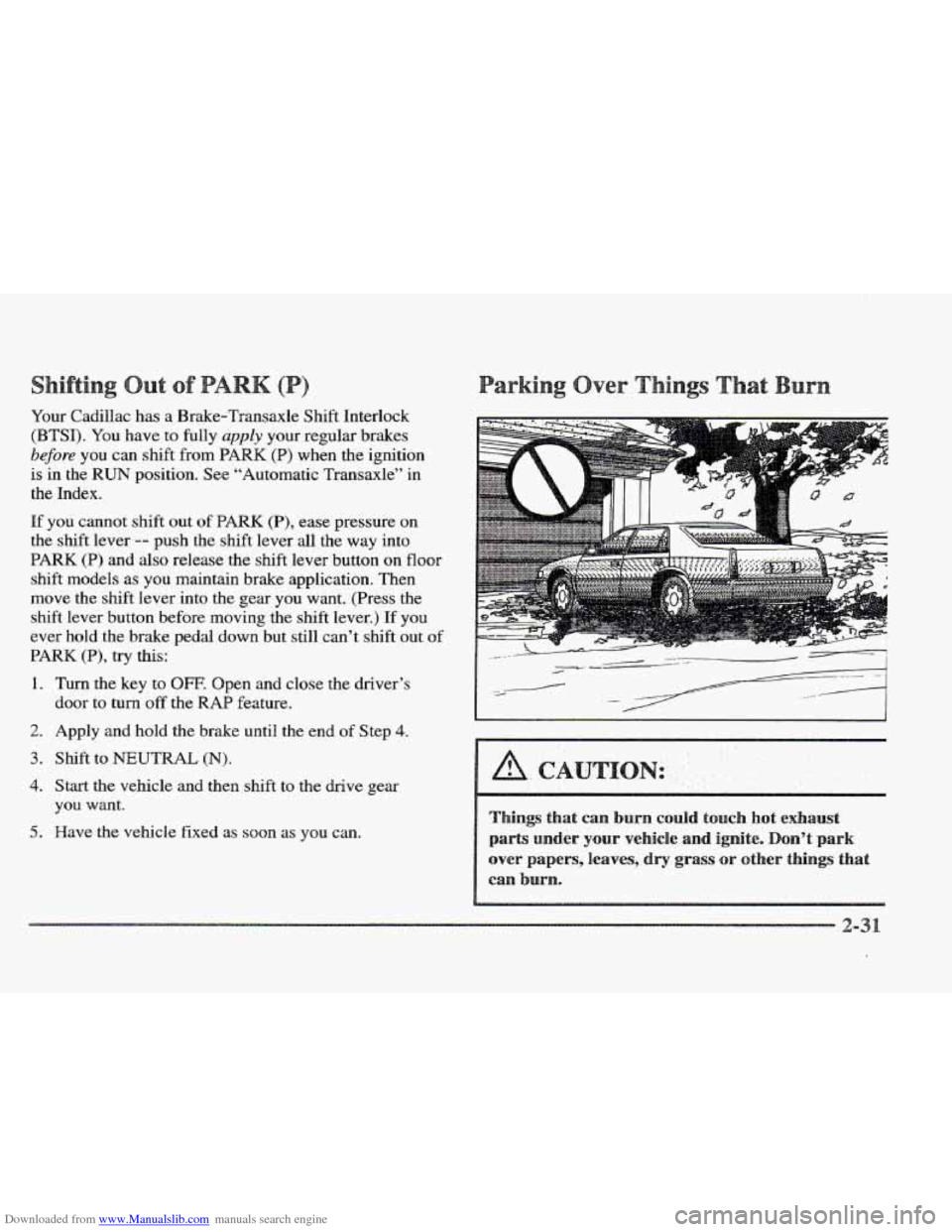
ings that can burn could touch h
parts under your vehicle and ignite
over papers, leaves, dry grass or other things that
can burn.
Page 96 of 361
Downloaded from www.Manualslib.com manuals search engine It can be dangerous to get out of your vehicle if
the shift lever is not fully in PARK (P) with the
parking brake firmly
set. Your vehicle can roll.
Don’t leave your vehicle when the engine
is
running unless you have to. If ydve left the
engine running, the vehicle can move
suddenly.
You or others cou%d be injured. TQ be sure your
vehicle move, even when you’re on fairly
level ground, always set your parking brake after
Follow the proper steps to be sure your vehicle won’t
move. See “Shifting Into
PARK (P)” in the Index.
If you are parking on a hill and if you’re pulling a
trailer, also see “Towing a Trailer” in the Index.
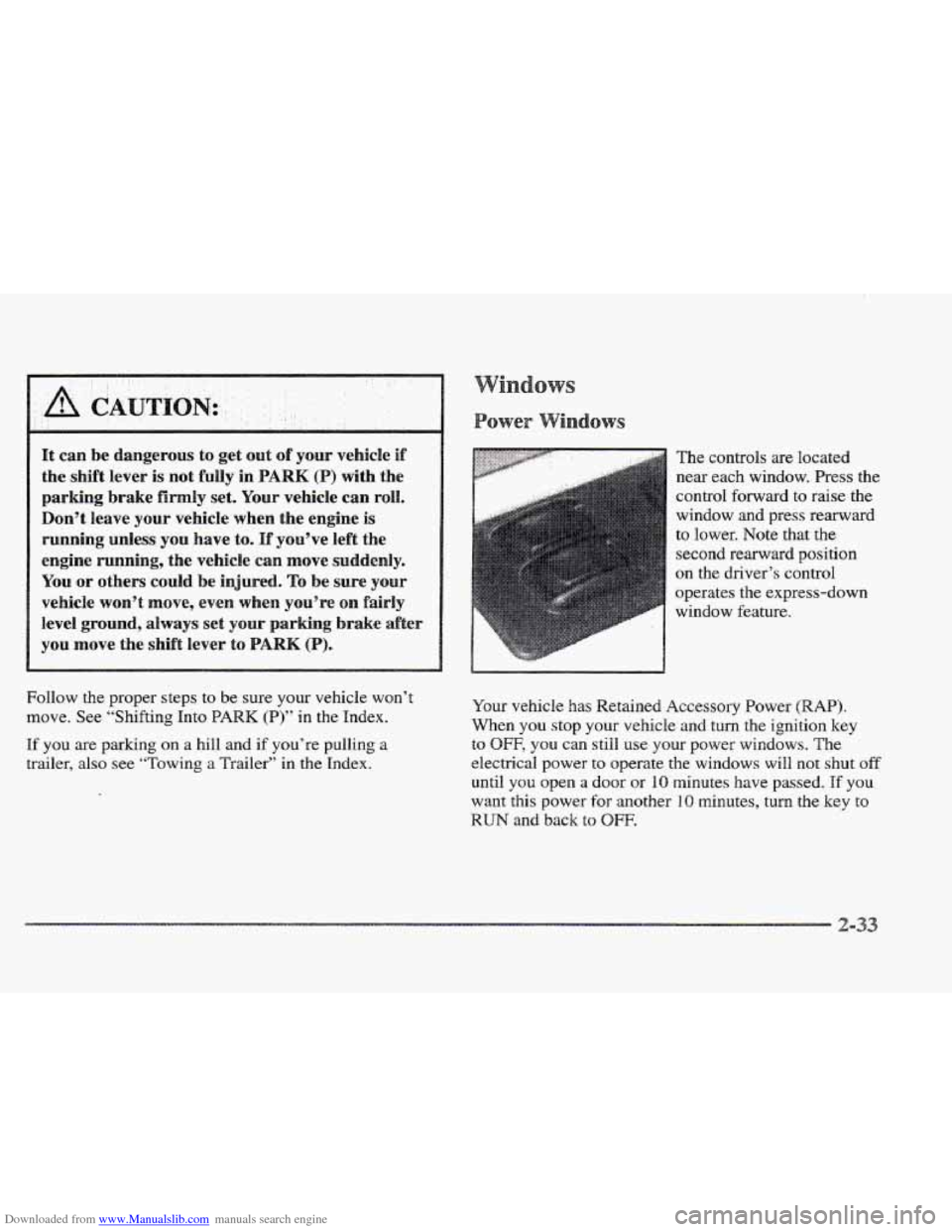
:rat~~~~~j,~.~.~.~~~:..i .I... . , .. :-., The controls are located
near each window. Press
the
control forward to raise the
window
and press rearward
to lower. Note that the
second rearward position
on the driver’s control
operates
the express-down
window feature.
Your vehicle has Retained Accessory Power (RAP).
When you stop your vehicle and turn the ignition key
to
OFF, YOU can still use your power windows. The
electrical power
to operate the windows will not shut off
until you open a door or 10 minutes have passed. If you
want this power
for another 10 minutes, turn the key BQ
RUN and back to OFF.
Page 101 of 361
Downloaded from www.Manualslib.com manuals search engine The Rainsense system can be activated by turning the
wiper stalk to one of the five sensitivity levels within the
AUTO DELAY
area. The AUTO DELAY position
closest to
OW is the lowest sensitivity setting. This
allows more water to collect on the windshield between
wipes. Rotating the stalk away from you to the other
AUTO DELAY settings increases the sensitivity of the
system and frequency
of wipes. A single wipe will occur
each time you
turn the wiper stalk to a higher sensitivity
level.
An initial wipe occurs when you turn the ignition
on as a reminder that Rainsense
is active. The
windshield wipers also remain in a “high
park” position,
even when
the ignition is turned off.
The Rainsense wipers operate in a delay mode as well as
a continuous low or high speed depending on the amount
of moisture and the sensitivity level. The MIST and
“wash” cycles operate as normal and are not affected
by the Rainsense hnction.
It is important to note that the Rainsense wiping feature
(AUTO DELAY) can be overridden at any time by
manually changing the wiper control to EO or
HI
speed.
Note that
if you ever need to replace the windshield,
make sure it
is Rainsense compatible.
~~ ~ ~~~ ~
In freezing weather, don’t use your washer until
the windshield
is warmed, Otherwise the washer
fluid
can form ice on the windshield, blocking
your vision,
Press and hold the PUSH paddle to wash the windshield.
Release the paddle when you have enough fluid.
The
wipers will clear the windshield and either stop or return
to your preset speed.
LOW WASHER
FLUID will be displayed on the DIC
when the washer fluid reaches a low level.
Driving without washer fluid can be dangerous.
A bad
mud splash can block your vision and you could hit
another vehicle or
go off the road. Check the washer
fluid level often.
-3
Page 105 of 361
Downloaded from www.Manualslib.com manuals search engine asshg Another Vehicle While Using Cruise Control
Use the accelerator pedal to increase your speed. When
you take your foot off the pedal, your vehicle will slow
down to the cruise control speed you set earlier.
Using Cruise Control on
How well your cruise control will work on hills depends
upon your speed, load and the steepness
of the hills.
When going up steep hills, you may have to step on the
accelerator pedal to maintain your speed. When going
downhill, you may have to brake or shift to
a lower gear
to keep your speed down.
Of course, applying the brakes
or downshifting into
FIRST (1) takes you out of cruise
control. Many drivers find this to be too much trouble
and don’t use
cruise control on steep hills.
Ending Cruise Conn&ro11
There are two ways to end cruise control:
Step lightly on the brake pedal.
Move
the CRUISE switch to OW.
Erasing Spee
The cruise control set speed memory is erased when you
turn off the cruise control or the ignition.
s
Headlamps
Taillamps
Parking Lamps
Sidemaker Lamps
License Plate
Lamp
Underhood Lamp
Fog Lamps (ETC Only)
Instrument Panel Lights
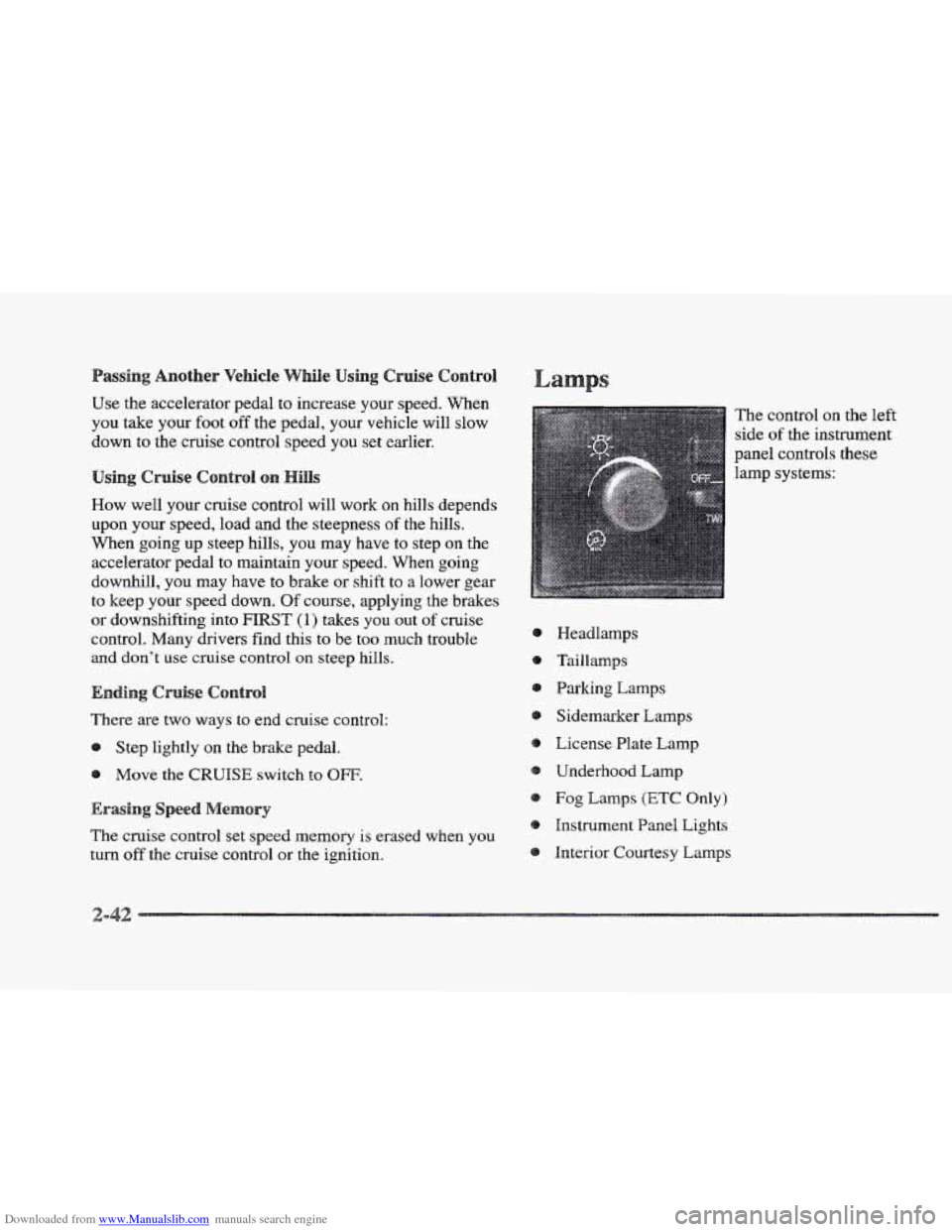
Interior Courtesy Lamps The control
on the left
side
of the instrument
panel controls
these
lamp systems:
Page 106 of 361
Downloaded from www.Manualslib.com manuals search engine Full the lamp control knob out to the first stop to turn
on the parking and taillamps, sidemarker lamps and
instrument panel lights. Pull the knob out
all the way to
turn on the headlamps. Push the control knob all the way
back in
to turn the lamps and lights off.
Cluster lighting as well as instrument panel backlighting
will dim only when it
is dark outside.
The control for the headlamps
is on the left side of the
instrument panel. Pull the lamp control
knob all the way
out to turn the headlamps on. Push the control knob all
the way back
in to turn the headlamps off.
This feature activates the headlamps and parlung lamps
after the windshield wipers have been in use for
approximately
20 seconds.
In order to operate the wiper activated headlamps, the
twilight sentinel must
be in the on position. This feature
lights the way
in poor weather and it also makes your
vehicle more visible
to other dnvers. If the wiper activated
headlamps are on, and the i,gpition switch
is turned off, the
wiper activated headlamps will immediately turn off.
The wiper activated headlamps will deactivate if you
turn
OR the twilight sentinel or if the windshield wipers
have been turned
off for a period of one or
two seconds.
You will hear a warning chime if you open either door
while leaving
the lamps on, if the manual headlamp
control is activated.
An exception to this is when you’re
using twilight sentinel.
Daytime Running Lamps
(DRE) can make it easier for
others to see the front of your vehicle during
the day.
DIU can be helpful in many different driving
conditions, but
they can be especially helpful in the
short periods after dawn and before sunset.
The DIU system will make the high-beam headlamps
come
on at reduced brightness when:
the ignition
is on,
the headlamp switch is off and
the transaxle
is not in PARK (P).
When DRE are on, only your high-beam headlamps (at
reduced brightness) will be
on. No other exterior lamps
such as the parking lamps, taillamps, etc. will be on
when
the DlRE are being used. Your instrument panel
won’t
be lit up either.
Page 108 of 361
Downloaded from www.Manualslib.com manuals search engine light Sentinel
.. . ..
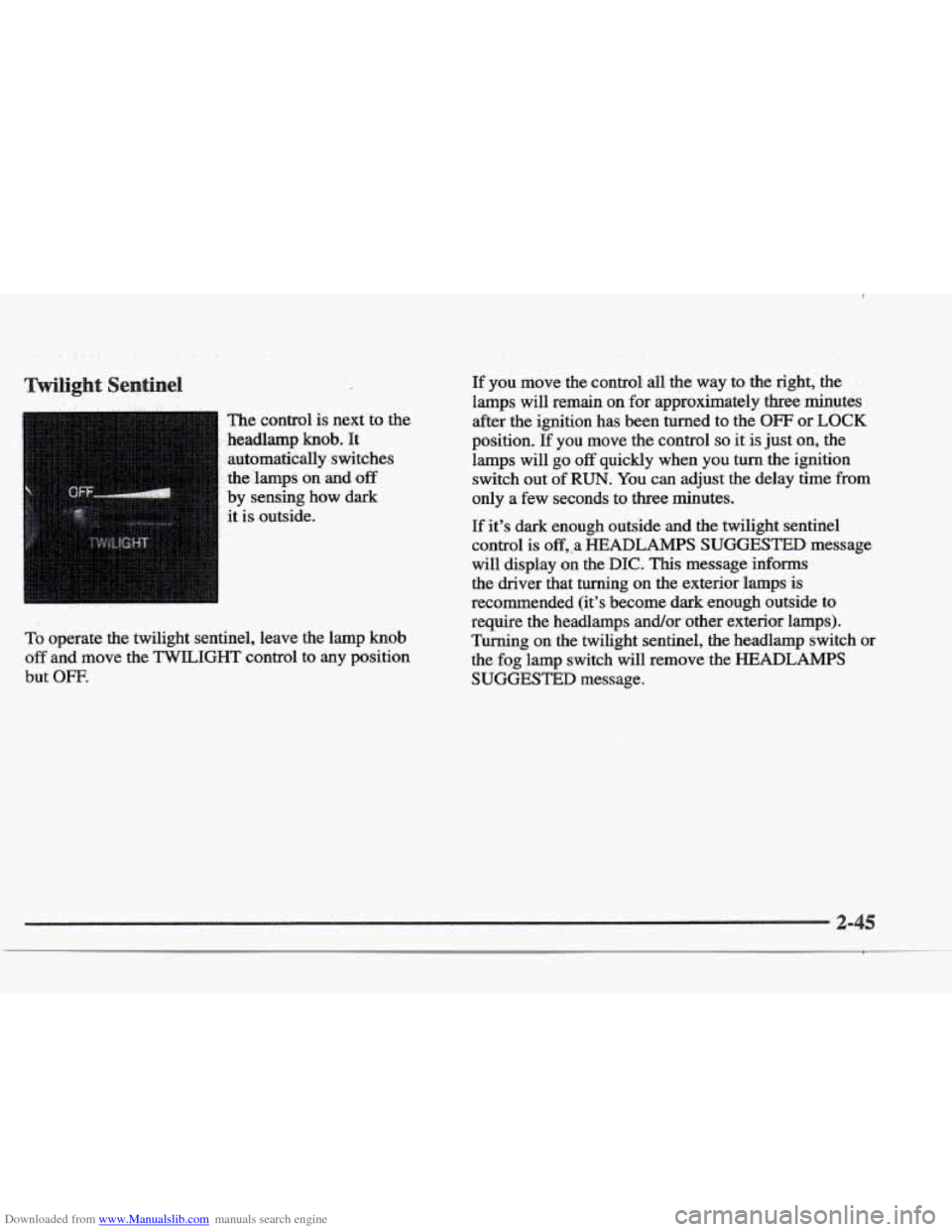
.. The control is next to the
.headlamp
knob. It
automatically switches
the’lamps
on and off
by sensing how dark
it
is outside.
To operate the twilight sentinel, leave the lamp knob
off and move the TWILIGHT control to any position
but
OFF.
If you move: the control: all the way to the right, the , .
lamps will remain on for approximately three rninutes
after the ignition has been turned to the OFF or
LOCK
position. If you move the control so it is just on, the
lamps will go
off quickly when you turn the ignition
switch out of
RUN. You can adjust the delay time from
only a few seconds to three minutes.
If it’s dark enough outside and the twilight sentinel
control
is off,,a HEADLAMPS SUGGESTED message
will display on the
DIC. This message informs
the driver that turning
on the exterior lamps is
recommended (it’s become dark enough outside
to
require the headlamps and/or other exterior lamps).
Turning on the twilight sentinel, the headlamp switch
or
the fog lamp switch will remove the HEADLAMPS
SUGGESTED message.
Page 110 of 361
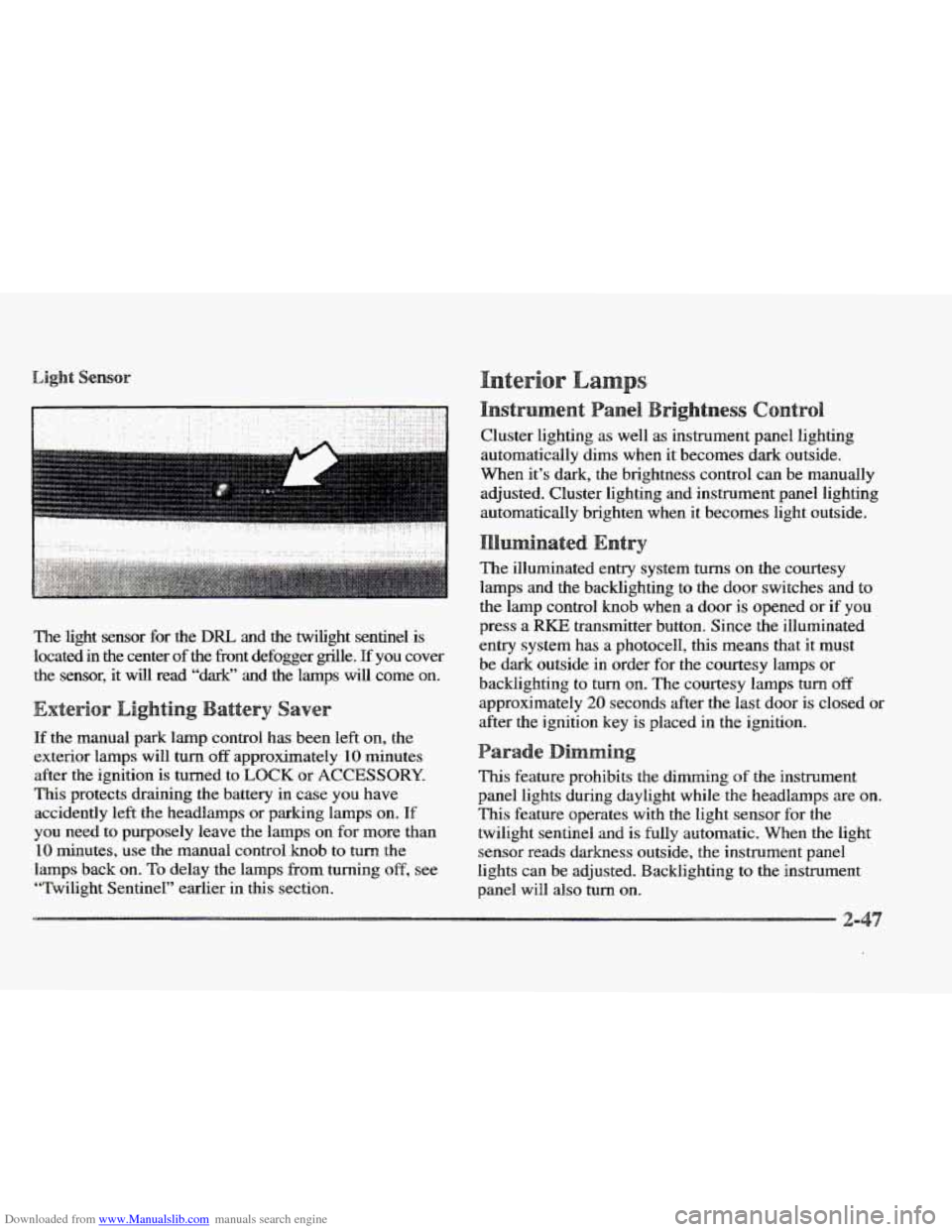
Downloaded from www.Manualslib.com manuals search engine The light sensor for the DRL and the twilight sentinel is
located in the center of
the fiont defogger grrlle. pf you cover
the sensor, it will read “dark”
and the lamps will come on.
If the manual park lamp control has been left on, the
exterior lamps will
turn off approximately 10 minutes
after the ignition
is turned to LOCK or ACCESSORY.
This protects draining the battery in case you have
accidently
left the headlamps or parkmg lamps on. If
you need to purposely leave the Imps on for more than
10 minutes, use the manual control knob to turn the
lamps back on.
To delay the lamps from turning off, see
“Twilight Sentinel” earlier in this section. Cluster lighting
as well
as instrument panel lighting
automatically dims when it becomes dark outside.
When it’s dark,
the brightness control can be manually
adjusted. Cluster lighting and instrument panel lighting
automatically brighten when it becomes light outside.
The illuminated entry system
turns on the courtesy
lamps and the backlighting to the door switches and
to
the lamp contr~l knob when a door is opened or if you
press a RKE transmitter button. Since the illuminated
entry system has
a photocell, this means that it must
be dark outside
in order for the courtesy lamps or
backlighting
to turn on. The courtesy lamps turn off
approximately 20 seconds after the last door is closed or
after the ignition key
is placed in the ignition.
This feature prohibits the dimming of the instrument
panel lights during daylight while
the headlamps are on.
This feature operates with the light sensor for the
twilight sentinel and is fully automatic. When the light
sensor reads darkness outside,
the instrument panel
lights can
be adjusted. Backlighting to the instrument
panel will
also turn on.
Page 111 of 361
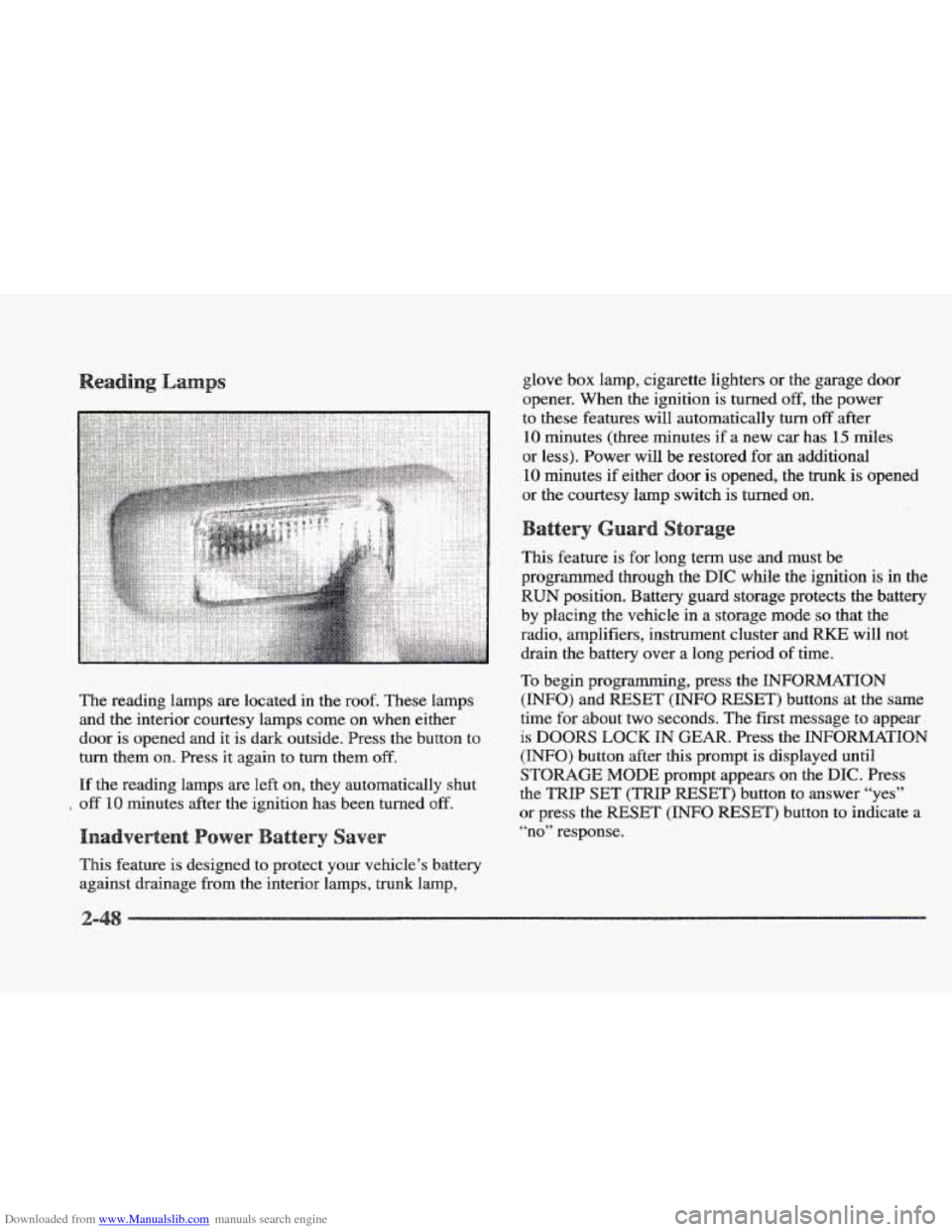
Downloaded from www.Manualslib.com manuals search engine The reading lamps are located in the roof. These lamps
and the interior courtesy lamps come on when either
door is opened and it is dark outside. Press
the button to
turn them
on. Press it again to turn them off.
If the reading lamps are left on, they automatically shut
off 10 minutes after the ignition has been turned off.
This feature is designed to protect your vehicle’s battery
against drainage from the interior lamps, trunk lamp, glove
box lamp, cigarette lighters or
the garage door
opener. When the ignition is turned
off, the power
to these features will automatically
turn off after
10 minutes (three minutes if a new car has 15 miles
or less). Power will be restored for
an additional
10 minutes if either door is opened, the trunk is opened
or the courtesy lamp switch is turned on.
This feature is for long term use and must be
programmed through the
DIC while the ignition is in the
RUN position. Battery guard storage protects the battery
by placing the vehicle
in a storage mode so that the
radio, amplifiers, instrument cluster and
RKE will not
drain
the battery over a long period of time.
To begin programming, press the INFORMATION
(INFO) and RESET (INFO RESET) buttons at the same
time
for about two seconds. The first message to appear
is DOORS LOCK IN GEAR. Press the INFORMATION
(INFO) button after this prompt is displayed until
STORAGE MODE prompt appears on the DIC. Press
the
TRIP SET (TRIP RESET’) button to answer “yes”
or press the RESET (INFO RESET) button to indicate a
“no” response.
Page 112 of 361
Downloaded from www.Manualslib.com manuals search engine FEATURE ON appears when a yes response is made
and
FEATURE OFF shows when a no response is made.
Since this
is the last personalization feature available, a
yes or no response
will end out of the DIC display.
Once the battery guard has been programmed, your
vehicle will enter the storage mode about
20 minutes
after the ignition key
has been turned off. The WKE will
also be disabled at this point. The RKE will reactivate
when a door
or the trunk is opened, however, if your
vehicle is left inactive for another
20 minutes, the RKE
will re-enter the storage mode.
Your vehicle will stay
in the storage mode until the
ignition key is turned out
of LOCK. The system will
“wake-up” when the door key is inserted
into the door,
however,
your vehicle will remain in the storage mode.
The ignition must be out of
LOCK before the battery
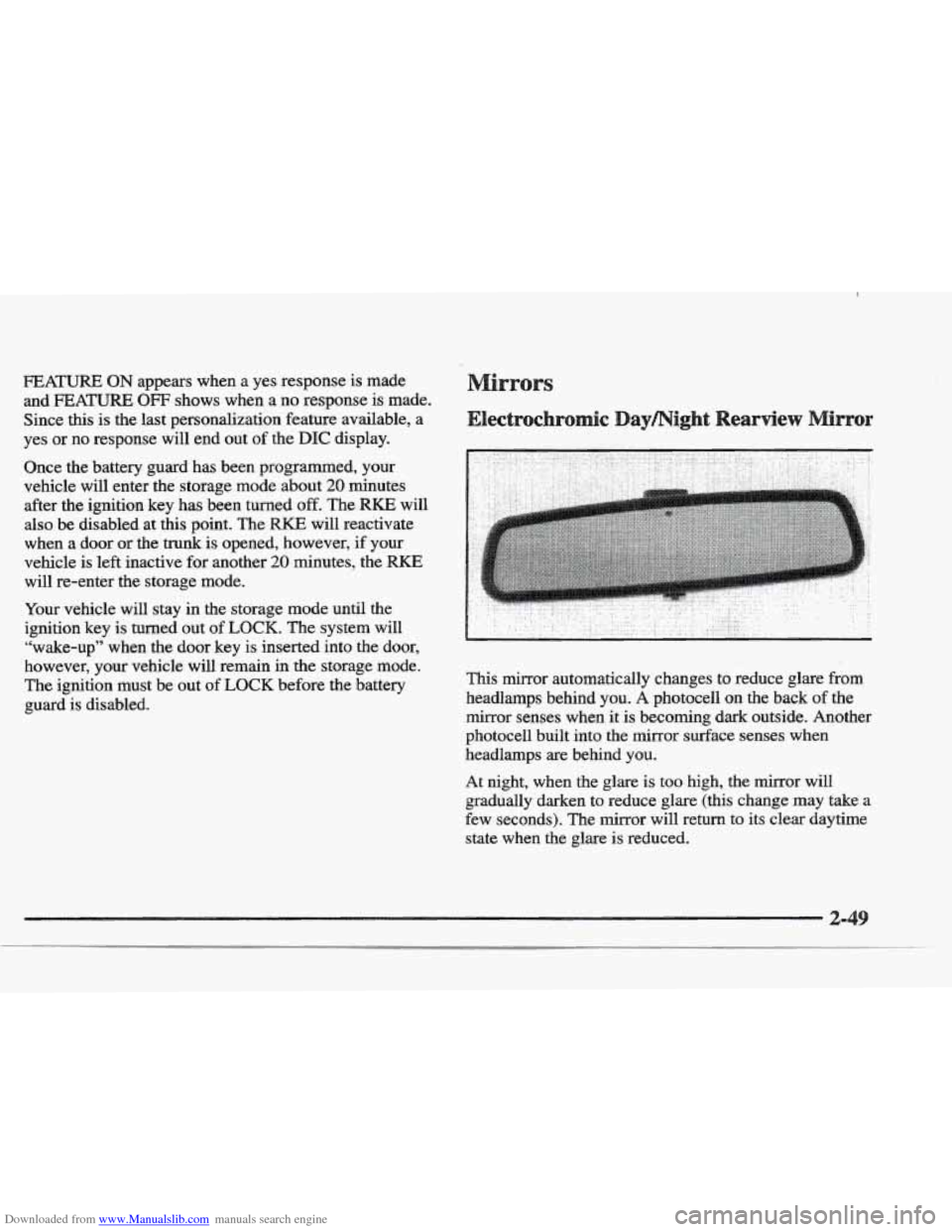
guard is disabled. This mirror automatically changes to reduce
glare from
headlamps behind you. A photocell on the back of the
mirror senses when it
is becoming dark outside. Another
photocell built into the mirror surface senses when
headlamps are behind you.
At night, when the glare is too high, the mirror will
gradually darken to reduce glare (this change
may take a
few seconds). The mirror will return
to its clear daytime
state
when the glare is reduced.