light CADILLAC ELDORADO 1998 10.G Repair Manual
[x] Cancel search | Manufacturer: CADILLAC, Model Year: 1998, Model line: ELDORADO, Model: CADILLAC ELDORADO 1998 10.GPages: 380, PDF Size: 21.39 MB
Page 245 of 380
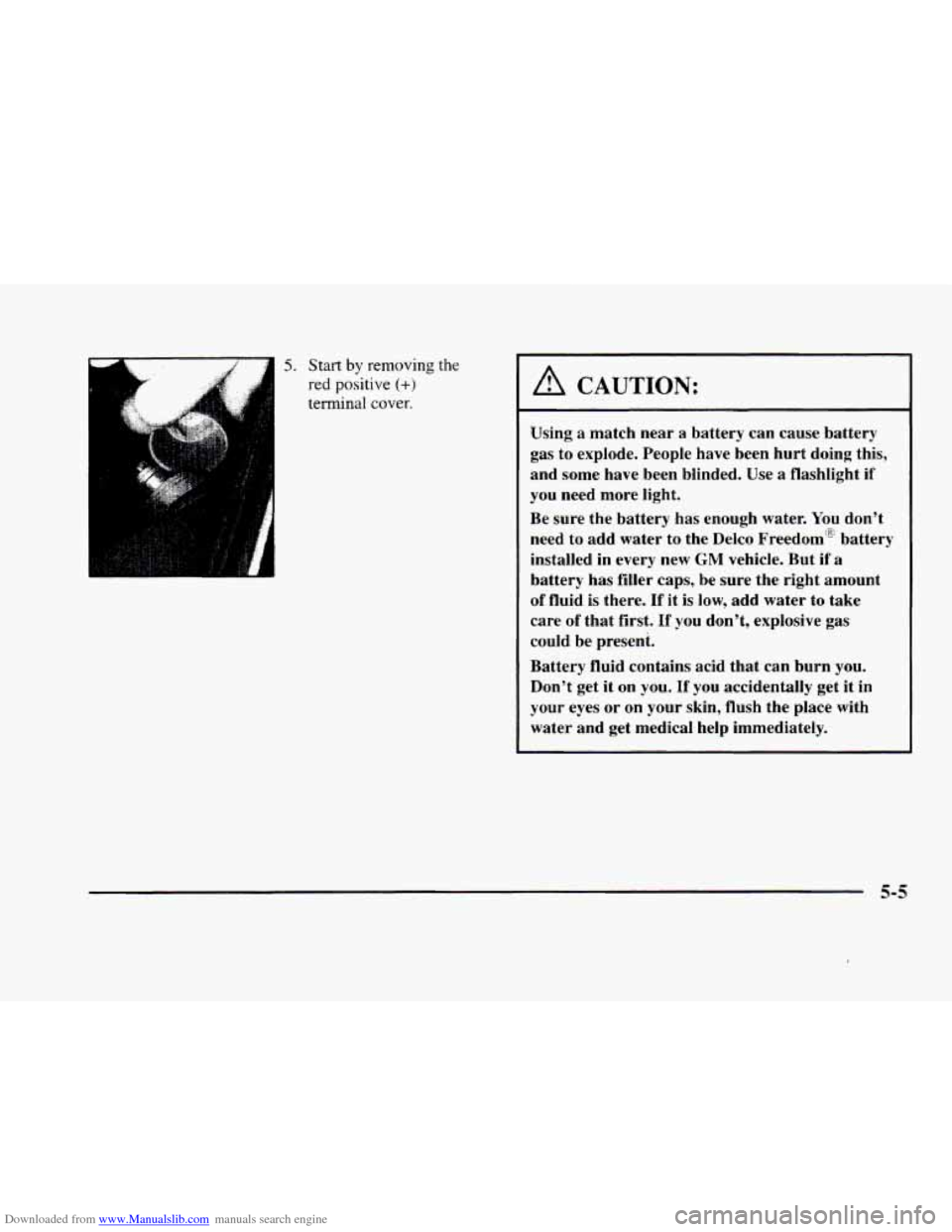
Downloaded from www.Manualslib.com manuals search engine 5. Start by removing the
red positive (+)
terminal cover.
A CAUTION:
Using a match near a battery can cause battery
gas to explode. People have been hurt doing this,
and some have been blinded. Use
a flashlight if
you need more light.
Be sure the battery has enough water.
You don’t
need to add water to the Delco Freedom@ battery
installed in every new
GM vehicle. But if a
battery has filler caps, be sure the right amount
of fluid is there. If it is low, add water to take
care of that first. If
you don’t, explosive gas
could be present.
Battery fluid contains acid that can burn you.
Don’t get it on you.
If you accidentally get it in
your eyes
or on your skin, flush the place with
water and get medical help immediately.
5-5
Page 255 of 380
Downloaded from www.Manualslib.com manuals search engine Engine Overheating
You will find an ENGINE COOLANT HOT, IDLE
ENGINE message or an ENGINE OVERHEATED,
STOP ENGINE message
on the Driver Information
Center (DIC).
You will also hear a chime. There is also
an engine temperature warning light and/or gage
on the
instrument panel. See “Engine Coolant Temperature
Warning Light” or “Engine Coolant Temperature Gage”
in the Index.
Overheated Engine Protection
Operating
Mode
Should an overheated engine condition exist and the
message ENGINE OVERHEATED
STOP ENGINE is
displayed, an overheat protection mode which alternates
firing groups
of four cylinders helps prevent engine
damage. In this mode, you will notice a loss in power and
engine performance. This operating mode allows
your vehicle to be driven to a safe place
in an
emergency; you may drive
up to 50 miles (80 km).
Towing a trailer in the overheat protection mode
should be avoided.
-~
NOTICE:
After driving in the overheated engine protection
operating mode, to avoid engine damage, allow
the engine to cool before attempting any repair.
The engine oil will be severely degraded. Repair
the cause of coolant loss, change the oil and reset
the oil life indicator. See “Engine Oil, When to
Change”
in the Index.
5-15
Page 276 of 380
Downloaded from www.Manualslib.com manuals search engine NOTICE:
Spinning your wheels can destroy parts of your
vehicle as well as the tires. If you spin the wheels
too fast while shifting your transaxle back and
forth, you can destroy your transaxle.
For information about using tire chains on your vehicle,
see “Tire Chains” in the Index.
Rocking Your Vehicle To Get It Out
First, turn your steering wheel left and right. That will
clear the area around your front wheels. You should
turn your traction control system off. (See “Traction
Control System”
in the Index.) Then shift back and forth
between REVERSE
(R) and a forward gear, spinning the
wheels as little
as possible. Release the accelerator pedal
while you shift, and press lightly
on the accelerator
pedal
when the transaxle is in gear. If that doesn’t get
you out after a few tries, you may need to be towed out.
If you do need
to be towed out, see “Towing Your
Vehicle” in the Index.
5-36
Page 287 of 380
Downloaded from www.Manualslib.com manuals search engine r
r
r-
f
I
f
1
I“
I
1 A CAUTION:
If you get gasoline on yourself and then
something ignites it, you could be badly burned.
Gasoline can spray out on you if you open the
fuel filler cap too quickly. This spray can happen
if your
tank is nearly full, and is more likely in
hot weather. Open the fuel filler cap slowly
and
wait for any “hiss” noise to stop. Then unscrew
the cap all the way.
Be careful not to spill gasoline. Clean gasoline from
painted surfaces as soon as possible. See “Cleaning the
Outside of Your Vehicle” in the Index. When
you put
the cap back on, turn it to the right
(clockwise) until you hear a clicking sound. Make
sure you
fully install the cap. The diagnostic system
can determine if the fuel cap has been left
off or
improperly installed. This would allow fuel to
evaporate into the atmosphere. See “Malfunction
Indicator Lamp” in the Index.
NOTICE:
If you need a new cap, be sure to get the right
type. Your dealer can get one for you.
If you get
the wrong type, it may not fit properly. This may
cause your malfunction indicator lamp
to light
and your fuel
tank and emissions system may be
damaged.
See “Malfunction Indicator Lamp” in
the Index.
6-7
Page 302 of 380
Downloaded from www.Manualslib.com manuals search engine Engine Coolant
The cooling s stem in your vehicle is filled with
DEX-COOL engine coolant. This coolant is designed
to remain in your vehicle for
5 years or 150,000 miles
(240 000 km) whichever occurs first, if you add only
DEX-COOL’ extended life coolant.
J
The following explains your cooling system and
how
to add coolant when it is low. If you have a
problem with engine overheating, see “Engine
Overheating” in the Index.
A 50/50 mixture of water and DEX-COOL@
coolant will:
0 Give freezing protection down to -34°F (-37°C).
Give boiling protection up to 265 “F (1 29°C).
Protect against rust and corrosion.
0 Help keep the proper engine temperature.
0 Let the warning lights and gages work as
they should.
NOTICE:
When adding coolant, it is important that you
use only
DEX-COOL@ (silicate-free) coolant.
If coolant other than DEX-COOL is added to
the system, premature engine, heater core or radiator corrosion may result. In addition, the
engine coolant will require change sooner
-0 at
30,000 miles (50 000 km) or 24 months,
whichever occurs first. Damage caused by the
use
of coolant other than DEX-COOL@ is not
covered by your new vehicle warranty.
6-32
Page 304 of 380
Downloaded from www.Manualslib.com manuals search engine Checking Coolant
.
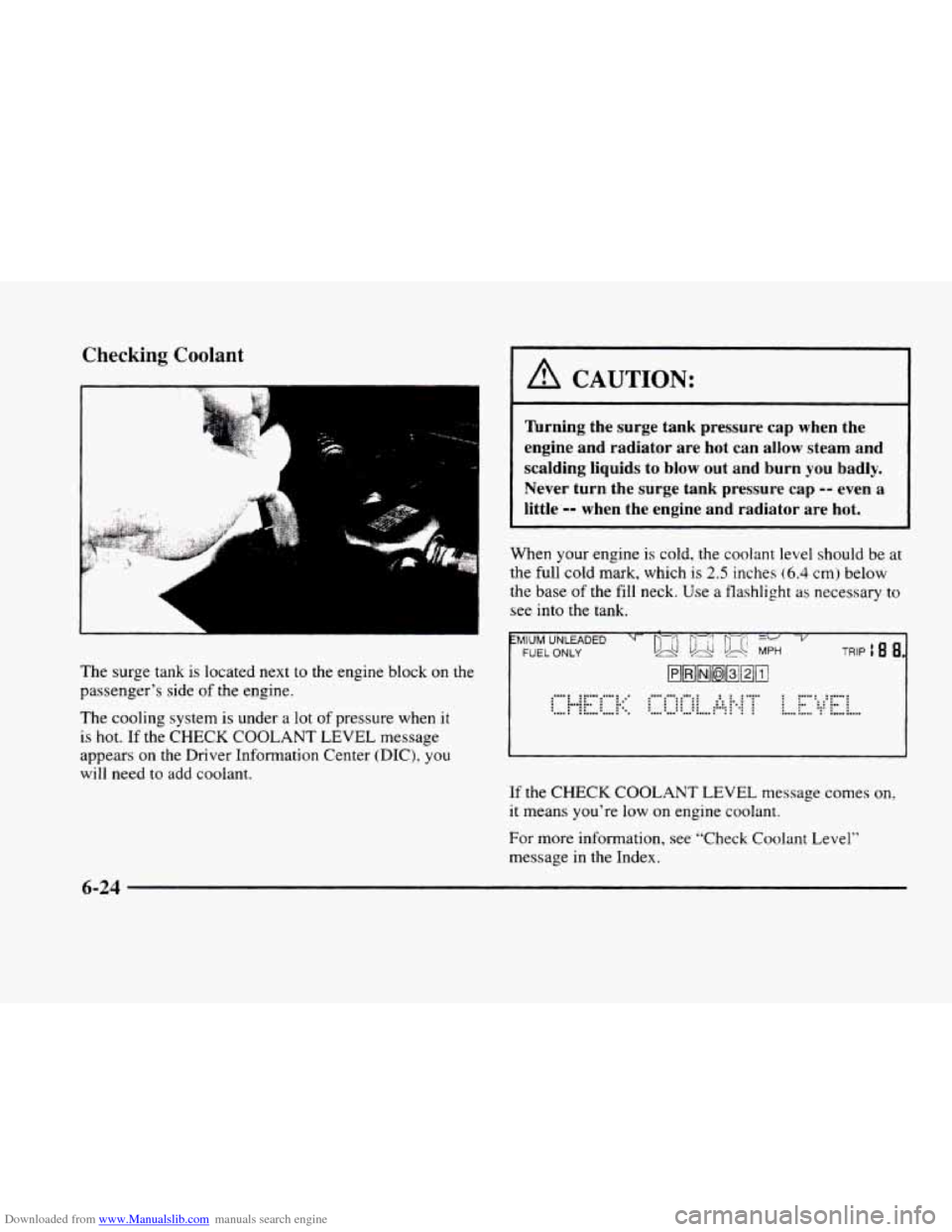
The surge tank is located next to the engine block on the
passenger's side
of the engine.
The cooling system is under a
lot of pressure when it
is hot. If the CHECK COOLANT LEVEL message
appears
on the Driver Information Center (DIC), you
will need to add coolant.
A CAUTION:
Turning the surge tank pressure cap when the
engine and radiator are hot can allow steam and
scalding liquids to blow out and burn
you badly.
Never turn the surge tank pressure cap
-- even a
little
-- when the engine and radiator are hot.
When your engine is cold. the coolant level should be at
the full cold mark, which
is 2.5 inches (6.4 cm) below
the base
of the fill neck. Use a flashlight as necessary to
see into the tank.
.................................................. ................. ...... ....... ............ ...... ............ ............ .......... ...................... ....... .................. ..... ..................................... .....................
If the CHECK COOLANT LEVEL message comes on.
it means you're low on engine coolant.
For more information, see "Check Coolant Level"
message in the Index.
6-24
Page 308 of 380
Downloaded from www.Manualslib.com manuals search engine Brakes
Brake Fluid
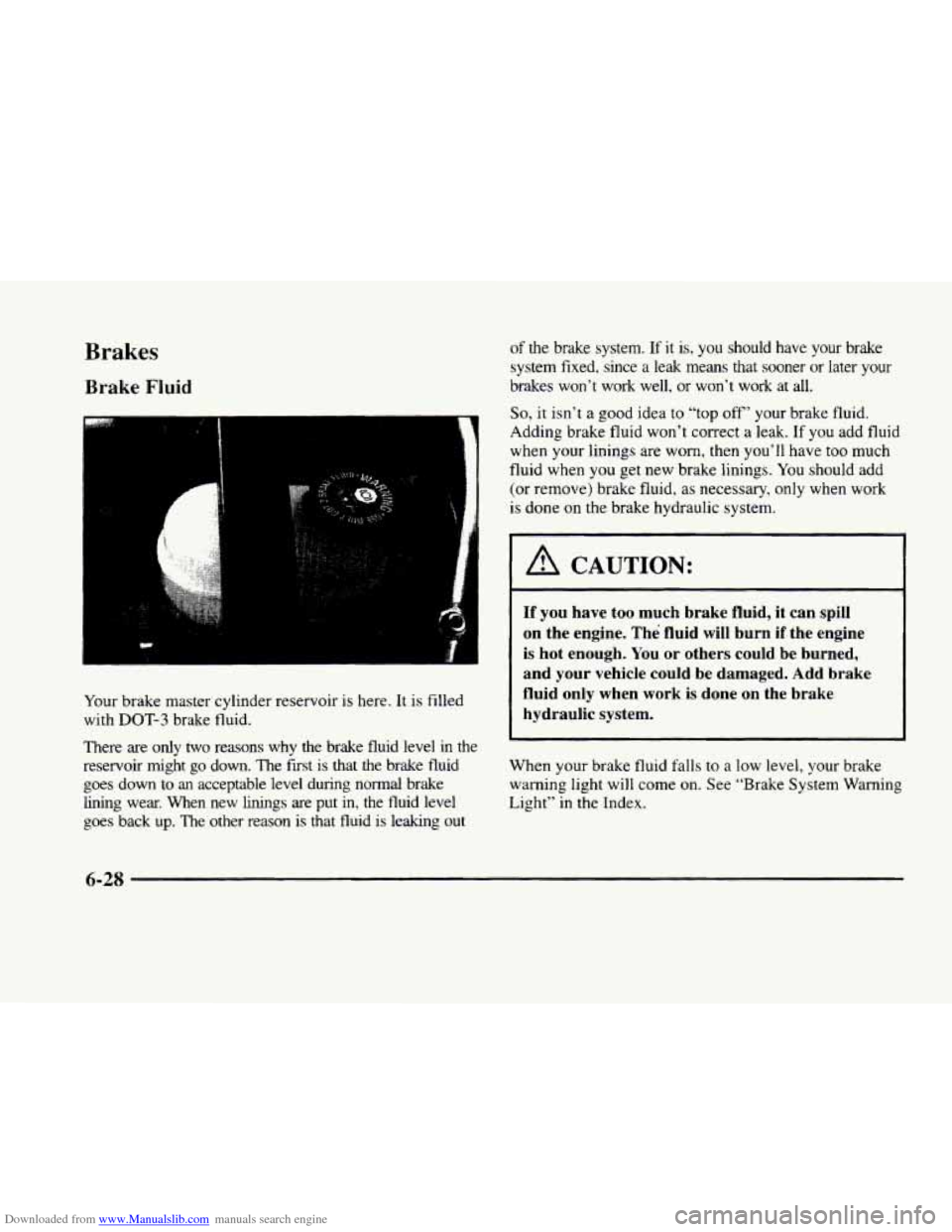
Your brake master cylinder reservoir is here. It is filled
with
DOT-3 brake fluid.
There are only two reasons why the brake fluid level in
the
reservoir might go down. The first is that the brake fluid
goes down to
an acceptable level during normal brake
lining wear. When new
linings are put in, the fluid level
goes back
up. The other reason is that fluid is leaking out
of the brake system. If it is. you should have your brake
system fixed, since a leak means that sooner or later your
brakes won’t work well, or won’t work at all.
So, it isn’t a good idea to “top off’ your brake fluid.
Adding brake fluid won’t correct a leak. If you add fluid
when your linings are
worn, then you’ll have too much
fluid when you get new brake linings.
You should add
(or remove) brake fluid, as necessary, only when work
is done on the brake hydraulic system.
I A CAUTION:
If you have too much brake fluid, it can spill
on the engine.
The fluid will burn if the engine
is hot enough. You or others could be burned,
and your vehicle could be damaged. Add brake
fluid only when work
is done on the brake
hydraulic system.
When your brake fluid falls to a low level, your brake
warning light will come
on. See “Brake System Warning
Light”
in the Index.
6-28
Page 310 of 380
Downloaded from www.Manualslib.com manuals search engine Brake Wear
Your vehicle has four-wheel disc brakes.
Disc brake pads have built-in wear indicators that
make a high-pitched warning sound when the brake
pads are worn and new pads are needed. The sound
may come and go or be heard all the time your vehicle
is moving (except when you are pushing on the brake
pedal firmly).
I A CAUTION:
The brake wear warning sound means that soon
your brakes won’t work well. That could lead to
an accident, When you hear the brake wear
warning sound, have your vehicle serviced.
NOTICE:
Continuing to drive with worn-out brake pads
could result
in costly brake repair.
Some driving conditions or climates may cause a brake
squeal when the brakes
are first applied or lightly
applied. This does not mean something is wrong with
your brakes.
Properly torqued wheel nuts are necessary
to help
prevent brake pulsation. When tires are rotated,
inspect brake pads for wear and evenly torque wheel
nuts
in the proper sequence to GM specifications.
Brake linings should always be replaced as complete
axle sets.
See “Brake System Inspection”
in Section 7 of the
Maintenance Schedule booklet under Part
C “Periodic
Maintenance Inspections.”
Brake Pedal Travel
See your dealer if the brake pedal does not return to
normal height, or if there is a rapid increase in pedal
travel. This could be a sign of brake trouble.
Brake Adjustment
Every time you apply the brakes, with or without the
vehicle moving, your brakes adjust for wear.
6-30
Page 323 of 380
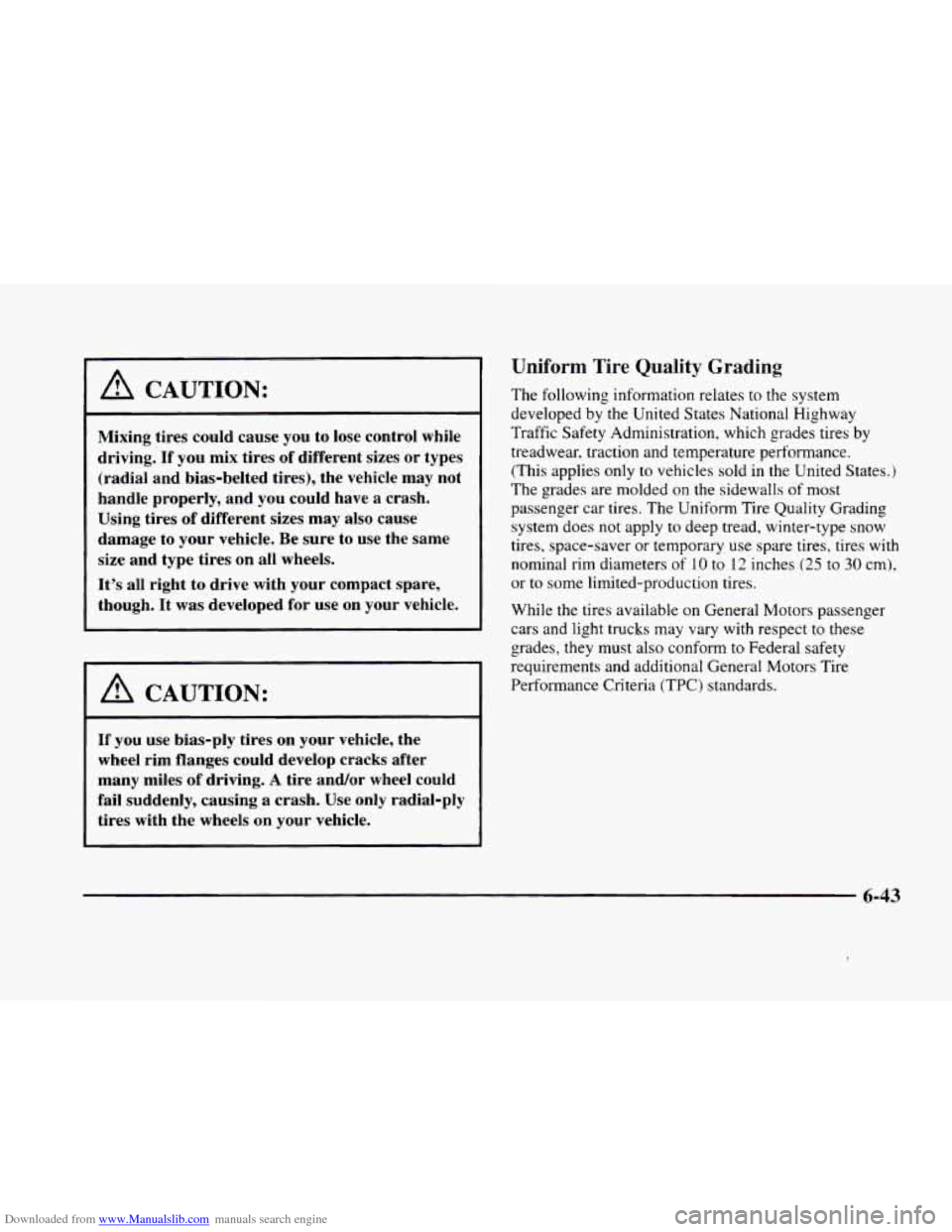
Downloaded from www.Manualslib.com manuals search engine I A CAUTION:
Mixing tires could cause you to lose control while
driving.
If you mix tires of different sizes or types
(radial and bias-belted tires), the vehicle may not
handle properly, and you could have a crash.
Using tires of different sizes may also cause
damage to
your vehicle. Be sure to use the same
size and type tires on
all wheels.
It’s all right to drive with your compact spare,
though. It
was developed for use on your vehicle.
A CAUTION:
If you use bias-ply tires on your vehicle, the
wheel rim flanges could develop cracks after
many miles of driving.
A tire and/or wheel could
fail suddenly, causing
a crash. Use only radial-ply
tires with the wheels
on your vehicle.
Uniform Tire Quality Grading
The following information relates to the system
developed by the United States National Highway
Traffic Safety Administration, which grades tires by
treadwear. traction and temperature performance.
(This applies only to vehicles sold in the United States.)
The grades are molded
on the sidewalls of most
passenger car tires. The Uniform Tire Quality Grading
system does
not apply to deep tread, winter-type snow
tires, space-saver or temporary
use spare tires, tires with
nominal rim diameters of
10 to 12 inches (25 to 30 cm),
or
to some limited-production tires.
While the tires available on General Motors passenger
cars and light trucks may vary with respect to these
grades, they must also conform to Federal safety
requirements and additional General Motors Tire
Performance Criteria (TPC) standards.
6-43
Page 334 of 380
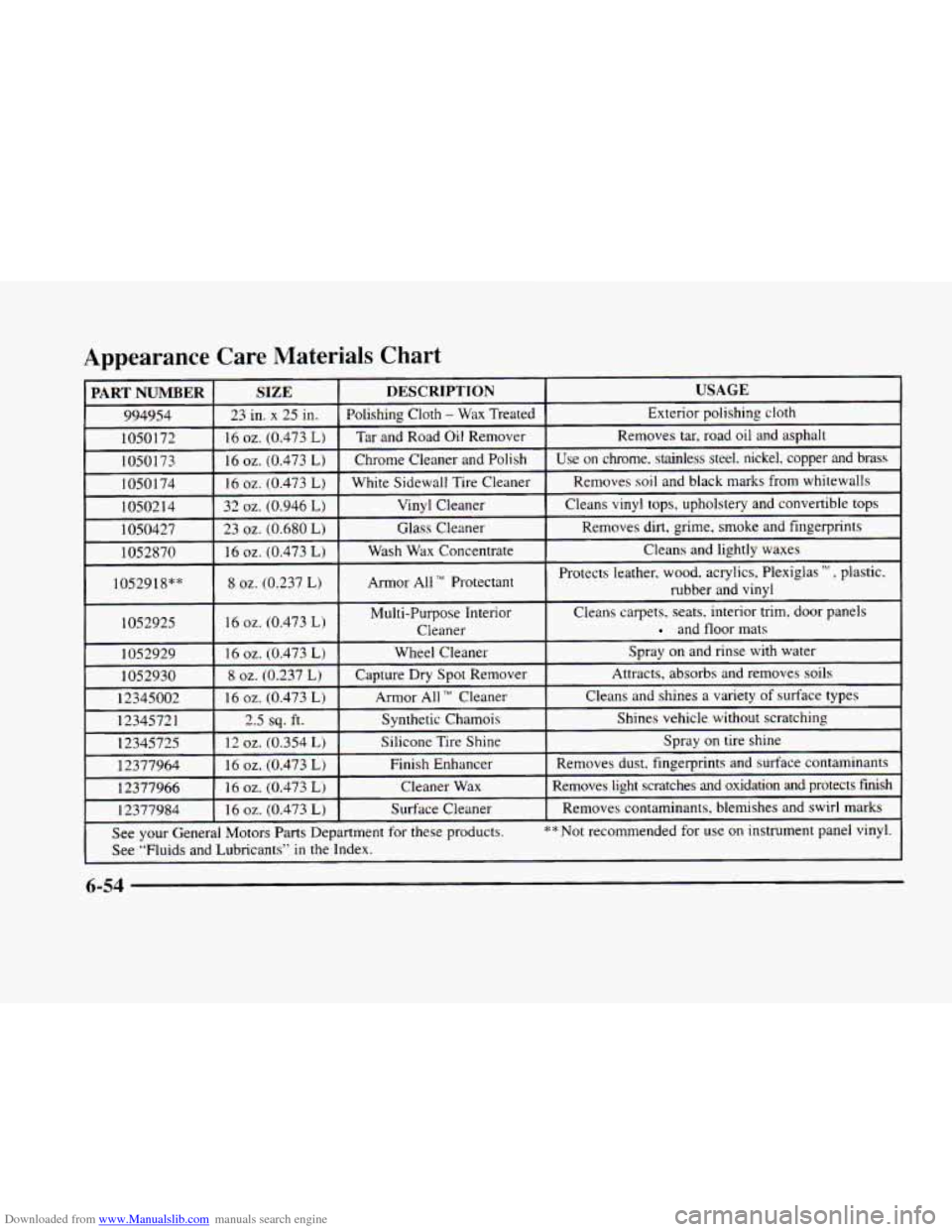
Downloaded from www.Manualslib.com manuals search engine Appearance Care Materials Chart
I PART NUMBER I SIZE I DESCRIPTION I USAGE I
994954 23 in. x 25 in. Polishing Cloth - Wax
Treated
Exterior polishing cloth
1050172 16
oz. (0.473 L) Tar and Road Oil Remover Removes tar, road oil and asphalt
1050173 16
oz. (0.473 L) Chrome Cleaner and Polish Use on chrome.
stainless steel. nickel, copper and brass
1050 174 16 oz. (,0.473 L) White Sidewall Tire Cleaner Removes soil and
black marks from whitewalls
10502 14 32
oz. (0.946 L) Vinyl Cleaner Cleans vinyl tops,
upholstery and convertible tops
1050427 23
oz. (0.680 L) Glass Cleaner Removes dirt,
grime, smoke and fingerprints
1052870 16
oz. (0.473 L) Wash Wax Concentrate Cleans
and lightly waxes
1052918""
8 02. (0.237 L) Armor All TM Protectant Protects leather.
wood. acrylics, Plexiglas lh1 , plastic.
rubber and vinyl
1052925 16
oz. (0.473 L) Multi-Purpose Interior Cleans carpets. seats, interior trim, door panels
Cleaner
and floor mats
6-54