lock CADILLAC ESCALADE 2003 2.G User Guide
[x] Cancel search | Manufacturer: CADILLAC, Model Year: 2003, Model line: ESCALADE, Model: CADILLAC ESCALADE 2003 2.GPages: 486, PDF Size: 3.32 MB
Page 27 of 486
Tilting the Full Bench Seat
{CAUTION:
If the seatback isn't locked, it could move
forward in a sudden stop or crash. That could
cause injury to the person sitting there. Always
press rearward on the seatback to be sure it is
locked.
1. Fold the seatbacks forward using the instructions
listed previously.
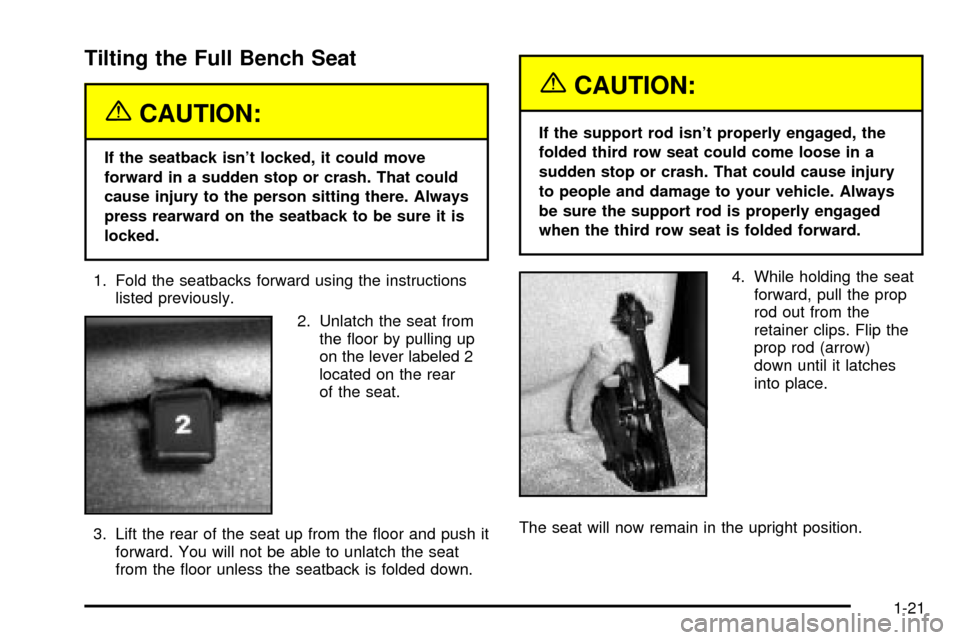
2. Unlatch the seat from
the ¯oor by pulling up
on the lever labeled 2
located on the rear
of the seat.
3. Lift the rear of the seat up from the ¯oor and push it
forward. You will not be able to unlatch the seat
from the ¯oor unless the seatback is folded down.
{CAUTION:
If the support rod isn't properly engaged, the
folded third row seat could come loose in a
sudden stop or crash. That could cause injury
to people and damage to your vehicle. Always
be sure the support rod is properly engaged
when the third row seat is folded forward.
4. While holding the seat
forward, pull the prop
rod out from the
retainer clips. Flip the
prop rod (arrow)
down until it latches
into place.
The seat will now remain in the upright position.
1-21
Page 28 of 486
Returning the Seat to an Upright
Position
To return the seatback to the upright position, do the
following:
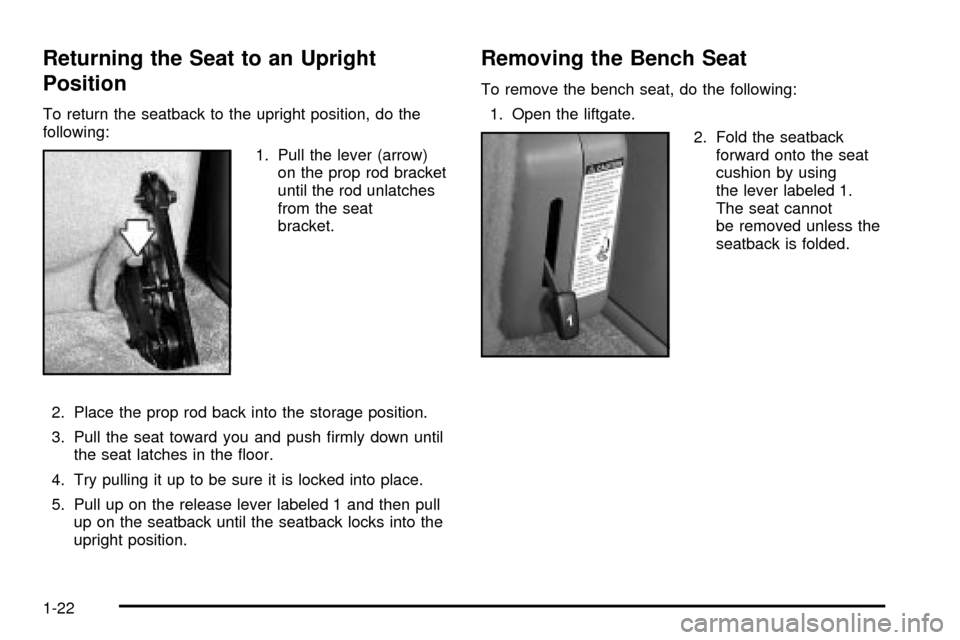
1. Pull the lever (arrow)
on the prop rod bracket
until the rod unlatches
from the seat
bracket.
2. Place the prop rod back into the storage position.
3. Pull the seat toward you and push ®rmly down until
the seat latches in the ¯oor.
4. Try pulling it up to be sure it is locked into place.
5. Pull up on the release lever labeled 1 and then pull
up on the seatback until the seatback locks into the
upright position.
Removing the Bench Seat
To remove the bench seat, do the following:
1. Open the liftgate.
2. Fold the seatback
forward onto the seat
cushion by using
the lever labeled 1.
The seat cannot
be removed unless the
seatback is folded.
1-22
Page 30 of 486
Replacing the Bench Seat
{CAUTION:
If the seatback isn't locked, it could move
forward in a sudden stop or crash. That could
cause injury to the person sitting there. Always
press rearward on the seatback to be sure it is
locked.
{CAUTION:
A seat that isn't locked into place properly can
move around in a collision or sudden stop.
People in the vehicle could be injured. Be sure
to lock the seat into place properly when
installing it.
{CAUTION:
A safety belt that is improperly routed, not
properly attached, or twisted won't provide the
protection needed in a crash. The person
wearing the belt could be seriously injured.
After raising the rear seatback, always check
to be sure that the safety belts are properly
routed and attached, and are not twisted.
To replace the bench seat, do the following:
1. While holding the rear of the seat up, slide the front
wheels into the slots on the ¯oor. The front latches
should lock into place. If the latches do not lock,
try tilting the rear of the seat upwards.
2. Once the latches are engaged, let the seat drop
into place. Release the lever labeled 1 to return
the seatback to its upright position.
3. Push and pull on the seat to make sure it is locked
into place. The seatback cannot be raised to the
upright position unless the seat is secured to
the ¯oor.
1-24
Page 31 of 486
Bucket Seats
If your vehicle has bucket seats, the seatbacks can be
reclined and the seats can be folded to give you
more cargo room.
Reclining the Seatbacks
To recline the seatback, do the following:
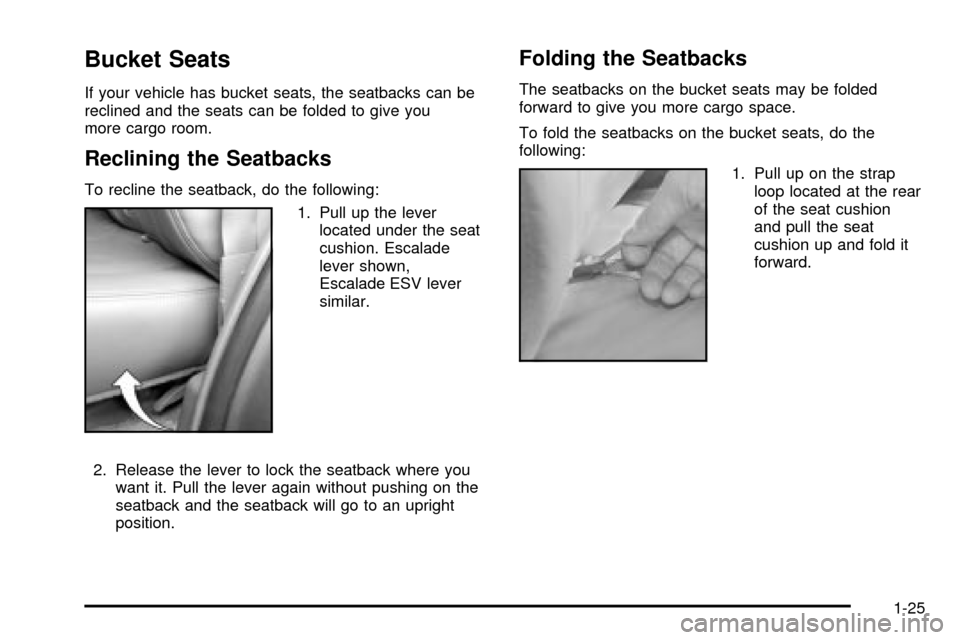
1. Pull up the lever
located under the seat
cushion. Escalade
lever shown,
Escalade ESV lever
similar.
2. Release the lever to lock the seatback where you
want it. Pull the lever again without pushing on the
seatback and the seatback will go to an upright
position.
Folding the Seatbacks
The seatbacks on the bucket seats may be folded
forward to give you more cargo space.
To fold the seatbacks on the bucket seats, do the
following:
1. Pull up on the strap
loop located at the rear
of the seat cushion
and pull the seat
cushion up and fold it
forward.
1-25
Page 33 of 486
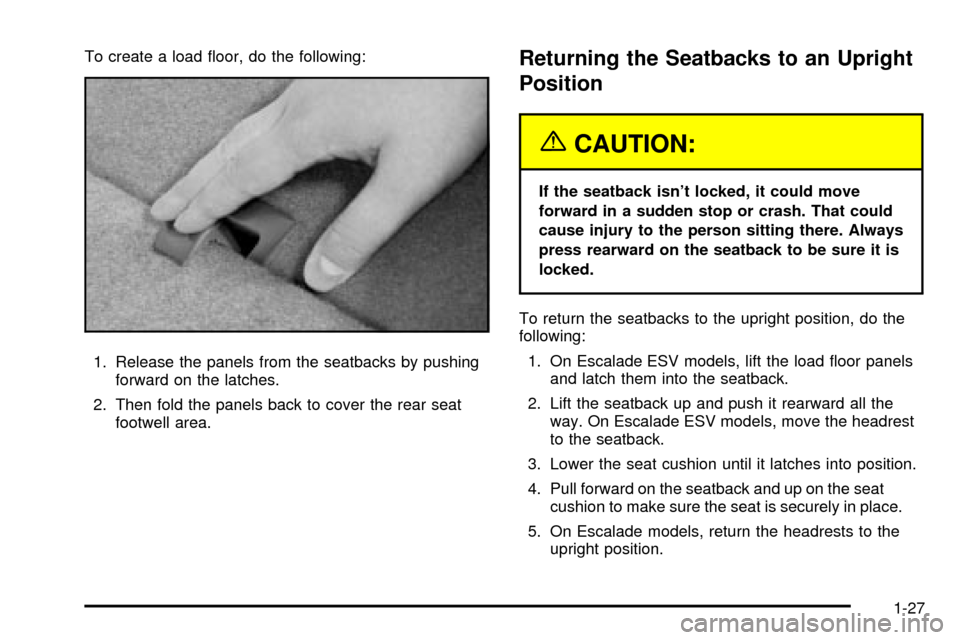
To create a load ¯oor, do the following:
1. Release the panels from the seatbacks by pushing
forward on the latches.
2. Then fold the panels back to cover the rear seat
footwell area.Returning the Seatbacks to an Upright
Position
{CAUTION:
If the seatback isn't locked, it could move
forward in a sudden stop or crash. That could
cause injury to the person sitting there. Always
press rearward on the seatback to be sure it is
locked.
To return the seatbacks to the upright position, do the
following:
1. On Escalade ESV models, lift the load ¯oor panels
and latch them into the seatback.
2. Lift the seatback up and push it rearward all the
way. On Escalade ESV models, move the headrest
to the seatback.
3. Lower the seat cushion until it latches into position.
4. Pull forward on the seatback and up on the seat
cushion to make sure the seat is securely in place.
5. On Escalade models, return the headrests to the
upright position.
1-27
Page 40 of 486
Driver Position
This part describes the driver's restraint system.
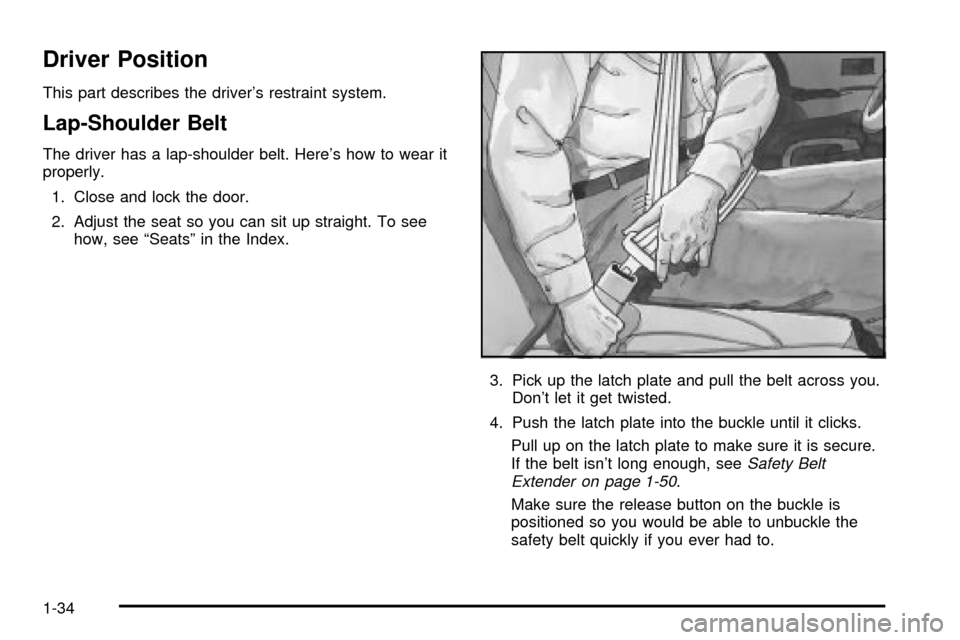
Lap-Shoulder Belt
The driver has a lap-shoulder belt. Here's how to wear it
properly.
1. Close and lock the door.
2. Adjust the seat so you can sit up straight. To see
how, see ªSeatsº in the Index.
3. Pick up the latch plate and pull the belt across you.
Don't let it get twisted.
4. Push the latch plate into the buckle until it clicks.
Pull up on the latch plate to make sure it is secure.
If the belt isn't long enough, see
Safety Belt
Extender on page 1-50.
Make sure the release button on the buckle is
positioned so you would be able to unbuckle the
safety belt quickly if you ever had to.
1-34
Page 41 of 486
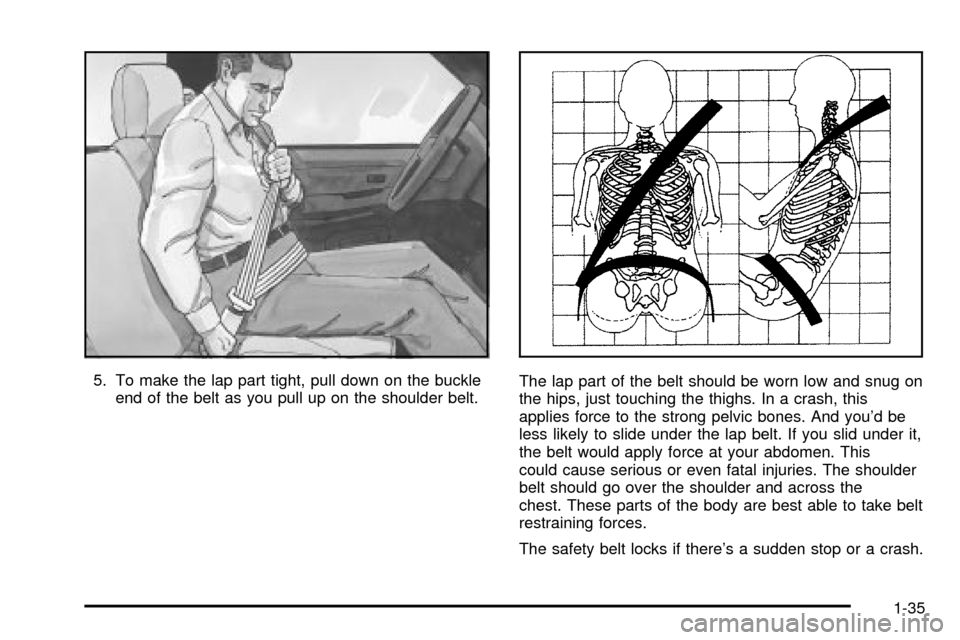
5. To make the lap part tight, pull down on the buckle
end of the belt as you pull up on the shoulder belt.The lap part of the belt should be worn low and snug on
the hips, just touching the thighs. In a crash, this
applies force to the strong pelvic bones. And you'd be
less likely to slide under the lap belt. If you slid under it,
the belt would apply force at your abdomen. This
could cause serious or even fatal injuries. The shoulder
belt should go over the shoulder and across the
chest. These parts of the body are best able to take belt
restraining forces.
The safety belt locks if there's a sudden stop or a crash.
1-35
Page 48 of 486

The best way to protect the fetus is to protect the
mother. When a safety belt is worn properly, it's more
likely that the fetus won't be hurt in a crash. For
pregnant women, as for anyone, the key to making
safety belts effective is wearing them properly.
Right Front Passenger Position
To learn how to wear the right front passenger's safety
belt properly, seeDriver Position on page 1-34.
The right front passenger's safety belt works the same
way as the driver's safety beltÐexcept for one thing.
If you ever pull the shoulder portion of the belt out all the
way, you will engage the child restraint locking feature
which may turn off the passenger's frontal air bag. If this
happens unintentionally, just let the belt go back all
the way and start again.
Center Passenger Position
Second Row ± Lap-Shoulder Belt
When you sit in the center seat position in the second
row you have a lap-shoulder belt which works the same
way as the rear outside seat positions. To learn how
to wear this belt, see ªLap-Shoulder Beltº under
Rear Seat Passengers on page 1-44.
1-42
Page 51 of 486
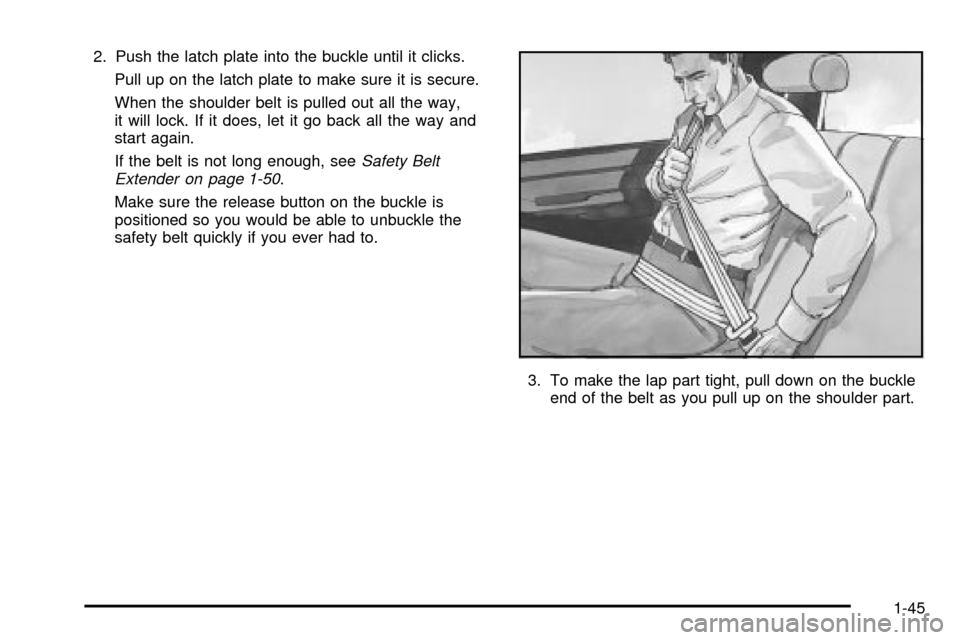
2. Push the latch plate into the buckle until it clicks.
Pull up on the latch plate to make sure it is secure.
When the shoulder belt is pulled out all the way,
it will lock. If it does, let it go back all the way and
start again.
If the belt is not long enough, see
Safety Belt
Extender on page 1-50.
Make sure the release button on the buckle is
positioned so you would be able to unbuckle the
safety belt quickly if you ever had to.
3. To make the lap part tight, pull down on the buckle
end of the belt as you pull up on the shoulder part.
1-45
Page 52 of 486
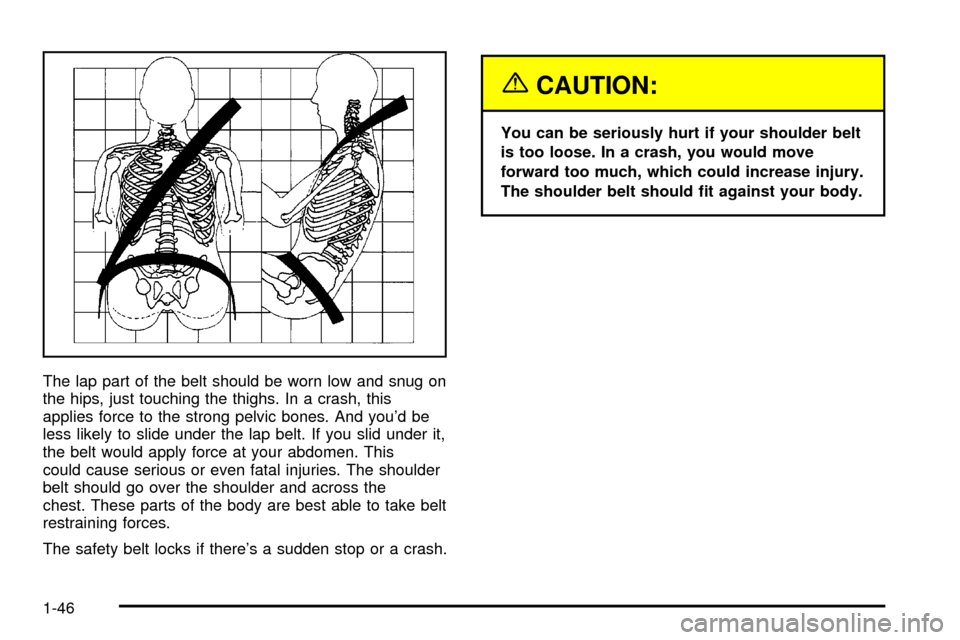
The lap part of the belt should be worn low and snug on
the hips, just touching the thighs. In a crash, this
applies force to the strong pelvic bones. And you'd be
less likely to slide under the lap belt. If you slid under it,
the belt would apply force at your abdomen. This
could cause serious or even fatal injuries. The shoulder
belt should go over the shoulder and across the
chest. These parts of the body are best able to take belt
restraining forces.
The safety belt locks if there's a sudden stop or a crash.
{CAUTION:
You can be seriously hurt if your shoulder belt
is too loose. In a crash, you would move
forward too much, which could increase injury.
The shoulder belt should ®t against your body.
1-46