child seat CADILLAC ESCALADE 2003 2.G Owner's Manual
[x] Cancel search | Manufacturer: CADILLAC, Model Year: 2003, Model line: ESCALADE, Model: CADILLAC ESCALADE 2003 2.GPages: 486, PDF Size: 3.32 MB
Page 77 of 486
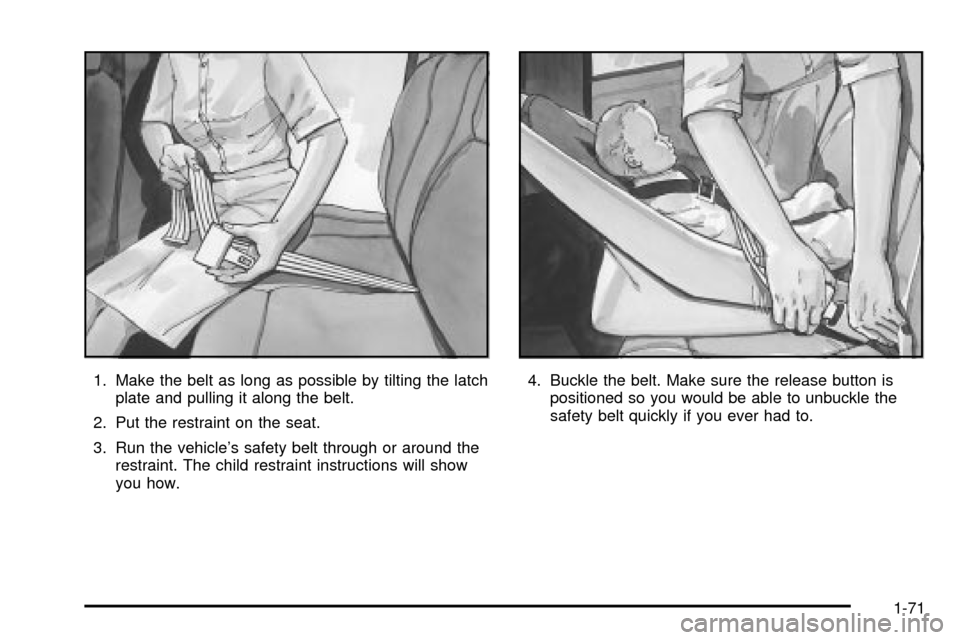
1. Make the belt as long as possible by tilting the latch
plate and pulling it along the belt.
2. Put the restraint on the seat.
3. Run the vehicle's safety belt through or around the
restraint. The child restraint instructions will show
you how.4. Buckle the belt. Make sure the release button is
positioned so you would be able to unbuckle the
safety belt quickly if you ever had to.
1-71
Page 78 of 486
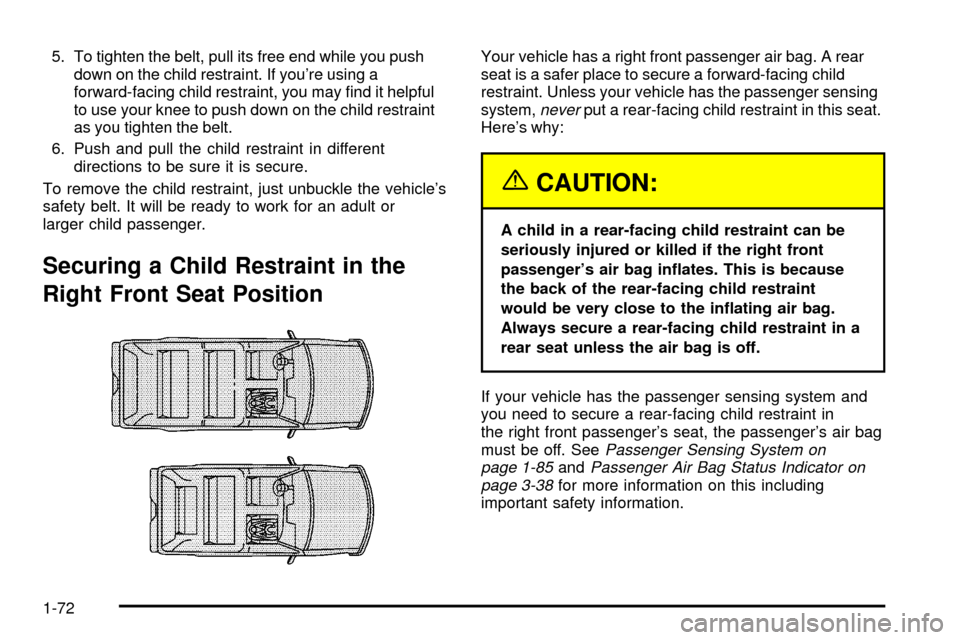
5. To tighten the belt, pull its free end while you push
down on the child restraint. If you're using a
forward-facing child restraint, you may ®nd it helpful
to use your knee to push down on the child restraint
as you tighten the belt.
6. Push and pull the child restraint in different
directions to be sure it is secure.
To remove the child restraint, just unbuckle the vehicle's
safety belt. It will be ready to work for an adult or
larger child passenger.
Securing a Child Restraint in the
Right Front Seat Position
Your vehicle has a right front passenger air bag. A rear
seat is a safer place to secure a forward-facing child
restraint. Unless your vehicle has the passenger sensing
system,
neverput a rear-facing child restraint in this seat.
Here's why:
{CAUTION:
A child in a rear-facing child restraint can be
seriously injured or killed if the right front
passenger's air bag in¯ates. This is because
the back of the rear-facing child restraint
would be very close to the in¯ating air bag.
Always secure a rear-facing child restraint in a
rear seat unless the air bag is off.
If your vehicle has the passenger sensing system and
you need to secure a rear-facing child restraint in
the right front passenger's seat, the passenger's air bag
must be off. See
Passenger Sensing System on
page 1-85andPassenger Air Bag Status Indicator on
page 3-38for more information on this including
important safety information.
1-72
Page 79 of 486
{CAUTION:
A child in a rear-facing child restraint can be
seriously injured or killed if the right front
passenger's air bag in¯ates. This is because
the back of the rear facing child restraint
would be very close to the in¯ating air bag. Be
sure the air bag is off before using a
rear-facing child restraint in the right front seat
position.
Even though the passenger sensing system is
designed to turn off the passenger's frontal air
bag if the system detects a rear-facing child
restraint, no system is fail-safe, and no one
can guarantee that an air bag will not deploy
under some unusual circumstance, even
though it is turned off. General Motors
therefore recommends that rear-facing child
restraints be secured in the rear seat whenever
possible, even if the air bag is off.You'll be using the lap-shoulder belt. See
Top Strap on
page 1-61if the child restraint has one. Be sure to
follow the instructions that came with the child restraint.
Secure the child in the child restraint when and as
the instructions say.
1. Because your vehicle has a right front passenger
air bag, always move the seat as far back as it will
go before securing a child restraint, if you need
to secure a forward-facing child restraint in the right
front seat position. See
Power Seats on page 1-3.
If your vehicle has the passenger sensing
system and you are using a rear-facing child
restraint in this seat, make sure the frontal air bag
is off. See
Passenger Sensing System on
page 1-85.
When the passenger sensing system has turned off
the right front passenger's frontal air bag, the off
indicator on the inside rearview mirror will be lit and
stay lit when you turn the ignition to RUN or START.
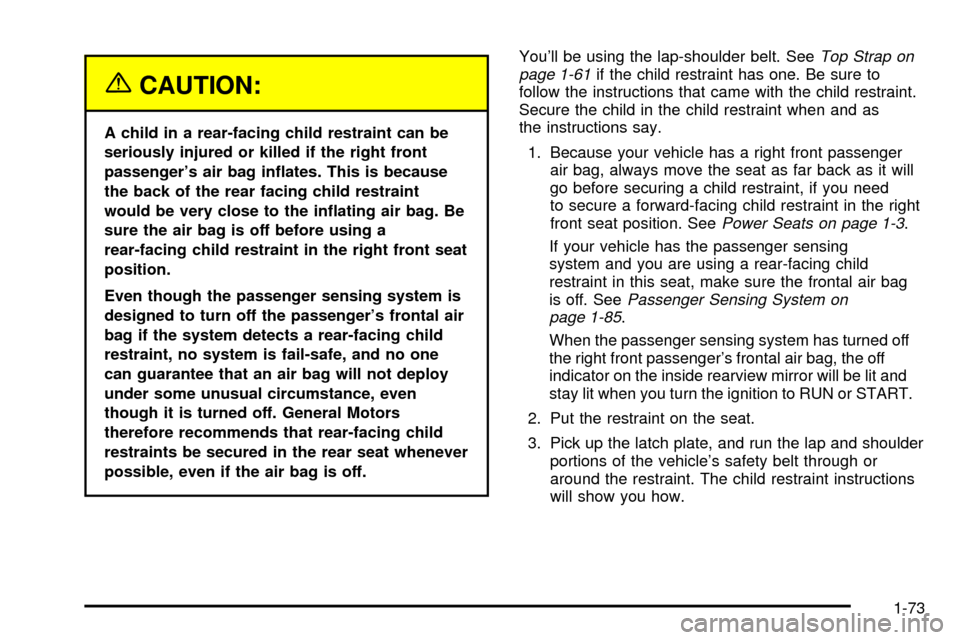
2. Put the restraint on the seat.
3. Pick up the latch plate, and run the lap and shoulder
portions of the vehicle's safety belt through or
around the restraint. The child restraint instructions
will show you how.
1-73
Page 81 of 486
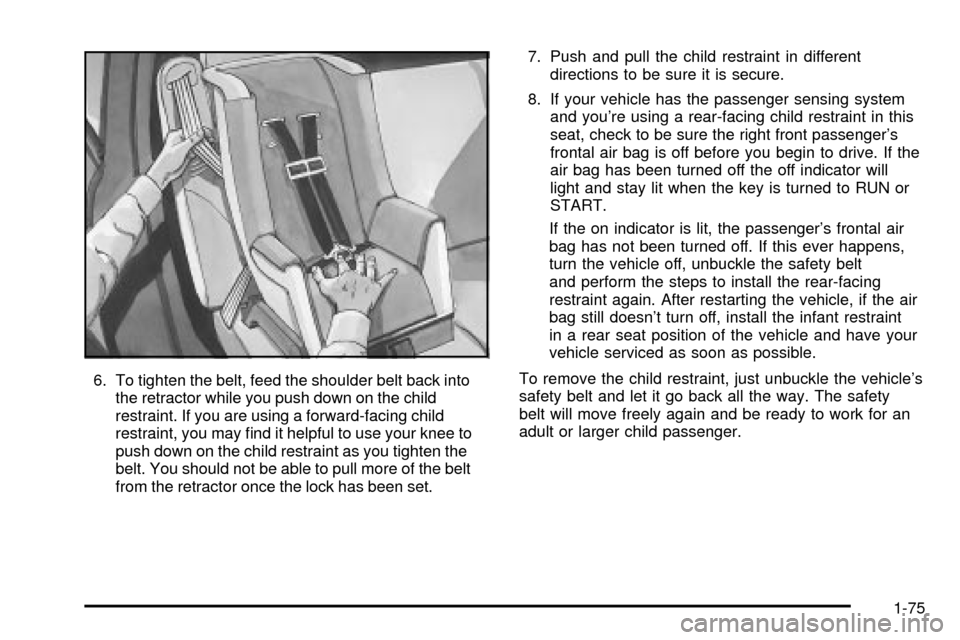
6. To tighten the belt, feed the shoulder belt back into
the retractor while you push down on the child
restraint. If you are using a forward-facing child
restraint, you may ®nd it helpful to use your knee to
push down on the child restraint as you tighten the
belt. You should not be able to pull more of the belt
from the retractor once the lock has been set.7. Push and pull the child restraint in different
directions to be sure it is secure.
8. If your vehicle has the passenger sensing system
and you're using a rear-facing child restraint in this
seat, check to be sure the right front passenger's
frontal air bag is off before you begin to drive. If the
air bag has been turned off the off indicator will
light and stay lit when the key is turned to RUN or
START.
If the on indicator is lit, the passenger's frontal air
bag has not been turned off. If this ever happens,
turn the vehicle off, unbuckle the safety belt
and perform the steps to install the rear-facing
restraint again. After restarting the vehicle, if the air
bag still doesn't turn off, install the infant restraint
in a rear seat position of the vehicle and have your
vehicle serviced as soon as possible.
To remove the child restraint, just unbuckle the vehicle's
safety belt and let it go back all the way. The safety
belt will move freely again and be ready to work for an
adult or larger child passenger.
1-75
Page 92 of 486
Accident statistics show that children are safer if they
are restrained in the rear rather than the front seat.
General Motors, therefore, recommends that child
restraints be secured in a rear seat, including an infant
riding in a rear-facing infant seat, a child riding in a
forward-facing child seat and an older child riding in a
booster seat. Never put a child in rear-facing child
restraint in the right front passenger seat unless your
vehicle has the passenger sensing system and the
passenger air bag status indicator shows off. Never put
a rear-facing child restraint in the right front passenger
seat unless the air bag is off.
{CAUTION:
A child in a rear-facing child restraint can be
seriously injured or killed if the right front
passenger's air bag in¯ates. This is because
the back of the rear-facing child restraint
would be very close to the in¯ating air bag. Be
sure the air bag is off before using a
rear-facing child restraint in the right front seat
position.
CAUTION: (Continued)
CAUTION: (Continued)
Even though the passenger sensing system is
designed to turn off the passenger's frontal air
bag if the system detects a rear-facing child
restraint, no system is fail-safe, and no one
can guarantee that an air bag will not deploy
under some unusual circumstance, even
though it is turned off. General Motors,
therefore, recommends that rear-facing child
restraints be secured in the rear seat whenever
possible, even if the air bag is off.
The passenger sensing system is designed to turn off
the right front passenger's frontal air bag if:
·the right front passenger seat is unoccupied
·the system determines that an infant is present in a
rear-facing infant seat
·the system determines that a small child is present
in a forward-facing child restraint
·the system determines that a small child is present
in a booster seat
1-86
Page 93 of 486

·a right front passenger takes his/her weight off of
the seat for a period of time
·the right front passenger seat is occupied by a
smaller person, such as a child who has outgrown
child restraints
·or if there is a critical problem with the air bag
system or the passenger sensing system.
When the passenger sensing system has turned off the
passenger's frontal air bag, the off indicator will light
and stay lit to remind you that the air bag is off.
The passenger sensing system is designed to turn off
the passenger's frontal air bag when a rear facing infant
seat, a forward-facing child restraint or a booster seat
is detected. If the child restraint has been installed
and the on indicator is lit, turn the vehicle off, remove
the child restraint from the vehicle and reinstall the
restraint following the child restraint manufacturer's
directions and refer to
Securing a Child Restraint in the
Right Front Seat Position on page 1-72of this manual.
If after reinstalling the child restraint and restarting
the vehicle, the on indicator is still lit, secure the child in
the child restraint in a rear seat position in the vehicle
and check with your dealer.The passenger sensing system is designed to enable
(may in¯ate) the right front passenger's frontal air
bag anytime the system senses that a person of adult
size is sitting properly in the right front passenger's seat.
When the passenger sensing system has allowed the
air bag to be enabled, the on indicator will light and stay
lit to remind you that the air bag is active.
For some children who have outgrown child restraints
and for very small adults, the passenger sensing system
may or may not turn off the right front passenger's
frontal air bag, depending upon the person's seating
posture and body build. Everyone in your vehicle
who has outgrown child restraints should wear a safety
belt properly Ð whether or not there is an air bag
for that person.
If a person of adult-size is sitting in the right front
passenger's seat, but the off indicator is lit, it could be
because that person isn't sitting properly in the seat. If
this happens, turn the vehicle off and ask the person to
place the seatback in the full upright position, then sit
upright in the seat, centered on the seat cushion, with the
person's legs comfortably extended. Restart the vehicle
and have the person remain in this position for about two
minutes. This will allow the system to detect that person
and then enable the passenger's air bag.
1-87
Page 188 of 486
Passenger Air Bag Status Indicator
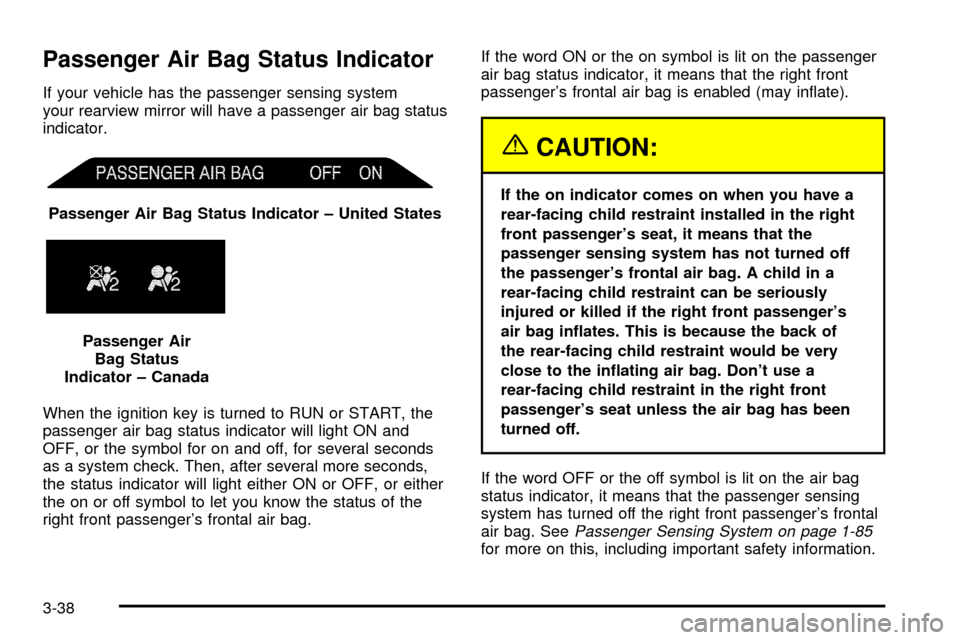
If your vehicle has the passenger sensing system
your rearview mirror will have a passenger air bag status
indicator.
When the ignition key is turned to RUN or START, the
passenger air bag status indicator will light ON and
OFF, or the symbol for on and off, for several seconds
as a system check. Then, after several more seconds,
the status indicator will light either ON or OFF, or either
the on or off symbol to let you know the status of the
right front passenger's frontal air bag.If the word ON or the on symbol is lit on the passenger
air bag status indicator, it means that the right front
passenger's frontal air bag is enabled (may in¯ate).
{CAUTION:
If the on indicator comes on when you have a
rear-facing child restraint installed in the right
front passenger's seat, it means that the
passenger sensing system has not turned off
the passenger's frontal air bag. A child in a
rear-facing child restraint can be seriously
injured or killed if the right front passenger's
air bag in¯ates. This is because the back of
the rear-facing child restraint would be very
close to the in¯ating air bag. Don't use a
rear-facing child restraint in the right front
passenger's seat unless the air bag has been
turned off.
If the word OFF or the off symbol is lit on the air bag
status indicator, it means that the passenger sensing
system has turned off the right front passenger's frontal
air bag. See
Passenger Sensing System on page 1-85for more on this, including important safety information. Passenger Air Bag Status Indicator ± United States
Passenger Air
Bag Status
Indicator ± Canada
3-38
Page 308 of 486
Using heavier suspension components to get added
durability might not change your weight ratings. Ask your
dealer to help you load your vehicle the right way.
If you put things inside your vehicle ± like suitcases,
tools, packages, or anything else ± they go as fast
as the vehicle goes. If you have to stop or turn quickly,
or if there is a crash, they'll keep going.
{CAUTION:
Things you put inside your vehicle can strike
and injure people in a sudden stop or turn, or
in a crash.
·Put things in the cargo area of your
vehicle. Try to spread the weight evenly.
·Never stack heavier things, like suitcases,
inside the vehicle so that some of them
are above the tops of the seats.
·Don't leave an unsecured child restraint in
your vehicle.
·When you carry something inside the
vehicle, secure it whenever you can.
·Don't leave a seat folded down unless you
need to.There's also important loading information for off-road
driving in this manual. See ªLoading Your Vehicle
for Off-Road Drivingº under
Operating Your
All-Wheel-Drive Vehicle Off Paved Roads on page 4-18.
Add-On Equipment
When you carry removable items, you may need to put
a limit on how many people you can carry inside
your vehicle. Be sure to weigh your vehicle before you
buy and install the new equipment.
Notice:Your warranty does not cover parts or
components that fail because of overloading.
Remember not to exceed the Gross Axle Weight Rating
(GAWR) of the front or rear axle. See
Loading Your
Vehicle on page 4-51.
The Cargo Weight Rating (CWR) is the maximum
weight of the load your vehicle can carry. It doesn't
include the weight of the people inside. But you
can ®gure about 150 lbs. (68 kg) for each seat.
The total cargo load must not be more than your
vehicle's CWR.
4-52
Page 471 of 486

Care of (cont.)
Your CD and DVD Player...........................3-104
Your CD Changer......................................3-104
Your CDs and DVDs..................................3-104
Cargo Area Door Lock Switch...........................2-10
Cargo Cover..................................................2-47
Cargo Tie Downs............................................2-48
Cassette Tape Messages.................................3-81
Cassette Tape Player Service...........................6-11
CD Adapter Kits.............................................3-82
CD Changer...................................................3-99
CD Functions...............................................3-100
Center Console Storage Area...........................2-45
Center High-Mounted Stoplamp (CHMSL)...........5-63
Center Instrument Panel Fuse Block................5-106
Center Passenger Position, Safety Belts.............1-42
Chains, Tires..................................................5-74
CHANGE ENGINE OIL....................................3-62
Charging System Light....................................3-39
Check Engine Light.........................................3-44
CHECK OIL LEVEL.........................................3-62
CHECK TIRE PRESSURE...............................3-69
CHECK WASHER FLUID.................................3-65
Checking Brake Fluid......................................5-40
Checking Coolant............................................5-26
Checking Engine Oil........................................5-14
Checking Things Under the Hood......................5-10
Checking Your Restraint Systems......................1-90Check...........................................................3-44
Engine Light...............................................3-44
Chemical Paint Spotting.................................5-100
Child Restraints..............................................1-57
Child Restraint Systems...............................1-57
Infants and Young Children...........................1-53
Lower Anchorages and Top Tethers for
Children (LATCH System)..........................1-65
Older Children.............................................1-51
Securing a Child Restraint Designed for the
LATCH System........................................1-67
Securing a Child Restraint in a Center Rear
Seat Position...........................................1-70
Securing a Child Restraint in a Rear Outside
Seat Position...........................................1-67
Securing a Child Restraint in the Right Front
Seat Position...........................................1-72
Top Strap Anchor Location............................1-63
Top Strap...................................................1-61
Where to Put the Restraint...........................1-60
Cigarette Lighter.............................................3-23
Cleaning Aluminum or Chrome-Plated Wheels.....5-99
Cleaning Exterior Lamps/Lenses.......................5-97
Cleaning Fabric/Carpet....................................5-94
Cleaning Glass Surfaces..................................5-96
Cleaning Interior Plastic Components.................5-95
Cleaning Leather............................................5-95
Cleaning the Mirror.........................................2-35
3
Page 482 of 486

S
Safety Belt.....................................................3-36
Reminder Light............................................3-36
Safety Belts...................................................5-96
Care of......................................................5-96
Center Passenger Position............................1-42
Driver Position............................................1-34
How to Wear Safety Belts Properly................1-33
Questions and Answers About Safety Belts.....1-32
Rear Safety Belt Comfort Guides for Children
and Small Adults......................................1-47
Rear Seat Passengers.................................1-44
Right Front Passenger Position......................1-42
Safety Belt Extender....................................1-50
Safety Belt Use During Pregnancy.................1-41
Safety Belts Are for Everyone.......................1-28
Safety Chains.................................................4-59
Safety Warnings and Symbols.............................. iii
Scanning the Terrain.......................................4-22
Scheduled Maintenance..................................... 6-5
Seat............................................................... 1-7
Head Restraints............................................ 1-7
Seats............................................................1-13
50/50 Split Bench Seat.................................1-13
60/40 Split Bench Seat.................................1-10
Bench Seat................................................1-19
Bucket Seats, Rear......................................1-25
Heated Seats, Rear.....................................1-10
Heated Seats............................................... 1-5Seats (cont.)
Memory.....................................................2-50
Power Lumbar.............................................. 1-4
Power Seats................................................. 1-3
Rear Seat Operation...................................... 1-8
Reclining Seatbacks...................................... 1-6
Second Row ± Lap-Shoulder Belt......................1-42
Second Row..................................................1-70
Secondary Latch System.................................5-90
Securing a Child Restraint................................1-70
Center Rear Seat Position............................1-70
Designed for the LATCH System...................1-67
Rear Outside Seat Position...........................1-67
Right Front Seat Position..............................1-72
Security Light.................................................3-49
Select Button.................................................3-61
Self Dimming Mirror Operation..........................2-34
SERVICE 4WD...............................................3-64
SERVICE AIR BAG.........................................3-63
SERVICE BRAKE BOOSTER...........................3-64
SERVICE BRAKE SYSTEM.............................3-63
Service Bulletins.............................................7-11
Service Manuals.............................................7-11
SERVICE RIDE CONTROL..............................3-64
SERVICE STABILITY......................................3-68
SERVICE TIRE MONITOR...............................3-69
Service........................................................... 5-3
Adding Equipment to the Outside of
Your Vehicle.............................................. 5-4
Doing Your Own Work................................... 5-3
14