transmission CADILLAC ESCALADE 2007 3.G User Guide
[x] Cancel search | Manufacturer: CADILLAC, Model Year: 2007, Model line: ESCALADE, Model: CADILLAC ESCALADE 2007 3.GPages: 574, PDF Size: 2.89 MB
Page 148 of 574
Your vehicle’s transmission uses adaptive shift
controls. Adaptive shift control continually
compares key shift parameters to pre-programmed
ideal shifts stored in the transmissions computer.
The transmission constantly makes adjustments to
improve vehicle performance according to how the
vehicle is being used, such as with a heavy load or
when temperature changes. During this adaptive
shift controls process, shifting may feel different as
the transmission determines the best settings.
When temperatures are very cold, the
Hydra-Matic
®6L80 automatic transmission’s gear
shifting may be delayed providing more stable
shifts until the engine warms up. Shifts may
be more noticeable with a cold transmission. This
difference in shifting is normal.
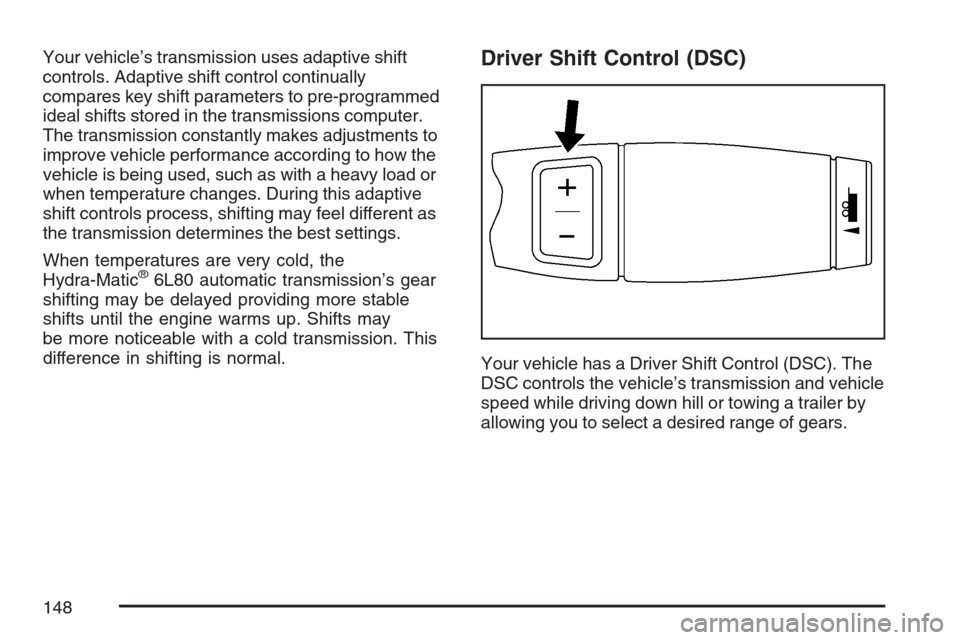
Driver Shift Control (DSC)
Your vehicle has a Driver Shift Control (DSC). The
DSC controls the vehicle’s transmission and vehicle
speed while driving down hill or towing a trailer by
allowing you to select a desired range of gears.
148
Page 149 of 574
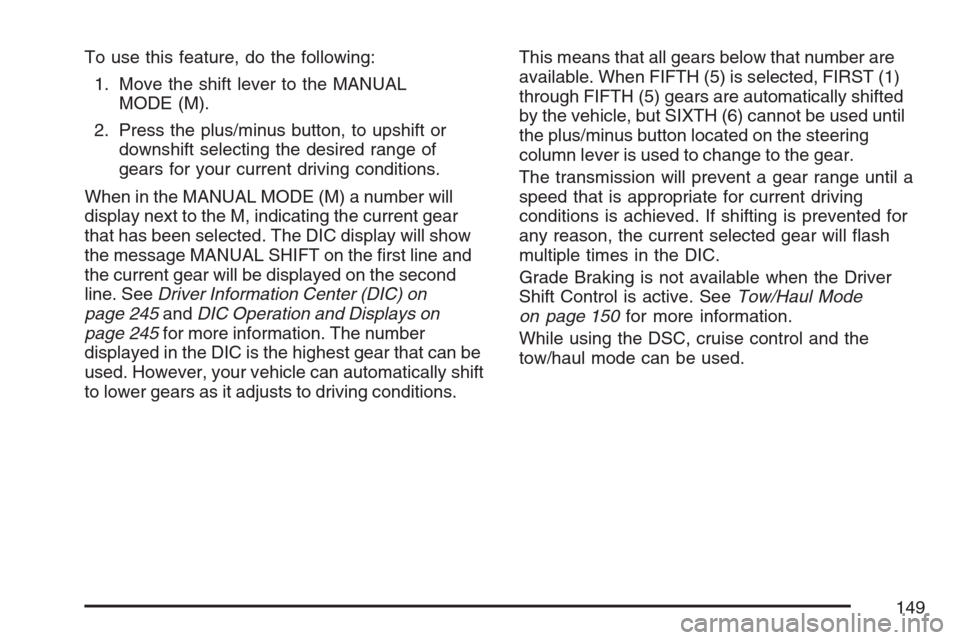
To use this feature, do the following:
1. Move the shift lever to the MANUAL
MODE (M).
2. Press the plus/minus button, to upshift or
downshift selecting the desired range of
gears for your current driving conditions.
When in the MANUAL MODE (M) a number will
display next to the M, indicating the current gear
that has been selected. The DIC display will show
the message MANUAL SHIFT on the rst line and
the current gear will be displayed on the second
line. SeeDriver Information Center (DIC) on
page 245andDIC Operation and Displays on
page 245for more information. The number
displayed in the DIC is the highest gear that can be
used. However, your vehicle can automatically shift
to lower gears as it adjusts to driving conditions.This means that all gears below that number are
available. When FIFTH (5) is selected, FIRST (1)
through FIFTH (5) gears are automatically shifted
by the vehicle, but SIXTH (6) cannot be used until
the plus/minus button located on the steering
column lever is used to change to the gear.
The transmission will prevent a gear range until a
speed that is appropriate for current driving
conditions is achieved. If shifting is prevented for
any reason, the current selected gear will ash
multiple times in the DIC.
Grade Braking is not available when the Driver
Shift Control is active. SeeTow/Haul Mode
on page 150for more information.
While using the DSC, cruise control and the
tow/haul mode can be used.
149
Page 150 of 574
Tow/Haul Mode
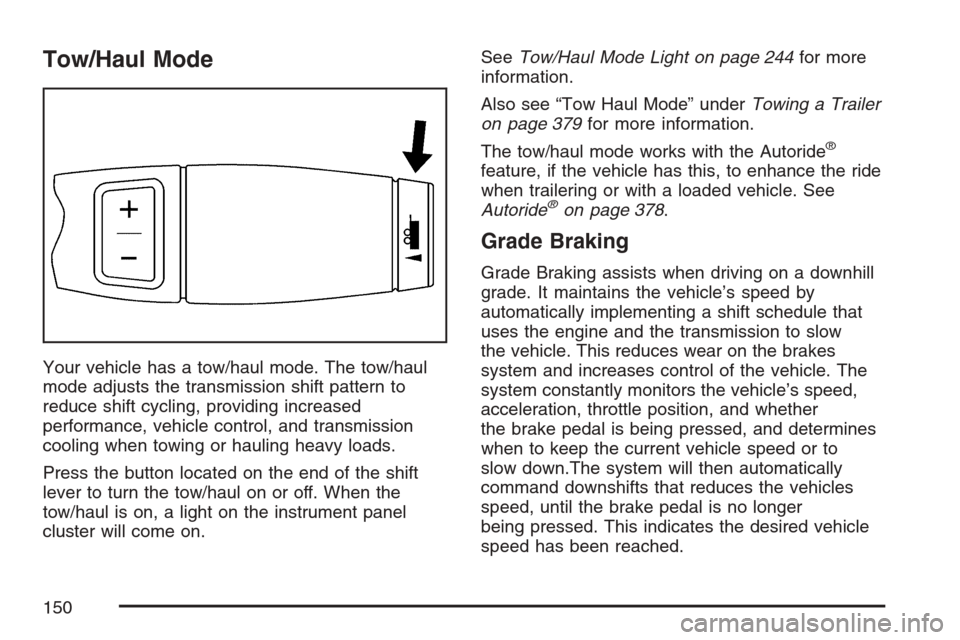
Your vehicle has a tow/haul mode. The tow/haul
mode adjusts the transmission shift pattern to
reduce shift cycling, providing increased
performance, vehicle control, and transmission
cooling when towing or hauling heavy loads.
Press the button located on the end of the shift
lever to turn the tow/haul on or off. When the
tow/haul is on, a light on the instrument panel
cluster will come on.SeeTow/Haul Mode Light on page 244for more
information.
Also see “Tow Haul Mode” underTowing a Trailer
on page 379for more information.
The tow/haul mode works with the Autoride
®
feature, if the vehicle has this, to enhance the ride
when trailering or with a loaded vehicle. See
Autoride
®on page 378.
Grade Braking
Grade Braking assists when driving on a downhill
grade. It maintains the vehicle’s speed by
automatically implementing a shift schedule that
uses the engine and the transmission to slow
the vehicle. This reduces wear on the brakes
system and increases control of the vehicle. The
system constantly monitors the vehicle’s speed,
acceleration, throttle position, and whether
the brake pedal is being pressed, and determines
when to keep the current vehicle speed or to
slow down.The system will then automatically
command downshifts that reduces the vehicles
speed, until the brake pedal is no longer
being pressed. This indicates the desired vehicle
speed has been reached.
150
Page 151 of 574
The tow/haul mode and grade braking shift modes
can be activated by pressing the button on the
end of the shift control stalk. While in the
DSC mode, grade braking is deactivated, allowing
the driver to select a gear.
SeeAutomatic Transmission Operation on
page 144for more information.
Parking Brake
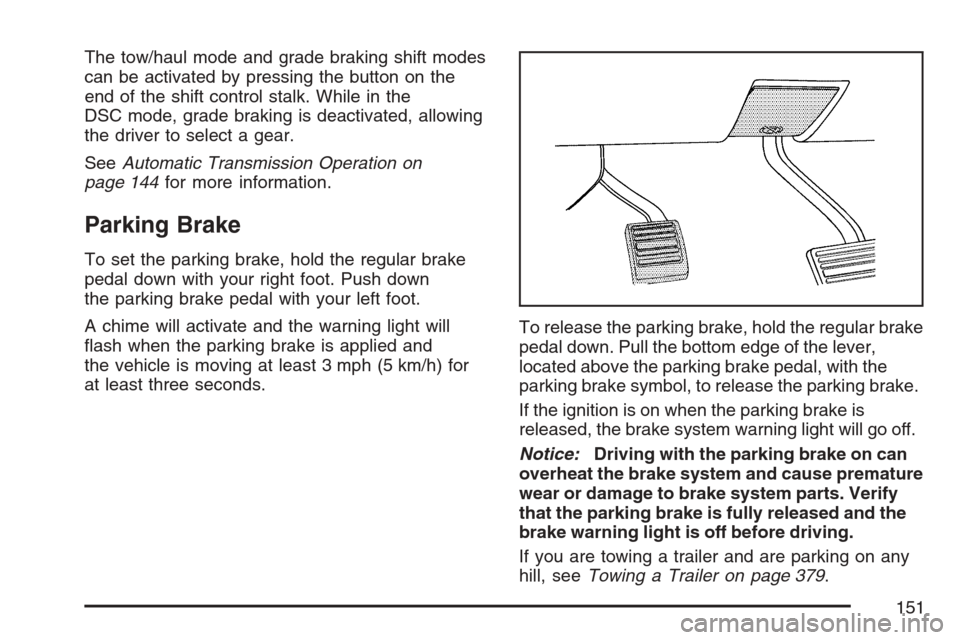
To set the parking brake, hold the regular brake
pedal down with your right foot. Push down
the parking brake pedal with your left foot.
A chime will activate and the warning light will
ash when the parking brake is applied and
the vehicle is moving at least 3 mph (5 km/h) for
at least three seconds.To release the parking brake, hold the regular brake
pedal down. Pull the bottom edge of the lever,
located above the parking brake pedal, with the
parking brake symbol, to release the parking brake.
If the ignition is on when the parking brake is
released, the brake system warning light will go off.
Notice:Driving with the parking brake on can
overheat the brake system and cause premature
wear or damage to brake system parts. Verify
that the parking brake is fully released and the
brake warning light is off before driving.
If you are towing a trailer and are parking on any
hill, seeTowing a Trailer on page 379.
151
Page 153 of 574
Torque Lock
If you are parking on a hill and you do not shift
your transmission into PARK (P) properly,
the weight of the vehicle may put too much force
on the parking pawl in the transmission. You
may nd it difficult to pull the shift lever out
of PARK (P). This is called torque lock. To prevent
torque lock, set the parking brake and then shift
into PARK (P) properly before you leave the
driver’s seat. To nd out how, seeShifting Into
Park (P) on page 152.
When you are ready to drive, move the shift lever
out of PARK (P) before you release the parking
brake.
If torque lock does occur, you may need to have
another vehicle push yours a little uphill to
take some of the pressure from the parking pawl
in the transmission, then you will be able to
pull the shift lever out of PARK (P).
Shifting Out of Park (P)
Your vehicle has an automatic transmission shift
lock control system which locks the shift lever
in PARK (P) when the ignition is in the LOCK.
You have to fully apply your regular brakes before
you can shift from PARK (P) when the ignition
is in RUN. SeeAutomatic Transmission Operation
on page 144.
If you cannot shift out of PARK (P), ease pressure
on the shift lever and push the shift lever all the
way up into PARK (P) as you maintain brake
application. Then, move the shift lever into
the desired gear.
153
Page 175 of 574
Read the instructions completely before attempting
to program the Universal Home Remote.
Because of the steps involved, it may be helpful to
have another person available to assist you in
the programming steps.
Keep the original hand-held transmitter for use in
other vehicles as well as for future Universal
Home Remote programming. It is also
recommended that upon the sale of the vehicle,
the programmed Universal Home Remote buttons
should be erased for security purposes. See
“Erasing Universal Home Remote Buttons” later in
this section or, for assistance, seeCustomer
Assistance Offices on page 544.
Be sure that people and objects are clear of the
garage door or gate operator you are
programming. When programming a garage door,
it is advised to park outside of the garage.
It is recommended that a new battery be installed
in your hand-held transmitter for quicker and
more accurate transmission of the radio-frequency
signal.Programming Universal Home Remote
Follow these steps to program up to three
channels:
1. Press and hold down the two outside
Universal Home Remote buttons, releasing
only when the Universal Home Remote
indicator light begins to ash, after
20 seconds. Do not hold down the buttons for
longer than 30 seconds and do not repeat
this step to program a second and/or
third hand-held transmitter to the remaining
two Universal Home Remote buttons.
2. Position the end of your hand-held transmitter
about 1 to 3 inches (3 to 8 cm) away from the
Universal Home Remote buttons while
keeping the indicator light in view.
3. Simultaneously press and hold both the
desired Universal Home Remote button
and the hand-held transmitter button. Do not
release the buttons until Step 4 has been
completed.
Some entry gates and garage door openers
may require you to substitute Step 3 with
the procedure noted in “Gate Operator and
Canadian Programming” later in this section.
175
Page 177 of 574
Gate Operator and Canadian
Programming
Canadian radio-frequency laws require transmitter
signals to time out or quit after several seconds
of transmission. This may not be long enough
for Universal Home Remote to pick up the signal
during programming. Similarly, some U.S. gate
operators are manufactured to time out in
the same manner.
If you live in Canada, or you are having difficulty
programming a gate operator or garage door
opener by using the “Programming Universal
Home Remote” procedures, regardless of where
you live, replace Step 3 under “Programming
Universal Home Remote” with the following:
Continue to press and hold the Universal Home
Remote button while you press and release every
two seconds (cycle) the hand-held transmitter
button until the frequency signal has been
successfully accepted by the Universal Home
Remote. The Universal Home Remote indicator
light will ash slowly at rst and then rapidly.
Proceed with Step 4 under “Programming
Universal Home Remote” to complete.
Using Universal Home Remote
Press and hold the appropriate Universal Home
Remote button for at least half of a second.
The indicator light will come on while the signal is
being transmitted.
Erasing Universal Home Remote
Buttons
To erase programming from the three Universal
Home Remote buttons do the following:
1. Press and hold down the two outside buttons
until the indicator light begins to ash, after
20 seconds. Do not hold the two outside
buttons for longer than 30 seconds.
2. Release both buttons.
The Universal Home Remote is now in the training
(learning) mode and can be programmed at any
time beginning with Step 2 under “Programming
Universal Home Remote” shown earlier in
this section.
Individual buttons cannot be erased, but they can
be reprogrammed. See “Reprogramming a
Single Universal Home Remote Button” following
this section.
177
Page 193 of 574
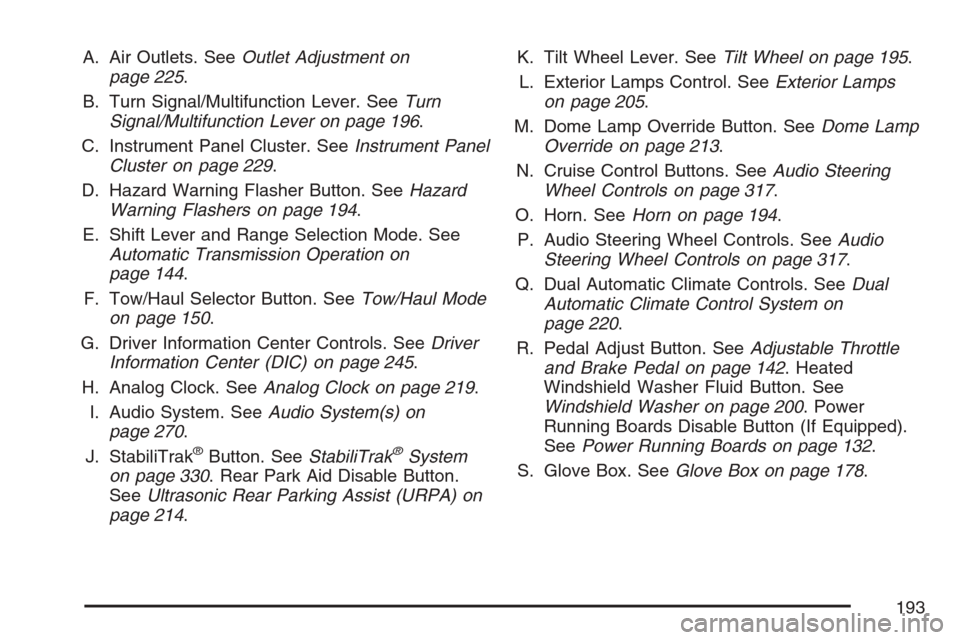
A. Air Outlets. SeeOutlet Adjustment on
page 225.
B. Turn Signal/Multifunction Lever. SeeTurn
Signal/Multifunction Lever on page 196.
C. Instrument Panel Cluster. SeeInstrument Panel
Cluster on page 229.
D. Hazard Warning Flasher Button. SeeHazard
Warning Flashers on page 194.
E. Shift Lever and Range Selection Mode. See
Automatic Transmission Operation on
page 144.
F. Tow/Haul Selector Button. SeeTow/Haul Mode
on page 150.
G. Driver Information Center Controls. SeeDriver
Information Center (DIC) on page 245.
H. Analog Clock. SeeAnalog Clock on page 219.
I. Audio System. SeeAudio System(s) on
page 270.
J. StabiliTrak
®Button. SeeStabiliTrak®System
on page 330. Rear Park Aid Disable Button.
SeeUltrasonic Rear Parking Assist (URPA) on
page 214.K. Tilt Wheel Lever. SeeTilt Wheel on page 195.
L. Exterior Lamps Control. SeeExterior Lamps
on page 205.
M. Dome Lamp Override Button. SeeDome Lamp
Override on page 213.
N. Cruise Control Buttons. SeeAudio Steering
Wheel Controls on page 317.
O. Horn. SeeHorn on page 194.
P. Audio Steering Wheel Controls. SeeAudio
Steering Wheel Controls on page 317.
Q. Dual Automatic Climate Controls. SeeDual
Automatic Climate Control System on
page 220.
R. Pedal Adjust Button. SeeAdjustable Throttle
and Brake Pedal on page 142. Heated
Windshield Washer Fluid Button. See
Windshield Washer on page 200. Power
Running Boards Disable Button (If Equipped).
SeePower Running Boards on page 132.
S. Glove Box. SeeGlove Box on page 178.
193
Page 239 of 574
Malfunction Indicator Lamp
Check Engine Light
Your vehicle has a
computer which
monitors operation of
the fuel, ignition,
and emission control
systems.
This system is called OBD II (On-Board
Diagnostics-Second Generation) and is intended
to assure that emissions are at acceptable
levels for the life of the vehicle, helping to produce
a cleaner environment. The check engine light
comes on to indicate that there is a problem and
service is required. Malfunctions often will be
indicated by the system before any problem is
apparent. This may prevent more serious damage
to your vehicle. This system is also designed to
assist your service technician in correctly
diagnosing any malfunction.Notice:If you keep driving your vehicle with
this light on, after awhile, your emission
controls may not work as well, your fuel
economy may not be as good, and your engine
may not run as smoothly. This could lead to
costly repairs that may not be covered by your
warranty.
Notice:Modications made to the engine,
transmission, exhaust, intake, or fuel system
of your vehicle or the replacement of the
original tires with other than those of the same
Tire Performance Criteria (TPC) can affect
your vehicle’s emission controls and may
cause this light to come on. Modications to
these systems could lead to costly repairs not
covered by your warranty. This may also
result in a failure to pass a required Emission
Inspection/Maintenance test. SeeAccessories
and Modifications on page 396.
239
Page 245 of 574
Driver Information Center (DIC)
Your vehicle has a Driver Information Center (DIC).
The DIC displays information about your vehicle.
It also displays warning messages if a system
problem is detected. The DIC also allows some
features to be customized. SeeDIC Vehicle
Customization on page 259for more information.
All messages will appear in the DIC display
located in the center of the instrument panel
cluster.
The DIC comes on when the ignition is on. After a
short delay, the DIC will display the information
that was last displayed before the engine was
turned off.
SeeDIC Operation and Displays on page 245and
DIC Vehicle Customization on page 259for the
displays available.
DIC Operation and Displays
The DIC has different displays which can be
accessed by pressing the DIC buttons located on
the instrument panel, next to the steering wheel.The DIC displays trip, fuel, and vehicle system
information, and warning messages if a system
problem is detected. A digital speedometer also
appears at the bottom of the DIC display. The
digital speedometer can be enabled or disabled.
See “DISPLAY DIGITAL SPEED” underDIC
Vehicle Customization on page 259for more
information.
DIC Buttons
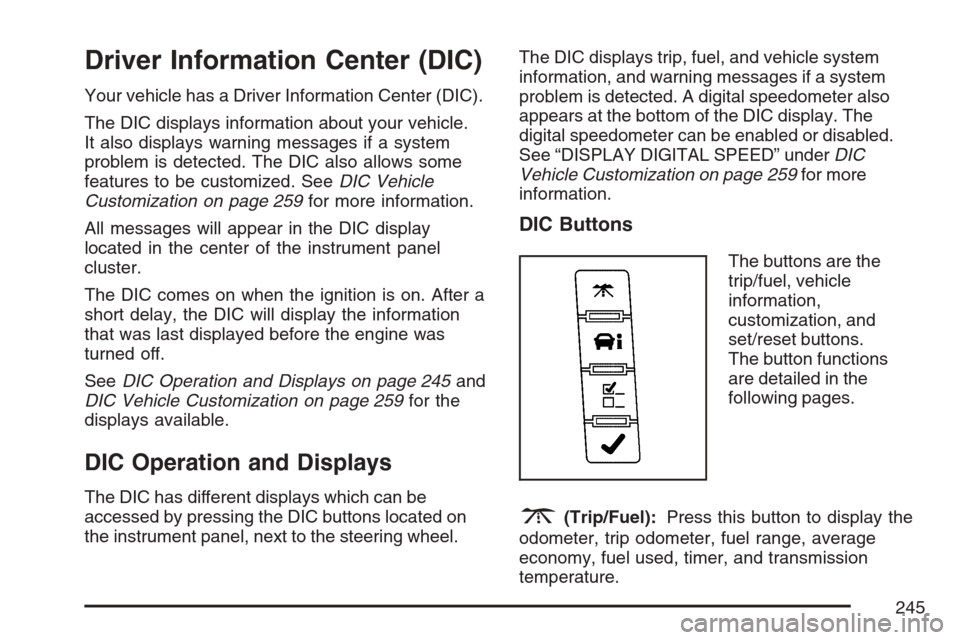
The buttons are the
trip/fuel, vehicle
information,
customization, and
set/reset buttons.
The button functions
are detailed in the
following pages.
3(Trip/Fuel):Press this button to display the
odometer, trip odometer, fuel range, average
economy, fuel used, timer, and transmission
temperature.
245