belt CADILLAC ESCALADE 2008 3.G Manual Online
[x] Cancel search | Manufacturer: CADILLAC, Model Year: 2008, Model line: ESCALADE, Model: CADILLAC ESCALADE 2008 3.GPages: 490, PDF Size: 2.65 MB
Page 423 of 490
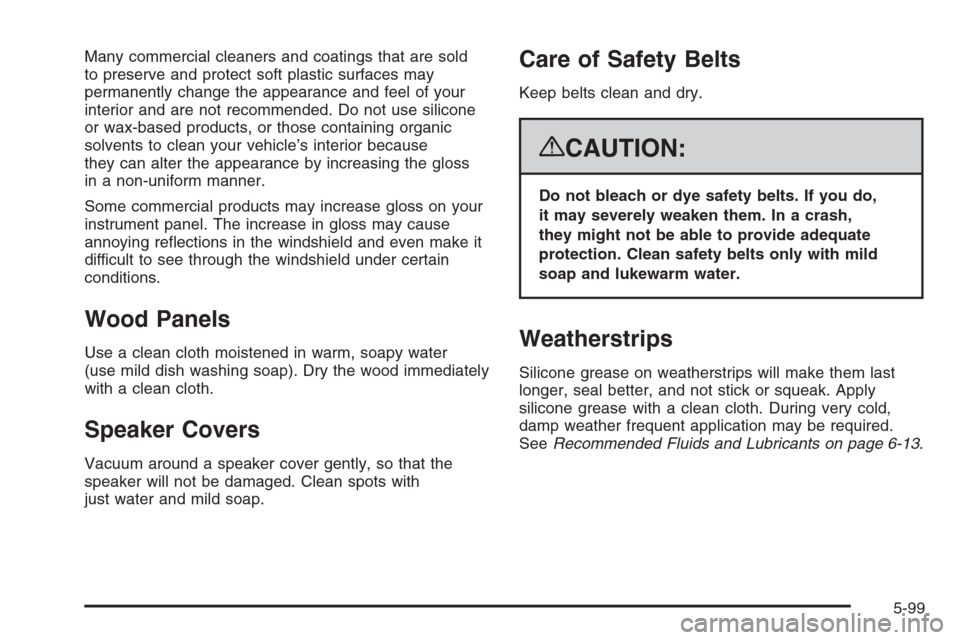
Many commercial cleaners and coatings that are sold
to preserve and protect soft plastic surfaces may
permanently change the appearance and feel of your
interior and are not recommended. Do not use silicone
or wax-based products, or those containing organic
solvents to clean your vehicle’s interior because
they can alter the appearance by increasing the gloss
in a non-uniform manner.
Some commercial products may increase gloss on your
instrument panel. The increase in gloss may cause
annoying reections in the windshield and even make it
difficult to see through the windshield under certain
conditions.
Wood Panels
Use a clean cloth moistened in warm, soapy water
(use mild dish washing soap). Dry the wood immediately
with a clean cloth.
Speaker Covers
Vacuum around a speaker cover gently, so that the
speaker will not be damaged. Clean spots with
just water and mild soap.
Care of Safety Belts
Keep belts clean and dry.
{CAUTION:
Do not bleach or dye safety belts. If you do,
it may severely weaken them. In a crash,
they might not be able to provide adequate
protection. Clean safety belts only with mild
soap and lukewarm water.
Weatherstrips
Silicone grease on weatherstrips will make them last
longer, seal better, and not stick or squeak. Apply
silicone grease with a clean cloth. During very cold,
damp weather frequent application may be required.
SeeRecommended Fluids and Lubricants on page 6-13.
5-99
Page 439 of 490
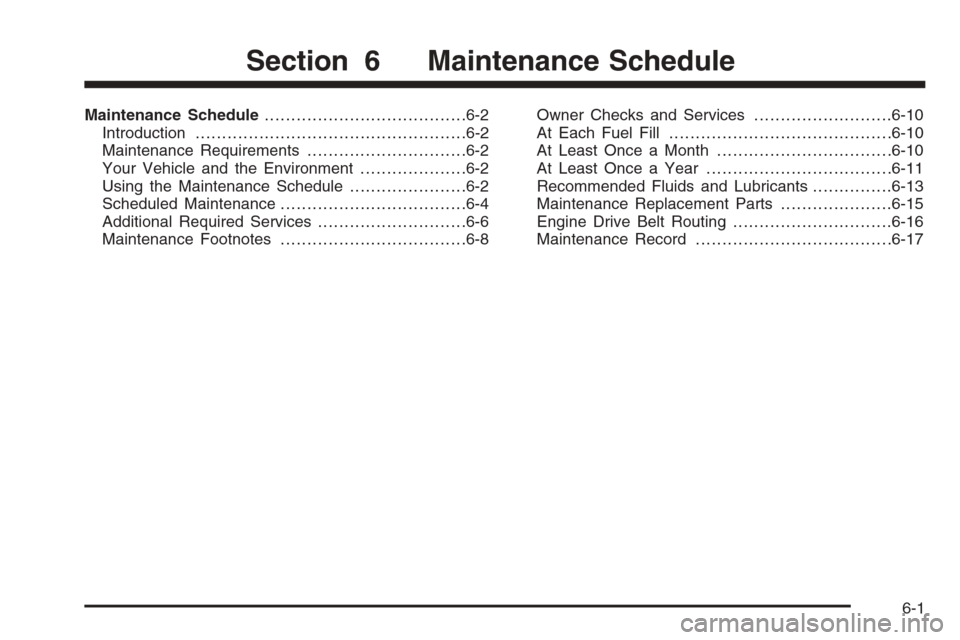
Maintenance Schedule......................................6-2
Introduction...................................................6-2
Maintenance Requirements..............................6-2
Your Vehicle and the Environment....................6-2
Using the Maintenance Schedule......................6-2
Scheduled Maintenance...................................6-4
Additional Required Services............................6-6
Maintenance Footnotes...................................6-8Owner Checks and Services..........................6-10
At Each Fuel Fill..........................................6-10
At Least Once a Month.................................6-10
At Least Once a Year...................................6-11
Recommended Fluids and Lubricants...............6-13
Maintenance Replacement Parts.....................6-15
Engine Drive Belt Routing..............................6-16
Maintenance Record.....................................6-17
Section 6 Maintenance Schedule
6-1
Page 445 of 490
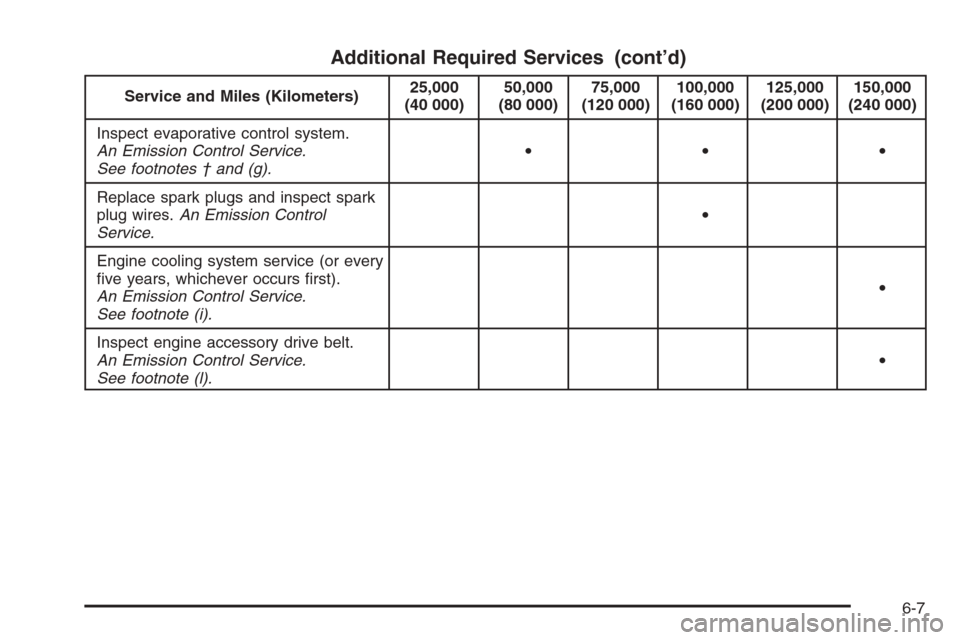
Additional Required Services (cont’d)
Service and Miles (Kilometers)25,000
(40 000)50,000
(80 000)75,000
(120 000)100,000
(160 000)125,000
(200 000)150,000
(240 000)
Inspect evaporative control system.
An Emission Control Service.
See footnotes † and (g).•••
Replace spark plugs and inspect spark
plug wires.An Emission Control
Service.•
Engine cooling system service (or every
ve years, whichever occurs rst).
An Emission Control Service.
See footnote (i).•
Inspect engine accessory drive belt.
An Emission Control Service.
See footnote (l).•
6-7
Page 446 of 490
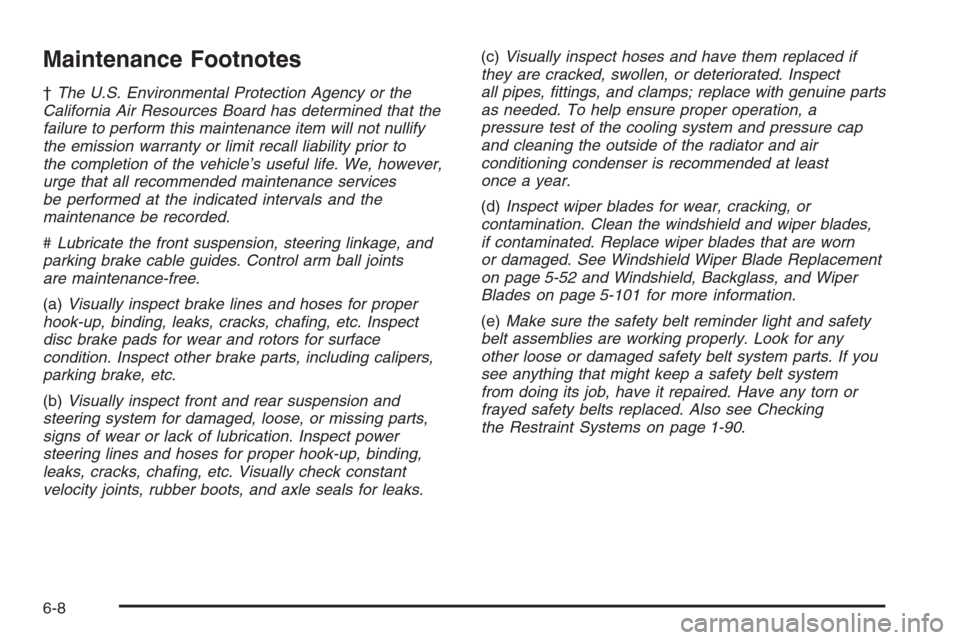
Maintenance Footnotes
†The U.S. Environmental Protection Agency or the
California Air Resources Board has determined that the
failure to perform this maintenance item will not nullify
the emission warranty or limit recall liability prior to
the completion of the vehicle’s useful life. We, however,
urge that all recommended maintenance services
be performed at the indicated intervals and the
maintenance be recorded.
#Lubricate the front suspension, steering linkage, and
parking brake cable guides. Control arm ball joints
are maintenance-free.
(a)Visually inspect brake lines and hoses for proper
hook-up, binding, leaks, cracks, chafing, etc. Inspect
disc brake pads for wear and rotors for surface
condition. Inspect other brake parts, including calipers,
parking brake, etc.
(b)Visually inspect front and rear suspension and
steering system for damaged, loose, or missing parts,
signs of wear or lack of lubrication. Inspect power
steering lines and hoses for proper hook-up, binding,
leaks, cracks, chafing, etc. Visually check constant
velocity joints, rubber boots, and axle seals for leaks.(c)Visually inspect hoses and have them replaced if
they are cracked, swollen, or deteriorated. Inspect
all pipes, fittings, and clamps; replace with genuine parts
as needed. To help ensure proper operation, a
pressure test of the cooling system and pressure cap
and cleaning the outside of the radiator and air
conditioning condenser is recommended at least
once a year.
(d)Inspect wiper blades for wear, cracking, or
contamination. Clean the windshield and wiper blades,
if contaminated. Replace wiper blades that are worn
or damaged. See Windshield Wiper Blade Replacement
on page 5-52 and Windshield, Backglass, and Wiper
Blades on page 5-101 for more information.
(e)Make sure the safety belt reminder light and safety
belt assemblies are working properly. Look for any
other loose or damaged safety belt system parts. If you
see anything that might keep a safety belt system
from doing its job, have it repaired. Have any torn or
frayed safety belts replaced. Also see Checking
the Restraint Systems on page 1-90.
6-8
Page 447 of 490
(f)Lubricate all key lock cylinders, hood latch assembly,
secondary latch, pivots, spring anchor, release pawl,
rear compartment hinges, outer tailgate handle
pivot points, latch bolt, fuel door hinge, and folding seat
hardware. More frequent lubrication may be required
when exposed to a corrosive environment. Applying
silicone grease on weatherstrips with a clean cloth will
make them last longer, seal better, and not stick or
squeak.
(g)Inspect system. Check all fuel and vapor lines and
hoses for proper hook-up, routing, and condition.
Check that the purge valve works properly, if equipped.
Replace as needed.
(h)Change automatic transmission fluid and filter if the
vehicle is mainly driven under one or more of these
conditions:
In heavy city traffic where the outside temperature
regularly reaches 90°F (32°C) or higher.
In hilly or mountainous terrain.
When doing frequent trailer towing.
Uses such as found in taxi, police, or delivery
service.(i)Drain, flush, and refill cooling system. This service
can be complex; you should have your dealer/retailer
perform this service. See Engine Coolant on page 5-23
for what to use. Inspect hoses. Clean radiator,
condenser, pressure cap, and filler neck. Pressure test
the cooling system and pressure cap.
(j)A fluid loss in any vehicle system could indicate a
problem. Have the system inspected and repaired and
the fluid level checked. Add fluid if needed.
(k)If you drive regularly under dusty conditions, inspect
the filter at each engine oil change.
(l)Visually inspect belt for fraying, excessive cracks, or
obvious damage. Replace belt if necessary.
(m)Check vent hose at transfer case for kinks and
proper installation.
6-9
Page 454 of 490
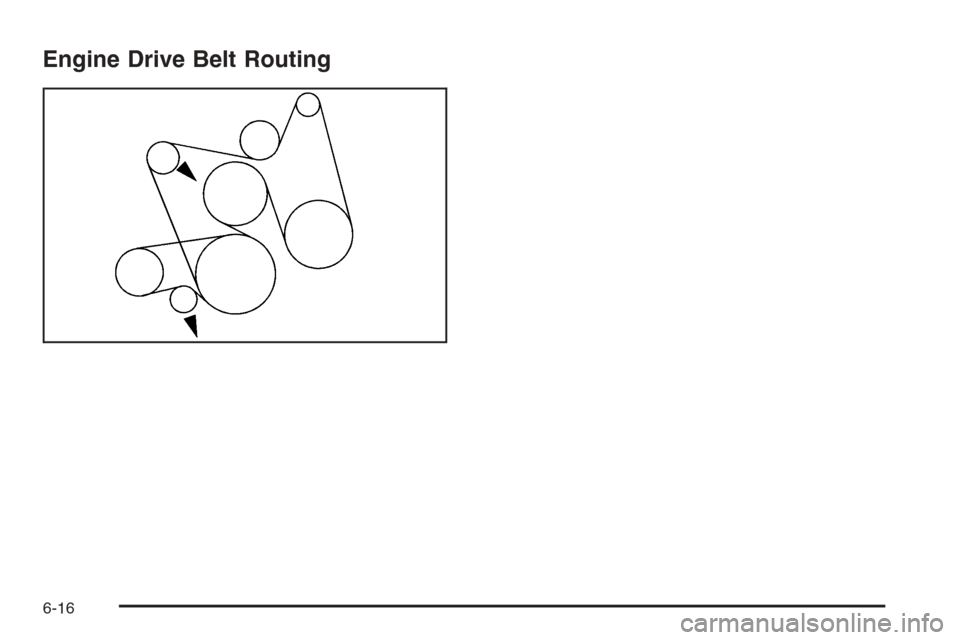
Engine Drive Belt Routing
6-16
Page 475 of 490
Event Data Recorders
This vehicle has an Event Data Recorder (EDR).
The main purpose of an EDR is to record, in certain
crash or near crash-like situations, such as an airbag
deployment or hitting a road obstacle, data that will
assist in understanding how a vehicle’s systems
performed. The EDR is designed to record data related
to vehicle dynamics and safety systems for a short
period of time, typically 30 seconds or less. The EDR in
this vehicle is designed to record such data as:
How various systems in your vehicle were operating
Whether or not the driver and passenger safety
belts were buckled/fastened
How far, if at all, the driver was pressing the
accelerator and/or brake pedal
How fast the vehicle was traveling
This data can help provide a better understanding of the
circumstances in which crashes and injuries occur.Important:EDR data is recorded by your vehicle
only if a non-trivial crash situation occurs; no data is
recorded by the EDR under normal driving conditions
and no personal data (e.g., name, gender, age, and
crash location) is recorded. However, other parties,
such as law enforcement, could combine the EDR data
with the type of personally identifying data routinely
acquired during a crash investigation.
To read data recorded by an EDR, special equipment
is required, and access to the vehicle or the EDR
is needed. In addition to the vehicle manufacturer,
other parties, such as law enforcement, that have the
special equipment, can read the information if they have
access to the vehicle or the EDR.
GM will not access this data or share it with others
except: with the consent of the vehicle owner or, if the
vehicle is leased, with the consent of the lessee; in
response to an official request of police or similar
government office; as part of GM’s defense of litigation
through the discovery process; or, as required by
law. Data that GM collects or receives may also be used
for GM research needs or may be made available to
others for research purposes, where a need is shown
and the data is not tied to a specic vehicle or
vehicle owner.
7-17
Page 477 of 490
A
Accessories and Modications............................ 5-3
Accessory Power Outlets.................................3-24
Adding Equipment to Your Airbag-Equipped
Vehicle.......................................................1-88
Additives, Fuel................................................. 5-6
Add-On Electrical Equipment...........................5-106
Adjustable Throttle and Brake Pedal..................2-28
Air Cleaner/Filter, Engine.................................5-17
Air Conditioning..............................................3-26
Airbag
Passenger Status Indicator...........................3-37
Readiness Light..........................................3-36
Airbag System................................................1-74
Adding Equipment to Your Airbag-Equipped
Vehicle...................................................1-88
How Does an Airbag Restrain?......................1-81
Passenger Sensing System...........................1-83
Servicing Your Airbag-Equipped Vehicle..........1-88
What Makes an Airbag Inate?......................1-81
What Will You See After an Airbag Inates?........1-82
When Should an Airbag Inate?....................1-79
Where Are the Airbags?...............................1-77
All-Wheel Drive...............................................5-44
All-Wheel-Drive (AWD) System........................... 4-8
Analog Clock..................................................3-25
Antenna, Rear Side Window...........................3-106
Antenna, XM™ Satellite Radio Antenna
System.....................................................3-106Antilock Brake System (ABS)............................. 4-4
Anti-lock Brake, System Warning Light...............3-41
Appearance Care
Aluminum or Chrome-Plated Wheels.............5-102
Care of Safety Belts....................................5-99
Chemical Paint Spotting..............................5-103
Cleaning Exterior Lamps/Lenses..................5-100
Fabric/Carpet..............................................5-97
Finish Care...............................................5-100
Finish Damage..........................................5-103
Instrument Panel, Vinyl, and Other
Plastic Surfaces.......................................5-98
Interior Cleaning..........................................5-96
Leather......................................................5-98
Sheet Metal Damage..................................5-103
Speaker Covers..........................................5-99
Tires........................................................5-103
Underbody Maintenance.............................5-103
Vehicle Care/Appearance Materials...............5-104
Washing Your Vehicle.................................5-100
Weatherstrips..............................................5-99
Windshield, Backglass, and Wiper Blades......5-101
Wood Panels..............................................5-99
Appointments, Scheduling Service....................... 7-9
Ashtray.........................................................3-25
Assist Handles...............................................2-62
Audio System.................................................3-68
Audio Steering Wheel Controls....................3-104
Navigation/Radio System,
see Navigation Manual..............................3-92
1
Page 478 of 490
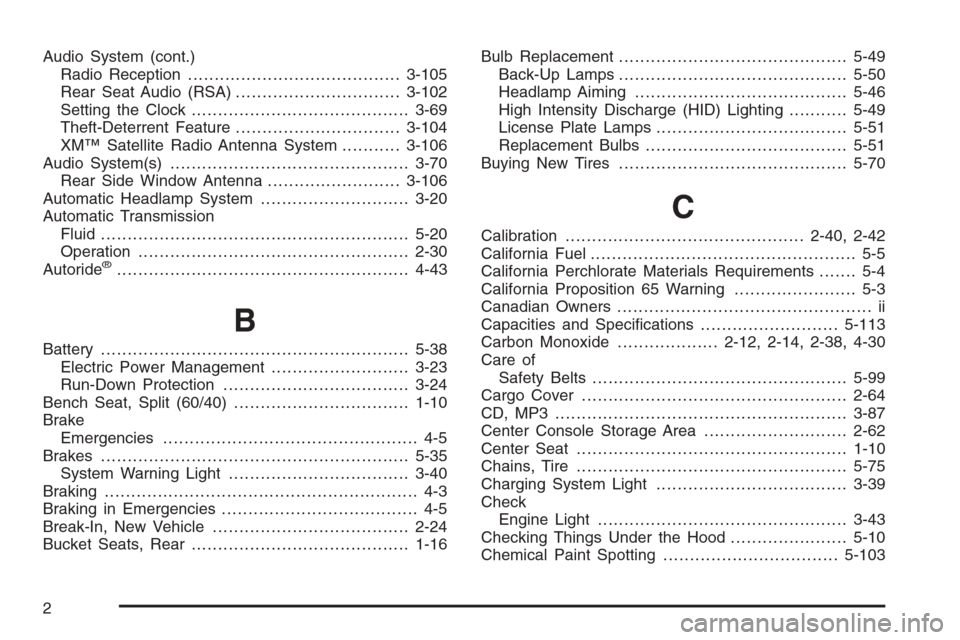
Audio System (cont.)
Radio Reception........................................3-105
Rear Seat Audio (RSA)...............................3-102
Setting the Clock.........................................3-69
Theft-Deterrent Feature...............................3-104
XM™ Satellite Radio Antenna System...........3-106
Audio System(s).............................................3-70
Rear Side Window Antenna.........................3-106
Automatic Headlamp System............................3-20
Automatic Transmission
Fluid..........................................................5-20
Operation...................................................2-30
Autoride
®.......................................................4-43
B
Battery..........................................................5-38
Electric Power Management..........................3-23
Run-Down Protection...................................3-24
Bench Seat, Split (60/40).................................1-10
Brake
Emergencies................................................ 4-5
Brakes..........................................................5-35
System Warning Light..................................3-40
Braking........................................................... 4-3
Braking in Emergencies..................................... 4-5
Break-In, New Vehicle.....................................2-24
Bucket Seats, Rear.........................................1-16Bulb Replacement...........................................5-49
Back-Up Lamps...........................................5-50
Headlamp Aiming........................................5-46
High Intensity Discharge (HID) Lighting...........5-49
License Plate Lamps....................................5-51
Replacement Bulbs......................................5-51
Buying New Tires...........................................5-70
C
Calibration.............................................2-40, 2-42
California Fuel.................................................. 5-5
California Perchlorate Materials Requirements....... 5-4
California Proposition 65 Warning....................... 5-3
Canadian Owners................................................ ii
Capacities and Specications..........................5-113
Carbon Monoxide...................2-12, 2-14, 2-38, 4-30
Care of
Safety Belts................................................5-99
Cargo Cover..................................................2-64
CD, MP3 .......................................................3-87
Center Console Storage Area...........................2-62
Center Seat...................................................1-10
Chains, Tire...................................................5-75
Charging System Light....................................3-39
Check
Engine Light...............................................3-43
Checking Things Under the Hood......................5-10
Chemical Paint Spotting.................................5-103
2
Page 481 of 490
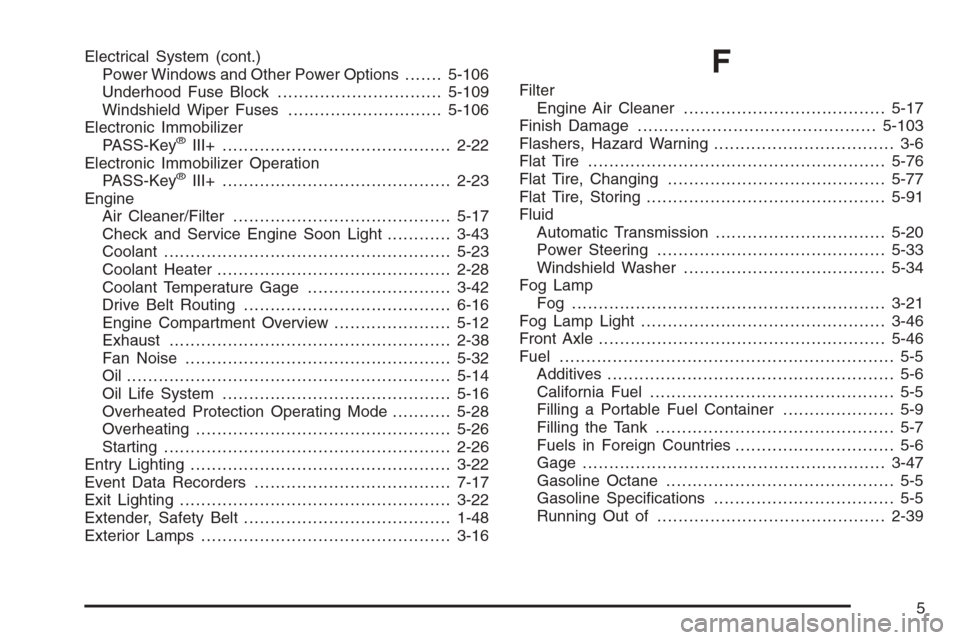
Electrical System (cont.)
Power Windows and Other Power Options.......5-106
Underhood Fuse Block...............................5-109
Windshield Wiper Fuses.............................5-106
Electronic Immobilizer
PASS-Key
®III+...........................................2-22
Electronic Immobilizer Operation
PASS-Key
®III+...........................................2-23
Engine
Air Cleaner/Filter.........................................5-17
Check and Service Engine Soon Light............3-43
Coolant......................................................5-23
Coolant Heater............................................2-28
Coolant Temperature Gage...........................3-42
Drive Belt Routing.......................................6-16
Engine Compartment Overview......................5-12
Exhaust.....................................................2-38
Fan Noise..................................................5-32
Oil .............................................................5-14
Oil Life System...........................................5-16
Overheated Protection Operating Mode...........5-28
Overheating................................................5-26
Starting......................................................2-26
Entry Lighting.................................................3-22
Event Data Recorders.....................................7-17
Exit Lighting...................................................3-22
Extender, Safety Belt.......................................1-48
Exterior Lamps...............................................3-16
F
Filter
Engine Air Cleaner......................................5-17
Finish Damage.............................................5-103
Flashers, Hazard Warning.................................. 3-6
Flat Tire........................................................5-76
Flat Tire, Changing.........................................5-77
Flat Tire, Storing.............................................5-91
Fluid
Automatic Transmission................................5-20
Power Steering...........................................5-33
Windshield Washer......................................5-34
Fog Lamp
Fog ...........................................................3-21
Fog Lamp Light..............................................3-46
Front Axle......................................................5-46
Fuel............................................................... 5-5
Additives...................................................... 5-6
California Fuel.............................................. 5-5
Filling a Portable Fuel Container..................... 5-9
Filling the Tank............................................. 5-7
Fuels in Foreign Countries.............................. 5-6
Gage .........................................................3-47
Gasoline Octane........................................... 5-5
Gasoline Specications.................................. 5-5
Running Out of...........................................2-39
5