belt CADILLAC ESCALADE 2010 3.G User Guide
[x] Cancel search | Manufacturer: CADILLAC, Model Year: 2010, Model line: ESCALADE, Model: CADILLAC ESCALADE 2010 3.GPages: 616, PDF Size: 39.41 MB
Page 49 of 616
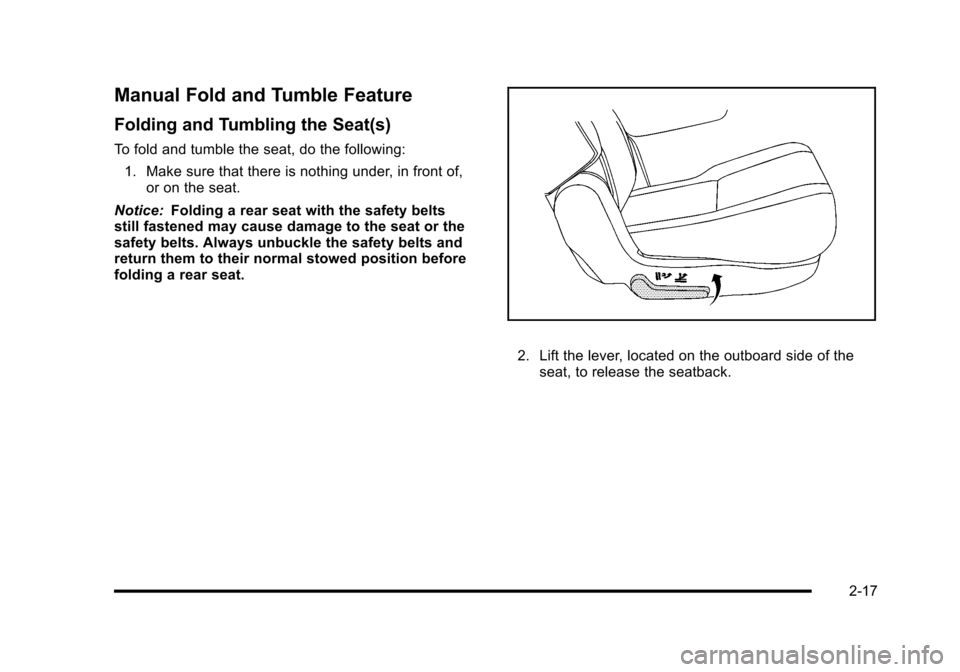
Manual Fold and Tumble Feature
Folding and Tumbling the Seat(s)
To fold and tumble the seat, do the following:
1. Make sure that there is nothing under, in front of,or on the seat.
Notice:Folding a rear seat with the safety beltsstill fastened may cause damage to the seat or thesafety belts. Always unbuckle the safety belts andreturn them to their normal stowed position beforefolding a rear seat.
2. Lift the lever, located on the outboard side of theseat, to release the seatback.
2-17
Page 51 of 616
Folding and Tumbling the Seat(s) from the
Third Row Seats
{WARNING:
Using the third row seating position while the
second row is folded, or folded and tumbled, could
cause injury in a sudden stop or crash. Be sure to
return the seat to the passenger seating position.
Push and pull on the seat to make sure it is
locked into place.
Notice:Folding a rear seat with the safety beltsstill fastened may cause damage to the seat or thesafety belts. Always unbuckle the safety belts andreturn them to their normal stowed position beforefolding a rear seat.
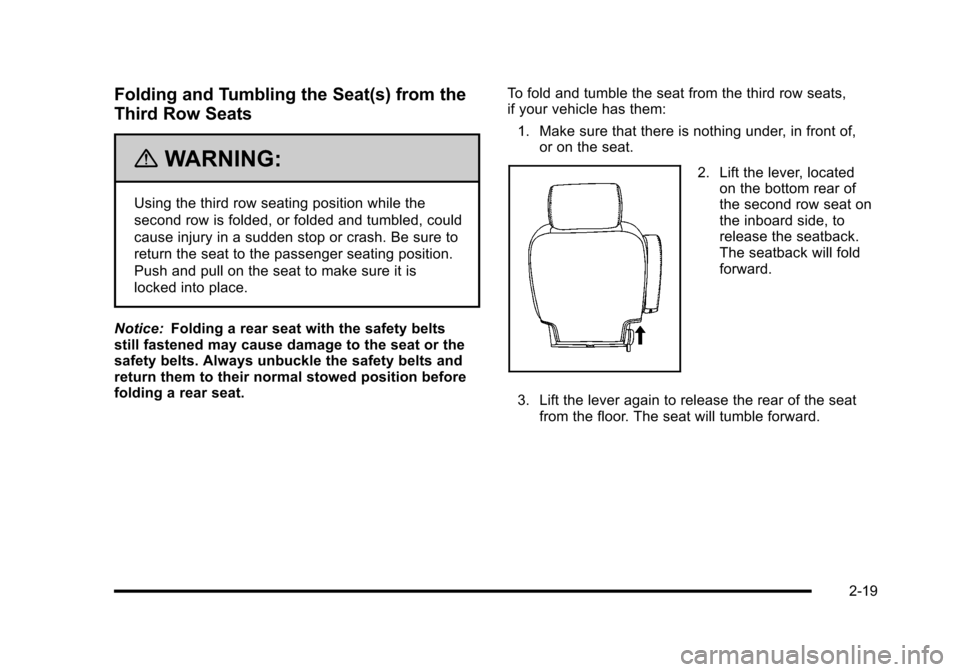
To fold and tumble the seat from the third row seats,if your vehicle has them:
1. Make sure that there is nothing under, in front of,or on the seat.
2. Lift the lever, locatedon the bottom rear ofthe second row seat onthe inboard side, torelease the seatback.The seatback will foldforward.
3. Lift the lever again to release the rear of the seatfrom the floor. The seat will tumble forward.
2-19
Page 52 of 616
Automatic Seat Release Fold and
Tumble Feature
The transmission must be in (P) for this featureto work.
{WARNING:
Automatically folding and tumbling the seat when
someone is sitting in the seat, could cause injury
to the person sitting there. Always make sure
there is no one sitting in the seat before pressing
the automatic seat release button.
Folding and Tumbling the Second Row
Seat(s) from the Third Row Seats or
Outside
{WARNING:
Using the third row seating position while the
second row is folded, or folded and tumbled, could
cause injury in a sudden stop or crash. Be sure to
return the seat to the passenger seating position.
Push and pull on the seat to make sure it is
locked into place.
To fold and tumble the seat from the third row seats,if your vehicle has them, do the following:
1. Make sure that there is nothing under, in front of,or on the seat.
Notice:Folding a rear seat with the safety beltsstill fastened may cause damage to the seat or thesafety belts. Always unbuckle the safety belts andreturn them to their normal stowed position beforefolding a rear seat.
2-20
Page 54 of 616
Folding the Seatback(s)
Notice:Folding a rear seat with the safety beltsstill fastened may cause damage to the seat or thesafety belts. Always unbuckle the safety belts andreturn them to their normal stowed position beforefolding a rear seat.
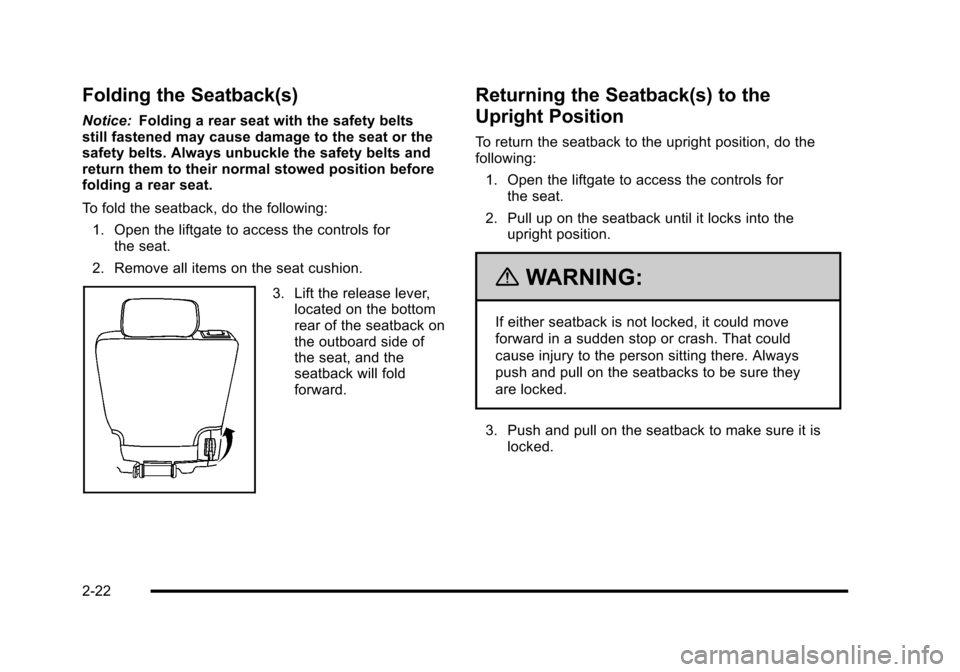
To fold the seatback, do the following:
1. Open the liftgate to access the controls forthe seat.
2. Remove all items on the seat cushion.
3. Lift the release lever,located on the bottomrear of the seatback onthe outboard side ofthe seat, and theseatback will foldforward.
Returning the Seatback(s) to the
Upright Position
To return the seatback to the upright position, do thefollowing:
1. Open the liftgate to access the controls forthe seat.
2. Pull up on the seatback until it locks into theupright position.
{WARNING:
If either seatback is not locked, it could move
forward in a sudden stop or crash. That could
cause injury to the person sitting there. Always
push and pull on the seatbacks to be sure they
are locked.
3. Push and pull on the seatback to make sure it islocked.
2-22
Page 57 of 616
Installing the Third Row Seat
To install the seat, do the following:
1. Open the liftgate to access the rear of the vehicle.
2. Slide the front outboard seat wheels into the trackon the floor and roll the seat forward. The frontlatches should lock into place. If the latches do notlock, try tilting the rear of the seat upward slightly.
3. Lower the rear of the seat and push down on theseat to engage the rear floor latches.
{WARNING:
A seat that is not locked into place properly can
move around in a collision or sudden stop. People
in the vehicle could be injured. Be sure to lock the
seat into place properly when installing it.
4. Push and pull on the seat to make sure it islocked into place. The seatback cannot be raisedto the upright position unless the seat is securedto the floor.
5. Pull up on the seatback until it locks into theupright position.
{WARNING:
If either seatback is not locked, it could move
forward in a sudden stop or crash. That could
cause injury to the person sitting there. Always
push and pull on the seatbacks to be sure they
are locked.
6. Push and pull on the seatback to make sure itis locked.
{WARNING:
A safety belt that is improperly routed, not
properly attached, or twisted will not provide the
protection needed in a crash. The person wearing
the belt could be seriously injured. After raising
the rear seatback, always check to be sure that
the safety belts are properly routed and attached,
and are not twisted.
7. Make sure the safety belts are returned to theoriginal position over the seatbacks.
2-25
Page 58 of 616
Safety Belts
Safety Belts: They Are for Everyone
This section of the manual describes how to use safetybelts properly. It also describes some things not to dowith safety belts.
{WARNING:
Do not let anyone ride where a safety belt cannot
be worn properly. In a crash, if you or your
passenger(s) are not wearing safety belts, the
injuries can be much worse. You can hit things
inside the vehicle harder or be ejected from the
vehicle. You and your passenger(s) can be
seriously injured or killed. In the same crash, you
might not be, if you are buckled up. Always fasten
your safety belt, and check that your passenger(s)
are restrained properly too.
{WARNING:
It is extremely dangerous to ride in a cargo area,
inside or outside of a vehicle. In a collision,
people riding in these areas are more likely to be
seriously injured or killed. Do not allow people to
ride in any area of your vehicle that is not
equipped with seats and safety belts. Be sure
everyone in your vehicle is in a seat and using a
safety belt properly.
This vehicle has indicators as a reminder to buckle thesafety belts. SeeSafety Belt Reminderson page 4!29for additional information.
In most states and in all Canadian provinces, the lawrequires wearing safety belts. Here is why:
You never know if you will be in a crash. If you do havea crash, you do not know if it will be a serious one.
A few crashes are mild, and some crashes can be soserious that even buckled up, a person would notsurvive. But most crashes are in between. In many ofthem, people who buckle up can survive and sometimeswalk away. Without safety belts, they could have beenbadly hurt or killed.
2-26
Page 59 of 616
After more than 40 years of safety belts in vehicles,the facts are clear. In most crashes buckling up doesmatter ... a lot!
Why Safety Belts Work
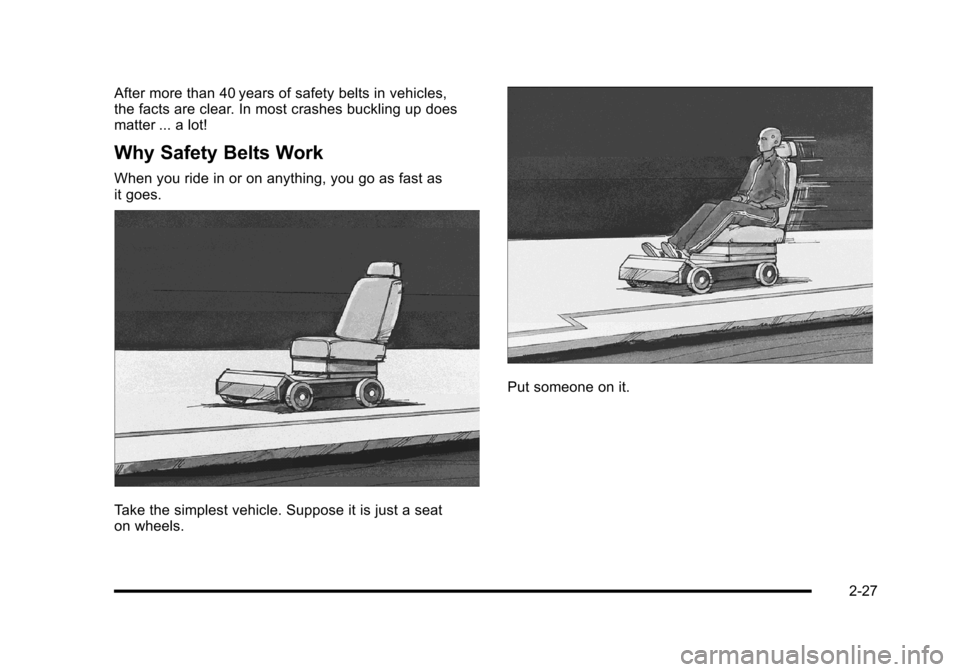
When you ride in or on anything, you go as fast asit goes.
Take the simplest vehicle. Suppose it is just a seaton wheels.
Put someone on it.
2-27
Page 61 of 616
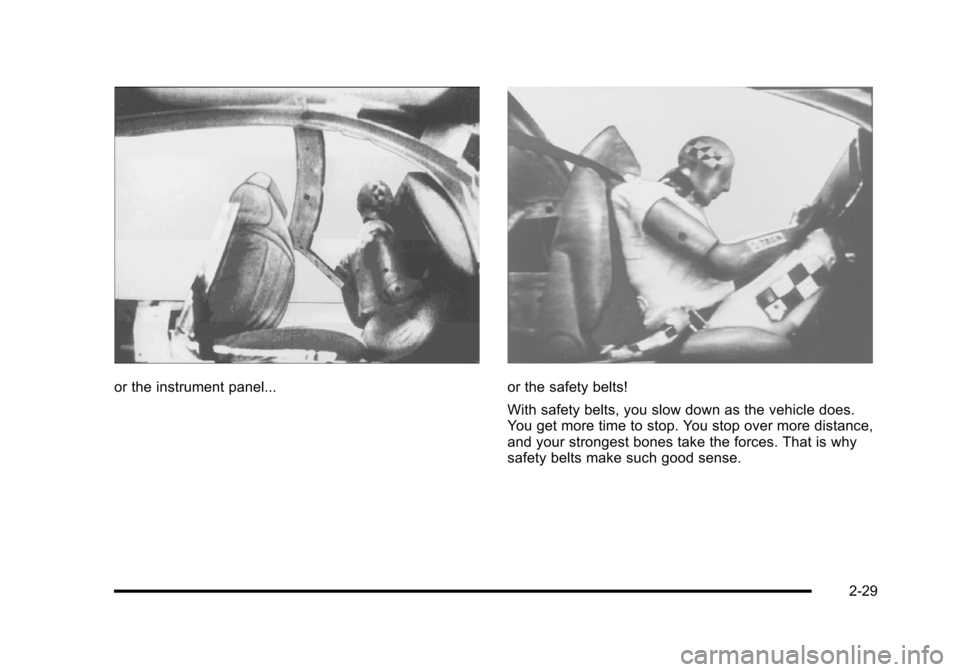
or the instrument panel...or the safety belts!
With safety belts, you slow down as the vehicle does.You get more time to stop. You stop over more distance,and your strongest bones take the forces. That is whysafety belts make such good sense.
2-29
Page 62 of 616
Questions and Answers About
Safety Belts
Q: Will I be trapped in the vehicle after a crash ifI am wearing a safety belt?
A:Youcouldbe—whether you are wearing a safetybelt or not. But your chance of being consciousduring and after an accident, so youcanunbuckleand get out, ismuchgreater if you are belted.And you can unbuckle a safety belt, even if youare upside down.
Q: If my vehicle has airbags, why should I have towear safety belts?
A:Airbags are supplemental systems only; so theyworkwithsafety belts—not instead of them.Whether or not an airbag is provided, all occupantsstill have to buckle up to get the most protection.That is true not only in frontal collisions, butespecially in side and other collisions.
Q: If I am a good driver, and I never drive far fromhome, why should I wear safety belts?
A:You may be an excellent driver, but if you are in acrash—even one that is not your fault—you andyour passenger(s) can be hurt. Being a good driverdoes not protect you from things beyond yourcontrol, such as bad drivers.
Most accidents occur within 25 miles (40 km)of home. And the greatest number of seriousinjuries and deaths occur at speeds of lessthan 40 mph (65 km/h).
Safety belts are for everyone.
How to Wear Safety Belts Properly
This section is only for people of adult size.
Be aware that there are special things to know aboutsafety belts and children. And there are different rulesfor smaller children and infants. If a child will be riding inthe vehicle, seeOlder Childrenon page 2!49orInfantsand Young Childrenon page 2!52. Follow those rulesfor everyone's protection.
It is very important for all occupants to buckle up.Statistics show that unbelted people are hurt more oftenin crashes than those who are wearing safety belts.
Occupants who are not buckled up can be thrown out ofthe vehicle in a crash. And they can strike others in thevehicle who are wearing safety belts.
2-30
Page 63 of 616
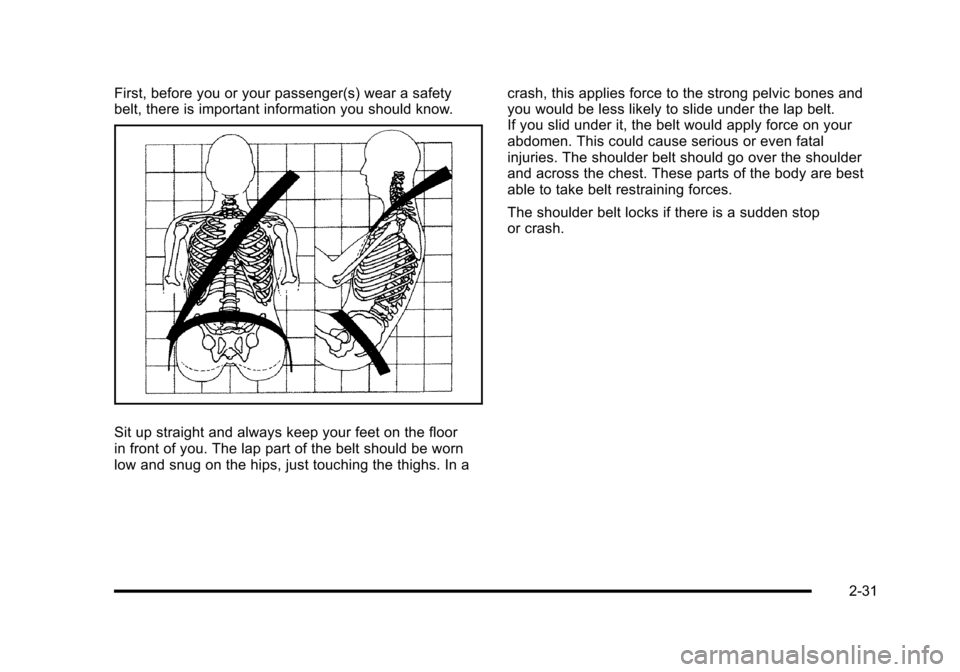
First, before you or your passenger(s) wear a safetybelt, there is important information you should know.
Sit up straight and always keep your feet on the floorin front of you. The lap part of the belt should be wornlow and snug on the hips, just touching the thighs. In a
crash, this applies force to the strong pelvic bones andyou would be less likely to slide under the lap belt.If you slid under it, the belt would apply force on yourabdomen. This could cause serious or even fatalinjuries. The shoulder belt should go over the shoulderand across the chest. These parts of the body are bestable to take belt restraining forces.
The shoulder belt locks if there is a sudden stopor crash.
2-31