transmission CADILLAC ESCALADE 2010 3.G User Guide
[x] Cancel search | Manufacturer: CADILLAC, Model Year: 2010, Model line: ESCALADE, Model: CADILLAC ESCALADE 2010 3.GPages: 616, PDF Size: 39.41 MB
Page 153 of 616
Starting the Engine
If the vehicle is a Two-mode Hybrid, see the Two-modeHybrid manual for more information.
Move the shift lever to P (Park) or N (Neutral). Theengine will not start in any other position. To restart theengine when the vehicle is are already moving, useN (Neutral) only.
Notice:Do not try to shift to P (Park) if thevehicle is moving. If you do, you could damagethe transmission. Shift to P (Park) only when thevehicle is stopped.
Starting Procedure
1. With your foot off the accelerator pedal, turn theignition key to START. When the engine starts,let go of the key. The idle speed will go down asthe engine gets warm. Do not race the engineimmediately after starting it. Operate the engineand transmission gently to allow the oil to warm upand lubricate all moving parts.
The vehicle has a Computer-Controlled CrankingSystem. This feature assists in starting the engineand protects components. If the ignition key isturned to the START position, and then releasedwhen the engine begins cranking, the engine willcontinue cranking for a few seconds or until thevehicle starts. If the engine does not start and thekey is held in START for many seconds, crankingwill be stopped after 15 seconds to preventcranking motor damage. To prevent gear damage,this system also prevents cranking if the engineis already running. Engine cranking can bestopped by turning the ignition switch to theACC/ACCESSORY or LOCK/OFF position.
Notice:Cranking the engine for long periods oftime, by returning the key to the START positionimmediately after cranking has ended, can overheatand damage the cranking motor, and drain thebattery. Wait at least 15 seconds between each try,to let the cranking motor cool down.
3-29
Page 154 of 616
2. If the engine does not start after 5!10 seconds,especially in very cold weather (below 0°F or!18°C), it could be flooded with too much gasoline.Try pushing the accelerator pedal all the way to thefloor and holding it there as you hold the key inSTART for up to a maximum of 15 seconds. Wait atleast 15 seconds between each try, to allow thecranking motor to cool down. When the enginestarts, let go of the key and accelerator. If thevehicle starts briefly but then stops again, do thesame thing. This clears the extra gasoline from theengine. Do not race the engine immediately afterstarting it. Operate the engine and transmissiongently until the oil warms up and lubricates allmoving parts.
Notice:The engine is designed to work with theelectronics in the vehicle. If you add electricalparts or accessories, you could change the waythe engine operates. Before adding electricalequipment, check with your dealer/retailer. If youdo not, the engine might not perform properly.Any resulting damage would not be covered bythe vehicle warranty.
Adjustable Throttle and Brake Pedal
The vehicle has adjustable throttle and brake pedalsthat allow you change their positions.
The feature will not operate when the vehicle is inR (Reverse) or while using the cruise control.
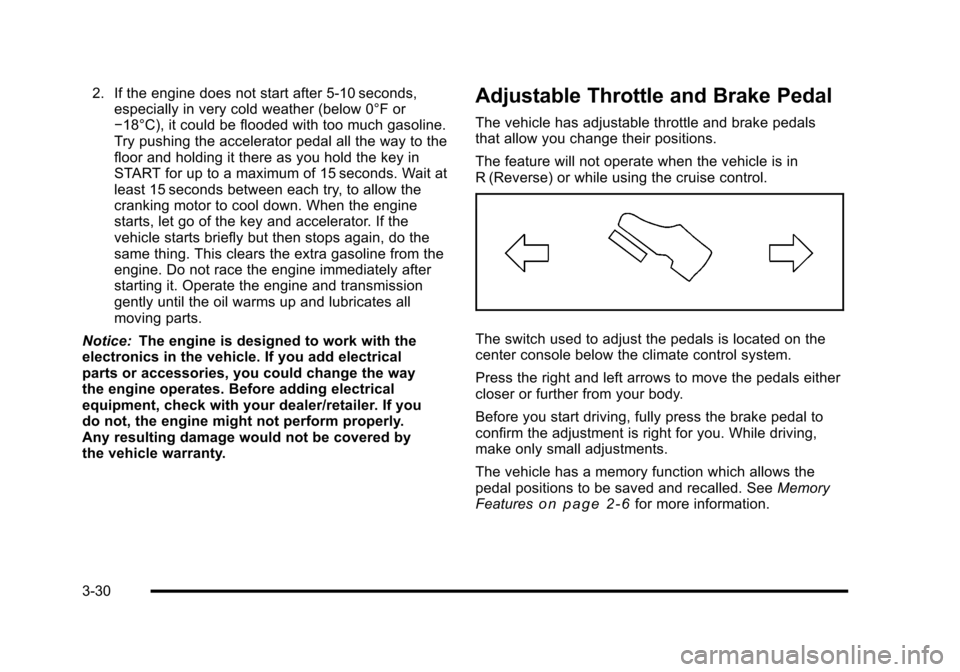
The switch used to adjust the pedals is located on thecenter console below the climate control system.
Press the right and left arrows to move the pedals eithercloser or further from your body.
Before you start driving, fully press the brake pedal toconfirm the adjustment is right for you. While driving,make only small adjustments.
The vehicle has a memory function which allows thepedal positions to be saved and recalled. SeeMemoryFeatureso n p a g e 2!6for more information.
3-30
Page 156 of 616
Active Fuel Management™
Vehicles with V8 engines may have Active FuelManagement™. This system allows the engine tooperate on either all or half of its cylinders, dependingon the driving conditions.
When less power is required, such as cruising at aconstant vehicle speed, the system will operate in thehalf cylinder mode, allowing the vehicle to achievebetter fuel economy. When greater power demands arerequired, such as accelerating from a stop, passing,or merging onto a freeway, the system will maintainfull-cylinder operation.
If the vehicle has an Active Fuel Management™indicator, seeDIC Operation and Displaysonpage 4!41for more information on using this display.
Automatic Transmission Operation
If the vehicle is a Two-mode Hybrid, see the Two-modeHybrid manual for more information.
The vehicle has a Hydra-Matic®6L80 automatictransmission, and has an electronic shift positionindicator within the instrument panel cluster.The electronic shift position indicator displays whenthe shift lever is moved out of P (Park).
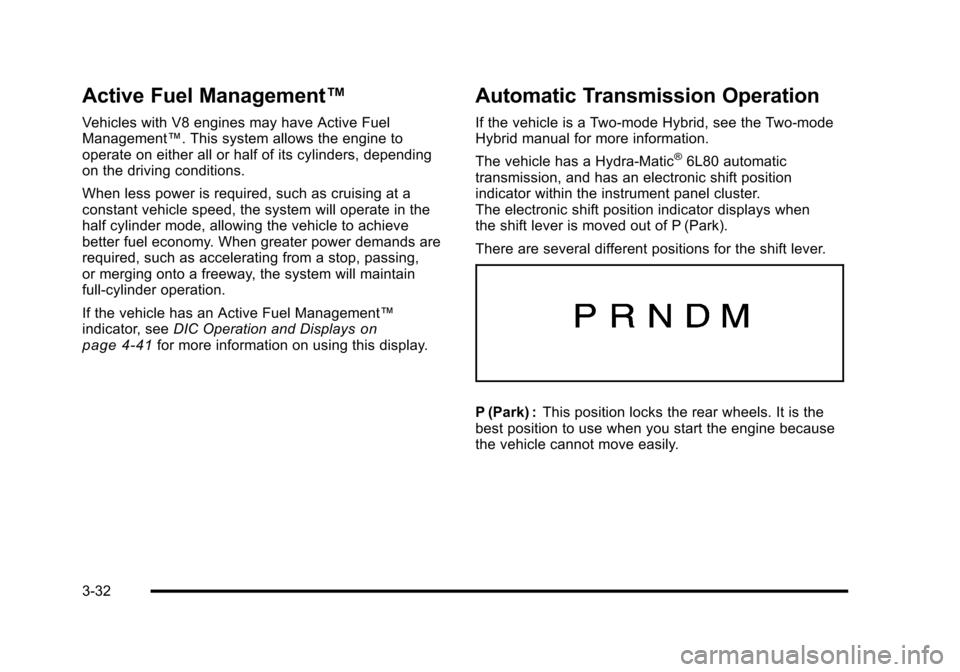
There are several different positions for the shift lever.
P (Park) :This position locks the rear wheels. It is thebest position to use when you start the engine becausethe vehicle cannot move easily.
3-32
Page 157 of 616
When parked on a hill, especially when the vehicle hasa heavy load, you may notice an increase in the effortto shift out of P (Park). See Torque Lock (AutomaticTransmission) underShifting Into Parkon page 3!39for more information.
{WARNING:
It is dangerous to get out of the vehicle if the shift
lever is not fully in P (Park) with the parking brake
firmly set. The vehicle can roll.
Do not leave the vehicle when the engine is
running unless you have to. If you have left the
engine running, the vehicle can move suddenly.
You or others could be injured. To be sure the
vehicle will not move, even when you are on fairly
level ground, always set the parking brake and
move the shift lever to P (Park). SeeShifting Into
Parkon page 3!39. If you are pulling a trailer,
seeTowing a Trailer on page 6!42.
R (Reverse) :Use this gear to back up.
Notice:Shifting to R (Reverse) while the vehicle ismoving forward could damage the transmission.The repairs would not be covered by the vehiclewarranty. Shift to R (Reverse) only after the vehicleis stopped.
To rock the vehicle back and forth to get out of snow,ice, or sand without damaging the transmission, seeIfYour Vehicle is Stuck in Sand, Mud, Ice, or Snowonpage 6!30.
3-33
Page 158 of 616
N (Neutral) :In this position, the engine does notconnect with the wheels. To restart when you arealready moving, use N (Neutral) only. Also, useN (Neutral) when the vehicle is being towed.
{WARNING:
Shifting into a drive gear while the engine is
running at high speed is dangerous. Unless your
foot is firmly on the brake pedal, the vehicle could
move very rapidly. You could lose control and hit
people or objects. Do not shift into a drive gear
while the engine is running at high speed.
Notice:Shifting out of P (Park) or N (Neutral) withthe engine running at high speed may damage thetransmission. The repairs would not be covered bythe vehicle warranty. Be sure the engine is notrunning at high speed when shifting the vehicle.
D (Drive) :This position is for normal driving. It providesthe best fuel economy. If you need more power forpassing, and you are:
.Going less than about 35 mph (55 km/h), push theaccelerator pedal about halfway down.
.Going about 35 mph (55 km/h) or more, push theaccelerator all the way down.
By doing this, the vehicle shifts down to the next gearand has more power.
D (Drive) can be used when towing a trailer, carrying aheavy load, driving on steep hills, or for off-road driving.You may want to shift the transmission to a lower gearselection if the transmission shifts too often.
Downshifting the transmission in slippery roadconditions could result in skidding, see Skidding underLoss of Control on page 6!12.
M (Manual Mode) :This position lets drivers selectthe range of gears appropriate for current drivingconditions. See Driver Shift Control (DSC) later inthis section.
Notice:Spinning the tires or holding the vehicle inone place on a hill using only the accelerator pedalmay damage the transmission. The repair will not becovered by the vehicle warranty. If you are stuck, donot spin the tires. When stopping on a hill, use thebrakes to hold the vehicle in place.
The vehicle has a shift stabilization feature thatadjusts the transmission shifting to the currentdriving conditions in order to reduce rapid upshiftsand downshifts. This shift stabilization feature isdesigned to determine, before making an upshift, ifthe engine will be able to maintain vehicle speed by
3-34
Page 159 of 616
analyzing things such as vehicle speed, throttle positionand vehicle load. If the shift stabilization featuredetermines that a current vehicle speed cannot bemaintained, the transmission does not upshift andinstead holds the current gear. In some cases, this mayappear to be a delayed shift, however the transmissionis operating normally.
The vehicle's transmission uses adaptive shift controlsthat compares key shift parameters to pre-programmedideal shifts stored in the transmissions computer. Thetransmission constantly makes adjustments to improvevehicle performance according to how the vehicle isbeing used, such as with a heavy load or whentemperature changes. During this adaptive shift controlsprocess, shifting may feel different as the transmissiondetermines the best settings.
When temperatures are very cold, the Hydra-Matic®
6L80 automatic transmission's gear shifting may bedelayed providing more stable shifts until the enginewarms up. Shifts may be more noticeable with a coldtransmission. This difference in shifting is normal.
Driver Shift Control (DSC)
The vehicle has Driver Shift Control (DSC). DSCcontrols the vehicle's transmission and vehicle speedwhile driving down hill or towing a trailer by allowing youto select a desired range of gears.
To use this feature, do the following:
1. Move the shift lever to the M (Manual Mode).
2. Press the plus/minus button, to upshift or downshiftselecting the desired range of gears for currentdriving conditions.
3-35
Page 160 of 616
The DIC display will show the message MANUALSHIFT on the first line and the current gear will bedisplayed on the second line. SeeDriver InformationCenter (DIC)on page 4!41andDIC Operation andDisplayson page 4!41for more information. Thenumber displayed in the DIC is the highest gear thatcan be used. However, the vehicle can automaticallyshift to lower gears as it adjusts to driving conditions.This means that all gears below that number areavailable. When 5 (Fifth) is selected, 1 (First) through5 (Fifth) gears are automatically shifted by the vehicle,but 6 (Sixth) cannot be used until the plus/minus buttonlocated on the steering column lever is used to changeto the gear.
Grade Braking is not available when the Driver ShiftControl is active. SeeTow/Haul Modeon page 3!36formore information.
While using the DSC, cruise control and the tow/haulmode can be used.
Tow/Haul Mode
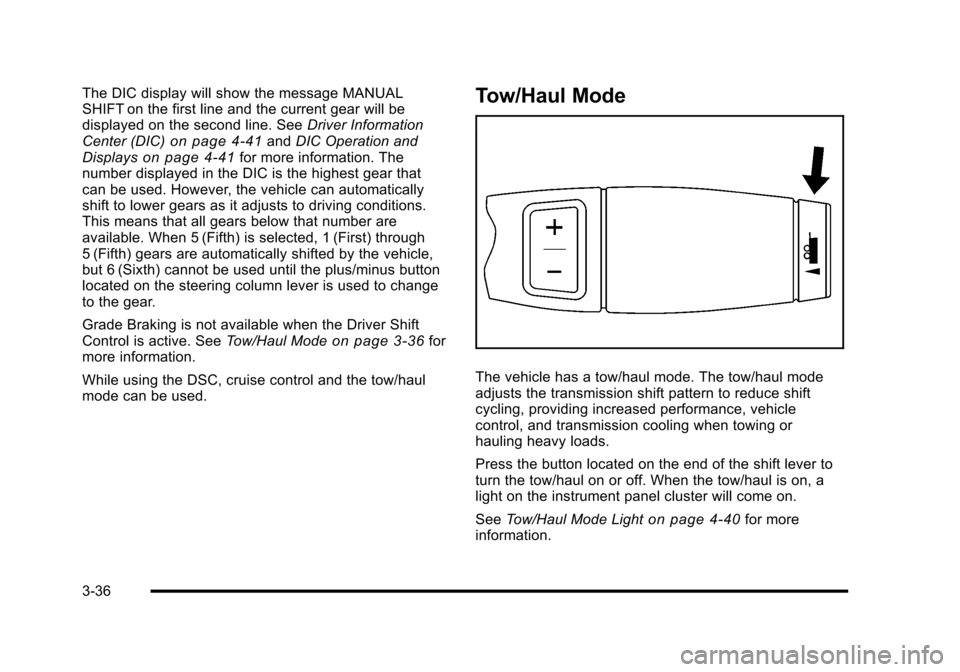
The vehicle has a tow/haul mode. The tow/haul modeadjusts the transmission shift pattern to reduce shiftcycling, providing increased performance, vehiclecontrol, and transmission cooling when towing orhauling heavy loads.
Press the button located on the end of the shift lever toturn the tow/haul on or off. When the tow/haul is on, alight on the instrument panel cluster will come on.
SeeTow/Haul Mode Lighton page 4!40for moreinformation.
3-36
Page 161 of 616
Also see“Tow Haul Mode”underTowing a Traileronpage 6!42for more information.
The tow/haul mode works with the Autoride®feature,if the vehicle has this, to enhance the ride whentrailering or with a loaded vehicle. SeeAutoride®onpage 6!42.
Grade Braking
The Grade Braking shift modes can be activated bypressing the button on the end of the shift control lever.While in Range Selection Mode , Grade Braking isdeactivated allowing the driver to select a desired rangeof gears.
Grade Braking is only active while the Tow/Haul Modeis selected and you are not in the Range SelectionMode. See“Tow/Haul Mode listed previously andAutomatic Transmission Operationon page 3!32formore information on the Range Selection Mode. GradeBraking assists in maintaining desired vehicle speedswhen driving on downhill grades by automaticallyimplementing a shift schedule that utilizes the engineand transmission to slow the vehicle. This reduces wearon the braking system and increases control of thevehicle. Grade Braking monitors vehicle speed,acceleration, engine torque and brake pedal usage.
Using this information, it detects when the vehicle is ona downhill grade and the driver desires to slow thevehicle by pressing the brake.
Also seeTowing a Traileron page 6!42for moreinformation.
Cruise Grade Braking
Cruise Grade Braking assists when driving on adownhill grade. It maintains vehicle speed byautomatically implementing a shift schedule that usesthe engine and the transmission to slow the vehicle.Cruise Grade Braking operates while Cruise Control isengaged in Tow/Haul mode to assist in maintainingvehicle speed under loaded vehicle conditions.It utilizes vehicle acceleration and deviation fromdesired speed to determine the correct gear for theoperating condition. If vehicle speed is above thedesired speed the transmission will downshift to slowthe vehicle. If vehicle speed is near or below desiredspeed the trans will upshift, allowing vehicle speedto increase.
While in the Range Select Mode (RSM) mode, cruisegrade braking is not available.
SeeAutomatic Transmission Operation on page 3!32.
3-37
Page 164 of 616
Torque Lock
If you are parking on a hill and you do not shift thetransmission into P (Park) properly, the weight of thevehicle can put too much force on the parking pawl inthe transmission. It might be difficult to pull the shiftlever out of P (Park). This is called torque lock. Toprevent torque lock, set the parking brake and then shiftinto P (Park) properly before you leave the driver seat.To find out how, seeShifting Into Park on page 3!39.
When you are ready to drive, move the shift lever out ofP (Park) before releasing the parking brake.
If torque lock does occur, you might need to haveanother vehicle push yours a little uphill to take some ofthe pressure from the parking pawl in the transmission.Then you should be able to pull the shift lever outof P (Park).
Shifting Out of Park
This vehicle is equipped with an electronic shift lockrelease system. The shift lock release is designed to:
.Prevent ignition key removal unless the shift leveris in P (Park) with the shift lever button fullyreleased, and
.Prevent movement of the shift lever out ofP (Park), unless the ignition is in ON/RUN orACC/ACCESSORY and the regular brake pedalis applied.
The shift lock release is always functional exceptin the case of an uncharged or low voltage(less than 9 volt) battery.
If the vehicle has an uncharged battery or a batterywith low voltage, try charging or jump starting thebattery. SeeJump Startingon page 7!44formore information.
To shift out of P (Park) use the following:
1. Apply the brake pedal.
2. Move the shift lever to the desired position.
If you still are unable to shift out of P (Park):
1. Ease the pressure on the shift lever.
2. While holding down the brake pedal, press theshift lever all the way into P (Park).
3. Move the shift lever to the desired position.
If you are still having a problem shifting, then have thevehicle serviced soon.
3-40
Page 166 of 616
Running the Vehicle While Parked
It is better not to park with the engine running. But if youever have to, here are some things to know.
{WARNING:
Idling a vehicle in an enclosed area with poor
ventilation is dangerous. Engine exhaust may
enter the vehicle. Engine exhaust contains
Carbon Monoxide (CO) which cannot be seen or
smelled. It can cause unconsciousness and even
death. Never run the engine in an enclosed area
that has no fresh air ventilation. For more
information, seeEngine Exhaust on page 3!41.
{WARNING:
It can be dangerous to get out of the vehicle if the
automatic transmission shift lever is not fully in
P (Park) with the parking brake firmly set. The
vehicle can roll. Do not leave the vehicle when the
engine is running unless you have to. If you have
left the engine running, the vehicle can move
suddenly. You or others could be injured. To be
sure the vehicle will not move, even when you are
on fairly level ground, always set the parking
brake and move the shift lever to P (Park).
Follow the proper steps to be sure the vehicle will notmove. SeeShifting Into Park on page 3!39.
If parking on a hill and pulling a trailer, seeTowing aTrailer on page 6!42.
3-42