lock CADILLAC ESCALADE 2010 3.G Owner's Manual
[x] Cancel search | Manufacturer: CADILLAC, Model Year: 2010, Model line: ESCALADE, Model: CADILLAC ESCALADE 2010 3.GPages: 616, PDF Size: 39.41 MB
Page 53 of 616
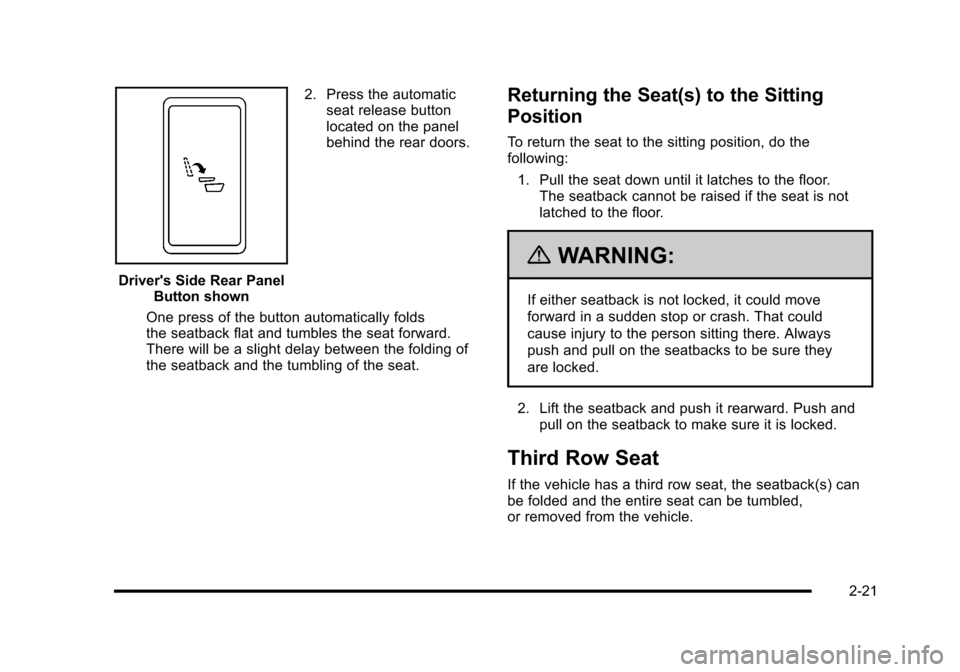
Driver's Side Rear PanelButton shown
2. Press the automaticseat release buttonlocated on the panelbehind the rear doors.
One press of the button automatically foldsthe seatback flat and tumbles the seat forward.There will be a slight delay between the folding ofthe seatback and the tumbling of the seat.
Returning the Seat(s) to the Sitting
Position
To return the seat to the sitting position, do thefollowing:
1. Pull the seat down until it latches to the floor.The seatback cannot be raised if the seat is notlatched to the floor.
{WARNING:
If either seatback is not locked, it could move
forward in a sudden stop or crash. That could
cause injury to the person sitting there. Always
push and pull on the seatbacks to be sure they
are locked.
2. Lift the seatback and push it rearward. Push andpull on the seatback to make sure it is locked.
Third Row Seat
If the vehicle has a third row seat, the seatback(s) canbe folded and the entire seat can be tumbled,or removed from the vehicle.
2-21
Page 54 of 616
Folding the Seatback(s)
Notice:Folding a rear seat with the safety beltsstill fastened may cause damage to the seat or thesafety belts. Always unbuckle the safety belts andreturn them to their normal stowed position beforefolding a rear seat.
To fold the seatback, do the following:
1. Open the liftgate to access the controls forthe seat.
2. Remove all items on the seat cushion.
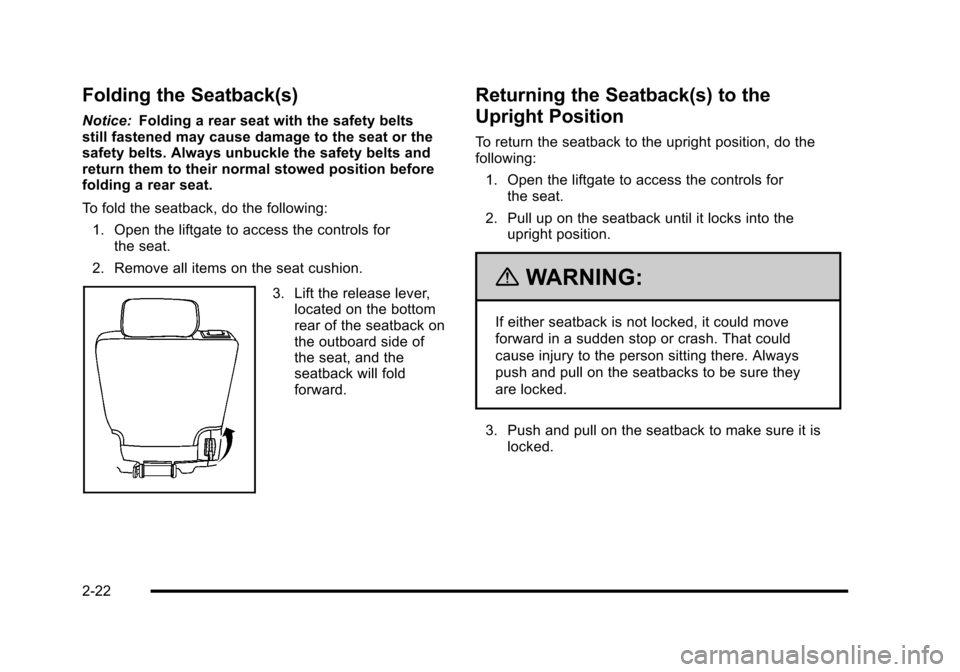
3. Lift the release lever,located on the bottomrear of the seatback onthe outboard side ofthe seat, and theseatback will foldforward.
Returning the Seatback(s) to the
Upright Position
To return the seatback to the upright position, do thefollowing:
1. Open the liftgate to access the controls forthe seat.
2. Pull up on the seatback until it locks into theupright position.
{WARNING:
If either seatback is not locked, it could move
forward in a sudden stop or crash. That could
cause injury to the person sitting there. Always
push and pull on the seatbacks to be sure they
are locked.
3. Push and pull on the seatback to make sure it islocked.
2-22
Page 55 of 616
Tumbling the Third Row Seat
The seat can be tumbled forward for additional cargospace.
To tumble the seat, do the following:
1. Open the liftgate to access the controls forthe seat.
2. Make sure the head rests are completely lowered,there is nothing under, in front of, or on the seat.
3. Fold the seatbacks forward using the instructionspreviously listed under“Folding the Seatbacks”.You will not be able to unlatch the seat from thefloor unless the seatback is folded down.
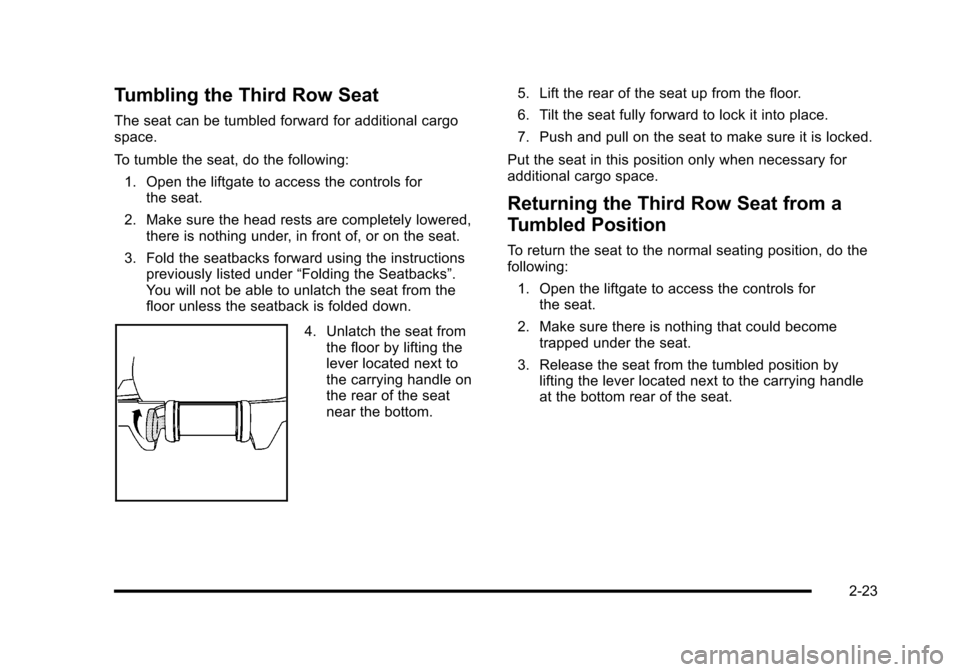
4. Unlatch the seat fromthe floor by lifting thelever located next tothe carrying handle onthe rear of the seatnear the bottom.
5. Lift the rear of the seat up from the floor.
6. Tilt the seat fully forward to lock it into place.
7. Push and pull on the seat to make sure it is locked.
Put the seat in this position only when necessary foradditional cargo space.
Returning the Third Row Seat from a
Tumbled Position
To return the seat to the normal seating position, do thefollowing:
1. Open the liftgate to access the controls forthe seat.
2. Make sure there is nothing that could becometrapped under the seat.
3. Release the seat from the tumbled position bylifting the lever located next to the carrying handleat the bottom rear of the seat.
2-23
Page 56 of 616
4. Pull the seat down until it latches to the floor. Theseatback cannot be raised if the seat is not latchedto the floor.
5. Pull up on the seatback until it locks into theupright position.
{WARNING:
If either seatback is not locked, it could move
forward in a sudden stop or crash. That could
cause injury to the person sitting there. Always
push and pull on the seatbacks to be sure they
are locked.
6. Push and pull on the seatback to make sure itis locked.
Removing the Third Row Seat
To remove the seat, do the following:
1. Open the liftgate to access the controls forthe seat.
2. Fold the seatback forward using the instructionslisted under“Folding the Seatbacks”previously.The seat cannot be removed unless the seatbackis folded.
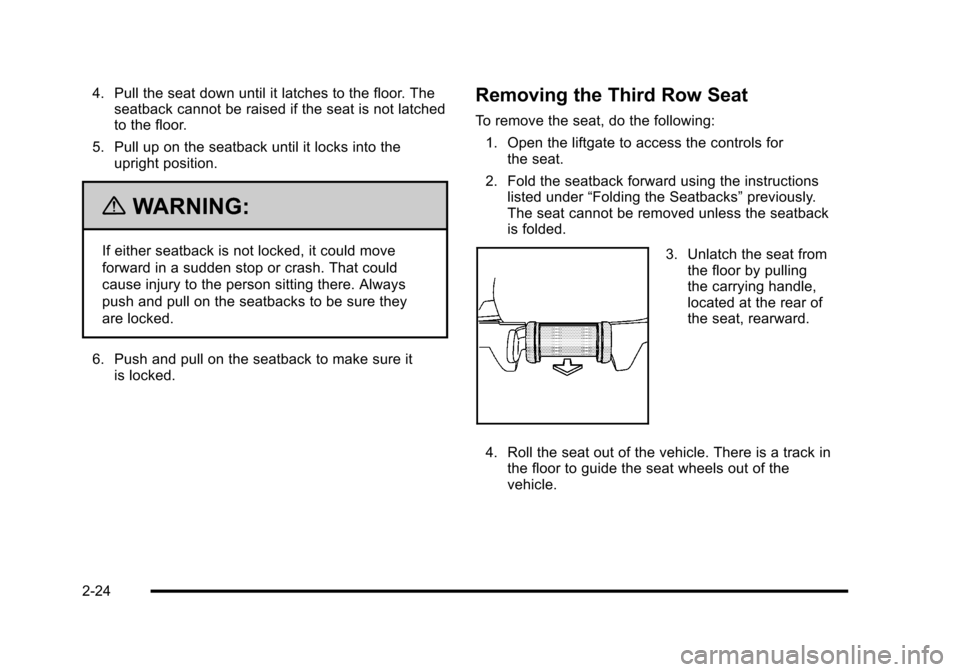
3. Unlatch the seat fromthe floor by pullingthe carrying handle,located at the rear ofthe seat, rearward.
4. Roll the seat out of the vehicle. There is a track inthe floor to guide the seat wheels out of thevehicle.
2-24
Page 57 of 616
Installing the Third Row Seat
To install the seat, do the following:
1. Open the liftgate to access the rear of the vehicle.
2. Slide the front outboard seat wheels into the trackon the floor and roll the seat forward. The frontlatches should lock into place. If the latches do notlock, try tilting the rear of the seat upward slightly.
3. Lower the rear of the seat and push down on theseat to engage the rear floor latches.
{WARNING:
A seat that is not locked into place properly can
move around in a collision or sudden stop. People
in the vehicle could be injured. Be sure to lock the
seat into place properly when installing it.
4. Push and pull on the seat to make sure it islocked into place. The seatback cannot be raisedto the upright position unless the seat is securedto the floor.
5. Pull up on the seatback until it locks into theupright position.
{WARNING:
If either seatback is not locked, it could move
forward in a sudden stop or crash. That could
cause injury to the person sitting there. Always
push and pull on the seatbacks to be sure they
are locked.
6. Push and pull on the seatback to make sure itis locked.
{WARNING:
A safety belt that is improperly routed, not
properly attached, or twisted will not provide the
protection needed in a crash. The person wearing
the belt could be seriously injured. After raising
the rear seatback, always check to be sure that
the safety belts are properly routed and attached,
and are not twisted.
7. Make sure the safety belts are returned to theoriginal position over the seatbacks.
2-25
Page 63 of 616
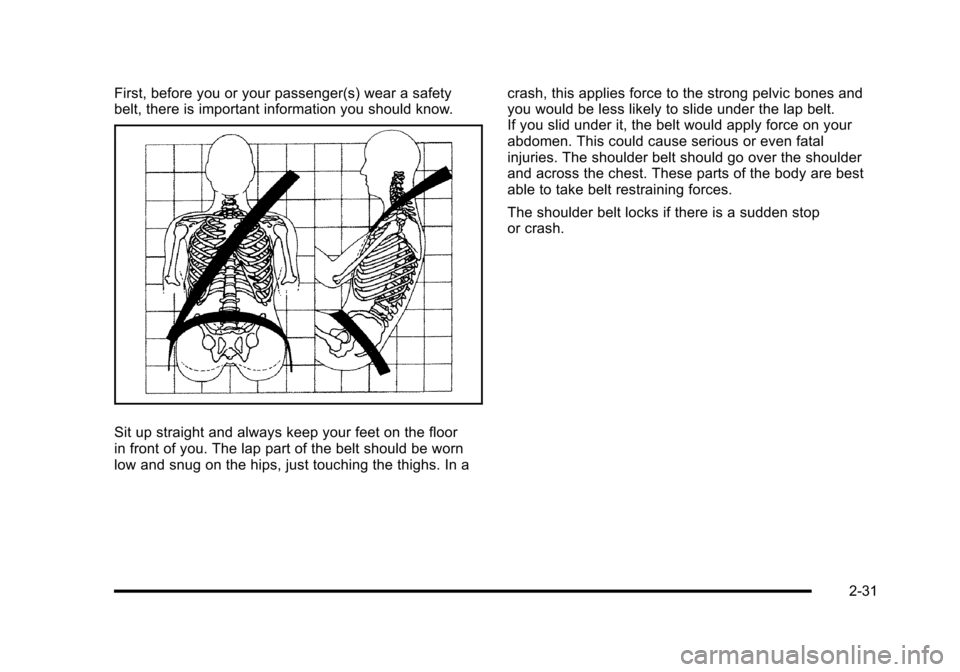
First, before you or your passenger(s) wear a safetybelt, there is important information you should know.
Sit up straight and always keep your feet on the floorin front of you. The lap part of the belt should be wornlow and snug on the hips, just touching the thighs. In a
crash, this applies force to the strong pelvic bones andyou would be less likely to slide under the lap belt.If you slid under it, the belt would apply force on yourabdomen. This could cause serious or even fatalinjuries. The shoulder belt should go over the shoulderand across the chest. These parts of the body are bestable to take belt restraining forces.
The shoulder belt locks if there is a sudden stopor crash.
2-31
Page 71 of 616
Lap-Shoulder Belt
All seating positions in the vehicle have a lap-shoulderbelt except for the center front passenger position,if equipped, which has a lap belt. SeeLap Beltonpage 2!47for more information.
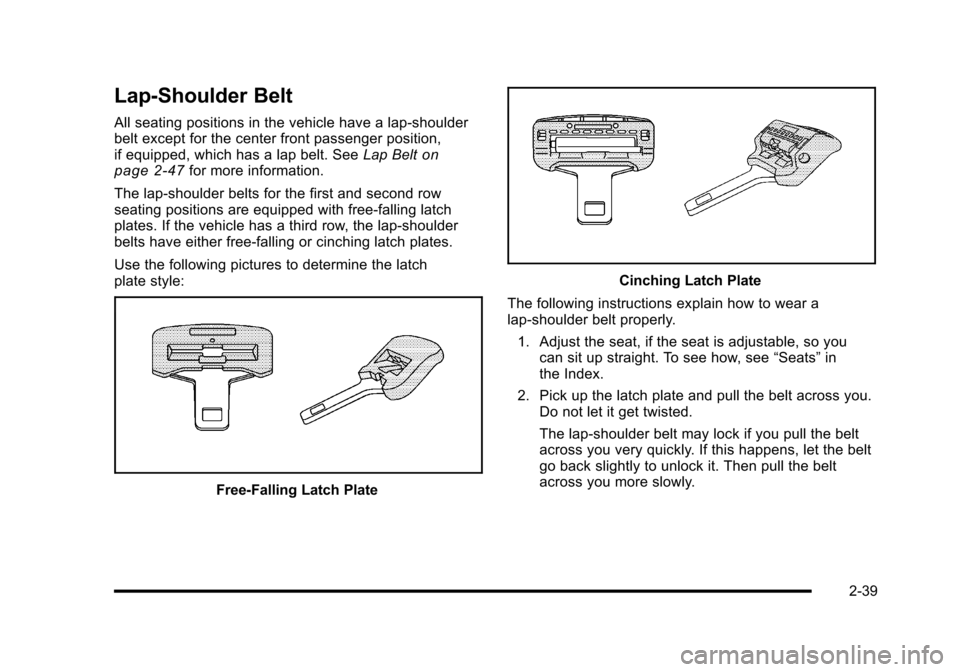
The lap!shoulder belts for the first and second rowseating positions are equipped with free!falling latchplates. If the vehicle has a third row, the lap!shoulderbelts have either free!falling or cinching latch plates.
Use the following pictures to determine the latchplate style:
Free-Falling Latch Plate
Cinching Latch Plate
The following instructions explain how to wear alap-shoulder belt properly.
1. Adjust the seat, if the seat is adjustable, so youcan sit up straight. To see how, see“Seats”inthe Index.
2. Pick up the latch plate and pull the belt across you.Do not let it get twisted.
The lap-shoulder belt may lock if you pull the beltacross you very quickly. If this happens, let the beltgo back slightly to unlock it. Then pull the beltacross you more slowly.
2-39
Page 72 of 616
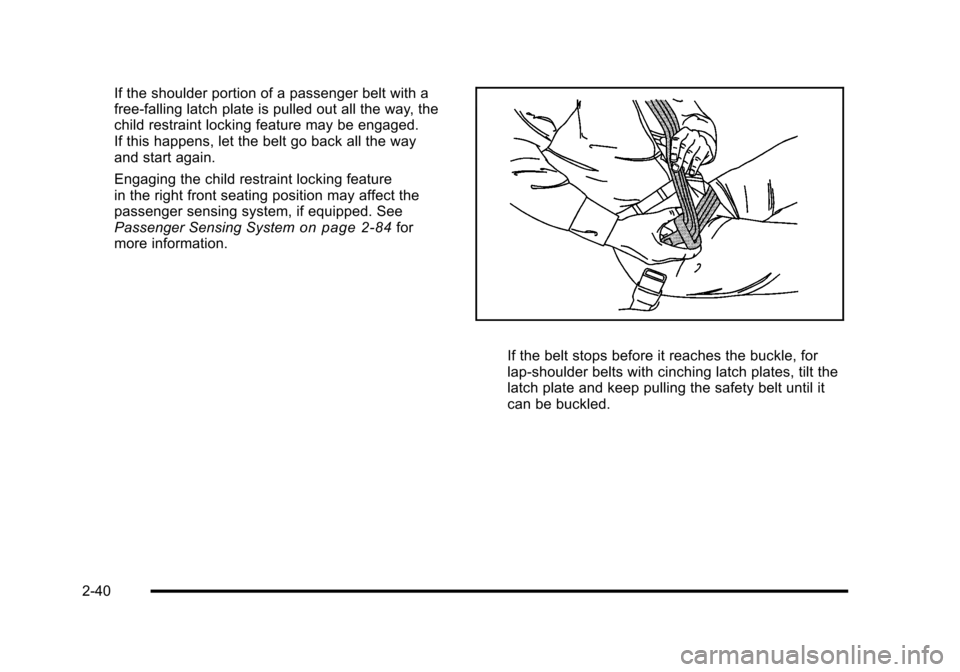
If the shoulder portion of a passenger belt with afree!falling latch plate is pulled out all the way, thechild restraint locking feature may be engaged.If this happens, let the belt go back all the wayand start again.
Engaging the child restraint locking featurein the right front seating position may affect thepassenger sensing system, if equipped. SeePassenger Sensing Systemon page 2!84formore information.
If the belt stops before it reaches the buckle, forlap!shoulder belts with cinching latch plates, tilt thelatch plate and keep pulling the safety belt until itcan be buckled.
2-40
Page 75 of 616
The adjuster can be moved up just by pushing up onthe shoulder belt guide.
After the adjuster is set to the desired position, try tomove it down without squeezing the buttons to makesure it has locked into position.
Safety Belt Pretensioners
This vehicle has safety belt pretensioners forfront outboard occupants. Although the safety beltpretensioners cannot be seen, they are part of thesafety belt assembly. They can help tighten the safetybelts during the early stages of a moderate to severefrontal, near frontal, or rear crash if the thresholdconditions for pretensioner activation are met.And, if the vehicle has side impact airbags, safety beltpretensioners can help tighten the safety belts in a sidecrash or a rollover event.
Pretensioners work only once. If the pretensionersactivate in a crash, they will need to be replaced, andprobably other new parts for the vehicle's safety beltsystem. SeeReplacing Restraint System Parts After aCrash on page 2!92.
Rear Safety Belt Comfort Guides
This vehicle may have rear shoulder belt comfortguides. If not, they are available through yourdealer/retailer. The guides may provide added safetybelt comfort for older children who have outgrownbooster seats and for some adults. When installed andproperly adjusted, the comfort guide positions the beltaway from the neck and head.
2-43
Page 96 of 616
According to accident statistics, children and infants aresafer when properly restrained in a child restraintsystem or infant restraint system secured in a rearseating position. SeeWhere to Put the Restraintonpage 2!57
Securing a Child Restraint Designed for
the LATCH System
{WARNING:
If a LATCH-type child restraint is not attached to
anchors, the child restraint will not be able to
protect the child correctly. In a crash, the child
could be seriously injured or killed. Install a
LATCH-type child restraint properly using the
anchors, or use the vehicle's safety belts to
secure the restraint, following the instructions that
came with the child restraint and the instructions
in this manual.
{WARNING:
Do not attach more than one child restraint to a
single anchor. Attaching more than one child
restraint to a single anchor could cause the
anchor or attachment to come loose or even
break during a crash. A child or others could be
injured. To reduce the risk of serious or fatal
injuries during a crash, attach only one child
restraint per anchor.
{WARNING:
Children can be seriously injured or strangled if a
shoulder belt is wrapped around their neck and
the safety belt continues to tighten. Buckle any
unused safety belts behind the child restraint so
children cannot reach them. Pull the shoulder belt
all the way out of the retractor to set the lock,
if your vehicle has one, after the child restraint
has been installed.
2-64