trailer CADILLAC ESCALADE 2010 3.G Owner's Manual
[x] Cancel search | Manufacturer: CADILLAC, Model Year: 2010, Model line: ESCALADE, Model: CADILLAC ESCALADE 2010 3.GPages: 616, PDF Size: 39.41 MB
Page 435 of 616
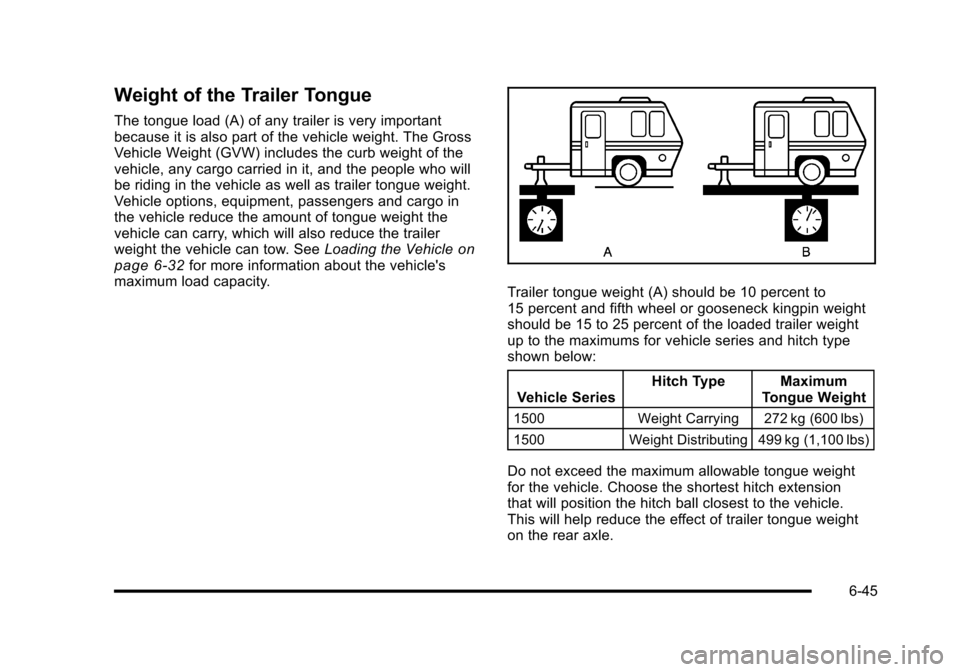
Weight of the Trailer Tongue
The tongue load (A) of any trailer is very importantbecause it is also part of the vehicle weight. The GrossVehicle Weight (GVW) includes the curb weight of thevehicle, any cargo carried in it, and the people who willbe riding in the vehicle as well as trailer tongue weight.Vehicle options, equipment, passengers and cargo inthe vehicle reduce the amount of tongue weight thevehicle can carry, which will also reduce the trailerweight the vehicle can tow. SeeLoading the Vehicleonpage 6!32for more information about the vehicle'smaximum load capacity.Trailer tongue weight (A) should be 10 percent to15 percent and fifth wheel or gooseneck kingpin weightshould be 15 to 25 percent of the loaded trailer weightup to the maximums for vehicle series and hitch typeshown below:
Vehicle SeriesHitch TypeMaximumTongue Weight
1500Weight Carrying 272 kg (600 lbs)
1500Weight Distributing 499 kg (1,100 lbs)
Do not exceed the maximum allowable tongue weightfor the vehicle. Choose the shortest hitch extensionthat will position the hitch ball closest to the vehicle.This will help reduce the effect of trailer tongue weighton the rear axle.
6-45
Page 436 of 616
Trailering may be limited by the vehicle's ability tocarry tongue weight. Tongue or kingpin weight cannotcause the vehicle to exceed the GVWR (Gross VehicleWeight Rating) or the RGAWR (Rear Gross Axle WeightRating). See“Total Weight on the Vehicle's Tires”laterin this section for more information.
After loading the trailer, weigh the trailer and then thetongue, separately, to see if the weights are proper.If they are not, adjustments might be made by movingsome items around in the trailer.
Total Weight on the Vehicle's Tires
Be sure the vehicle's tires are inflated to the inflationpressures found on the Certification label on the driverdoor or seeLoading the Vehicleon page 6!32for moreinformation. Make sure not to exceed the GVWR limitfor the vehicle, or the RGAWR, with the tow vehicle andtrailer fully loaded for the trip including the weight of thetrailer tongue. If using a weight distributing hitch, makesure not to exceed the RGAWR before applying theweight distribution spring bars.
Weight of the Trailering Combination
It is important that the combination of the towvehicle and trailer does not exceed any of its weightratings—GCWR, GVWR, RGAWR, Trailer WeightRating or Tongue Weight. The only way to be sure it isnot exceeding any of these ratings is to weigh the towvehicle and trailer combination, fully loaded for the trip,getting individual weights for each of these items.
Hitches
The correct hitch equipment helps maintain combinationcontrol. Most small-to-medium trailers can be towedwith a weight carrying hitch which simply features acoupler latched to the hitch ball. Larger trailers mayrequire a weight distributing hitch that uses spring barsto distribute the trailer tongue weight among thetwo vehicle and trailer axles. See“Weight of the TrailerTongue”earlier in this section for rating limits withvarious hitch types.
If a step-bumper hitch will be used, the bumper couldbe damaged in sharp turns. Make sure there is ampleroom when turning to avoid contact between the trailerand the bumper.
Consider using sway controls with any trailer. Ask atrailering professional about sway controls or refer tothe trailer manufacturer's recommendations andinstructions.
6-46
Page 437 of 616
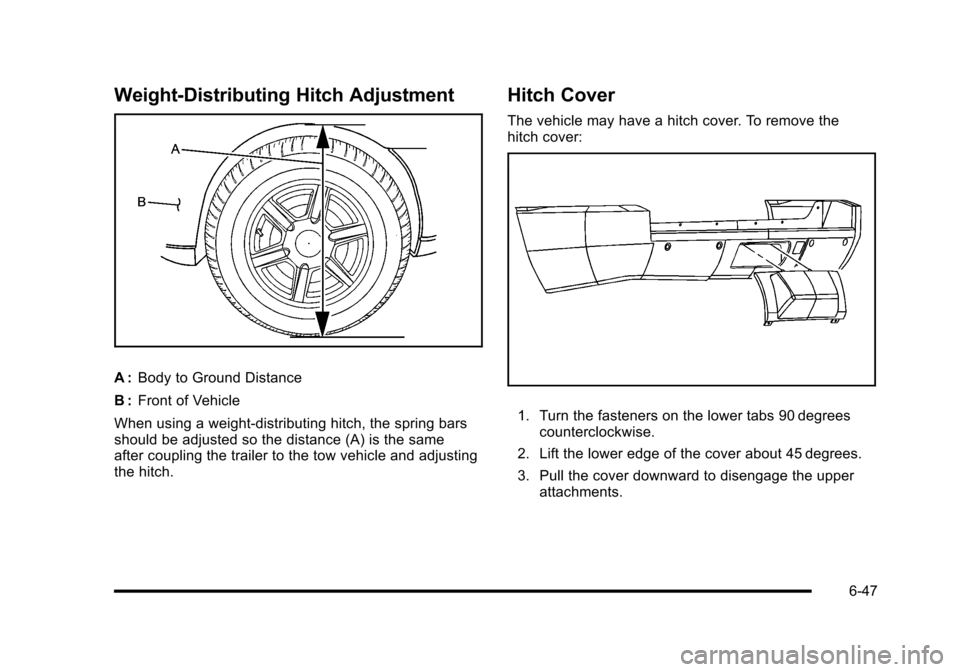
Weight!Distributing Hitch Adjustment
A:Body to Ground Distance
B:Front of Vehicle
When using a weight-distributing hitch, the spring barsshould be adjusted so the distance (A) is the sameafter coupling the trailer to the tow vehicle and adjustingthe hitch.
Hitch Cover
The vehicle may have a hitch cover. To remove thehitch cover:
1. Turn the fasteners on the lower tabs 90 degreescounterclockwise.
2. Lift the lower edge of the cover about 45 degrees.
3. Pull the cover downward to disengage the upperattachments.
6-47
Page 438 of 616
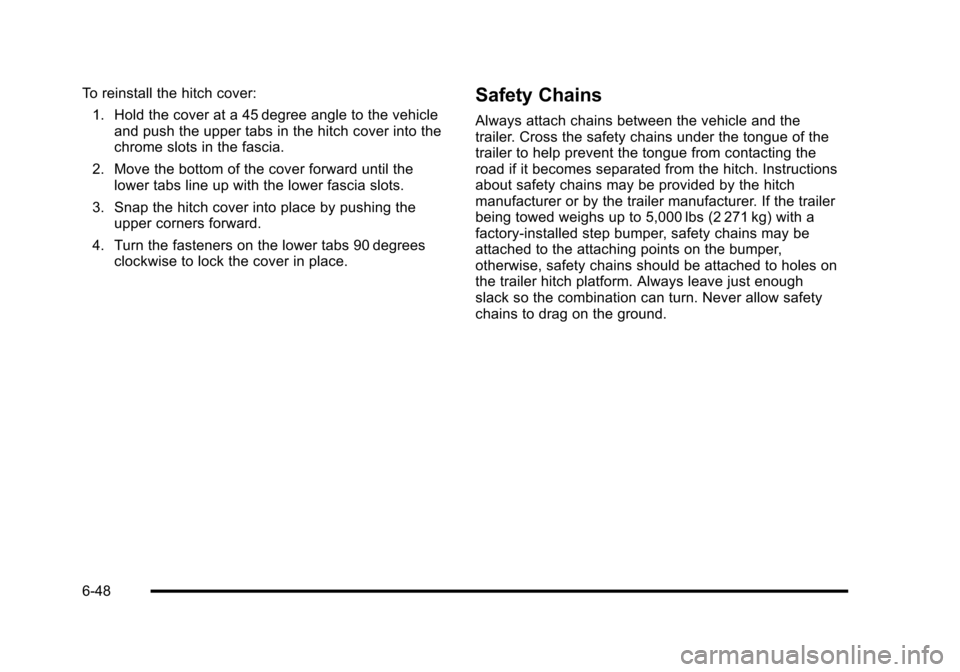
To reinstall the hitch cover:
1. Hold the cover at a 45 degree angle to the vehicleand push the upper tabs in the hitch cover into thechrome slots in the fascia.
2. Move the bottom of the cover forward until thelower tabs line up with the lower fascia slots.
3. Snap the hitch cover into place by pushing theupper corners forward.
4. Turn the fasteners on the lower tabs 90 degreesclockwise to lock the cover in place.
Safety Chains
Always attach chains between the vehicle and thetrailer. Cross the safety chains under the tongue of thetrailer to help prevent the tongue from contacting theroad if it becomes separated from the hitch. Instructionsabout safety chains may be provided by the hitchmanufacturer or by the trailer manufacturer. If the trailerbeing towed weighs up to 5,000 lbs (2 271 kg) with afactory-installed step bumper, safety chains may beattached to the attaching points on the bumper,otherwise, safety chains should be attached to holes onthe trailer hitch platform. Always leave just enoughslack so the combination can turn. Never allow safetychains to drag on the ground.
6-48
Page 439 of 616
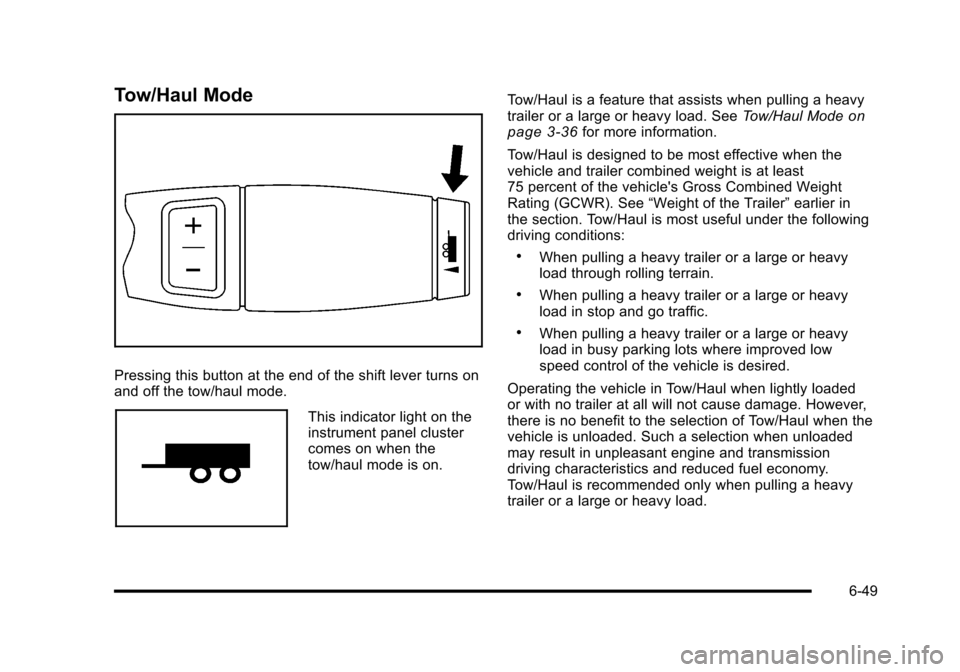
Tow/Haul Mode
Pressing this button at the end of the shift lever turns onand off the tow/haul mode.
This indicator light on theinstrument panel clustercomes on when thetow/haul mode is on.
Tow/Haul is a feature that assists when pulling a heavytrailer or a large or heavy load. SeeTow/Haul Modeonpage 3!36for more information.
Tow/Haul is designed to be most effective when thevehicle and trailer combined weight is at least75 percent of the vehicle's Gross Combined WeightRating (GCWR). See“Weight of the Trailer”earlier inthe section. Tow/Haul is most useful under the followingdriving conditions:
.When pulling a heavy trailer or a large or heavyload through rolling terrain.
.When pulling a heavy trailer or a large or heavyload in stop and go traffic.
.When pulling a heavy trailer or a large or heavyload in busy parking lots where improved lowspeed control of the vehicle is desired.
Operating the vehicle in Tow/Haul when lightly loadedor with no trailer at all will not cause damage. However,there is no benefit to the selection of Tow/Haul when thevehicle is unloaded. Such a selection when unloadedmay result in unpleasant engine and transmissiondriving characteristics and reduced fuel economy.Tow/Haul is recommended only when pulling a heavytrailer or a large or heavy load.
6-49
Page 440 of 616

Trailer Brakes
A loaded trailer that weighs more than 2,000 lbs(900 kg) needs to have its own brake system that isadequate for the weight of the trailer. Be sure to readand follow the instructions for the trailer brakes so theyare installed, adjusted and maintained properly.
Since the vehicle is equipped with StabiliTrak®, thetrailer brakes cannot tap into the vehicle's hydraulicsystem.
Driving with a Trailer
{WARNING:
When towing a trailer, exhaust gases may collect
at the rear of the vehicle and enter if the liftgate,
trunk/hatch, or rear-most window is open.
Engine exhaust contains carbon monoxide (CO)
which cannot be seen or smelled. It can cause
unconsciousness and even death.
To maximize safety when towing a trailer:
.Have the exhaust system inspected for
leaks and make necessary repairs before
starting a trip.
(Continued)
WARNING: (Continued)
.Never drive with the liftgate, trunk/hatch,
or rear-most window open.
.Fully open the air outlets on or under the
instrument panel.
.Adjust the Climate Control system to a setting
that brings in only outside air and set the fan
speed to the highest setting. See Climate
Control System in the Index.
For more information about carbon monoxide, see
Engine Exhaust on page 3!41.
Towing a trailer requires a certain amount ofexperience. The combination you are driving is longerand not as responsive as the vehicle itself. Getacquainted with the handling and braking of the rigbefore setting out for the open road.
Before starting, check all trailer hitch parts andattachments, safety chains, electrical connectors,lamps, tires and mirrors. If the trailer has electricbrakes, start the combination moving and then applythe trailer brake controller by hand to be sure thebrakes work.
6-50
Page 441 of 616
During the trip, check occasionally to be sure that theload is secure and the lamps and any trailer brakesstill work.
Following Distance
Stay at least twice as far behind the vehicle ahead asyou would when driving the vehicle without a trailer.This can help to avoid heavy braking and sudden turns.
Passing
More passing distance is needed when towing a trailer.The combination will not accelerate as quickly and islonger so it is necessary to go much farther beyond thepassed vehicle before returning to the lane.
Backing Up
Hold the bottom of the steering wheel with one hand.Then, to move the trailer to the left, move that hand tothe left. To move the trailer to the right, move your handto the right. Always back up slowly and, if possible,have someone guide you.
Making Turns
Notice:Making very sharp turns while traileringcould cause the trailer to come in contact with thevehicle. The vehicle could be damaged. Avoidmaking very sharp turns while trailering.
When turning with a trailer, make wider turns thannormal. Do this so the trailer will not strike softshoulders, curbs, road signs, trees or other objects.Avoid jerky or sudden maneuvers. Signal wellin advance.
If the trailer turn signal bulbs burn out, the arrowson the instrument panel will still flash for turns. It isimportant to check occasionally to be sure the trailerbulbs are still working.
6-51
Page 442 of 616
Driving On Grades
Reduce speed and shift to a lower gearbeforestartingdown a long or steep downgrade. If the transmission isnot shifted down, the brakes might get hot and nolonger work well.
Vehicles can tow in D (Drive). Shift the transmission toa lower gear if the transmission shifts too often underheavy loads and/or hilly conditions.
The tow/haul mode may be used if the transmissionshifts too often. SeeTow/Haul Mode on page 3!36.
When towing at high altitude on steep uphill grades,consider the following: Engine coolant will boil at alower temperature than at normal altitudes. If the engineis turned off immediately after towing at high altitude onsteep uphill grades, the vehicle may show signs similarto engine overheating. To avoid this, let the engine runwhile parked, preferably on level ground, with theautomatic transmission in P (Park) for a few minutesbefore turning the engine off. If the overheat warningcomes on, seeEngine Overheating on page 7!34.
Parking on Hills
{WARNING:
Parking the vehicle on a hill with the trailer
attached can be dangerous. If something goes
wrong, the rig could start to move. People can be
injured, and both the vehicle and the trailer can be
damaged. When possible, always park the rig on
a flat surface.
If parking the rig on a hill:
1. Press the brake pedal, but do not shift intoP (Park) yet. Turn the wheels into the curb if facingdownhill or into traffic if facing uphill.
2. Have someone place chocks under the trailerwheels.
3. When the wheel chocks are in place, release theregular brakes until the chocks absorb the load.
6-52
Page 443 of 616
4. Reapply the brake pedal. Then apply the parkingbrake and shift into P (Park).
5. Release the brake pedal.
{WARNING:
It can be dangerous to get out of the vehicle if the
shift lever is not fully in P (Park) with the parking
brake firmly set. The vehicle can roll.
If the engine has been left running, the vehicle
can move suddenly. You or others could be
injured. To be sure the vehicle will not move, even
when on fairly level ground, always put the shift
lever fully in P (Park) with the parking brake
firmly set.
Leaving After Parking on a Hill
1. Apply and hold the brake pedal.
2. Start the engine
3. Shift into a gear
4. Release the parking brake
5. Let up on the brake pedal.
6. Drive slowly until the trailer is clear of the chocks.
7. Stop and have someone pick up and storethe chocks.
Maintenance When Trailer Towing
The vehicle needs service more often when pulling atrailer. See this manual's Maintenance Schedule orIndex for more information. Things that are especiallyimportant in trailer operation are automatic transmissionfluid, engine oil, axle lubricant, belts, cooling systemand brake system. It is a good idea to inspect thesebefore and during the trip.
Check periodically to see that all hitch nuts and boltsare tight.
6-53
Page 444 of 616
Trailer Wiring Harness
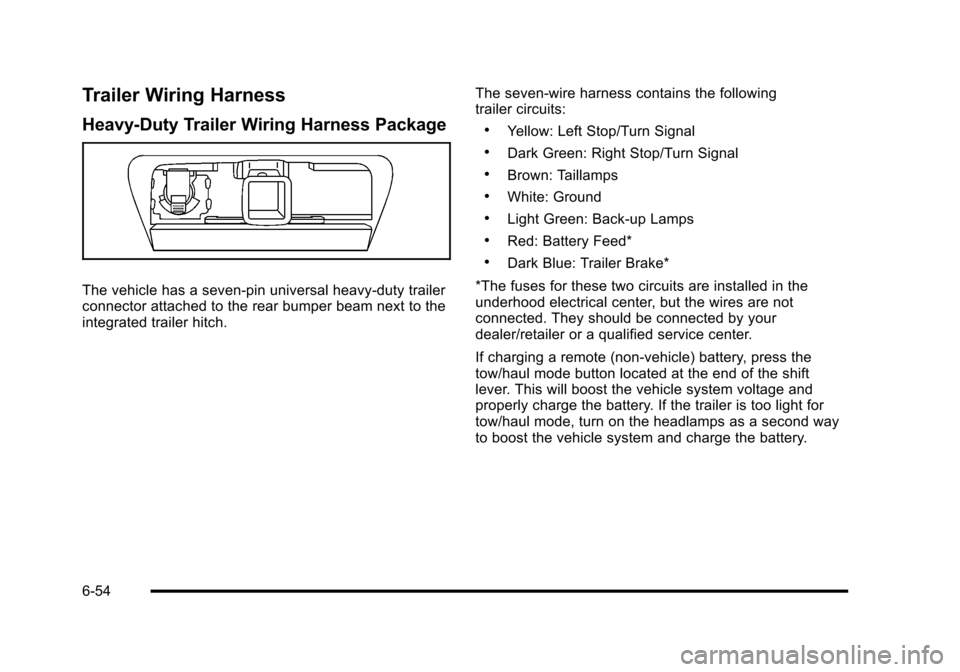
Heavy-Duty Trailer Wiring Harness Package
The vehicle has a seven-pin universal heavy-duty trailerconnector attached to the rear bumper beam next to theintegrated trailer hitch.
The seven-wire harness contains the followingtrailer circuits:
.Yellow: Left Stop/Turn Signal
.Dark Green: Right Stop/Turn Signal
.Brown: Taillamps
.White: Ground
.Light Green: Back-up Lamps
.Red: Battery Feed*
.Dark Blue: Trailer Brake*
*The fuses for these two circuits are installed in theunderhood electrical center, but the wires are notconnected. They should be connected by yourdealer/retailer or a qualified service center.
If charging a remote (non-vehicle) battery, press thetow/haul mode button located at the end of the shiftlever. This will boost the vehicle system voltage andproperly charge the battery. If the trailer is too light fortow/haul mode, turn on the headlamps as a second wayto boost the vehicle system and charge the battery.
6-54