trailer CADILLAC ESCALADE 2011 3.G Owner's Manual
[x] Cancel search | Manufacturer: CADILLAC, Model Year: 2011, Model line: ESCALADE, Model: CADILLAC ESCALADE 2011 3.GPages: 558, PDF Size: 7.59 MB
Page 396 of 558
Black plate (74,1)Cadillac Escalade/Escalade ESV Owner Manual - 2011
9-74 Driving and Operating
2. Have someone place chocksunder the trailer wheels.
3. When the wheel chocks are in place, release the regular brakes
until the chocks absorb the load.
4. Reapply the brake pedal. Then apply the parking brake and shift
into P (Park).
5. Release the brake pedal.
{WARNING
It can be dangerous to get out of
the vehicle if the shift lever is not
fully in P (Park) with the parking
brake firmly set. The vehicle
can roll. (Continued)
WARNING (Continued)
If the engine has been left
running, the vehicle can move
suddenly. You or others could
be injured. To be sure the vehicle
will not move, even when on fairly
level ground, always put the shift
lever fully in P (Park) with the
parking brake firmly set.
Leaving After Parking on a Hill
1. Apply and hold the brake pedal.
2. Start the engine.
3. Shift into a gear.
4. Release the parking brake.
5. Let up on the brake pedal.
6. Drive slowly until the trailer isclear of the chocks.
7. Stop and have someone pick up and store the chocks.
Maintenance When Trailer
Towing
The vehicle needs service
more often when pulling a trailer.
See the Maintenance Schedule
for more information. Things
that are especially important in
trailer operation are automatic
transmission fluid, engine oil, axle
lubricant, belts, cooling system and
brake system. It is a good idea to
inspect these before and during
the trip.
Check periodically to see that all
hitch nuts and bolts are tight.
Trailer Towing
If the vehicle is a hybrid, see
the hybrid supplement for more
information.
Do not tow a trailer during break‐in.
See New Vehicle Break-In on
page 9‑30 for more information.
Page 397 of 558
Black plate (75,1)Cadillac Escalade/Escalade ESV Owner Manual - 2011
Driving and Operating 9-75
{WARNING
The driver can lose control when
pulling a trailer if the correct
equipment is not used or the
vehicle is not driven properly.
For example, if the trailer is
too heavy, the brakes may
not work well—or even at all.
The driver and passengers could
be seriously injured. The vehicle
may also be damaged; the
resulting repairs would not be
covered by the vehicle warranty.
Pull a trailer only if all the steps in
this section have been followed.
Ask your dealer for advice and
information about towing a trailer
with the vehicle.
Notice: Pulling a trailer
improperly can damage the
vehicle and result in costly
repairs not covered by the vehicle warranty. To pull a trailer
correctly, follow the advice in
this section and see your dealer
for important information about
towing a trailer with the vehicle.
To identify the trailering capacity of
the vehicle, read the information in
“Weight of the Trailer”
that appears
later in this section.
Trailering is different than just
driving the vehicle by itself.
Trailering means changes in
handling, acceleration, braking,
durability and fuel economy.
Successful, safe trailering takes
correct equipment, and it has to
be used properly.
The following information has many
time-tested, important trailering tips
and safety rules. Many of these are
important for your safety and that of
your passengers. So please read
this section carefully before pulling
a trailer.
Weight of the Trailer
How heavy can a trailer safely be?
It depends on how the rig is used.
Speed, altitude, road grades,
outside temperature and how much
the vehicle is used to pull a trailer
are all important. It can depend
on any special equipment on the
vehicle, and the amount of tongue
weight the vehicle can carry. See
“Weight of the Trailer Tongue” later
in this section for more information.
Trailer weight rating (TWR) is
calculated assuming the tow vehicle
has only the driver but all required
trailering equipment. Weight of
additional optional equipment,
passengers and cargo in the tow
vehicle must be subtracted from
the trailer weight rating.
Use the following chart to determine
how much the vehicle can weigh,
based upon the vehicle model and
options.
Page 398 of 558
Black plate (76,1)Cadillac Escalade/Escalade ESV Owner Manual - 2011
9-76 Driving and Operating
VehicleAxle Ratio Maximum Trailer Weight GCWR*
Escalade 2WD 6.2L V8 3.423 765 kg (8,300 lbs) 6 350 kg (14,000 lbs)
Escalade AWD 6.2L V8 3.423 674 kg (8,100 lbs) 6 350 kg (14,000 lbs)
Escalade ESV 2WD 6.2L V8 3.423 629 kg (8,000 lbs) 6 350 kg (14,000 lbs)
Escalade ESV AWD 6.2L V8 3.423 493 kg (7,700 lbs) 6 350 kg (14,000 lbs)
*The Gross Combination Weight Rating™(GCWR) is the total allowable weight of the completely loaded vehicle
and trailer including any passengers, cargo, equipment and conversions. The GCWR for the vehicle should not be
exceeded.
Ask your dealer for trailering
information or advice, or write us at
our Customer Assistance Offices.
See Customer Assistance Offices
(U.S. and Canada) on page 13‑5
or Customer Assistance Offices
(Mexico) on page 13‑5 for more
information.
Weight of the Trailer Tongue
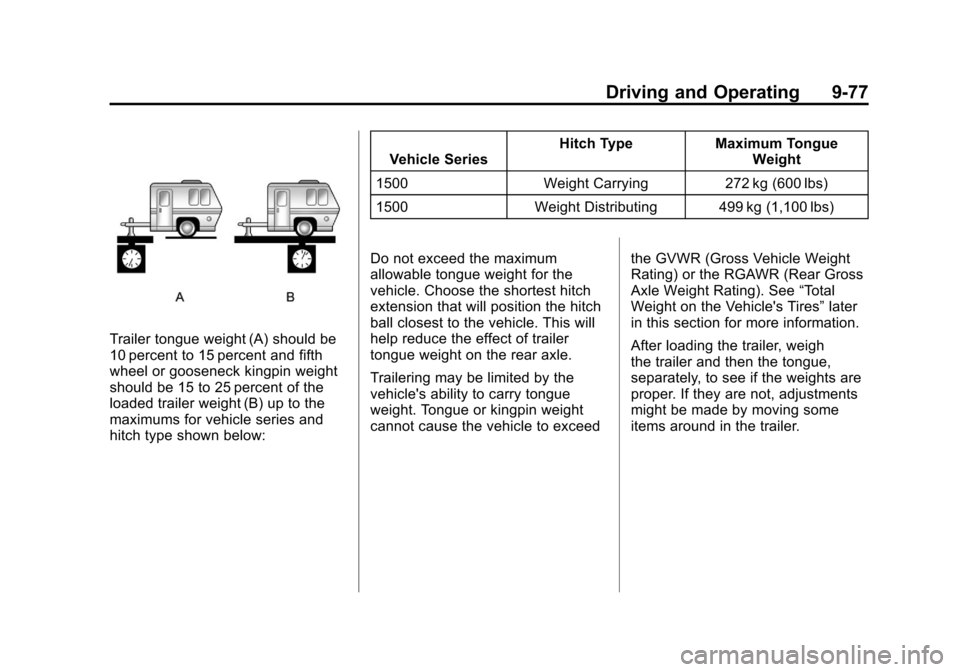
The tongue load (A) of any
trailer is very important because
it is also part of the vehicle weight.
The Gross Vehicle Weight (GVW)
includes the curb weight of the
vehicle, any cargo carried in it, and
the people who will be riding in the
vehicle as well as trailer tongue weight. Vehicle options, equipment,
passengers and cargo in the vehicle
reduce the amount of tongue weight
the vehicle can carry, which will also
reduce the trailer weight the vehicle
can tow. See
Vehicle Load Limits on
page 9‑24 for more information
about the vehicle's maximum load
capacity.
Page 399 of 558
Black plate (77,1)Cadillac Escalade/Escalade ESV Owner Manual - 2011
Driving and Operating 9-77
Trailer tongue weight (A) should be
10 percent to 15 percent and fifth
wheel or gooseneck kingpin weight
should be 15 to 25 percent of the
loaded trailer weight (B) up to the
maximums for vehicle series and
hitch type shown below:Vehicle Series
Hitch Type Maximum Tongue
Weight
1500 Weight Carrying 272 kg (600 lbs)
1500 Weight Distributing 499 kg (1,100 lbs)
Do not exceed the maximum
allowable tongue weight for the
vehicle. Choose the shortest hitch
extension that will position the hitch
ball closest to the vehicle. This will
help reduce the effect of trailer
tongue weight on the rear axle.
Trailering may be limited by the
vehicle's ability to carry tongue
weight. Tongue or kingpin weight
cannot cause the vehicle to exceed the GVWR (Gross Vehicle Weight
Rating) or the RGAWR (Rear Gross
Axle Weight Rating). See
“Total
Weight on the Vehicle's Tires” later
in this section for more information.
After loading the trailer, weigh
the trailer and then the tongue,
separately, to see if the weights are
proper. If they are not, adjustments
might be made by moving some
items around in the trailer.
Page 400 of 558
Black plate (78,1)Cadillac Escalade/Escalade ESV Owner Manual - 2011
9-78 Driving and Operating
Total Weight on the Vehicle's
Tires
Be sure the vehicle's tires are
inflated to the inflation pressures
found on the Certification label
on the driver door or seeVehicle
Load Limits on page 9‑24 for more
information. Make sure not to
exceed the GVWR limit for the
vehicle, or the RGAWR, with the
tow vehicle and trailer fully loaded
for the trip including the weight of
the trailer tongue. If using a weight
distributing hitch, make sure not to
exceed the RGAWR before applying
the weight distribution spring bars.
Weight of the Trailering
Combination
It is important that the combination
of the tow vehicle and trailer
does not exceed any of its weight
ratings —GCWR, GVWR, RGAWR,
Trailer Weight Rating or Tongue
Weight. The only way to be sure
it is not exceeding any of these
ratings is to weigh the tow vehicle
and trailer combination, fully loaded
for the trip, getting individual
weights for each of these items.
Towing Equipment
Hitches
The correct hitch equipment helps
maintain combination control.
Most small-to-medium trailers can
be towed with a weight carrying
hitch which simply features a coupler latched to the hitch ball.
Larger trailers may require a weight
distributing hitch that uses spring
bars to distribute the trailer tongue
weight among the two vehicle and
trailer axles. See
“Weight of the
Trailer Tongue” inTrailer Towing on
page 9‑74 for rating limits with
various hitch types.
If a step-bumper hitch will be used,
the bumper could be damaged
in sharp turns. Make sure there
is ample room when turning to
avoid contact between the trailer
and the bumper.
Consider using sway controls
with any trailer. Ask a trailering
professional about sway controls
or refer to the trailer manufacturer's
recommendations and instructions.
Page 401 of 558
Black plate (79,1)Cadillac Escalade/Escalade ESV Owner Manual - 2011
Driving and Operating 9-79
Weight‐Distributing Hitch
Adjustment
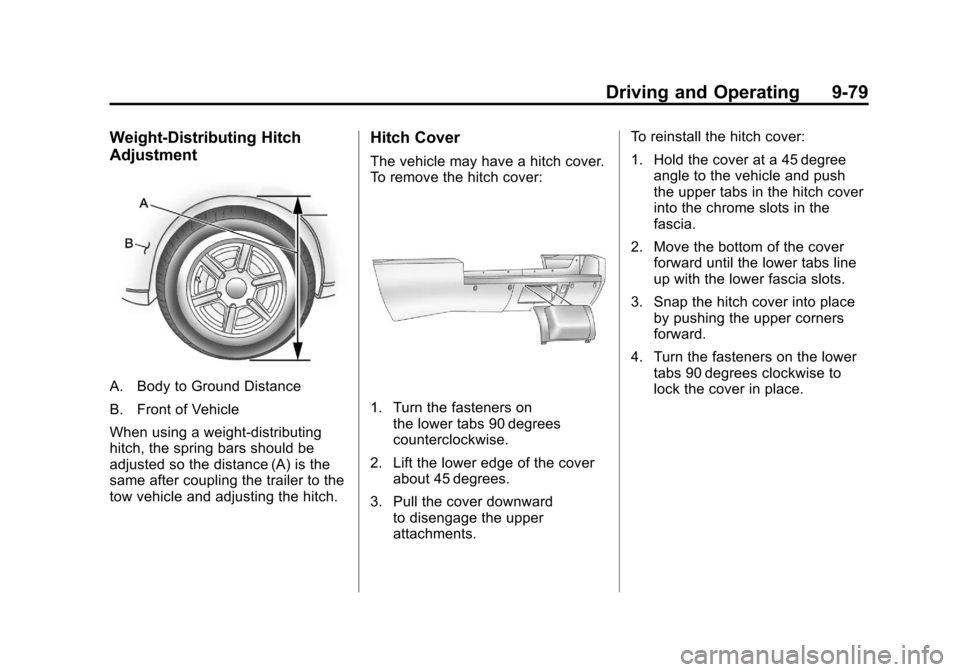
A. Body to Ground Distance
B. Front of Vehicle
When using a weight-distributing
hitch, the spring bars should be
adjusted so the distance (A) is the
same after coupling the trailer to the
tow vehicle and adjusting the hitch.
Hitch Cover
The vehicle may have a hitch cover.
To remove the hitch cover:
1. Turn the fasteners onthe lower tabs 90 degrees
counterclockwise.
2. Lift the lower edge of the cover about 45 degrees.
3. Pull the cover downward to disengage the upper
attachments. To reinstall the hitch cover:
1. Hold the cover at a 45 degree
angle to the vehicle and push
the upper tabs in the hitch cover
into the chrome slots in the
fascia.
2. Move the bottom of the cover forward until the lower tabs line
up with the lower fascia slots.
3. Snap the hitch cover into place by pushing the upper corners
forward.
4. Turn the fasteners on the lower tabs 90 degrees clockwise to
lock the cover in place.
Page 402 of 558
Black plate (80,1)Cadillac Escalade/Escalade ESV Owner Manual - 2011
9-80 Driving and Operating
Safety Chains
Always attach chains between the
vehicle and the trailer. Cross the
safety chains under the tongue
of the trailer to help prevent the
tongue from contacting the road
if it becomes separated from the
hitch. Instructions about safety
chains may be provided by the
hitch manufacturer or by the trailer
manufacturer. Safety chains should
be attached to holes on the trailer
hitch platform. Always leave just
enough slack so the combination
can turn. Never allow safety chains
to drag on the ground.
Trailer Brakes
A loaded trailer that weighs more
than 900 kg (2,000 lbs) needs to
have its own brake system that
is adequate for the weight of the
trailer. Be sure to read and follow
the instructions for the trailer brakes
so they are installed, adjusted and
maintained properly.Since the vehicle is equipped with
StabiliTrak, the trailer brakes cannot
tap into the vehicle's hydraulic
system.
Trailer Wiring Harness
Heavy-Duty Trailer Wiring Harness
Package
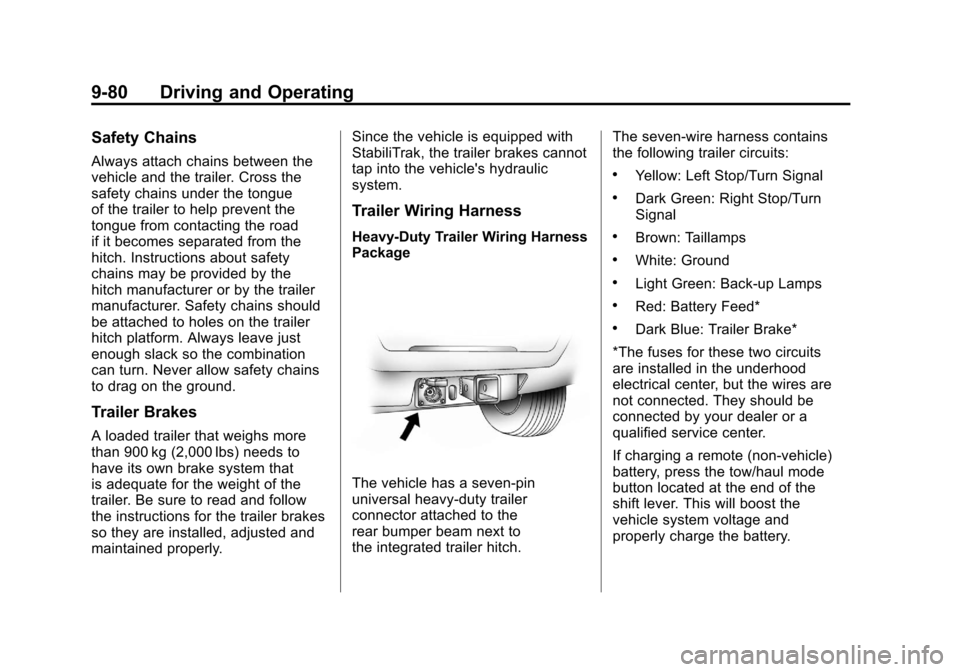
The vehicle has a seven-pin
universal heavy-duty trailer
connector attached to the
rear bumper beam next to
the integrated trailer hitch.
The seven-wire harness contains
the following trailer circuits:
.Yellow: Left Stop/Turn Signal
.Dark Green: Right Stop/Turn
Signal
.Brown: Taillamps
.White: Ground
.Light Green: Back-up Lamps
.Red: Battery Feed*
.Dark Blue: Trailer Brake*
*The fuses for these two circuits
are installed in the underhood
electrical center, but the wires are
not connected. They should be
connected by your dealer or a
qualified service center.
If charging a remote (non-vehicle)
battery, press the tow/haul mode
button located at the end of the
shift lever. This will boost the
vehicle system voltage and
properly charge the battery.
Page 403 of 558
Black plate (81,1)Cadillac Escalade/Escalade ESV Owner Manual - 2011
Driving and Operating 9-81
If the trailer is too light for tow/haul
mode, turn on the headlamps as a
second way to boost the vehicle
system and charge the battery.
Electric Brake Control Wiring
Provisions
These wiring provisions are
included with the vehicle as part of
the trailer wiring package. These
provisions are for an electric brake
controller. The instrument panel
contains blunt cut wires near the
data link connector for the trailer
brake controller. The harness
contains the following wires:
.Dark Blue: Brake Signal to
Trailer Connector
.Red/Black: Battery
.Light Blue/White: Brake Switch
.White: Ground
It should be installed by your dealer
or a qualified service center.
Tow/Haul Mode
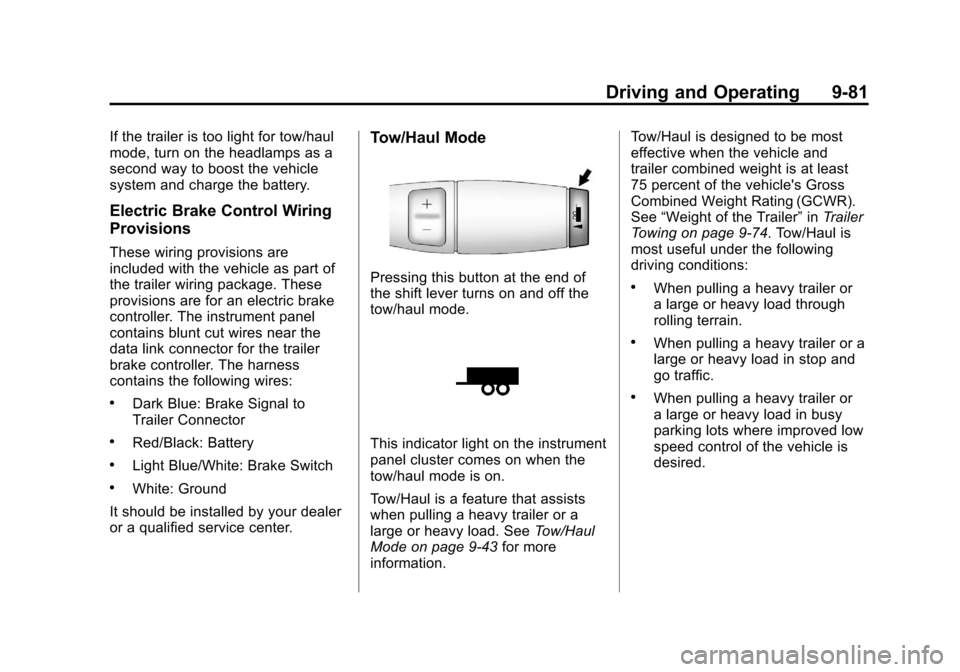
Pressing this button at the end of
the shift lever turns on and off the
tow/haul mode.
This indicator light on the instrument
panel cluster comes on when the
tow/haul mode is on.
Tow/Haul is a feature that assists
when pulling a heavy trailer or a
large or heavy load. See Tow/Haul
Mode on page 9‑43 for more
information. Tow/Haul is designed to be most
effective when the vehicle and
trailer combined weight is at least
75 percent of the vehicle's Gross
Combined Weight Rating (GCWR).
See
“Weight of the Trailer” inTrailer
Towing on page 9‑74. Tow/Haul is
most useful under the following
driving conditions:
.When pulling a heavy trailer or
a large or heavy load through
rolling terrain.
.When pulling a heavy trailer or a
large or heavy load in stop and
go traffic.
.When pulling a heavy trailer or
a large or heavy load in busy
parking lots where improved low
speed control of the vehicle is
desired.
Page 404 of 558

Black plate (82,1)Cadillac Escalade/Escalade ESV Owner Manual - 2011
9-82 Driving and Operating
Operating the vehicle in Tow/Haul
when lightly loaded or with no
trailer at all will not cause damage.
However, there is no benefit to
the selection of Tow/Haul when
the vehicle is unloaded. Such a
selection when unloaded may
result in unpleasant engine and
transmission driving characteristics
and reduced fuel economy. Tow/
Haul is recommended only when
pulling a heavy trailer or a large or
heavy load.Conversions and
Add-Ons
Add-On Electrical
Equipment
Notice:Do not add anything
electrical to the vehicle unless
you check with your dealer first.
Some electrical equipment can
damage the vehicle and the
damage would not be covered
by the vehicle's warranty. Some
add-on electrical equipment can
keep other components from
working as they should. Add-on equipment can drain the
vehicle's 12‐volt battery, even if the
vehicle is not operating.
The vehicle has an airbag system.
Before attempting to add anything
electrical to the vehicle, see
Servicing the Airbag-Equipped
Vehicle on page 3‑52
andAdding
Equipment to the Airbag-Equipped
Vehicle on page 3‑53.
Page 428 of 558
Black plate (24,1)Cadillac Escalade/Escalade ESV Owner Manual - 2011
10-24 Vehicle Care
If No Steam Is Coming from
the Engine Compartment
The ENGINE OVERHEATED
STOP ENGINE or the ENGINE
OVERHEATED IDLE ENGINE
message, along with a low coolant
condition, can indicate a serious
problem.
If there is an engine overheat
warning, but see or hear no steam,
the problem may not be too serious.
Sometimes the engine can get a
little too hot when the vehicle:
.Climbs a long hill on a hot day.
.Stops after high-speed driving.
.Idles for long periods in traffic.
.Tows a trailer. SeeTrailer
Towing on page 9‑74. If the ENGINE OVERHEATED
STOP ENGINE or the ENGINE
OVERHEATED IDLE ENGINE
message appears with no sign of
steam, try this for a minute or so:
If the overheat warning is displayed
with no sign of steam:
1. Turn the air conditioning off.
2. Turn the heater on to the highest
temperature and to the highest
fan speed. Open the windows
as necessary.
3. In heavy traffic, let the engine idle in N (Neutral) while stopped.
If it is safe to do so, pull off
the road, shift to P (Park)
or N (Neutral) and let the
engine idle. If the temperature overheat gauge
is no longer in the overheat zone
or an overheat warning no longer
displays, the vehicle can be driven.
Continue to drive the vehicle slowly
for about 10 minutes. Keep a safe
vehicle distance from the vehicle in
front. If the warning does not come
back on, continue to drive normally.
If the warning continues, pull
over, stop, and park the vehicle
right away.
If there is no sign of steam, idle
the engine for five minutes while
parked. If the warning is still
displayed, turn off the engine until it
cools down. Also, see
“Overheated
Engine Protection Operating Mode”
later in this section.