warning CADILLAC ESCALADE 2011 3.G Workshop Manual
[x] Cancel search | Manufacturer: CADILLAC, Model Year: 2011, Model line: ESCALADE, Model: CADILLAC ESCALADE 2011 3.GPages: 558, PDF Size: 7.59 MB
Page 114 of 558
Black plate (58,1)Cadillac Escalade/Escalade ESV Owner Manual - 2011
3-58 Seats and Restraints
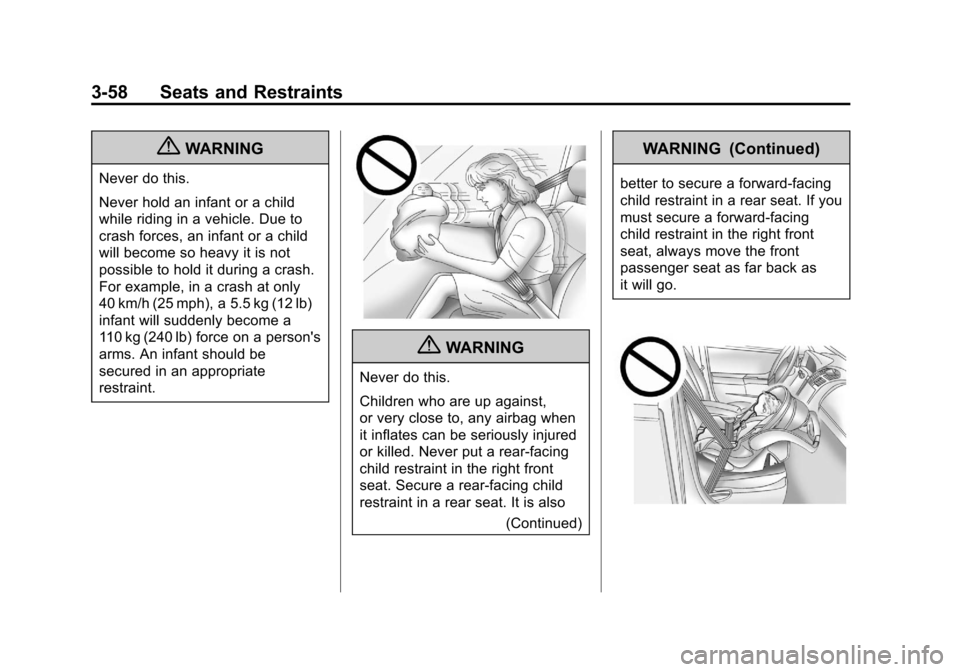
{WARNING
Never do this.
Never hold an infant or a child
while riding in a vehicle. Due to
crash forces, an infant or a child
will become so heavy it is not
possible to hold it during a crash.
For example, in a crash at only
40 km/h (25 mph), a 5.5 kg (12 lb)
infant will suddenly become a
110 kg (240 lb) force on a person's
arms. An infant should be
secured in an appropriate
restraint.
{WARNING
Never do this.
Children who are up against,
or very close to, any airbag when
it inflates can be seriously injured
or killed. Never put a rear-facing
child restraint in the right front
seat. Secure a rear-facing child
restraint in a rear seat. It is also(Continued)
WARNING (Continued)
better to secure a forward-facing
child restraint in a rear seat. If you
must secure a forward-facing
child restraint in the right front
seat, always move the front
passenger seat as far back as
it will go.
Page 115 of 558
Black plate (59,1)Cadillac Escalade/Escalade ESV Owner Manual - 2011
Seats and Restraints 3-59
Q: What are the different types ofadd-on child restraints?
A: Add-on child restraints, which
are purchased by the vehicle's
owner, are available in four basic
types. Selection of a particular
restraint should take into
consideration not only the child's
weight, height, and age but also
whether or not the restraint will
be compatible with the motor
vehicle in which it will be used.
For most basic types of child
restraints, there are many
different models available.
When purchasing a child
restraint, be sure it is designed
to be used in a motor vehicle.
If it is, the restraint will have a
label saying that it meets federal
motor vehicle safety standards.
The restraint manufacturer's
instructions that come with the
restraint state the weight and height limitations for a particular
child restraint. In addition, there
are many kinds of restraints
available for children with
special needs.
{WARNING
To reduce the risk of neck and
head injury during a crash,
infants need complete support.
This is because an infant's neck
is not fully developed and its head
weighs so much compared with
the rest of its body. In a crash,
an infant in a rear-facing child
restraint settles into the restraint,
so the crash forces can be
distributed across the strongest
part of an infant's body, the back
and shoulders. Infants should
always be secured in rear-facing
child restraints.
{WARNING
A young child's hip bones are still
so small that the vehicle's regular
safety belt may not remain low
on the hip bones, as it should.
Instead, it may settle up around
the child's abdomen. In a crash,
the belt would apply force on a
body area that is unprotected by
any bony structure. This alone
could cause serious or fatal
injuries. To reduce the risk of
serious or fatal injuries during a
crash, young children should
always be secured in appropriate
child restraints.
Page 117 of 558
Black plate (61,1)Cadillac Escalade/Escalade ESV Owner Manual - 2011
Seats and Restraints 3-61
Securing an Add-On Child
Restraint in the Vehicle
{WARNING
A child can be seriously injured
or killed in a crash if the child
restraint is not properly secured
in the vehicle. Secure the child
restraint properly in the vehicle
using the vehicle's safety belt or
LATCH system, following the
instructions that came with that
child restraint and the instructions
in this manual.
To help reduce the chance of injury,
the child restraint must be secured
in the vehicle. Child restraint
systems must be secured in vehicle
seats by lap belts or the lap belt
portion of a lap-shoulder belt, or by the LATCH system. See
Lower
Anchors and Tethers for Children
(LATCH System) on page 3‑63 for
more information. Children can be
endangered in a crash if the child
restraint is not properly secured in
the vehicle.
When securing an add-on child
restraint, refer to the instructions
that come with the restraint which
may be on the restraint itself or in a
booklet, or both, and to this manual.
The child restraint instructions
are important, so if they are not
available, obtain a replacement
copy from the manufacturer.
Keep in mind that an unsecured
child restraint can move around in a
collision or sudden stop and injure
people in the vehicle. Be sure to
properly secure any child restraint
in the vehicle —even when no child
is in it. In some areas of the United States
and Canada, Certified Child
Passenger Safety Technicians
(CPSTs) are available to inspect
and demonstrate how to correctly
use and install child restraints.
In the U.S., refer to the
National Highway Traffic Safety
Administration (NHTSA) website
to locate the nearest child safety
seat inspection station. For CPST
availability in Canada, check with
Transport Canada or the Provincial
Ministry of Transportation office.
Securing the Child Within the
Child Restraint
{WARNING
A child can be seriously injured
or killed in a crash if the child
is not properly secured in the
child restraint. Secure the child
properly following the instructions
that came with that child restraint.
Page 118 of 558
Black plate (62,1)Cadillac Escalade/Escalade ESV Owner Manual - 2011
3-62 Seats and Restraints
Where to Put the
Restraint
According to accident statistics,
children and infants are safer
when properly restrained in a child
restraint system or infant restraint
system secured in a rear seating
position.
We recommend that children and
child restraints be secured in a rear
seat, including: an infant or a child
riding in a rear-facing child restraint;
a child riding in a forward-facing
child seat; an older child riding in a
booster seat; and children, who are
large enough, using safety belts.
A label on your sun visor says,
“Never put a rear-facing child seat
in the front.”This is because the risk
to the rear-facing child is so great,
if the airbag deploys.
{WARNING
A child in a rear-facing child
restraint can be seriously
injured or killed if the right
front passenger airbag inflates.
This is because the back of the
rear-facing child restraint would
be very close to the inflating
airbag. A child in a forward-facing
child restraint can be seriously
injured or killed if the right front
passenger airbag inflates and the
passenger seat is in a forward
position.
The vehicle may have a
passenger sensing system which
is designed to turn off the right
front passenger frontal airbag
under certain conditions.
Even if the passenger sensing
system, if equipped, has turned
off the right front passenger
(Continued)
WARNING (Continued)
frontal airbag, no system
is fail-safe. No one can
guarantee that an airbag
will not deploy under some
unusual circumstance, even
though it is turned off.
Secure rear-facing child restraints
in a rear seat, even if the
airbag is off. If you secure a
forward-facing child restraint in
the right front seat, always move
the front passenger seat as far
back as it will go. It is better to
secure the child restraint in a
rear seat.
SeePassenger Sensing System
on page 3‑48 for additional
information.
Page 119 of 558
Black plate (63,1)Cadillac Escalade/Escalade ESV Owner Manual - 2011
Seats and Restraints 3-63
{WARNING
A child in a child restraint in the
center front seat can be badly
injured or killed by the frontal
airbags if they inflate. Never
secure a child restraint in the
center front seat. It is always
better to secure a child restraint
in a rear seat.
Do not use child restraints in the
center front seat position.
When securing a child restraint in
a rear seating position, study the
instructions that came with your
child restraint to make sure it is
compatible with this vehicle.
Child restraints and booster seats
vary considerably in size, and some
may fit in certain seating positions
better than others. Always make
sure the child restraint is properly
secured. Depending on where you place
the child restraint and the size of
the child restraint, you may not
be able to access adjacent safety
belt assemblies or LATCH anchors
for additional passengers or
child restraints. Adjacent seating
positions should not be used if the
child restraint prevents access to
or interferes with the routing of the
safety belt.
Wherever a child restraint is
installed, be sure to secure the
child restraint properly.
Keep in mind that an unsecured
child restraint can move around in a
collision or sudden stop and injure
people in the vehicle. Be sure to
properly secure any child restraint in
your vehicle
—even when no child
is in it.
Lower Anchors and
Tethers for Children
(LATCH System)
The LATCH system holds a child
restraint during driving or in a crash.
This system is designed to make
installation of a child restraint easier.
The LATCH system uses anchors in
the vehicle and attachments on the
child restraint that are made for use
with the LATCH system.
Make sure that a LATCH-compatible
child restraint is properly installed
using the anchors, or use the
vehicle's safety belts to secure the
restraint, following the instructions
that came with that restraint, and
also the instructions in this manual.
Page 124 of 558
Black plate (68,1)Cadillac Escalade/Escalade ESV Owner Manual - 2011
3-68 Seats and Restraints
Securing a Child Restraint
Designed for the LATCH
System
{WARNING
If a LATCH-type child restraint is
not attached to anchors, the child
restraint will not be able to protect
the child correctly. In a crash, the
child could be seriously injured
or killed. Install a LATCH-type
child restraint properly using
the anchors, or use the vehicle's
safety belts to secure the
restraint, following the instructions
that came with the child restraint
and the instructions in this
manual.
{WARNING
Do not attach more than one
child restraint to a single anchor.
Attaching more than one child
restraint to a single anchor could
cause the anchor or attachment
to come loose or even break
during a crash. A child or others
could be injured. To reduce the
risk of serious or fatal injuries
during a crash, attach only one
child restraint per anchor.
{WARNING
Children can be seriously injured
or strangled if a shoulder belt is
wrapped around their neck and
the safety belt continues to
tighten. Buckle any unused safety
belts behind the child restraint
so children cannot reach them.
Pull the shoulder belt all the way
out of the retractor to set the lock,
if your vehicle has one, after the
child restraint has been installed.
Page 127 of 558
Black plate (71,1)Cadillac Escalade/Escalade ESV Owner Manual - 2011
Seats and Restraints 3-71
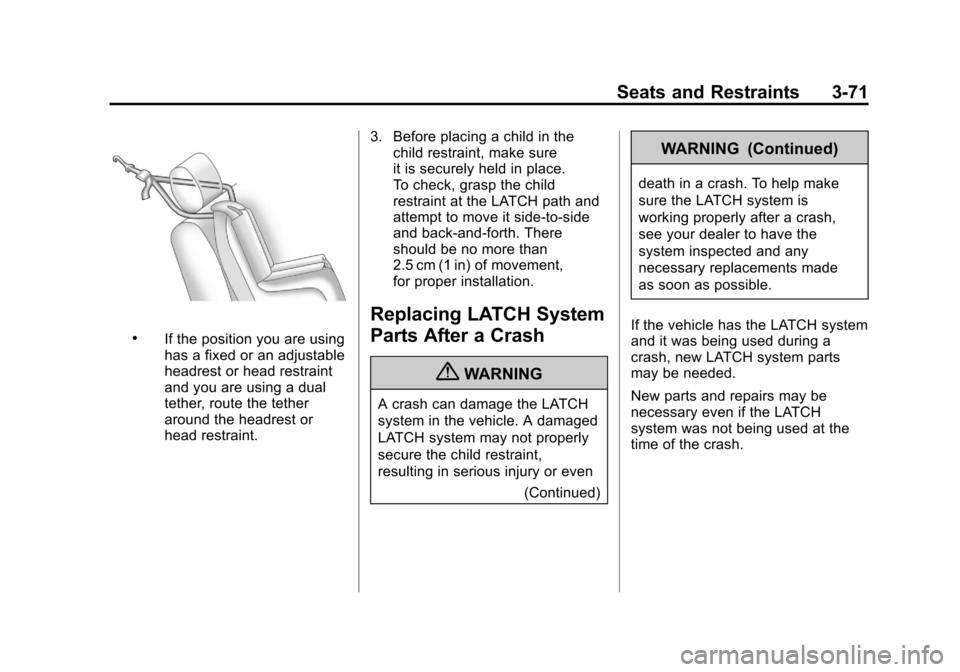
.If the position you are using
has a fixed or an adjustable
headrest or head restraint
and you are using a dual
tether, route the tether
around the headrest or
head restraint.3. Before placing a child in the
child restraint, make sure
it is securely held in place.
To check, grasp the child
restraint at the LATCH path and
attempt to move it side‐to‐side
and back‐and‐forth. There
should be no more than
2.5 cm (1 in) of movement,
for proper installation.
Replacing LATCH System
Parts After a Crash
{WARNING
A crash can damage the LATCH
system in the vehicle. A damaged
LATCH system may not properly
secure the child restraint,
resulting in serious injury or even
(Continued)
WARNING (Continued)
death in a crash. To help make
sure the LATCH system is
working properly after a crash,
see your dealer to have the
system inspected and any
necessary replacements made
as soon as possible.
If the vehicle has the LATCH system
and it was being used during a
crash, new LATCH system parts
may be needed.
New parts and repairs may be
necessary even if the LATCH
system was not being used at the
time of the crash.
Page 131 of 558
Black plate (75,1)Cadillac Escalade/Escalade ESV Owner Manual - 2011
Seats and Restraints 3-75
6. If the child restraint has a toptether, follow the child restraint
manufacturer's instructions
regarding the use of the top
tether. See Lower Anchors and
Tethers for Children (LATCH
System) on page 3‑63 for more
information.
7. Before placing a child in the child restraint, make sure it is
securely held in place. To check,
grasp the child restraint at the
safety belt path and attempt
to move it side‐to‐side and
back‐and‐forth. When the child
restraint is properly installed,
there should be no more than
2.5 cm (1 in) of movement.
To remove the child restraint,
unbuckle the vehicle safety belt and
let it return to the stowed position.
If the top tether is attached to a top
tether anchor, disconnect it.Securing Child Restraints
(Center Front Seat
Position)
{WARNING
A child in a child restraint in the
center front seat can be badly
injured or killed by the frontal
airbags if they inflate. Never
secure a child restraint in the
center front seat. It is always
better to secure a child restraint
in a rear seat.
Do not use child restraints in the
center front seat position.
Securing Child Restraints
(Right Front Seat
Position)
This vehicle has airbags. A rear
seat is a safer place to secure
a forward-facing child restraint.
See Where to Put the Restraint on
page 3‑62.
In addition, the vehicle may have a
passenger sensing system which is
designed to turn off the right front
passenger frontal airbag under
certain conditions. See Passenger
Sensing System on page 3‑48 and
Passenger Airbag Status Indicator
on page 5‑16 for more information,
including important safety
information.
Page 132 of 558
Black plate (76,1)Cadillac Escalade/Escalade ESV Owner Manual - 2011
3-76 Seats and Restraints
A label on the sun visor says,
“Never put a rear-facing child seat in
the front.”This is because the risk to
the rear-facing child is so great if the
airbag deploys.
{WARNING
A child in a rear-facing child
restraint can be seriously
injured or killed if the right
front passenger airbag inflates.
This is because the back of the
rear-facing child restraint would
be very close to the inflating
airbag. A child in a forward-facing
child restraint can be seriously
injured or killed if the right front
passenger airbag inflates and the
passenger seat is in a forward
position.
The vehicle may have a
passenger sensing system which
is designed to turn off the right
front passenger frontal airbag
under certain conditions.
(Continued)
WARNING (Continued)
Even if the passenger
sensing system, if equipped,
has turned off the right front
passenger frontal airbag, no
system is fail-safe. No one can
guarantee that an airbag will not
deploy under some unusual
circumstance, even though it
is turned off.
Secure rear-facing child
restraints in a rear seat, even if
the airbag is off. If you secure a
forward-facing child restraint in
the right front seat, always move
the front passenger seat as far
back as it will go. It is better to
secure the child restraint in a
rear seat.
SeePassenger Sensing System
on page 3‑48 for additional
information. If the child restraint has the LATCH
system, see
Lower Anchors and
Tethers for Children (LATCH
System) on page 3‑63 for how and
where to install the child restraint
using LATCH. If a child restraint
is secured using a safety belt and
it uses a top tether, see Lower
Anchors and Tethers for Children
(LATCH System) on page 3‑63 for
top tether anchor locations.
Do not secure a child seat in a
position without a top tether anchor
if a national or local law requires
that the top tether be anchored, or if
the instructions that come with the
child restraint say that the top strap
must be anchored.
In Canada, the law requires that
forward-facing child restraints have
a top tether, and that the tether be
attached.
Page 137 of 558
Black plate (3,1)Cadillac Escalade/Escalade ESV Owner Manual - 2011
Storage 4-3
Center Console Storage
A console compartment is located
between the bucket seats.
The console has both an upper and
lower storage bin accessed by lifting
up on the latches located at the
front of the console lid.
The console may have an
accessory power outlet inside.
SeePower Outlets on page 5‑9.
The rear of the console also has a
cupholder that swings down for the
rear seat passengers to use.
Roof Rack System
{WARNING
If something is carried on top of
the vehicle that is longer or wider
than the roof rack— like paneling,
plywood, or a mattress— the wind
can catch it while the vehicle is
being driven. The item being
carried could be violently torn off,
and this could cause a collision,
and damage the vehicle. Never
carry something longer or wider
than the roof rack on top of the
vehicle unless using a GM
Certified accessory carrier.
For vehicles with a roof rack, the
rack can be used to load items.
For roof racks that do not have
crossrails included, GM Certified
crossrails can be purchased as
an accessory. See your dealer
for additional information. For vehicles with crossrails, they
can be moved back and forth to
help secure cargo. To adjust them,
turn the knob located at each end
of the crossrail counterclockwise
until the crossrail can move freely.
To secure the crossrail, turn the
knob located at each end of the
crossrail clockwise until tightened.
Tie the load to the siderails or
siderail supports.
Notice:
Loading cargo on the
roof rack that weighs more than
91 kg (200 lbs) or hangs over the
rear or sides of the vehicle may
damage the vehicle. Load cargo
so that it rests evenly between
the crossrails, making sure to
fasten cargo securely.
To prevent damage or loss of
cargo when driving, check to
make sure crossrails and cargo
are securely fastened. Loading
cargo on the roof rack will make the
vehicle’s center of gravity higher.