reset CADILLAC ESCALADE 2016 4.G Owner's Manual
[x] Cancel search | Manufacturer: CADILLAC, Model Year: 2016, Model line: ESCALADE, Model: CADILLAC ESCALADE 2016 4.GPages: 357, PDF Size: 3.49 MB
Page 322 of 357
Cadillac Escalade Owner Manual (GMNA-Localizing-MidEast-9369153) -
2016 - crc - 6/19/15
Vehicle Care 321
10. Move the steering wheel tomake sure the steering column
is unlocked.
11. With a foot on the brake pedal, release the parking brake.
12. If equipped with Keyless Access, keep the RKE
transmitter outside of the
vehicle, and manually lock the
doors. Access the vehicle as if
it has a dead RKE transmitter
battery, by using the key in the
door lock.
Disconnecting the Towed Vehicle
Before disconnecting the towed
vehicle: 1. Park on a level surface.
2. Set the parking brake, then shift the transmission to
P (Park).
3. Connect the battery.
4. Apply the brake pedal.
5. Turn the ignition to ON/RUN with the engine off. Shift the
transfer case out of N (Neutral)
to 2
m. See “Shifting out of N (Neutral)”
underFour-Wheel
Drive 0213. See your dealer if
the transfer case cannot be
shifted out of N (Neutral).
6. Check that the vehicle is in 2
m
by starting the engine and
shifting the transmission to
R (Reverse) and then to D
(Drive). There should be
movement of the vehicle while
shifting.
7. Shift the transmission to P (Park) and turn off the
ignition.
8. Disconnect the vehicle from the tow vehicle.
9. Release the parking brake.
10. Reset any lost presets. The outside temperature
display will default to 0 °C (32 °
F) but will reset with normal
usage.
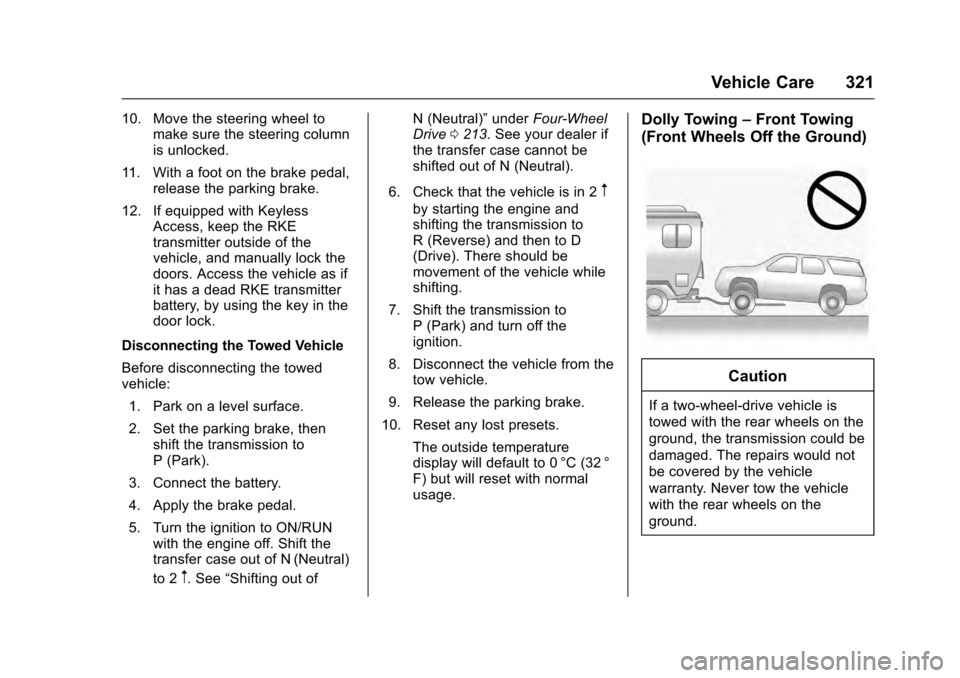
Dolly Towing –Front Towing
(Front Wheels Off the Ground)
Caution
If a two-wheel-drive vehicle is
towed with the rear wheels on the
ground, the transmission could be
damaged. The repairs would not
be covered by the vehicle
warranty. Never tow the vehicle
with the rear wheels on the
ground.
Page 334 of 357
Cadillac Escalade Owner Manual (GMNA-Localizing-MidEast-9369153) -
2016 - crc - 6/19/15
Service and Maintenance 333
At your dealer, you can be certain
that you will receive the highest
level of service available. Your
dealer has specially trained service
technicians, uses genuine
replacement parts, as well as,
up-to-date tools and equipment to
ensure fast and accurate
diagnostics.
The proper replacement parts,
fluids, and lubricants to use are
listed inRecommended Fluids and
Lubricants 0338 andMaintenance
Replacement Parts 0339. We
recommend the use of genuine
parts from your dealer.
Rotation of New Tires
Tire rotation is not recommended if
the vehicle has different size tires
on the front and rear wheels. If tire
rotation is recommended for the
vehicle, to maintain ride, handling,
and performance of the vehicle, it is
important that the first rotation
service for new tires be performed.
Tires should be rotated every
service. See Tire Rotation 0299.Maintenance
Schedule
When the Change Engine Oil
Soon Message Displays
Change engine oil and filter. See
Engine Oil 0262. An Emission
Control Service.
When the CHANGE ENGINE OIL
SOON message displays, service is
required for the vehicle as soon as
possible, within the next 1 000 km/
600 miles. If driving under the best
conditions, the engine oil life system
may not indicate the need for
vehicle service for up to a year. The
engine oil and filter must be
changed at least once a year and
the oil life system must be reset.
Your dealer has trained service
technicians who will perform this
work and reset the system. If the
engine oil life system is reset
accidentally, service the vehicle
within 5 000 km/3,000 miles since
the last service. Reset the oil life
system whenever the oil is changed.
See Engine Oil Life System 0264.
Passenger Compartment Air
Filter
The passenger compartment air
filter reduces dust, pollen, and other
airborne irritants from outside air
that is pulled into the vehicle. The
filter should be replaced as part of
routine scheduled maintenance.
Inspect the passenger compartment
air filter every 36 000 km/
22,500 miles or two years,
whichever comes first. Replace if
necessary. More frequent
replacement may be needed if the
vehicle is driven in areas with heavy
traffic, poor air quality, areas with
high dust levels or are sensitive to
environmental allergens. Filter
replacement may also be needed if
you notice reduced airflow, windows
fogging up, or odors. Your local GM
Service location can help you
determine when it is the right time to
replace your filter.
Page 335 of 357

Cadillac Escalade Owner Manual (GMNA-Localizing-MidEast-9369153) -
2016 - crc - 6/19/15
334 Service and Maintenance
Every Engine Oil Change
.Change engine oil and filter.
Reset oil life system. See
Engine Oil 0262 and Engine Oil
Life System 0264. An Emission
Control Service.
. Engine coolant level check. See
Engine Coolant 0268.
. Engine cooling system
inspection. Visual inspection of
hoses, pipes, fittings, and
clamps and replacement,
if needed.
. Windshield washer fluid level
check. See Washer Fluid 0272.
. Windshield wiper blade
inspection for wear, cracking,
or contamination and windshield
and wiper blade cleaning,
if contaminated. See Exterior
Care 0323. Worn or damaged
wiper blade replacement. See
Wiper Blade Replacement
0 278.
. Tire inflation pressures check.
See Tire Pressure 0293. .
Tire wear inspection. See Tire
Inspection 0299.
. Rotate tires if necessary. See
Tire Rotation 0299.
. Fluids visual leak check (or
every 12 months, whichever
occurs first). A leak in any
system must be repaired and the
fluid level checked.
. Engine air cleaner filter
inspection. See Engine Air
Cleaner/Filter 0266.
. Brake system inspection (or
every 12 months, whichever
occurs first). See Exterior Care
0 323.
. Visually inspect steering,
suspension, and chassis
components for damaged, loose,
or missing parts or signs of wear
at least once a year. See
Exterior Care 0323.
Lubricate the steering and
suspension components at least
every other oil change.
(If equipped with grease fittings) .
Body hinges and latches, key
lock cylinders, rear compartment
hinges, outer tailgate handle
pivot points, and folding seat
hardware lubrication. See
Recommended Fluids and
Lubricants 0338. More frequent
lubrication may be required
when the vehicle is exposed to a
corrosive environment. Applying
silicone grease on weatherstrips
with a clean cloth makes them
last longer, seal better, and not
stick or squeak.
. Restraint system component
check. See Safety System
Check 076.
. Fuel system inspection for
damage or leaks.
. Exhaust system and nearby heat
shields inspection for loose or
damaged components.
. Verify spare tire key lock
operation and lubricate as
needed. See Tire Changing
0 306.
Page 346 of 357
Cadillac Escalade Owner Manual (GMNA-Localizing-MidEast-9369153) -
2016 - crc - 6/19/15
Customer Information 345
Customer
Information
Vehicle Data Recording and
Privacy
Vehicle Data Recording andPrivacy . . . . . . . . . . . . . . . . . . . . . . 345
Event Data Recorders . . . . . . . . 345
Infotainment System . . . . . . . . . . 346
Vehicle Data
Recording and
Privacy
The vehicle has a number of
computers that record information
about the vehicle’s performance and
how it is driven. For example, the
vehicle uses computer modules to
monitor and control engine and
transmission performance, to
monitor the conditions for airbag
deployment and deploy them in a
crash, and, if equipped, to provide
antilock braking to help the driver
control the vehicle. These modules
may store data to help the dealer
technician service the vehicle.
Some modules may also store data
about how the vehicle is operated,
such as rate of fuel consumption or
average speed. These modules may
retain personal preferences, such as
radio presets, seat positions, and
temperature settings.
Event Data Recorders
This vehicle is equipped with an
event data recorder (EDR). The
main purpose of an EDR is to
record, in certain crash or near
crash-like situations, such as an
airbag deployment or hitting a road
obstacle, data that will assist in
understanding how a vehicle's
systems performed. The EDR is
designed to record data related to
vehicle dynamics and safety
systems for a short period of time,
typically 30 seconds or less. The
EDR in this vehicle is designed to
record such data as:
. How various systems in your
vehicle were operating.
. Whether or not the driver and
passenger safety belts were
buckled/fastened;
. How far (if at all) the driver was
depressing the accelerator and/
or brake pedal; and
. How fast the vehicle was
traveling.