automatic transmission CADILLAC ESCALADE 2021 Owner's Guide
[x] Cancel search | Manufacturer: CADILLAC, Model Year: 2021, Model line: ESCALADE, Model: CADILLAC ESCALADE 2021Pages: 492, PDF Size: 7.92 MB
Page 269 of 492

Cadillac Escalade Owner Manual (GMNA-Localizing-U.S./Canada/Mexico-
13690472) - 2021 - CRC - 8/10/21
268 DRIVING AND OPERATING
for better control at lower speeds and
over rough terrain. This mode
modifies accelerator pedal mapping,
transmission shift pattern, ride height,
suspension, steering, AWD, Electronic
Limited-Slip Differential (eSLD), ESC
performance and TCS performance.
When the vehicle comes to a stop on
an upward grade, Automatic Vehicle
Hold is engaged until the driver
presses the accelerator pedal. Stop/
Start and cruise control are disabled
in Terrain Mode.
Active Braking during lift throttle will
be engaged. This feature automatically
applies light braking to simulate
heavy engine braking of
four-wheel-dive low. It also applies
light braking in D (Drive) until the
vehicle is at idle speeds. In M1 and
M2 light braking will typically bring
the vehicle to a stop. Active Braking
during lift throttle will also reduce
trailer braking.
Terrain Mode will automatically exit
to Tour Mode if the brake
temperatures become too hot,electronic parking brake becomes
inoperable or the vehicle cannot
perform braking or vehicle hold.
For more information on off-road
driving, see
Off-Road Driving 0234 and
Hill and Mountain Roads 0238.
Magnetic Ride Control
This vehicle may have a semi-active
damping system called Magnetic Ride
Control. With this feature, improved
vehicle ride and handling is provided
under a variety of passenger and
loading conditions.
Locking Rear Axle
Vehicles with a locking rear axle can
give more traction on snow, mud, ice,
sand, or gravel. It works like a
standard axle most of the time, but
when traction is low, this feature will
allow the rear wheel with the most
traction to move the vehicle.
Four Corner Air Suspension
System
The Four Corner Air Suspension
feature provides full time load leveling
capability along with the benefit of
adjusting ride height for increased
convenience and capability.
{Warning
To help avoid personal injury or
death, make sure the area
underneath the vehicle and inside
the wheel wells is clear when
lowering the vehicle.
{Warning
To help avoid personal injury or
death, always select the lowest ride
height for the current driving
conditions. Higher ride heights raise
the vehicle's center of gravity,
increasing the chance of a rollover
during extreme maneuvers.
Page 274 of 492

Cadillac Escalade Owner Manual (GMNA-Localizing-U.S./Canada/Mexico-
13690472) - 2021 - CRC - 8/10/21
DRIVING AND OPERATING 273
.To increase vehicle speed in small
increments, press RES+ up briefly to
the first detent. For each press, the
vehicle goes about 1 km/h (1 mph)
faster.
The speedometer reading can be
displayed in either English or metric
units. See Instrument Cluster 0114.
The increment value used depends on
the units displayed.
Reducing Speed While Cruise
Control is at a Set Speed
If the cruise control system is already
activated:
.Press and hold SET− down until the
desired lower speed is reached, then
release it.
.To decrease the vehicle speed in
small increments, press SET− down
briefly. For each press, the vehicle
goes about 1 km/h (1 mph) slower.
The speedometer reading can be
displayed in either English or metric
units. See Instrument Cluster 0114.
The increment value used depends on
the units displayed. Passing Another Vehicle While
Using Cruise Control
Use the accelerator pedal to increase
the vehicle speed. When you take your
foot off the pedal, the vehicle will slow
down to the previous set cruise speed.
While pressing the accelerator pedal
or shortly following the release to
override cruise, briefly applying the
SET−
control will result in cruise set
to the current vehicle speed.
Using Cruise Control on Hills
How well the cruise control works on
hills depends on the vehicle speed, the
load, and the steepness of the hills.
When going up steep hills, pressing
the accelerator pedal may be
necessary to maintain vehicle speed.
When going downhill, Cruise Grade
Braking helps maintain the driver
selected speed.
Cruise Grade Braking is enabled when
the vehicle is started and cruise
control is active. It is not enabled in
Range Selection Mode. It assists in
maintaining driver selected speed when driving on downhill grades by
using the engine and transmission to
slow the vehicle.
To disable and enable Cruise Grade
Braking for the current ignition cycle,
press and hold the Tow/Haul button
for five seconds. A Driver Information
Center (DIC) message displays.
For other forms of Grade Braking, see
Automatic Transmission
0251 and
Tow/Haul Mode 0256.
Ending Cruise Control
There are four ways to end cruise
control:
.Step lightly on the brake pedal.
.Press*.
.Shift the transmission to
N (Neutral).
.To turn off cruise control, pressJ.
Erasing Speed Memory
The cruise control set speed is erased
from memory if
Jis pressed or if the
ignition is turned off.
Page 331 of 492
Cadillac Escalade Owner Manual (GMNA-Localizing-U.S./Canada/Mexico-
13690472) - 2021 - CRC - 8/10/21
330 DRIVING AND OPERATING
assistance with preparing the vehicle
to tow a trailer. Read the entire
section before towing a trailer.
To tow a disabled vehicle, seeTowing
the Vehicle 0428. To tow the vehicle
behind another vehicle such as a
motor home, see Recreational Vehicle
Towing 0429.
Driving Characteristics and
Towing Tips
{Warning
You can lose control when towing a
trailer if the correct equipment is
not used or the vehicle is not driven
properly. For example, if the trailer
is too heavy or the trailer brakes are
inadequate for the load, the vehicle
may not stop as expected. You and
others could be seriously injured.
The vehicle may also be damaged,
and the repairs would not be
covered by the vehicle warranty.
Pull a trailer only if all the steps in
this section have been followed. Ask
(Continued)
Warning (Continued)
your dealer for advice and
information about towing a trailer
with the vehicle.
Driving with a Trailer
Trailering is different than just driving
the vehicle by itself. Trailering means
changes in handling, acceleration,
braking, durability, and fuel economy.
Successful, safe trailering takes correct
equipment, and it has to be used
properly.
The following information has many
time-tested, important trailering tips
and safety rules. Many of these are
important for your safety and that of
your passengers. Read this section
carefully before pulling a trailer.
When towing a trailer:
.Become familiar with and follow all
state and local laws that apply to
trailer towing. These requirements
vary from state to state.
.State laws may require the use of
extended side view mirrors. Even if
not required, you should install extended side view mirrors if your
visibility is limited or restricted
while towing.
.Do not tow a trailer during the first
800 km (500 mi) of vehicle use to
prevent damage to the engine, axle,
or other parts.
.It is recommended to perform the
first oil change before heavy towing.
.During the first 800 km (500 mi) of
trailer towing, do not drive over
80 km/h (50 mph) and do not make
starts at full throttle.
.Vehicles can tow in D (Drive). Tow/
Haul Mode is recommended for
heavier trailers. See
Tow/Haul Mode
0 256. If the transmission
downshifts too often, a lower gear
may be selected using Manual
Mode. See Manual Mode 0255.
If equipped, the following driver
assistance features should be turned
off when towing a trailer:
.Adaptive Cruise Control (ACC)
.Super Cruise Control
.Lane Keep Assist (LKA)
.Park Assist
.Automatic Parking Assist (APA)
Page 345 of 492
Cadillac Escalade Owner Manual (GMNA-Localizing-U.S./Canada/Mexico-
13690472) - 2021 - CRC - 8/10/21
344 DRIVING AND OPERATING
Turn Signals When Towing a
Trailer
When properly connected, the trailer
turn signals should will illuminate to
indicate the vehicle is turning,
changing lanes, or stopping. When
towing a trailer, the arrows on the
instrument cluster will illuminate
even if the trailer is not properly
connected or the bulbs are
burned out.
Tow/Haul Mode
For instructions on how to enter Tow/
Haul mode, seeTow/Haul Mode0256.
Tow/Haul assists when pulling a
heavy trailer or a large or heavy load.
Tow/Haul Mode is designed to be
most effective when the vehicle and
trailer combined weight is at least
75% of the vehicle's Gross Combined
Weight Rating (GCWR). See
“Maximum Trailer Weight ”under
Trailer Towing 0334.
Tow/Haul Mode is most useful when
towing a heavy trailer or carrying a
large or heavy load:
.through rolling terrain
.in stop-and-go traffic
.in busy parking lots
Operating the vehicle in Tow/Haul
Mode when lightly loaded or not
towing will not cause damage;
however, it is not recommended and
may result in unpleasant engine and
transmission driving characteristics
and reduced fuel economy.
Integrated Trailer Brake Control
System
The vehicle may have an Integrated
Trailer Brake Control (ITBC) system
for use with electric trailer brakes or
most electric over hydraulic trailer
brake systems. These instructions
apply to both types of electric trailer
brakes.
This symbol is on the Trailer Brake
Control Panel on vehicles with an
ITBC system. The power output to the
trailer brakes is proportional to the amount of vehicle braking. This
available power output to the trailer
brakes can be adjusted to a wide
range of trailering situations.
The ITBC system is integrated with
the vehicle’s brake, anti-lock brake,
and StabiliTrak/Electronic Stability
Control (ESC) systems. In trailering
conditions that cause the vehicle’s
anti-lock brake or StabiliTrak/ESC
systems to activate, power sent to the
trailer's brakes will be automatically
adjusted to minimize trailer wheel
lock-up. This does not imply that the
trailer has StabiliTrak/ESC.
If the vehicle’s brake, anti-lock brake,
or StabiliTrak systems are not
functioning properly, the ITBC system
may not function fully or at all. Make
sure all of these systems are fully
operational to allow the ITBC system
to function properly.
The ITBC system is powered through
the vehicle's electrical system. Turning
the ignition off will also turn off the
ITBC system. The ITBC system is fully
functional only when the ignition is in
ON/RUN.
Page 355 of 492

Cadillac Escalade Owner Manual (GMNA-Localizing-U.S./Canada/Mexico-
13690472) - 2021 - CRC - 8/10/21
354 DRIVING AND OPERATING
Light Test
Touch Start Light Test to cycle the
trailer lights on and off to determine if
they are working. The test follows this
sequence:1. The running lights turn on first and remain on throughout the
sequence.
2. The brake lights turn on for about two seconds.
3. The left turn signal light flashes three times.
4. The right turn signal light flashes three times.
5. The reverse lights turn on for about two seconds.
6. Steps 2–5 repeat for approximately one minute and 45 seconds,
or until the test deactivates.
Touch Stop to stop the test. The test
will automatically end after
one minute and 45 seconds.
The sequence also deactivates when
any of the following occur:
.The ignition is turned off.
.The transmission is shifted out of
P (Park).
.The brake pedal is pressed.
.The turn signal is activated.
.The hazard warning lights are
activated.
Tires
1. Trailer Tire Pressure/Temperature
Tire Pressure and Temperature
If the TTPMS sensor-to-vehicle learn
process was completed, the status
view will display the current tire
pressure and temperature of the
trailer tires related to the active
Trailer Profile. If a tire’s pressure is
low or high, the color of the pressure
value will be amber. If a sensor
malfunctions, the values are dashed
lines. If the screen displays “ServiceTire Pressure Monitoring System
”, the
vehicle needs to be taken to a dealer
for service.
Maintenance
1. List of Maintenance Reminders
2. Add a New Maintenance Reminder
The Maintenance Status view displays
reminders. Touch a reminder to edit.
Touch + New Maintenance Reminder
to go to the Select New
Reminder view.
The progress bar turns yellow when
the maintenance item reaches 90%
complete.
The progress bar turns red when the
maintenance item reaches 100%
complete.
Page 363 of 492
Cadillac Escalade Owner Manual (GMNA-Localizing-U.S./Canada/Mexico-
13690472) - 2021 - CRC - 8/10/21
362 VEHICLE CARE
Vehicle Care
General Information
General Information . . . . . . . . . . . . . 363
California Proposition65 Warning . . . . . . . . . . . . . . . . . . . . . 363
California Perchlorate Materials Requirements . . . . . . . . . . . . . . . . . . . 363
Accessories and Modifications . . . . . . . . . . . . . . . . . . . 364
Vehicle Checks
Doing Your OwnService Work . . . . . . . . . . . . . . . . . . . . 364
Hood . . . . . . . . . . . . . . . . . . . . . . . . . . . . . . 365
Engine Compartment Overview . . . . . . . . . . . . . . . . . . . . . . . . . 366
Engine Oil . . . . . . . . . . . . . . . . . . . . . . . . . 367
Engine Oil Life System . . . . . . . . . . . 369
Automatic Transmission Fluid . . . . . . . . . . . . . . . . . . . . . . . . . . . . . 370
Engine Air Filter Life System . . . . 371
Engine Air Cleaner/Filter . . . . . . . . . 371
Cooling System . . . . . . . . . . . . . . . . . . . 372
Engine Overheating . . . . . . . . . . . . . . 375
Engine Fan . . . . . . . . . . . . . . . . . . . . . . . . 376
Washer Fluid . . . . . . . . . . . . . . . . . . . . . 377
Brakes . . . . . . . . . . . . . . . . . . . . . . . . . . . . . 377
Brake Pad Life System . . . . . . . . . . . 378
Brake Fluid . . . . . . . . . . . . . . . . . . . . . . . 379 Battery - North America . . . . . . . . . 380
Four-Wheel Drive . . . . . . . . . . . . . . . . 380
Front Axle . . . . . . . . . . . . . . . . . . . . . . . . 381
Rear Axle . . . . . . . . . . . . . . . . . . . . . . . . . 381
Park Brake and P (Park)
Mechanism Check . . . . . . . . . . . . . . 381
Wiper Blade Replacement . . . . . . . 382
Glass Replacement . . . . . . . . . . . . . . . 383
Windshield Replacement . . . . . . . . 383
Gas Strut(s) . . . . . . . . . . . . . . . . . . . . . . . 383
Headlamp Aiming
Front Headlamp Aiming . . . . . . . . . 384
Bulb Replacement
Bulb Replacement . . . . . . . . . . . . . . . . 384
LED Lighting . . . . . . . . . . . . . . . . . . . . . 384
Electrical System
Electrical System Overload . . . . . . 385
Fuses and Circuit Breakers . . . . . . 385
Engine Compartment Fuse Block . . . . . . . . . . . . . . . . . . . . . . . . . . . . 386
Instrument Panel Fuse Block . . . . 389
Rear Compartment Fuse Block . . . . . . . . . . . . . . . . . . . . . . . . . . . . 391
Wheels and Tires
Tires . . . . . . . . . . . . . . . . . . . . . . . . . . . . . . . 393
All-Season Tires . . . . . . . . . . . . . . . . . . 394
Winter Tires . . . . . . . . . . . . . . . . . . . . . . 394
Low-Profile Tires . . . . . . . . . . . . . . . . . 395 All-Terrain Tires . . . . . . . . . . . . . . . . . . 395
Tire Sidewall Labeling . . . . . . . . . . . 395
Tire Designations . . . . . . . . . . . . . . . . . 397
Tire Terminology and
Definitions . . . . . . . . . . . . . . . . . . . . . . 397
Tire Pressure . . . . . . . . . . . . . . . . . . . . . . 400
Tire Pressure for High-Speed Operation . . . . . . . . . . . . . . . . . . . . . . . . 401
Tire Pressure Monitor System . . . 402
Tire Pressure Monitor Operation . . . . . . . . . . . . . . . . . . . . . . . . 403
Tire Inspection . . . . . . . . . . . . . . . . . . . 406
Tire Rotation . . . . . . . . . . . . . . . . . . . . . 406
When It Is Time for New Tires . . . . . . . . . . . . . . . . . . . . . . . . . . . . . 407
Buying New Tires . . . . . . . . . . . . . . . . 408
Different Size Tires and Wheels . . . . . . . . . . . . . . . . . . . . . . . . . . 409
Uniform Tire Quality Grading . . . 410
Wheel Alignment and Tire Balance . . . . . . . . . . . . . . . . . . . . . . . . . . 411
Wheel Replacement . . . . . . . . . . . . . . 411
Tire Chains . . . . . . . . . . . . . . . . . . . . . . . 412
If a Tire Goes Flat . . . . . . . . . . . . . . . . 412
Tire Changing . . . . . . . . . . . . . . . . . . . . . 413
Full-Size Spare Tire . . . . . . . . . . . . . . 424Jump Starting
Jump Starting - North America . . . . . . . . . . . . . . . . . . . . . . . . . 425
Page 371 of 492
Cadillac Escalade Owner Manual (GMNA-Localizing-U.S./Canada/Mexico-
13690472) - 2021 - CRC - 8/10/21
370 VEHICLE CARE
How to Reset the Engine Oil Life
System
Reset the system whenever the engine
oil is changed so that the system can
calculate the next engine oil change.
To reset the system:1. Using the vehicle information screen controls on the right side of
the instrument cluster, display OIL
LIFE on the screen. See Vehicle
Information 0134. When remaining
oil life is low, the CHANGE
ENGINE OIL SOON message will
appear on the display.
2. Touch RESET on the screen to clear the CHANGE ENGINE OIL
SOON message and reset the oil life
at 100%.
Be careful not to reset the oil life
display accidentally at any time
other than after the oil is changed.
It cannot be reset accurately until
the next oil change.
The oil life system can also be reset as
follows: 1. Display OIL LIFE on the vehicle information screen. See Vehicle
Information 0134. 2. Fully press and release the
accelerator pedal three times
within five seconds.
If the CHANGE ENGINE OIL SOON
message is not on, the system is
reset.
The system is reset when the
CHANGE ENGINE OIL SOON message
is off.
If the CHANGE ENGINE OIL SOON
message comes back on when the
vehicle is started, the engine oil life
system has not been reset. Repeat the
procedure.
Automatic Transmission
Fluid
When to Check and Change
Automatic Transmission Fluid
If the vehicle has a diesel engine, see
the Duramax diesel supplement.
It is usually not necessary to check
the transmission fluid level. The only
reason for fluid loss is a transmission
leak or overheated transmission. This
vehicle is not equipped with a
transmission fluid level dipstick. There is a special procedure for
checking and changing the
transmission fluid in these vehicles.
Because this procedure is difficult,
this should be done at the dealer.
Contact the dealer for additional
information or the procedure can be
found in the service manual. See
Publication Ordering Information
0467.
Caution
Use of the incorrect automatic
transmission fluid may damage the
vehicle, and the damage may not be
covered by the vehicle warranty.
Always use the correct automatic
transmission fluid. See
Recommended Fluids and Lubricants
0451.
Change the fluid and filter at the
scheduled maintenance intervals
listed in Maintenance Schedule 0442.
Be sure to use the transmission fluid
listed in Recommended Fluids and
Lubricants 0451.
Page 398 of 492

Cadillac Escalade Owner Manual (GMNA-Localizing-U.S./Canada/Mexico-
13690472) - 2021 - CRC - 8/10/21
VEHICLE CARE 397
Tire Designations
Tire Size
The example shows a typical
passenger vehicle tire size.
Passenger (P-Metric) Tire
(1) Passenger (P-Metric) Tire:
The United States version of a
metric tire sizing system. The
letter "P" as the first character in
the tire size means a passenger
vehicle tire engineered to
standards set by the U.S. Tire and
Rim Association.
(2) Tire Width
:The 3-digit
number indicates the tire section
width in millimeters from sidewall
to sidewall. (3) Aspect Ratio
:A 2-digit
number that indicates the tire
height-to-width measurements.
For example, if the tire size aspect
ratio is 75, as shown in item (3) of
the illustration, it would mean
that the tire's sidewall is
75 percent as high as it is wide.
(4) Construction Code
:A letter
code is used to indicate the type
of ply construction in the tire. The
letter "R" means radial ply
construction; the letter "D" means
diagonal or bias ply construction.
(5) Rim Diameter
:Diameter of
the wheel in inches.
(6) Service Description
:These
characters represent the load
index and speed rating of the tire.
The load index represents the load
carrying capacity a tire is certified
to carry. The speed rating is the
maximum speed a tire is certified
to carry a load.
Tire Terminology and
Definitions
Air Pressure:The amount of air
inside the tire pressing outward
on each square inch of the tire.
Air pressure is expressed in kPa
(kilopascal) or psi (pounds per
square inch).
Accessory Weight
:The combined
weight of optional accessories.
Some examples of optional
accessories are automatic
transmission, power windows,
power seats, and air conditioning.
Aspect Ratio
:The relationship of
a tire's height to its width.
Belt
:A rubber coated layer of
cords between the plies and the
tread. Cords may be made from
steel or other reinforcing
materials.
Page 427 of 492
Cadillac Escalade Owner Manual (GMNA-Localizing-U.S./Canada/Mexico-
13690472) - 2021 - CRC - 8/10/21
426 VEHICLE CARE
Caution
Ignoring these steps could result in
costly damage to the vehicle that
would not be covered by the vehicle
warranty. Trying to start the vehicle
by pushing or pulling it will not
work, and it could damage the
vehicle.
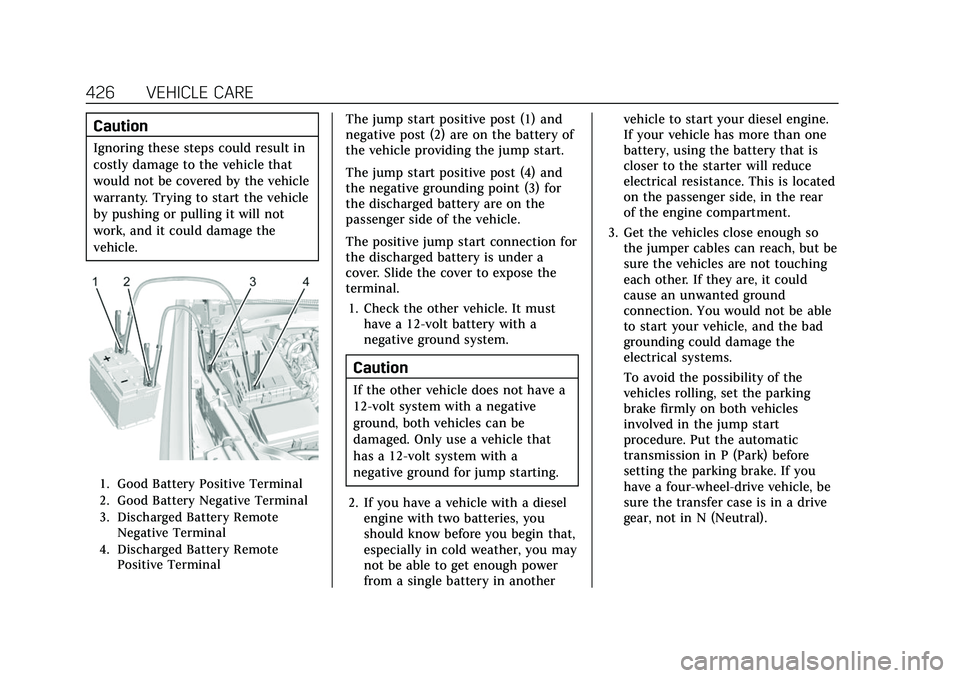
1. Good Battery Positive Terminal
2. Good Battery Negative Terminal
3. Discharged Battery RemoteNegative Terminal
4. Discharged Battery Remote Positive Terminal
The jump start positive post (1) and
negative post (2) are on the battery of
the vehicle providing the jump start.
The jump start positive post (4) and
the negative grounding point (3) for
the discharged battery are on the
passenger side of the vehicle.
The positive jump start connection for
the discharged battery is under a
cover. Slide the cover to expose the
terminal.
1. Check the other vehicle. It must have a 12-volt battery with a
negative ground system.
Caution
If the other vehicle does not have a
12-volt system with a negative
ground, both vehicles can be
damaged. Only use a vehicle that
has a 12-volt system with a
negative ground for jump starting.
2. If you have a vehicle with a diesel engine with two batteries, you
should know before you begin that,
especially in cold weather, you may
not be able to get enough power
from a single battery in another vehicle to start your diesel engine.
If your vehicle has more than one
battery, using the battery that is
closer to the starter will reduce
electrical resistance. This is located
on the passenger side, in the rear
of the engine compartment.
3. Get the vehicles close enough so the jumper cables can reach, but be
sure the vehicles are not touching
each other. If they are, it could
cause an unwanted ground
connection. You would not be able
to start your vehicle, and the bad
grounding could damage the
electrical systems.
To avoid the possibility of the
vehicles rolling, set the parking
brake firmly on both vehicles
involved in the jump start
procedure. Put the automatic
transmission in P (Park) before
setting the parking brake. If you
have a four-wheel-drive vehicle, be
sure the transfer case is in a drive
gear, not in N (Neutral).
Page 445 of 492
Cadillac Escalade Owner Manual (GMNA-Localizing-U.S./Canada/Mexico-
13690472) - 2021 - CRC - 8/10/21
444 SERVICE AND MAINTENANCE
.Inspect power steering for proper
attachment, connections, binding,
leaks, cracks, chafing, etc.
.Visually inspect halfshafts and drive
shafts for excessive wear, lubricant
leaks, and/or damage including:
tube dents or cracks, constant
velocity joint or universal joint
looseness, cracked or missing boots,
loose or missing boot clamps, center
bearing excessive looseness, loose or
missing fasteners, and axle seal
leaks.
.Check restraint system components.
SeeSafety System Check 064.
.Visually inspect fuel system for
damage or leaks.
.Visually inspect exhaust system and
nearby heat shields for loose or
damaged parts.
.Lubricate body components. See
Exterior Care 0432.
.Check parking brake and automatic
transmission park mechanism. See
Park Brake and P (Park) Mechanism
Check 0381.
.Check accelerator pedal for damage,
high effort, or binding. Replace if
needed.
.Visually inspect gas strut for signs
of wear, cracks, or other damage.
Check the hold open ability of the
strut. If the hold open is low,
service the gas strut. See Gas
Strut(s) 0383.
.Inspect sunroof track and seal,
if equipped. See Sunroof038.
.Verify spare tire key lock operation
and lubricate as needed. See Tire
Changing 0413.
.Visually inspect the spare tire to
ensure that it is tightly stowed
under the vehicle. Push, pull, and
try to turn the tire. If the spare tire
moves, tighten as necessary. See
Tire Changing 0413.