towing CADILLAC ESCALADE 2021 Workshop Manual
[x] Cancel search | Manufacturer: CADILLAC, Model Year: 2021, Model line: ESCALADE, Model: CADILLAC ESCALADE 2021Pages: 492, PDF Size: 7.92 MB
Page 422 of 492

Cadillac Escalade Owner Manual (GMNA-Localizing-U.S./Canada/Mexico-
13690472) - 2021 - CRC - 8/10/21
VEHICLE CARE 421
Warning (Continued)
damage if the hoist cable fails or if
the tire comes loose. Make sure the
tire is stored securely before
driving.
Caution
Always store the spare tire or flat
tire with the valve stem pointed up.
Stowing a tire with the valve stem
pointed down could result in
damage to the wheel.
Caution
The tire hoist is designed to be
raised and lowered with tension on
the cable. If the hoist must be
raised or lowered without a tire
attached, do so only by hand, and
at a slow pace, to avoid damaging
the mechanism. Do not use power
tools.
{Warning
An improperly stored spare tire
could come loose and cause a crash.
To avoid personal injury or property
damage, always store the spare tire
when the vehicle is parked on a
level surface.
If the vehicle has 275/60R20 or 275/
50R22 size tires, the flat tire must be
stored inside of the vehicle using the
flat tire secure strap inside the glove
box. See “Storing a Flat Tire Inside of
the Vehicle ”later in this section.
If the vehicle has 265/65R18 or 275/
55R20 size tires, store the flat tire
under the rear of the vehicle in the
spare tire carrier. Refer to the
following graphics and instructions:
1. Hoist Assembly
2. Hoist Shaft
3. Hoist Shaft Access Cover/Hole
4. Jack Handle Extension
5. Wheel Wrench
6. Spare Tire Lock
7. Hoist End of Extension Tool
8. Hoist Shaft Access Hole
9. Spare Tire (Valve Stem Pointed Up)
10.Tire/Wheel Retainer
11.Hoist Cable
1. Put the tire (9) on the ground at the rear of the vehicle with the
valve stem pointed up, and to
the rear.
Page 429 of 492
Cadillac Escalade Owner Manual (GMNA-Localizing-U.S./Canada/Mexico-
13690472) - 2021 - CRC - 8/10/21
428 VEHICLE CARE
7. Connect one end of the redpositive (+) cable to the remote
positive (+) terminal of the vehicle
with the discharged battery.
8. Do not let the other end touch metal. Connect it to the positive (+)
terminal of the good battery. Use a
remote positive (+) terminal if the
vehicle has one.
9. Connect one end of the black negative (−) cable to the negative
(−) terminal of the good battery.
Use a remote negative (−) terminal
if the vehicle has one.
Do not let the other end touch
anything until the next step.
10. Connect the other end of the negative (−) cable to the remote
negative (−) terminal to the
discharged battery.
11. Start the vehicle with the good battery and run the engine for a
while.
12. Try to start the vehicle that had the dead battery. If it will not start
after a few tries, it probably needs
service.Caution
If the jumper cables are connected
or removed in the wrong order,
electrical shorting may occur and
damage the vehicle. The repairs
would not be covered by the vehicle
warranty. Always connect and
remove the jumper cables in the
correct order, making sure that the
cables do not touch each other or
other metal.
Jumper Cable Removal
Reverse the sequence exactly when
removing the jumper cables.
After starting the disabled vehicle and
removing the jumper cables, allow it
to idle for several minutes.
Towing the Vehicle
Caution
Incorrectly towing a disabled
vehicle may cause damage. The
damage would not be covered by
the vehicle warranty. Do not lash or (Continued)
Caution (Continued)
hook to suspension components.
Use the proper straps around the
tires to secure the vehicle. Do not
drag a locked wheel/tire. Use tire
skates or dollies under any locked
wheel/tire while loading the vehicle.
Do not use a sling type lift to tow
the vehicle. This could damage the
vehicle.
Caution
Improper use of the tow eye can
damage the vehicle. If equipped, use
the tow eye to load a disabled
vehicle onto a flatbed tow truck
from a flat road surface, or to move
the vehicle a short distance. Use
caution and low speeds. The
transmission must be
in (N) Neutral when moving the
vehicle.
GM recommends a flatbed tow truck
to transport a disabled vehicle. Use
ramps to help reduce approach angles,
if necessary. A towed vehicle should
Page 430 of 492
Cadillac Escalade Owner Manual (GMNA-Localizing-U.S./Canada/Mexico-
13690472) - 2021 - CRC - 8/10/21
VEHICLE CARE 429
have its drive wheels off the ground.
Contact Roadside Service or a
professional towing service if the
disabled vehicle must be towed.
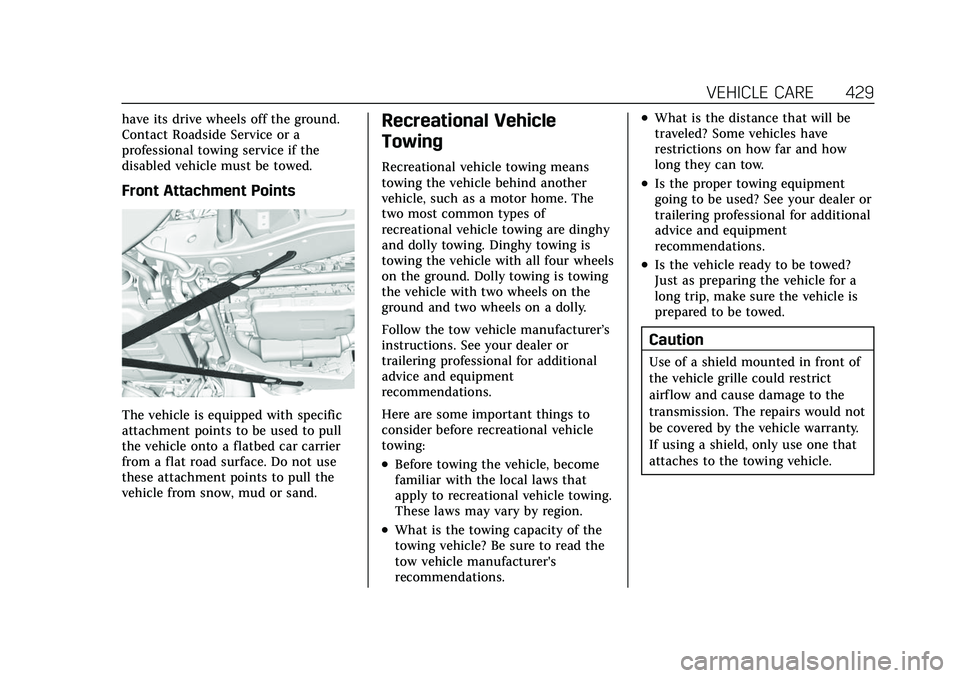
Front Attachment Points
The vehicle is equipped with specific
attachment points to be used to pull
the vehicle onto a flatbed car carrier
from a flat road surface. Do not use
these attachment points to pull the
vehicle from snow, mud or sand.
Recreational Vehicle
Towing
Recreational vehicle towing means
towing the vehicle behind another
vehicle, such as a motor home. The
two most common types of
recreational vehicle towing are dinghy
and dolly towing. Dinghy towing is
towing the vehicle with all four wheels
on the ground. Dolly towing is towing
the vehicle with two wheels on the
ground and two wheels on a dolly.
Follow the tow vehicle manufacturer’s
instructions. See your dealer or
trailering professional for additional
advice and equipment
recommendations.
Here are some important things to
consider before recreational vehicle
towing:
.Before towing the vehicle, become
familiar with the local laws that
apply to recreational vehicle towing.
These laws may vary by region.
.What is the towing capacity of the
towing vehicle? Be sure to read the
tow vehicle manufacturer's
recommendations.
.What is the distance that will be
traveled? Some vehicles have
restrictions on how far and how
long they can tow.
.Is the proper towing equipment
going to be used? See your dealer or
trailering professional for additional
advice and equipment
recommendations.
.Is the vehicle ready to be towed?
Just as preparing the vehicle for a
long trip, make sure the vehicle is
prepared to be towed.
Caution
Use of a shield mounted in front of
the vehicle grille could restrict
airflow and cause damage to the
transmission. The repairs would not
be covered by the vehicle warranty.
If using a shield, only use one that
attaches to the towing vehicle.
Page 431 of 492
Cadillac Escalade Owner Manual (GMNA-Localizing-U.S./Canada/Mexico-
13690472) - 2021 - CRC - 8/10/21
430 VEHICLE CARE
Dinghy Towing
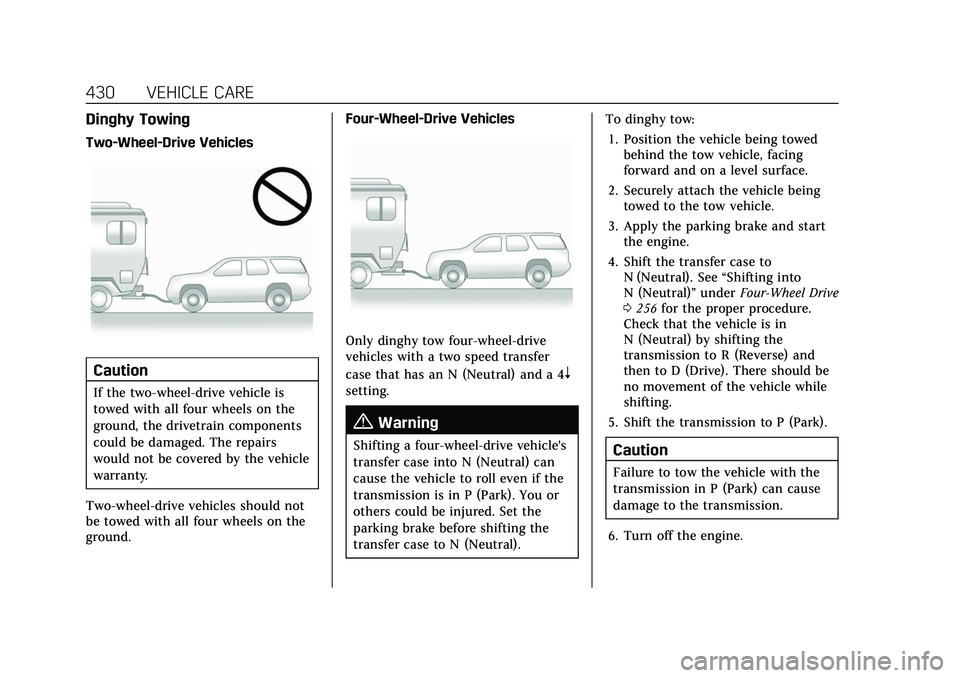
Two-Wheel-Drive Vehicles
Caution
If the two-wheel-drive vehicle is
towed with all four wheels on the
ground, the drivetrain components
could be damaged. The repairs
would not be covered by the vehicle
warranty.
Two-wheel-drive vehicles should not
be towed with all four wheels on the
ground. Four-Wheel-Drive Vehicles
Only dinghy tow four-wheel-drive
vehicles with a two speed transfer
case that has an N (Neutral) and a 4
n
setting.
{Warning
Shifting a four-wheel-drive vehicle's
transfer case into N (Neutral) can
cause the vehicle to roll even if the
transmission is in P (Park). You or
others could be injured. Set the
parking brake before shifting the
transfer case to N (Neutral).To dinghy tow:
1. Position the vehicle being towed behind the tow vehicle, facing
forward and on a level surface.
2. Securely attach the vehicle being towed to the tow vehicle.
3. Apply the parking brake and start the engine.
4. Shift the transfer case to N (Neutral). See “Shifting into
N (Neutral)” underFour-Wheel Drive
0 256 for the proper procedure.
Check that the vehicle is in
N (Neutral) by shifting the
transmission to R (Reverse) and
then to D (Drive). There should be
no movement of the vehicle while
shifting.
5. Shift the transmission to P (Park).Caution
Failure to tow the vehicle with the
transmission in P (Park) can cause
damage to the transmission.
6. Turn off the engine.
Page 432 of 492
Cadillac Escalade Owner Manual (GMNA-Localizing-U.S./Canada/Mexico-
13690472) - 2021 - CRC - 8/10/21
VEHICLE CARE 431
7. Place the vehicle in ACC/ACCESSORY mode by pressing the
start button without stepping on
the brake pedal.
8. Release the parking brake only when you are confident it is
secured to tow vehicle and will
not roll.
Before going on to the next step, be
sure to take the mechanical key
with you. It will be needed to
re-enter the vehicle after the power
is disconnected. See “Drive Door
Key Lock Cylinder Access” under
Door Locks 015.
9. Disconnect the negative battery cable at the battery and secure the
nut and bolt. Cover the negative
battery post with a non-conductive
material to prevent any contact
with the negative battery terminal.
Caution
Failure to disconnect the negative
battery cable or to have it contact
the terminals can cause damage to
the vehicle. 10. Move the steering wheel to make
sure the steering column is
unlocked.
Caution
If the steering column is locked,
vehicle damage may occur.
11. Rock the vehicle to make sure the parking brake is not set and
transfer case is in N (Neutral).
Caution
Towing the vehicle with the parking
brake set can damage it. Always
release the parking brake prior to
towing the vehicle.
Disconnecting the Towed Vehicle
Before disconnecting the towed
vehicle: 1. Park on a level surface.
2. Connect the battery.
3. Apply the brake pedal.
{Warning
The vehicle can roll when the brake
pedal is released. Always apply and
hold the brake pedal when setting
the parking brake. Make sure the
parking brake is fully engaged
before releasing the brake pedal.
4. Start the engine and shift the transfer case out of N (Neutral) to
2
m. See “Shifting out of
N (Neutral)” underFour-Wheel Drive
0 256. See your dealer if the
transfer case cannot be shifted out
of N (Neutral).
5. Check that the vehicle is in 2
mby
shifting the transmission to
R (Reverse) and then to D (Drive).
There should be movement of the
vehicle while shifting.
6. Shift the transmission to P (Park) and turn off the vehicle.
7. Set the parking brake.
8. Release the parking brake.
9. Disconnect the vehicle from the tow vehicle.
Page 433 of 492
Cadillac Escalade Owner Manual (GMNA-Localizing-U.S./Canada/Mexico-
13690472) - 2021 - CRC - 8/10/21
432 VEHICLE CARE
10. Reset any lost presets.The outside temperature display
will default to 0 °C (32 °F) but will
reset with normal usage.
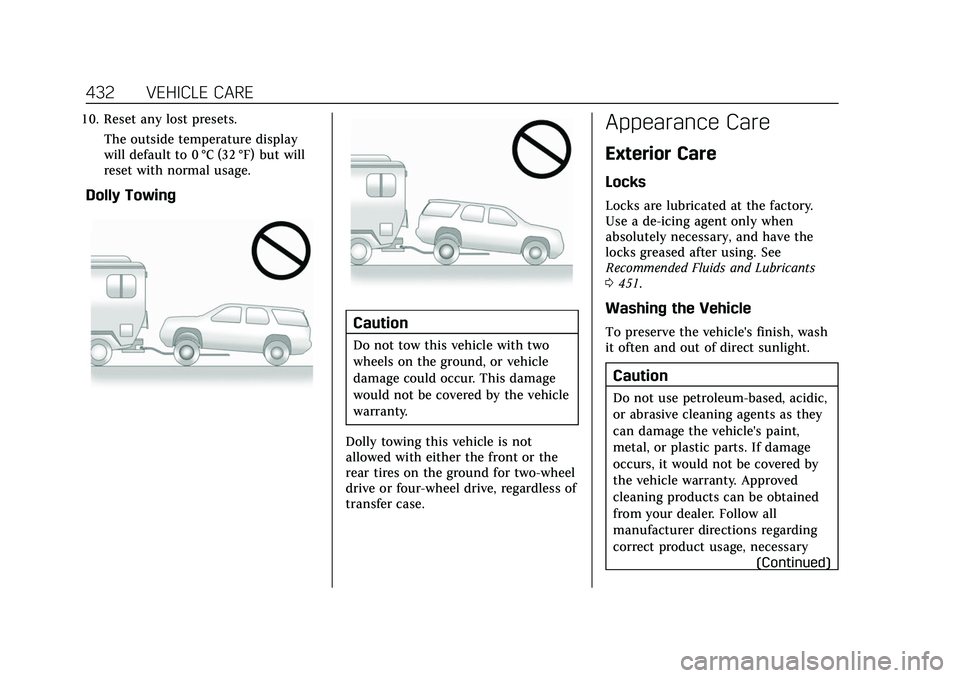
Dolly Towing
Caution
Do not tow this vehicle with two
wheels on the ground, or vehicle
damage could occur. This damage
would not be covered by the vehicle
warranty.
Dolly towing this vehicle is not
allowed with either the front or the
rear tires on the ground for two-wheel
drive or four-wheel drive, regardless of
transfer case.
Appearance Care
Exterior Care
Locks
Locks are lubricated at the factory.
Use a de-icing agent only when
absolutely necessary, and have the
locks greased after using. See
Recommended Fluids and Lubricants
0 451.
Washing the Vehicle
To preserve the vehicle's finish, wash
it often and out of direct sunlight.
Caution
Do not use petroleum-based, acidic,
or abrasive cleaning agents as they
can damage the vehicle's paint,
metal, or plastic parts. If damage
occurs, it would not be covered by
the vehicle warranty. Approved
cleaning products can be obtained
from your dealer. Follow all
manufacturer directions regarding
correct product usage, necessary
(Continued)
Page 443 of 492

Cadillac Escalade Owner Manual (GMNA-Localizing-U.S./Canada/Mexico-
13690472) - 2021 - CRC - 8/10/21
442 SERVICE AND MAINTENANCE
keep the vehicle in good working
condition, improves fuel economy, and
reduces vehicle emissions.
Because of the way people use
vehicles, maintenance needs vary.
There may need to be more frequent
checks and services. The Additional
Required Services - Normal are for
vehicles that:
.Carry passengers and cargo within
recommended limits on the Tire
and Loading Information label. See
Vehicle Load Limits0240.
.Are driven on reasonable road
surfaces within legal driving limits.
.Use the recommended fuel. See
Recommended Fuel 0326.
Refer to the information in the
Maintenance Schedule Additional
Required Services - Normal chart.
The Additional Required Services -
Severe are for vehicles that are:
.Mainly driven in heavy city traffic
in hot weather.
.Mainly driven in hilly or
mountainous terrain.
.Frequently towing a trailer.
.Used for high speed or competitive
driving.
.Used for taxi, police, or delivery
service.
Refer to the information in the
Maintenance Schedule Additional
Required Services - Severe chart.
{Warning
Performing maintenance work can
be dangerous and can cause serious
injury. Perform maintenance work
only if the required information,
proper tools, and equipment are
available. If they are not, see your
dealer to have a trained technician
do the work. See Doing Your Own
Service Work 0364.
Maintenance Schedule
For diesel engine vehicles, see
“Maintenance Schedule ”in the
Duramax diesel supplement.
Owner Checks and Services
Check the engine oil level. See Engine
Oil 0367.
Once a Month
.Check the tire inflation pressures,
including the spare. See Tire
Pressure 0400.
.Inspect the tires for wear. See Tire
Inspection 0406.
.Check the windshield washer fluid
level. See Washer Fluid 0377.
Page 464 of 492

Cadillac Escalade Owner Manual (GMNA-Localizing-U.S./Canada/Mexico-
13690472) - 2021 - CRC - 8/10/21
CUSTOMER INFORMATION 463
Cadillac Technician Roadside
Service (U.S. Only)
Cadillac's exceptional Roadside Service
is more than an auto club or towing
service. It provides every Cadillac
owner in the United States with the
advantage of contacting a Cadillac
advisor and, where available, a
Cadillac trained dealer technician who
can provide on-site service.
A dealer technician will travel to your
location within a 30-mile radius of a
participating Cadillac dealership.
If beyond this radius, we will arrange
to have your car towed to the nearest
Cadillac dealership. Each technician
travels with a specially equipped
service vehicle complete with the
necessary Cadillac parts and tools
required to handle most roadside
repairs.
Services Not Included in
Roadside Service
.Impound towing caused by violation
of any laws
.Legal fines
.Mounting, dismounting, or changing
of snow tires, chains, or other
traction devices
Service is not provided if a vehicle is
in an area that is not accessible to the
service vehicle or is not a regularly
traveled or maintained public road,
which includes ice and winter roads.
Off-road use is not covered.
Services Specific to
Canadian-Purchased Vehicles
.Fuel delivery: Reimbursement is up
to 7 liters. Diesel fuel delivery may
be restricted. Propane and other
fuels are not provided through this
service.
.Lock-Out Service: Vehicle
registration is required.
.Trip Interruption Benefits and
Service: Pre-authorization, original
detailed receipts, and a copy of the
repair orders are required. Once
authorization has been received, the
Roadside Service advisor will help
you make arrangements and explain
how to receive payment. Items
considered are hotel, meals, and rental car or a vehicle being
delivered back to the customer, up
to 800 km.
.Alternative Service:
If assistance
cannot be provided right away, the
Roadside Service advisor may give
you permission to get local
emergency road service. You will
receive payment, up to $100, after
sending the original receipt to
Roadside Service. Mechanical
failures may be covered, however
any cost for parts and labor for
repairs not covered by the warranty
are the owner responsibility.
Scheduling Service
Appointments
When the vehicle requires warranty
service, contact your dealer and
request an appointment. By
scheduling a service appointment and
advising the service consultant of
your transportation needs, your dealer
can help minimize your
inconvenience.
If the vehicle cannot be scheduled
into the service department
immediately, keep driving it until it
Page 467 of 492
Cadillac Escalade Owner Manual (GMNA-Localizing-U.S./Canada/Mexico-
13690472) - 2021 - CRC - 8/10/21
466 CUSTOMER INFORMATION
limiting compensation for damage
repairs by using aftermarket collision
parts. Some insurance companies will
not specify aftermarket collision parts.
When purchasing insurance, we
recommend that you ensure that the
vehicle will be repaired with GM
original equipment collision parts.
If such insurance coverage is not
available from your current insurance
carrier, consider switching to another
insurance carrier.
If the vehicle is leased, the leasing
company may require you to have
insurance that ensures repairs with
Genuine GM Original Equipment
Manufacturer (OEM) parts or Genuine
Manufacturer replacement parts. Read
the lease carefully, as you may be
charged at the end of the lease for
poor quality repairs.
If a Crash Occurs
If there has been an injury, call
emergency services for help. Do not
leave the scene of a crash until all
matters have been taken care of. Move
the vehicle only if its position puts
you in danger, or you are instructed to
move it by a police officer.Give only the necessary information
to police and other parties involved in
the crash.
For emergency towing see
Roadside
Service 0462.
Gather the following information:
.Driver name, address, and telephone
number
.Driver license number
.Owner name, address, and
telephone number
.Vehicle license plate number
.Vehicle make, model, and
model year
.Vehicle Identification Number (VIN)
.Insurance company and policy
number
.General description of the damage
to the other vehicle
Choose a reputable repair facility that
uses quality replacement parts. See
“Collision Parts ”earlier in this section.
If the airbag has inflated, see What
Will You See after an Airbag Inf lates?
0 70.
Managing the Vehicle Damage
Repair Process
In the event that the vehicle requires
damage repairs, GM recommends that
you take an active role in its repair.
If you have a pre-determined repair
facility of choice, take the vehicle
there, or have it towed there. Specify
to the facility that any required
replacement collision parts be original
equipment parts, either new Genuine
GM parts or recycled original GM
parts. Remember, recycled parts will
not be covered by the GM vehicle
warranty.
Insurance pays the bill for the repair,
but you must live with the repair.
Depending on your policy limits, your
insurance company may initially value
the repair using aftermarket parts.
Discuss this with the repair
professional, and insist on Genuine
GM parts. Remember, if the vehicle is
leased, you may be obligated to have
the vehicle repaired with Genuine GM
parts, even if your insurance coverage
does not pay the full cost.
Page 483 of 492

Cadillac Escalade Owner Manual (GMNA-Localizing-U.S./Canada/Mexico-
13690472) - 2021 - CRC - 8/10/21
482 INDEX
Door (cont'd)Power Locks . . . . . . . . . . . . . . . . . . . . . . . . 18
Drive Belt Routing, Engine . . . . . . . . . 457
Driver Teen . . . . . . . . . . . . . . . . . . . . . . . . . . . . . . . 207
Driver Assistance Systems . . . . . . . . . 298
Driver Information Center (DIC) . . . . . . . . . . . . . . . . . . . . . . . 132
Driver Mode Control . . . . . . . . . . . . . . . . 266
Driver Mode Control Light . . . . . . . . . 128
Driving Assistance Systems . . . . . . . . . . . . . . . 313
Better Fuel Economy . . . . . . . . . . . . . 230
Characteristics and
Towing Tips . . . . . . . . . . . . . . . . . . . . . 330
Defensive . . . . . . . . . . . . . . . . . . . . . . . . . . 231
Hill and Mountain Roads . . . . . . . . 238
If the Vehicle is Stuck . . . . . . . . . . . . 240
Impaired . . . . . . . . . . . . . . . . . . . . . . . . . . . 231
Loss of Control . . . . . . . . . . . . . . . . . . . . 233
Off-Road . . . . . . . . . . . . . . . . . . . . . . . . . . . 234
Off-Road Recovery . . . . . . . . . . . . . . . . 233
Vehicle Load Limits . . . . . . . . . . . . . . 240
Wet Roads . . . . . . . . . . . . . . . . . . . . . . . . . 237
Winter . . . . . . . . . . . . . . . . . . . . . . . . . . . . . 239
Dual Automatic Climate
Control System . . . . . . . . . . . . . . . . . . . . 220
Dynamic Fuel Management . . . . . . . . 250E
Electric Brake Boost . . . . . . . . . . . . . . . . 261
Electric Parking Brake . . . . . . . . . . . . . . 261
Electric Parking Brake Light . . . . . . . 124
Electrical Equipment, Add-On . . . . . 360
Electrical System Engine Compartment FuseBlock . . . . . . . . . . . . . . . . . . . . . . . . . . . . . 386
Fuses and Circuit Breakers . . . . . . . 385
Instrument Panel Fuse Block . . . . 389
Overload . . . . . . . . . . . . . . . . . . . . . . . . . . . 385
Rear Compartment Fuse Block . . . . . . . . . . . . . . . . . . . . . . . . . . . . . 391
Emergency
OnStar . . . . . . . . . . . . . . . . . . . . . . . . . . . . . 472
Engine Air Cleaner/Filter . . . . . . . . . . . . . . . . . 371
Check Light (MalfunctionIndicator) . . . . . . . . . . . . . . . . . . . . . . . . 122
Compartment Overview . . . . . . . . . . 366
Coolant Temperature Gauge . . . . . 117
Coolant Temperature Warning Light . . . . . . . . . . . . . . . . . . . 128
Cooling System . . . . . . . . . . . . . . . . . . . 372
Drive Belt Routing . . . . . . . . . . . . . . . . 457
Exhaust . . . . . . . . . . . . . . . . . . . . . . . . . . . . 250
Fan . . . . . . . . . . . . . . . . . . . . . . . . . . . . . . . . . 376
Oil Life System . . . . . . . . . . . . . . . . . . . . 369 Engine (cont'd)
Oil Pressure Gauge . . . . . . . . . . . . . . . . 116
Oil Pressure Light . . . . . . . . . . . . . . . . . 130
Overheating . . . . . . . . . . . . . . . . . . . . . . . 375
Power Messages . . . . . . . . . . . . . . . . . . 138
Running While Parked . . . . . . . . . . . 251
Starting . . . . . . . . . . . . . . . . . . . . . . . . . . . . 246
Engine Air Filter Life System . . . . . . 371
Entry Lighting . . . . . . . . . . . . . . . . . . . . . . 155
Equipment, Towing . . . . . . . . . . . . . . . . . 338
Event Data Recorders . . . . . . . . . . . . . . 469
Exit Lighting . . . . . . . . . . . . . . . . . . . . . . . . 155
Extended Parking . . . . . . . . . . . . . . . . . . . 250
Extender, Seat Belt . . . . . . . . . . . . . . . . . . 64
Exterior Lamp Controls . . . . . . . . . . . . 149
Exterior Lamps Off Reminder . . . . . . 151
Exterior Lighting Battery Saver . . . . 156
F
Fan Engine . . . . . . . . . . . . . . . . . . . . . . . . . . . . . 376
Filter,
Engine Air Cleaner . . . . . . . . . . . . . . . . 371
Flash-to-Pass . . . . . . . . . . . . . . . . . . . . . . . . 151
Flashers, Hazard Warning . . . . . . . . . . 153
Flat Tire . . . . . . . . . . . . . . . . . . . . . . . . . . . . . 412 Changing . . . . . . . . . . . . . . . . . . . . . . . . . . 413
Floor Mats . . . . . . . . . . . . . . . . . . . . . . . . . . . 440