cruise control CADILLAC ESCALADE ESV 2009 User Guide
[x] Cancel search | Manufacturer: CADILLAC, Model Year: 2009, Model line: ESCALADE ESV, Model: CADILLAC ESCALADE ESV 2009Pages: 602, PDF Size: 5.18 MB
Page 184 of 602
Using Cruise Control on Hills How well the cruise control will work on hills depends
upon the vehicle speed, load, and the steepness of
the hills. When going up steep hills, you might have to
step on the accelerator pedal to maintain the vehicle’s
speed. When going downhill, you might have to brake
or shift to a lower gear to keep the vehicle’s speed
down. When the brakes are applied the cruise control
turns off.
Ending Cruise Control There are three ways to end cruise control:
Step lightly on the brake pedal.
Press the
[ button on the steering wheel.
Press the
I button on the steering wheel.
Erasing Speed Memory The cruise control set speed memory is erased when
the cruise control or the ignition is turned off. Exterior Lamps The exterior lamps control
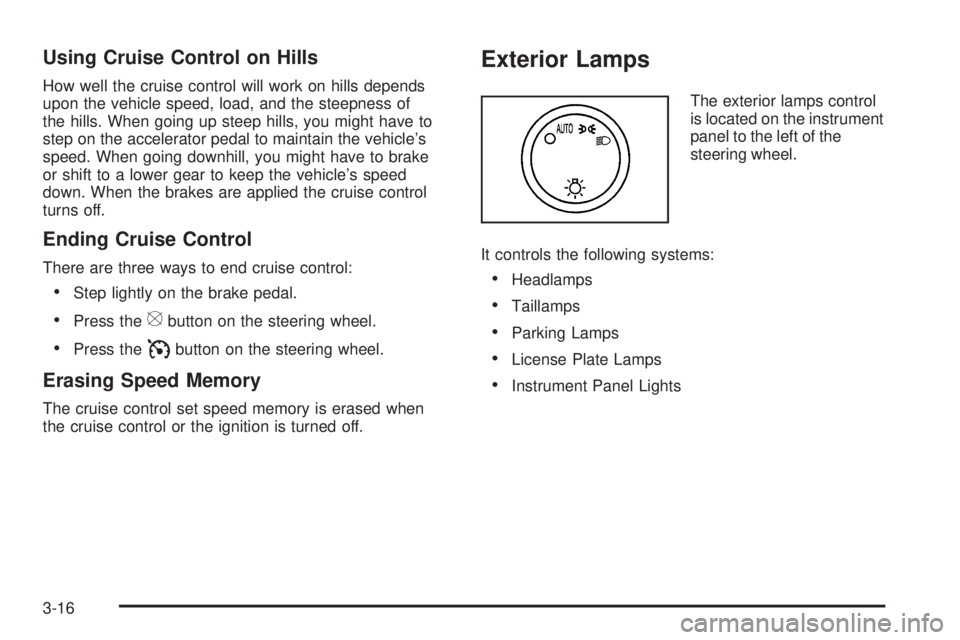
is located on the instrument
panel to the left of the
steering wheel.
It controls the following systems:
Headlamps
Taillamps
Parking Lamps
License Plate Lamps
Instrument Panel Lights
3-16
Page 214 of 602
Cruise Control Light The cruise control light
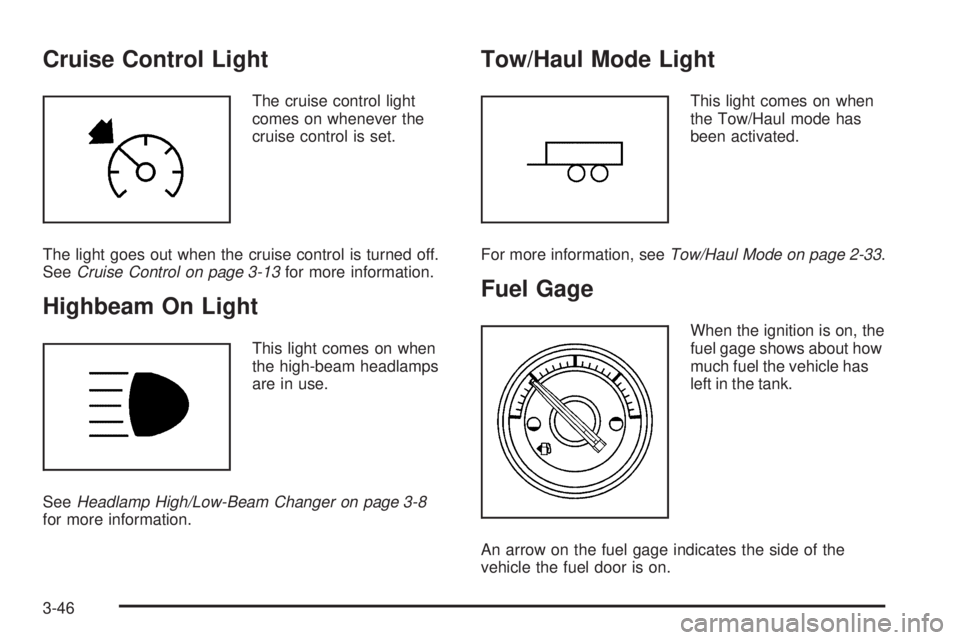
comes on whenever the
cruise control is set.
The light goes out when the cruise control is turned off.
See Cruise Control on page 3-13 for more information.
Highbeam On Light This light comes on when
the high-beam headlamps
are in use.
See Headlamp High/Low-Beam Changer on page 3-8
for more information. Tow/Haul Mode Light This light comes on when
the Tow/Haul mode has
been activated.
For more information, see Tow/Haul Mode on page 2-33 .
Fuel Gage When the ignition is on, the
fuel gage shows about how
much fuel the vehicle has
left in the tank.
An arrow on the fuel gage indicates the side of the
vehicle the fuel door is on.
3-46
Page 378 of 602

Your Driving, the Road, and
the Vehicle Driving for Better Fuel Economy Driving habits can affect fuel mileage. Here are some
driving tips to get the best fuel economy possible.
Avoid fast starts and accelerate smoothly.
Brake gradually and avoid abrupt stops.
Avoid idling the engine for long periods of time.
When road and weather conditions are appropriate,
use cruise control, if equipped.
Always follow posted speed limits or drive more
slowly when conditions require.
Keep vehicle tires properly inated.
Combine several trips into a single trip.
Replace the vehicle’s tires with the same TPC Spec
number molded into the tire’s sidewall near the size.
Follow recommended scheduled maintenance. Defensive Driving Defensive driving means “always expect the
unexpected.” The rst step in driving defensively is to
wear your safety belt — See Safety Belts: They Are for
Everyone on page 1-30 .
{ CAUTION: Assume that other road users (pedestrians,
bicyclists, and other drivers) are going to be
careless and make mistakes. Anticipate what they
might do and be ready. In addition:
Allow enough following distance between you
and the driver in front of you.
Focus on the task of driving.
Driver distraction can cause collisions resulting in
injury or possible death. These simple defensive
driving techniques could save your life.
5-2
Page 382 of 602

Braking in Emergencies ABS allows the driver to steer and brake at the same
time. In many emergencies, steering can help more than
even the very best braking.
Brake Assist This vehicle has a Brake Assist feature designed to assist
the driver in stopping or decreasing vehicle speed in
emergency driving conditions. This feature uses the
stability system hydraulic brake control module to
supplement the power brake system under conditions
where the driver has quickly and forcefully applied the
brake pedal in an attempt to quickly stop or slow down
the vehicle. The stability system hydraulic brake control
module increases brake pressure at each corner of the
vehicle until the ABS activates. Minor brake pedal
pulsations or pedal movement during this time is normal
and the driver should continue to apply the brake pedal
as the driving situation dictates The Brake Assist feature
will automatically disengage when the brake pedal is
released or brake pedal pressure is quickly decreased. StabiliTrak ®
System The vehicle has a vehicle stability enhancement system
called StabiliTrak. It is an advanced computer controlled
system that assists the driver with directional control of
the vehicle in difficult driving conditions.
StabiliTrak activates when the computer senses a
discrepancy between the intended path and the direction
the vehicle is actually traveling. StabiliTrak selectively
applies braking pressure at any one of the vehicle’s
brakes to assist the driver with keeping the vehicle on the
intended path.
When the vehicle is started and begins to move, the
system performs several diagnostic checks to insure
there are no problems. The system may be heard or felt
while it is working. This is normal and does not mean
there is a problem with the vehicle. The system should
initialize before the vehicle reaches 20 mph (32 km/h).
In some cases, it may take approximately two miles of
driving before the system initializes.
If cruise control is being used when StabiliTrak activates,
the cruise control automatically disengages. The cruise
control can be re-engaged when road conditions allow.
See Cruise Control on page 3-13 .
5-6
Page 384 of 602

It is recommended to leave the system on for normal
driving conditions, but it may be necessary to turn the
system off if the vehicle is stuck in sand, mud, ice or
snow, and you want to “rock” the vehicle to attempt to
free it. It may also be necessary to turn off the system
when driving in extreme off-road conditions where high
wheel spin is required. See If Your Vehicle is Stuck in
Sand, Mud, Ice, or Snow on page 5-31 .
Traction Control Operation The traction control system is part of the StabiliTrak
system. Traction control limits wheel spin by reducing
engine power to the wheels (engine speed management)
and by applying brakes to each individual wheel
(brake-traction control) as necessary.
The traction control system is enabled automatically
when the vehicle is started. It will activate and the
StabiliTrak light will ash if it senses that any of the
wheels are spinning or beginning to lose traction
while driving. If traction control is turned off, only the
brake-traction control portion of traction control will work.
The engine speed management will be disabled. In this
mode, engine power is not reduced automatically and the
driven wheels can spin more freely. This can cause the
brake-traction control to activate constantly. Notice: If the wheel(s) of one axle is allowed
to spin excessively while the StabiliTrak, ABS and
brake warning lights and any relevant DIC messages
are displayed, the transfer case could be damaged.
The repairs would not be covered by the vehicle
warranty. Reduce engine power and do not spin
the wheel(s) excessively while these lights and
messages are displayed.
The traction control system may activate on dry or
rough roads or under conditions such as heavy
acceleration while turning or abrupt upshifts/downshifts
of the transmission. When this happens, a reduction in
acceleration may be noticed, or a noise or vibration may
be heard. This is normal.
If cruise control is being used when the system activates,
the StabiliTrak light will ash and cruise control will
automatically disengage. Cruise control may be
reengaged when road conditions allow. See Cruise
Control on page 3-13 .
StabiliTrak may also turn off automatically if it determines
that a problem exists with the system. If the problem does
not clear itself after restarting the vehicle, see your
dealer/retailer for service.
5-8
Page 402 of 602
Driving in Rain and on Wet Roads Rain and wet roads can reduce vehicle traction
and affect your ability to stop and accelerate. Always
drive slower in these types of driving conditions
and avoid driving through large puddles and
deep-standing or owing water.
{ CAUTION: Wet brakes can cause crashes. They might not
work as well in a quick stop and could cause
pulling to one side. You could lose control of the
vehicle.
After driving through a large puddle of water or a
car/vehicle wash, lightly apply the brake pedal until
the brakes work normally.
Flowing or rushing water creates strong forces.
Driving through owing water could cause your
vehicle to be carried away. If this happens, you
and other vehicle occupants could drown. Do not
ignore police warnings and be very cautious about
trying to drive through owing water. Hydroplaning Hydroplaning is dangerous. Water can build up under
your vehicle’s tires so they actually ride on the water.
This can happen if the road is wet enough and you are
going fast enough. When your vehicle is hydroplaning, it
has little or no contact with the road.
There is no hard and fast rule about hydroplaning.
The best advice is to slow down when the road is wet.
Other Rainy Weather Tips Besides slowing down, other wet weather driving tips
include:
Allow extra following distance.
Pass with caution.
Keep windshield wiping equipment in good shape.
Keep the windshield washer uid reservoir lled.
Have good tires with proper tread depth. See Tires
on page 6-56 .
Turn off cruise control.
5-26
Page 405 of 602
Winter Driving Driving on Snow or Ice Drive carefully when there is snow or ice between the
tires and the road, creating less traction or grip. Wet ice
can occur at about 32°F (0°C) when freezing rain begins
to fall, resulting in even less traction. Avoid driving on wet
ice or in freezing rain until roads can be treated with salt
or sand.
Drive with caution, whatever the condition. Accelerate
gently so traction is not lost. Accelerating too quickly
causes the wheels to spin and makes the surface under
the tires slick, so there is even less traction.
Try not to break the fragile traction. If you accelerate too
fast, the drive wheels will spin and polish the surface
under the tires even more. The StabiliTrak ®
System on page 5-6 improves the ability
to accelerate on slippery roads, but slow down and adjust
your driving to the road conditions. When driving through
deep snow, turn off the traction control part of the
StabiliTrak ®
System to help maintain vehicle motion at
lower speeds.
The Antilock Brake System (ABS) on page 5-5 improves
vehicle stability during hard stops on a slippery roads,
but apply the brakes sooner than when on dry
pavement.
Allow greater following distance on any slippery road
and watch for slippery spots. Icy patches can occur on
otherwise clear roads in shaded areas. The surface
of a curve or an overpass can remain icy when the
surrounding roads are clear. Avoid sudden steering
maneuvers and braking while on ice.
Turn off cruise control, if equipped, on slippery surfaces.
5-29
Page 545 of 602

Fuses Usage
24 Fuel Injectors, Ignition Coils
(Left Side)
25 Trailer Park Lamps
26 Driver Side Park Lamps
27 Passenger Side Park Lamps
28 Fog Lamps
29 Horn
30 Passenger Side High-Beam
Headlamp
31 Daytime Running Lamps (DRL)
32 Driver Side High-Beam Headlamp
33 Daytime Running Lamps 2
34 Sunroof
35 Key Ignition System, Theft Deterrent
System
36 Windshield Wiper
37 SEO B2 Uptter Usage (Battery)
38 Electric Adjustable Pedals
39 Climate Controls (Battery)
40 Airbag System (Ignition)
41 Amplier
42 Audio System
43 Miscellaneous (Ignition), Cruise
Control Fuses Usage
44 Liftgate Release
45 Airbag System (Battery)
46 Instrument Panel Cluster
47 Not Used
48 Auxiliary Climate Control (Ignition)
49 Center High-Mounted Stoplamp
(CHMSL)
50 Rear Defogger
51 Heated Mirrors
52 SEO B1 Uptter Usage (Battery)
53 Cigarette Lighter, Auxiliary Power
Outlet
54 Automatic Level Control Compressor
Relay
55 Climate Controls (Ignition)
56 Engine Control Module, Secondary
Fuel Pump (Ignition)
J-Case Fuses Usage
57 Cooling Fan 1
58 Automatic Level Control Compressor
59 Heavy Duty Antilock Braking System
60 Cooling Fan 2
61 Antilock Brake System 1
6-111
Page 590 of 602

Cleaning (cont.)
Weatherstrips ............................................ 6-100
Windshield, Backglass, and Wiper Blades ...... 6-102
Wood Panels ............................................ 6-100
Climate Control System
Outlet Adjustment ........................................ 3-31
Rear Air Conditioning and Heating System,
Electronic ................................................ 3-32
Climate Control Systems
Dual Automatic ............................................ 3-27
Clock ............................................................ 3-26
Collision Damage Repair .................................. 8-12
Compass ....................................................... 3-53
Content Theft-Deterrent .................................... 2-21
Control of a Vehicle .......................................... 5-3
Coolant
Engine ....................................................... 6-25
Engine Temperature Gage ............................ 3-41
Cooled Seats ................................................... 1-6
Cooling System .............................................. 6-24
Courtesy Transportation Program ...................... 8-10
Cruise Control ................................................ 3-13
Light .......................................................... 3-46
Cupholders .................................................... 2-62 Customer Assistance ......................................... 8-6
Offices ......................................................... 8-6
Text Telephone (TTY) Users ........................... 8-6
Customer Information
Service Publications Ordering Information ........ 8-15
Customer Satisfaction Procedure ........................ 8-2
D Damage Repair, Collision ................................. 8-12
Data Recorders
Event ......................................................... 8-17
Database Coverage Explanations ...................... 4-62
Daytime Running Lamps (DRL) ......................... 3-21
Defensive Driving ............................................. 5-2
Delayed Locking ............................................. 2-10
DIC Compass ................................................. 3-53
Doing Your Own Service Work ........................... 6-4
Dome Lamp Override ...................................... 3-23
Dome Lamps ................................................. 3-23
Door
Delayed Locking .......................................... 2-10
Locks ........................................................ 2-10
Power Locks ............................................... 2-10
Programmable Automatic Door Locks ............. 2-11
Rear Door Security Locks ............................. 2-11
4
Page 594 of 602
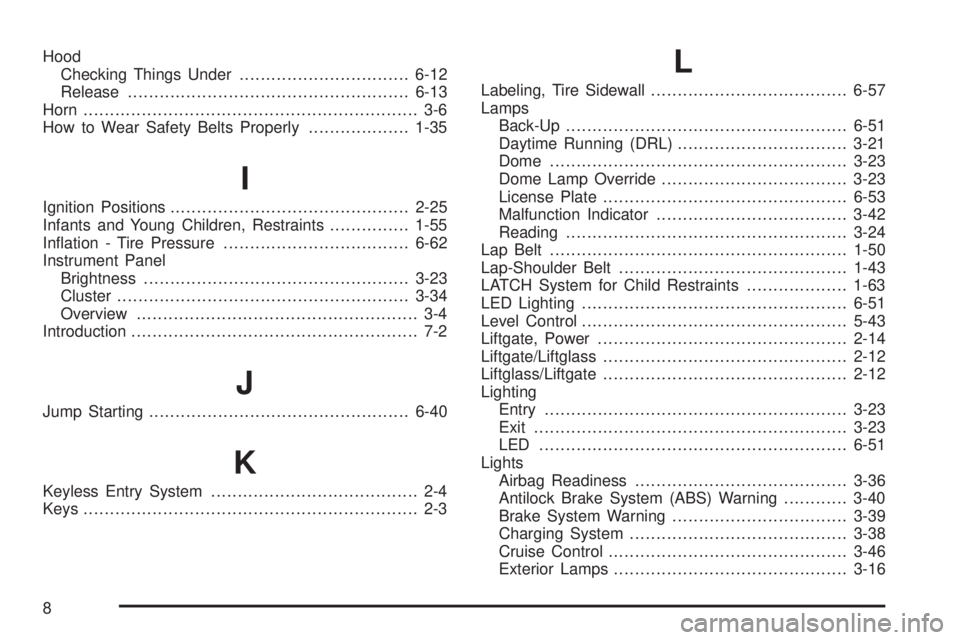
Hood
Checking Things Under ................................ 6-12
Release ..................................................... 6-13
Horn ............................................................... 3-6
How to Wear Safety Belts Properly ................... 1-35
IIgnition Positions ............................................. 2-25
Infants and Young Children, Restraints ............... 1-55
Ination - Tire Pressure ................................... 6-62
Instrument Panel
Brightness .................................................. 3-23
Cluster ....................................................... 3-34
Overview ..................................................... 3-4
Introduction ...................................................... 7-2
JJump Starting ................................................. 6-40
KKeyless Entry System ....................................... 2-4
Keys ............................................................... 2-3 L Labeling, Tire Sidewall ..................................... 6-57
Lamps
Back-Up ..................................................... 6-51
Daytime Running (DRL) ................................ 3-21
Dome ........................................................ 3-23
Dome Lamp Override ................................... 3-23
License Plate .............................................. 6-53
Malfunction Indicator .................................... 3-42
Reading ..................................................... 3-24
Lap Belt ........................................................ 1-50
Lap-Shoulder Belt ........................................... 1-43
LATCH System for Child Restraints ................... 1-63
LED Lighting .................................................. 6-51
Level Control .................................................. 5-43
Liftgate, Power ............................................... 2-14
Liftgate/Liftglass .............................................. 2-12
Liftglass/Liftgate .............................................. 2-12
Lighting
Entry ......................................................... 3-23
Exit ........................................................... 3-23
LED .......................................................... 6-51
Lights
Airbag Readiness ........................................ 3-36
Antilock Brake System (ABS) Warning ............ 3-40
Brake System Warning ................................. 3-39
Charging System ......................................... 3-38
Cruise Control ............................................. 3-46
Exterior Lamps ............................................ 3-16
8