high beam CADILLAC ESCALADE ESV 2009 User Guide
[x] Cancel search | Manufacturer: CADILLAC, Model Year: 2009, Model line: ESCALADE ESV, Model: CADILLAC ESCALADE ESV 2009Pages: 602, PDF Size: 5.18 MB
Page 190 of 602

There is a delay in the transition between the daytime
and nighttime operation of the Daytime Running Lamps
(DRL) and the automatic headlamp systems so that
driving under bridges or bright overhead street lights
does not affect the system. The DRL and automatic
headlamp system is only affected when the light sensor
detects a change in lighting lasting longer than the delay.
If the vehicle is started in a dark garage, the automatic
headlamp system will come on immediately. Once the
vehicle leaves the garage, it takes approximately
one minute for the automatic headlamp system to
change to DRL if it is bright enough outside. During
that delay, the instrument panel cluster may not be
as bright as usual. Make sure the instrument panel
brightness control is in the full bright position.
See Instrument Panel Brightness on page 3-23 .
To idle the vehicle with the automatic headlamp system
off, turn the control to the off position.
The headlamps will also stay on after you exit the
vehicle. This feature can be programmed using the
Driver Information Center (DIC). See DIC Vehicle
Customization on page 3-65 .
The regular headlamp system can be turned on when
needed. Fog Lamps For vehicles with fog lamps, the control is located next
to the exterior lamps control on the instrument panel
to the left of the steering column.
# (Fog Lamps): Press the button to turn the fog lamps
on or off. A indicator light comes on in the instrument
panel cluster. The ignition must be in the ON/RUN
position for the fog lamps to come on.
When the fog lamps are turned on, the headlamps
automatically turn on.
When the headlamps are changed to high-beam, the
fog lamps also go off. When the high-beam headlamps
go off, the fog lamps will come on again.
Some localities have laws that require the headlamps to
be on along with the fog lamps.
3-22
Page 192 of 602
Reading Lamps If the vehicle has reading lamps, press the button
located next to the lamp to turn it on or off.
The vehicle may also have reading lamps in other
locations. The lamps cannot be adjusted.
Electric Power Management The vehicle has Electric Power Management (EPM) that
estimates the battery’s temperature and state of charge.
It then adjusts the voltage for best performance and
extended life of the battery.
When the battery’s state of charge is low, the voltage
is raised slightly to quickly bring the charge back up.
When the state of charge is high, the voltage is lowered
slightly to prevent overcharging. If the vehicle has a
voltmeter gage or a voltage display on the Driver
Information Center (DIC), you may see the voltage
move up or down. This is normal. If there is a problem,
an alert will be displayed.
The battery can be discharged at idle if the electrical
loads are very high. This is true for all vehicles.
This is because the generator (alternator) may not
be spinning fast enough at idle to produce all the
power that is needed for very high electrical loads. A high electrical load occurs when several of the
following are on, such as: headlamps, high beams,
fog lamps, rear window defogger, climate control fan at
high speed, heated seats, engine cooling fans, trailer
loads, and loads plugged into accessory power outlets.
EPM works to prevent excessive discharge of the
battery. It does this by balancing the generator’s output
and the vehicle’s electrical needs. It can increase engine
idle speed to generate more power, whenever needed.
It can temporarily reduce the power demands of some
accessories.
Normally, these actions occur in steps or levels, without
being noticeable. In rare cases at the highest levels of
corrective action, this action may be noticeable to the
driver. If so, a Driver Information Center (DIC) message
might be displayed, such as BATTERY SAVER ACTIVE,
BATTERY VOLTAGE LOW, or LOW BATTERY. If this
message is displayed, it is recommended that the driver
reduce the electrical loads as much as possible. See DIC
Warnings and Messages on page 3-56 .
3-24
Page 214 of 602
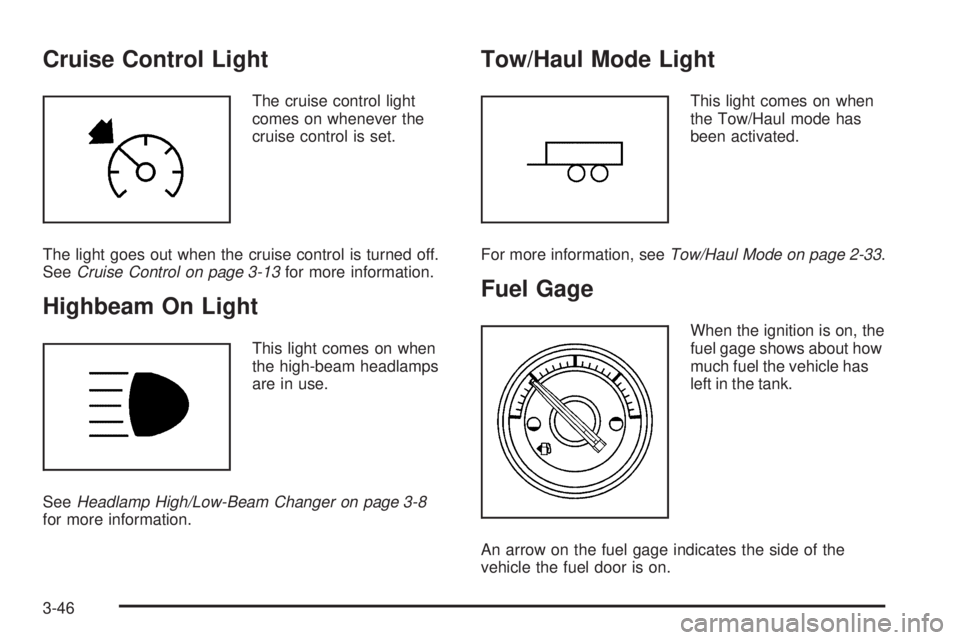
Cruise Control Light The cruise control light
comes on whenever the
cruise control is set.
The light goes out when the cruise control is turned off.
See Cruise Control on page 3-13 for more information.
Highbeam On Light This light comes on when
the high-beam headlamps
are in use.
See Headlamp High/Low-Beam Changer on page 3-8
for more information. Tow/Haul Mode Light This light comes on when
the Tow/Haul mode has
been activated.
For more information, see Tow/Haul Mode on page 2-33 .
Fuel Gage When the ignition is on, the
fuel gage shows about how
much fuel the vehicle has
left in the tank.
An arrow on the fuel gage indicates the side of the
vehicle the fuel door is on.
3-46
Page 238 of 602
AUTO HIGH BEAMS If your vehicle has this feature, it allows you to select
to have the Intellibeam ®
system turned off or on.
See Exterior Lamps on page 3-16 for more information.
Press the customization button until AUTO HIGH
BEAMS appears on the DIC display. Press the set/reset
button once to access the settings for this feature.
Then press the customization button to scroll through
the following settings:
OFF (default): The Intellibeam ®
system will be
turned off.
ON: The Intellibeam ®
system will be turned on.
NO CHANGE: No change will be made to this feature.
The current setting will remain.
To select a setting, press the set/reset button while the
desired setting is displayed on the DIC. CHIME VOLUME This feature allows you to select the volume level of the
chime.
Press the customization button until CHIME VOLUME
appears on the DIC display. Press the set/reset
button once to access the settings for this feature.
Then press the customization button to scroll through
the following settings:
NORMAL: The chime volume will be set to a normal
level.
LOUD: The chime volume will be set to a loud level.
NO CHANGE: No change will be made to this feature.
The current setting will remain.
There is no default for chime volume. The volume will
stay at the last known setting.
To select a setting, press the set/reset button while the
desired setting is displayed on the DIC.
3-70
Page 482 of 602

What to Use Refer to the Maintenance Schedule to determine what
kind of lubricant to use. See Recommended Fluids
and Lubricants on page 7-13 .
Headlamp Aiming The vehicle has a visual optical headlamp aiming
system. The aim of the headlamps have been preset at
the factory and should need no further adjustment.
However, if the vehicle is damaged in a crash, the aim
of the headlamps may be affected and adjustment
may be necessary.
If oncoming vehicles ash their high beams at you, this
may mean the vertical aim of your headlamps needs
to be adjusted.
It is recommended that the vehicle is taken to your
dealer/retailer for service if the headlamps need to
be adjusted. It is possible however, to re-aim the
headlamps as described. The vehicle should:
Be placed so the headlamps are 25 ft. (7.6 m) from
a light colored wall or other at surface.
Have all four tires on a level surface which is level
all the way to the wall or other at surface.
Be placed so it is perpendicular to the wall or other
at surface.
Not have any snow, ice, or mud on it.
Be fully assembled and all other work stopped while
headlamp aiming is being performed.
Be normally loaded with a full tank of fuel and one
person or 160 lbs (75 kg) sitting on the driver seat.
Have the tires properly inated.
Have the spare tire is in its proper location in the
vehicle.
6-48
Page 483 of 602
Headlamp aiming is done with the vehicle’s low-beam
headlamps. The high-beam headlamps will be correctly
aimed if the low-beam headlamps are aimed properly.
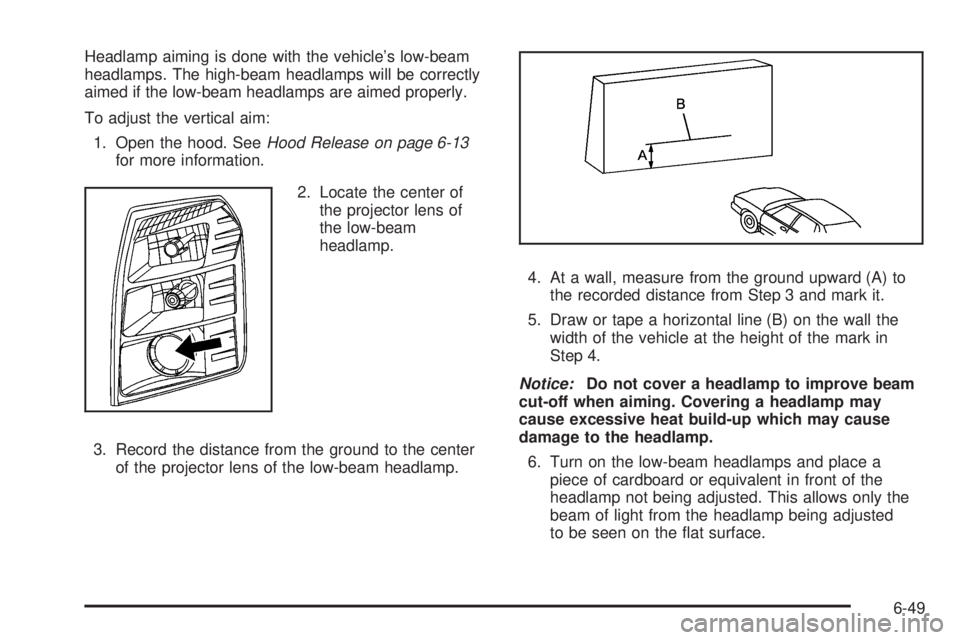
To adjust the vertical aim:
1. Open the hood. See Hood Release on page 6-13
for more information.
2. Locate the center of
the projector lens of
the low-beam
headlamp.
3. Record the distance from the ground to the center
of the projector lens of the low-beam headlamp. 4. At a wall, measure from the ground upward (A) to
the recorded distance from Step 3 and mark it.
5. Draw or tape a horizontal line (B) on the wall the
width of the vehicle at the height of the mark in
Step 4.
Notice: Do not cover a headlamp to improve beam
cut-off when aiming. Covering a headlamp may
cause excessive heat build-up which may cause
damage to the headlamp.
6. Turn on the low-beam headlamps and place a
piece of cardboard or equivalent in front of the
headlamp not being adjusted. This allows only the
beam of light from the headlamp being adjusted
to be seen on the at surface.
6-49
Page 485 of 602

Bulb Replacement For the proper type of replacement bulbs, see
Replacement Bulbs on page 6-53 .
For any bulb changing procedure not listed in this
section, contact your dealer/retailer.
High Intensity Discharge (HID)
Lighting
{ CAUTION: The low beam high intensity discharge lighting
system operates at a very high voltage. If you try to
service any of the system components, you could
be seriously injured. Have your dealer/retailer or a
qualied technician service them.
The vehicle may have HID headlamps. After an HID
headlamp bulb has been replaced, you may notice that
the beam is a slightly different shade than it was
originally. This is normal. LED Lighting The vehicle may have LED headlamps. For replacement
of the LED lighting assembly contact your dealer/retailer.
Back-Up Lamps To replace this bulb:
1. Open the liftgate.
See Power Liftgate
on page 2-14 for more
information.
6-51
Page 545 of 602

Fuses Usage
24 Fuel Injectors, Ignition Coils
(Left Side)
25 Trailer Park Lamps
26 Driver Side Park Lamps
27 Passenger Side Park Lamps
28 Fog Lamps
29 Horn
30 Passenger Side High-Beam
Headlamp
31 Daytime Running Lamps (DRL)
32 Driver Side High-Beam Headlamp
33 Daytime Running Lamps 2
34 Sunroof
35 Key Ignition System, Theft Deterrent
System
36 Windshield Wiper
37 SEO B2 Uptter Usage (Battery)
38 Electric Adjustable Pedals
39 Climate Controls (Battery)
40 Airbag System (Ignition)
41 Amplier
42 Audio System
43 Miscellaneous (Ignition), Cruise
Control Fuses Usage
44 Liftgate Release
45 Airbag System (Battery)
46 Instrument Panel Cluster
47 Not Used
48 Auxiliary Climate Control (Ignition)
49 Center High-Mounted Stoplamp
(CHMSL)
50 Rear Defogger
51 Heated Mirrors
52 SEO B1 Uptter Usage (Battery)
53 Cigarette Lighter, Auxiliary Power
Outlet
54 Automatic Level Control Compressor
Relay
55 Climate Controls (Ignition)
56 Engine Control Module, Secondary
Fuel Pump (Ignition)
J-Case Fuses Usage
57 Cooling Fan 1
58 Automatic Level Control Compressor
59 Heavy Duty Antilock Braking System
60 Cooling Fan 2
61 Antilock Brake System 1
6-111
Page 546 of 602

J-Case Fuses Usage
62 Starter
63 Stud 2 (Trailer Brakes)
64 Left Bussed Electrical Center 1
65 Electric Running Boards
66 Heated Windshield Washer System
67 Transfer Case
68 Stud 1 (Trailer Connector Battery
Power)
69 Mid-Bussed Electrical Center 1
70 Climate Control Blower
71 Power Liftgate Module
72 Left Bussed Electrical Center 2 Relays Usage
FAN HI Cooling Fan High Speed
FAN LO Cooling Fan Low Speed
FAN CNTRL Cooling Fan Control
HDLP LO/HID Low-Beam Headlamp
FOG LAMP Front Fog Lamps
A/C CMPRSR Air Conditioning Compressor
STRTR Starter
PWR/TRN Powertrain
FUEL PMP Fuel Pump
PRK LAMP Parking Lamps
REAR DEFOG Rear Defogger
RUN/CRANK Switched Power
6-112
Page 593 of 602
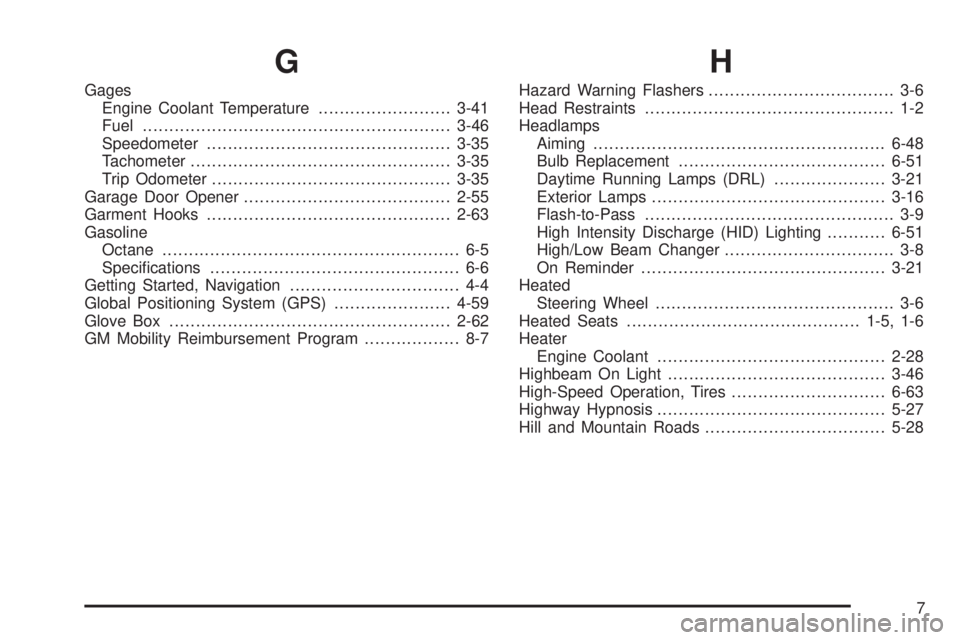
GGages
Engine Coolant Temperature ......................... 3-41
Fuel .......................................................... 3-46
Speedometer .............................................. 3-35
Tachometer ................................................. 3-35
Trip Odometer ............................................. 3-35
Garage Door Opener ....................................... 2-55
Garment Hooks .............................................. 2-63
Gasoline
Octane ........................................................ 6-5
Specications ............................................... 6-6
Getting Started, Navigation ................................ 4-4
Global Positioning System (GPS) ...................... 4-59
Glove Box ..................................................... 2-62
GM Mobility Reimbursement Program .................. 8-7
H Hazard Warning Flashers ................................... 3-6
Head Restraints ............................................... 1-2
Headlamps
Aiming ....................................................... 6-48
Bulb Replacement ....................................... 6-51
Daytime Running Lamps (DRL) ..................... 3-21
Exterior Lamps ............................................ 3-16
Flash-to-Pass ............................................... 3-9
High Intensity Discharge (HID) Lighting ........... 6-51
High/Low Beam Changer ................................ 3-8
On Reminder .............................................. 3-21
Heated
Steering Wheel ............................................. 3-6
Heated Seats ............................................ 1-5, 1-6
Heater
Engine Coolant ........................................... 2-28
Highbeam On Light ......................................... 3-46
High-Speed Operation, Tires ............................. 6-63
Highway Hypnosis ........................................... 5-27
Hill and Mountain Roads .................................. 5-28
7