brake light CADILLAC ESCALADE ESV 2009 Owner's Manual
[x] Cancel search | Manufacturer: CADILLAC, Model Year: 2009, Model line: ESCALADE ESV, Model: CADILLAC ESCALADE ESV 2009Pages: 602, PDF Size: 5.18 MB
Page 401 of 602

If the water is not too deep, drive slowly through it. At
faster speeds, water splashes on the ignition system and
the vehicle can stall. Stalling can also occur if you get the
tailpipe under water. If the tailpipe is under water, you will
never be able to start the engine. When going through
water, remember that when the brakes get wet, it might
take longer to stop. See Driving in Rain and on Wet
Roads on page 5-26 .
After Off-Road Driving Remove any brush or debris that has collected
on the underbody, chassis, or under the hood.
These accumulations can be a re hazard.
After operation in mud or sand, have the brake linings
cleaned and checked. These substances can cause
glazing and uneven braking. Check the body structure,
steering, suspension, wheels, tires, and exhaust system
for damage and check the fuel lines and cooling system
for any leakage.
The vehicle requires more frequent service due to
off-road use. Refer to the Maintenance Schedule for
additional information. Driving at Night Night driving is more dangerous than day driving because
some drivers are likely to be impaired — by alcohol or
drugs, with night vision problems, or by fatigue.
Night driving tips include:
Drive defensively.
Do not drink and drive.
Reduce headlamp glare by adjusting the inside
rearview mirror.
Slow down and keep more space between you and
other vehicles because headlamps can only light up
so much road ahead.
Watch for animals.
When tired, pull off the road.
Do not wear sunglasses.
Avoid staring directly into approaching headlamps.
Keep the windshield and all glass on your vehicle
clean — inside and out.
Keep your eyes moving, especially during turns or
curves.
No one can see as well at night as in the daytime.
But, as we get older, these differences increase.
A 50-year-old driver might need at least twice as much
light to see the same thing at night as a 20-year-old.
5-25
Page 402 of 602
Driving in Rain and on Wet Roads Rain and wet roads can reduce vehicle traction
and affect your ability to stop and accelerate. Always
drive slower in these types of driving conditions
and avoid driving through large puddles and
deep-standing or owing water.
{ CAUTION: Wet brakes can cause crashes. They might not
work as well in a quick stop and could cause
pulling to one side. You could lose control of the
vehicle.
After driving through a large puddle of water or a
car/vehicle wash, lightly apply the brake pedal until
the brakes work normally.
Flowing or rushing water creates strong forces.
Driving through owing water could cause your
vehicle to be carried away. If this happens, you
and other vehicle occupants could drown. Do not
ignore police warnings and be very cautious about
trying to drive through owing water. Hydroplaning Hydroplaning is dangerous. Water can build up under
your vehicle’s tires so they actually ride on the water.
This can happen if the road is wet enough and you are
going fast enough. When your vehicle is hydroplaning, it
has little or no contact with the road.
There is no hard and fast rule about hydroplaning.
The best advice is to slow down when the road is wet.
Other Rainy Weather Tips Besides slowing down, other wet weather driving tips
include:
Allow extra following distance.
Pass with caution.
Keep windshield wiping equipment in good shape.
Keep the windshield washer uid reservoir lled.
Have good tires with proper tread depth. See Tires
on page 6-56 .
Turn off cruise control.
5-26
Page 419 of 602

Two-wheel-drive vehicles should not be towed with
the rear wheels on the ground. Two-wheel-drive
transmissions have no provisions for internal lubrication
while being towed.
Dolly Towing (Rear Wheels Off the Ground)
Use the following procedure to dinghy tow a
two-wheel-drive vehicle from the rear:
1. Attach the dolly to the tow vehicle following the
dolly manufacturer’s instructions.
2. Drive the rear wheels onto the dolly.
3. Firmly set the parking brake. See Parking Brake on
page 2-34 . 4. Put the transmission in P (Park).
5. Secure the vehicle to the dolly following the
manufacturer’s instructions.
6. Use an adequate clamping device designed for
towing to ensure that the front wheels are locked
into the straight position.
7. Turn the ignition to LOCK/OFF.
Level Control
Automatic Level Control The automatic level control rear suspension is available
on light-duty vehicles and comes as a part of the
Autoride ®
suspension, if equipped.
This type of level control is fully automatic and will provide
a better leveled riding position as well as better handling
under a variety of passenger and loading conditions. An
air compressor connected to the rear shocks will raise or
lower the rear of the vehicle to maintain proper vehicle
height. The system is activated when the ignition key is
turned to ON/RUN and will automatically adjust vehicle
height thereafter. The system may exhaust (lower vehicle
height) for up to ten minutes after the ignition key has
been turned off. You may hear the air compressor
operating when the height is being adjusted.
If a weight-distributing hitch is being used, it is
recommended to allow the shocks to inate, thereby
leveling the vehicle prior to adjusting the hitch.
5-43
Page 428 of 602
Operating the vehicle in Tow/Haul when lightly loaded
or with no trailer at all will not cause damage. However,
there is no benet to the selection of Tow/Haul when
the vehicle is unloaded. Such a selection when unloaded
may result in unpleasant engine and transmission
driving characteristics and reduced fuel economy.
Tow/Haul is recommended only when pulling a heavy
trailer or a large or heavy load.
The vehicle is equipped with Autoride ®
which further
improves the vehicle’s ride while towing. See Autoride ®
on page 5-44 for more information.
Trailer Brakes A loaded trailer that weighs more than 2,000 lbs
(900 kg) needs to have its own brake system that is
adequate for the weight of the trailer. Be sure to read
and follow the instructions for the trailer brakes so
they are installed, adjusted and maintained properly.
Since the vehicle is equipped with StabiliTrak ®
, the trailer
brakes cannot tap into the vehicle’s hydraulic system. Driving with a Trailer
{ CAUTION: When towing a trailer, exhaust gases may collect
at the rear of the vehicle and enter if the liftgate,
trunk/hatch, or rear-most window is open.
Engine exhaust contains carbon monoxide (CO)
which cannot be seen or smelled. It can cause
unconsciousness and even death.
To maximize safety when towing a trailer:
Have the exhaust system inspected for leaks
and make necessary repairs before starting
a trip.
Never drive with the liftgate, trunk/hatch, or
rear-most window open.
Fully open the air outlets on or under the
instrument panel.
Adjust the Climate Control system to a setting
that brings in only outside air and set the fan
speed to the highest setting. See Climate
Control System in the Index.
For more information about carbon monoxide, see
Engine Exhaust on page 2-38 .
5-52
Page 430 of 602

Driving On Grades Reduce speed and shift to a lower gear before starting
down a long or steep downgrade. If the transmission is
not shifted down, the brakes might have to be used so
much that they would get hot and no longer work well.
Vehicles can tow in D (Drive). Shift the transmission to
a lower gear if the transmission shifts too often under
heavy loads and/or hilly conditions.
The tow/haul mode may be used if the transmission
shifts too often. See Tow/Haul Mode Light on page 3-46 .
When towing at high altitude on steep uphill grades,
consider the following: Engine coolant will boil at a lower
temperature than at normal altitudes. If the engine is
turned off immediately after towing at high altitude on
steep uphill grades, the vehicle may show signs similar to
engine overheating. To avoid this, let the engine run while
parked, preferably on level ground, with the transmission
in P (Park) for a few minutes before turning the engine
off. If the overheat warning comes on, see Engine
Overheating on page 6-30 . Parking on Hills
{ CAUTION: Parking the vehicle on a hill with the trailer
attached can be dangerous. If something goes
wrong, the rig could start to move. People can be
injured, and both the vehicle and the trailer can be
damaged. When possible, always park the rig on a
at surface.
If parking the rig on a hill:
1. Press the brake pedal, but do not shift into P (Park)
yet. Turn the wheels into the curb if facing downhill
or into traffic if facing uphill.
2. Have someone place chocks under the trailer
wheels.
3. When the wheel chocks are in place, release the
regular brakes until the chocks absorb the load.
4. Reapply the brake pedal. Then apply the parking
brake and shift into P (Park).
5. Release the brake pedal.
5-54
Page 432 of 602

Maintenance When Trailer Towing The vehicle needs service more often when pulling a
trailer. See this manual’s Maintenance Schedule or Index
for more information. Things that are especially important
in trailer operation are automatic transmission uid,
engine oil, axle lubricant, belts, cooling system and brake
system. It is a good idea to inspect these before and
during the trip.
Check periodically to see that all hitch nuts and bolts
are tight.
Trailer Wiring Harness Heavy-Duty Trailer Wiring Package
The vehicle is equipped with the seven-wire trailer
towing harness. This harness with a seven-pin universal
heavy-duty trailer connector is attached to the rear
bumper beam. It is located next to the integrated trailer
hitch. The seven-wire harness contains the following trailer
circuits:
Yellow: Left Stop/Turn Signal
Dark Green: Right Stop/Turn Signal
Brown: Taillamps
White: Ground
Light Green: Back-up Lamps
Red w/ Black Stripe: Battery Feed*
Dark Blue: Trailer Brake*
*The fuses for these two circuits are installed in the
underhood electrical center, but the circuits are
not connected. They should be installed by your dealer
or a qualied service center.
If charging a remote (non-vehicle) battery, press the
Tow/Haul mode button, if equipped, located at the end of
the shift lever. This will boost the vehicle system voltage
and properly charge the battery. If the trailer is too light
for Tow/Haul mode, or the vehicle is not equipped with
Tow/Haul, turn on the headlamps as a second way to
boost the vehicle system and charge the battery.
5-56
Page 433 of 602
Electric Brake Control Wiring
Provisions These wiring provisions are included with the vehicle
as part of the heavy-duty trailer wiring package.
These provisions are for an electric brake controller.
The red/black stripe power feed will not be connected
to the battery until the ring terminal is unstowed and
connected to the underhood electrical center. The
instrument panel contains blunt cut wires near the data
link connector for the trailer brake controller. The harness
contains the following wires:
Dark Blue: Auxiliary
Red/Black: Battery
Light Blue/White: Brake Switch
White: Ground
The trailer brake controller should be installed by your
dealer/retailer or a qualied service center. Trailer Recommendations Subtract the hitch loads from the Cargo Weight Rating
(CWR). CWR is the maximum weight of the load
the vehicle can carry. It does not include the weight of
the people inside, but you can gure about 150 lbs.
(68 kg) for each passenger. The total cargo load must
not be more than the vehicles CWR.
Weigh the vehicle with the trailer attached, so the
GVWR or GAWR are not exceeded. If using a
weight-distributing hitch, weigh the vehicle without
the spring bars in place.
The best performance is obtained by correctly spreading
out the weight of the load and choosing the correct
hitch and trailer brakes.
For more information see Towing a Trailer on page 5-44 .
5-57
Page 435 of 602
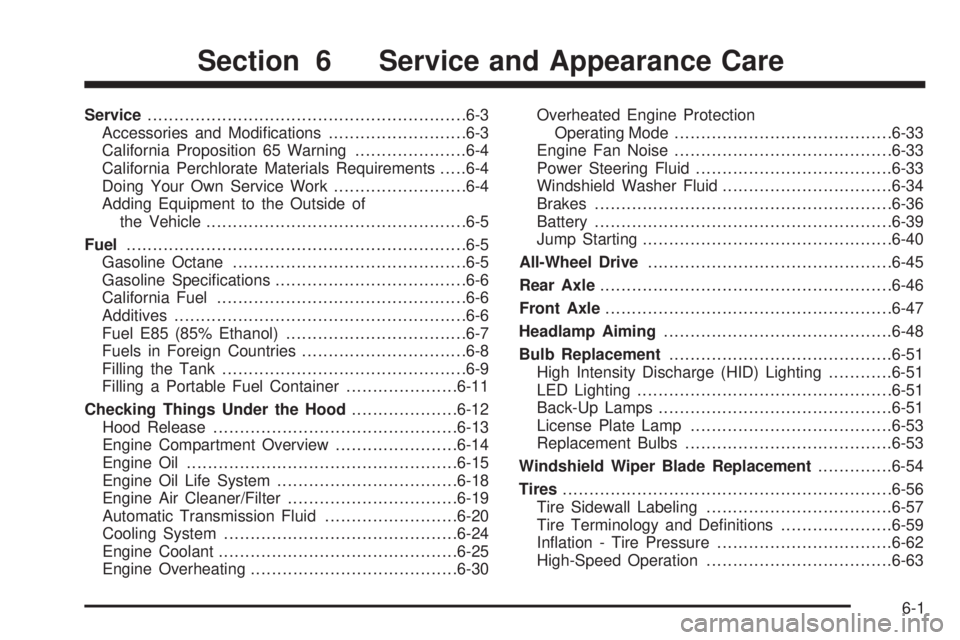
Service ........................................................... .6-3
Accessories and Modications ......................... .6-3
California Proposition 65 Warning .................... .6-4
California Perchlorate Materials Requirements .... .6-4
Doing Your Own Service Work ........................ .6-4
Adding Equipment to the Outside of
the Vehicle ................................................ .6-5
Fuel ............................................................... .6-5
Gasoline Octane ........................................... .6-5
Gasoline Specications ................................... .6-6
California Fuel .............................................. .6-6
Additives ...................................................... .6-6
Fuel E85 (85% Ethanol) ................................. .6-7
Fuels in Foreign Countries .............................. .6-8
Filling the Tank ............................................. .6-9
Filling a Portable Fuel Container .................... .6-11
Checking Things Under the Hood ................... .6-12
Hood Release ............................................. .6-13
Engine Compartment Overview ...................... .6-14
Engine Oil .................................................. .6-15
Engine Oil Life System ................................. .6-18
Engine Air Cleaner/Filter ............................... .6-19
Automatic Transmission Fluid ........................ .6-20
Cooling System ........................................... .6-24
Engine Coolant ............................................ .6-25
Engine Overheating ...................................... .6-30 Overheated Engine Protection
Operating Mode ........................................ .6-33
Engine Fan Noise ........................................ .6-33
Power Steering Fluid .................................... .6-33
Windshield Washer Fluid ............................... .6-34
Brakes ....................................................... .6-36
Battery ....................................................... .6-39
Jump Starting .............................................. .6-40
All-Wheel Drive ............................................. .6-45
Rear Axle ...................................................... .6-46
Front
Axle ..................................................... .6-47
Headlamp Aiming .......................................... .6-48
Bulb Replacement ......................................... .6-51
High Intensity Discharge (HID) Lighting ........... .6-51
LED Lighting ............................................... .6-51
Back-Up Lamps ........................................... .6-51
License Plate Lamp ..................................... .6-53
Replacement Bulbs ...................................... .6-53
Windshield Wiper Blade Replacement ............. .6-54
Tires ............................................................. .6-56
Tire Sidewall Labeling .................................. .6-57
Tire Terminology and Denitions .................... .6-59
Ination - Tire Pressure ................................ .6-62
High-Speed Operation .................................. .6-63Section 6 Service and Appearance Care
6-1
Page 471 of 602

{ CAUTION: If too much brake uid is added, it can spill on
the engine and burn, if the engine is hot enough.
You or others could be burned, and the vehicle
could be damaged. Add brake uid only when
work is done on the brake hydraulic system.
See “Checking Brake Fluid” in this section.
When the brake uid falls to a low level, the brake
warning light comes on. See Brake System Warning
Light on page 3-39 .
Refer to the Maintenance Schedule to determine when
to check the brake uid. See Scheduled Maintenance
on page 7-4 . Checking Brake Fluid Check brake uid by looking at the brake uid reservoir.
See Engine Compartment Overview on page 6-14 .
The uid level should be
above MIN. If it is not,
have the brake hydraulic
system checked to
see if there is a leak.
After work is done on the brake hydraulic system,
make sure the level is above the MIN but not over the
MAX mark.
6-37
Page 472 of 602

What to Add Use only new DOT 3 brake uid from a sealed container.
See Recommended Fluids and Lubricants on page 7-13 .
Always clean the brake uid reservoir cap and the
area around the cap before removing it. This helps keep
dirt from entering the reservoir.
{ CAUTION: With the wrong kind of uid in the brake hydraulic
system, the brakes might not work well. This could
cause a crash. Always use the proper brake uid.
Notice:
Using the wrong uid can badly damage brake
hydraulic system parts. For example, just a few
drops of mineral-based oil, such as engine oil, in
the brake hydraulic system can damage brake
hydraulic system parts so badly that they will
have to be replaced. Do not let someone put in
the wrong kind of uid.
If brake uid is spilled on the vehicle’s painted
surfaces, the paint nish can be damaged. Be
careful not to spill brake uid on the vehicle. If
you do, wash it off immediately. See Washing
Your Vehicle on page 6-100 . Brake Wear This vehicle has disc brakes. Disc brake pads have
built-in wear indicators that make a high-pitched warning
sound when the brake pads are worn and new pads
are needed. The sound can come and go or be heard all
the time the vehicle is moving, except when applying
the brake pedal rmly.
{ CAUTION: The brake wear warning sound means that soon
the brakes will not work well. That could lead to an
accident. When the brake wear warning sound is
heard, have the vehicle serviced.
Notice: Continuing to drive with worn-out brake
pads could result in costly brake repair.
Some driving conditions or climates can cause a brake
squeal when the brakes are rst applied or lightly
applied. This does not mean something is wrong with
the brakes.
6-38