instrument panel CADILLAC ESCALADE ESV 2009 Owner's Manual
[x] Cancel search | Manufacturer: CADILLAC, Model Year: 2009, Model line: ESCALADE ESV, Model: CADILLAC ESCALADE ESV 2009Pages: 602, PDF Size: 5.18 MB
Page 184 of 602
Using Cruise Control on Hills How well the cruise control will work on hills depends
upon the vehicle speed, load, and the steepness of
the hills. When going up steep hills, you might have to
step on the accelerator pedal to maintain the vehicle’s
speed. When going downhill, you might have to brake
or shift to a lower gear to keep the vehicle’s speed
down. When the brakes are applied the cruise control
turns off.
Ending Cruise Control There are three ways to end cruise control:
Step lightly on the brake pedal.
Press the
[ button on the steering wheel.
Press the
I button on the steering wheel.
Erasing Speed Memory The cruise control set speed memory is erased when
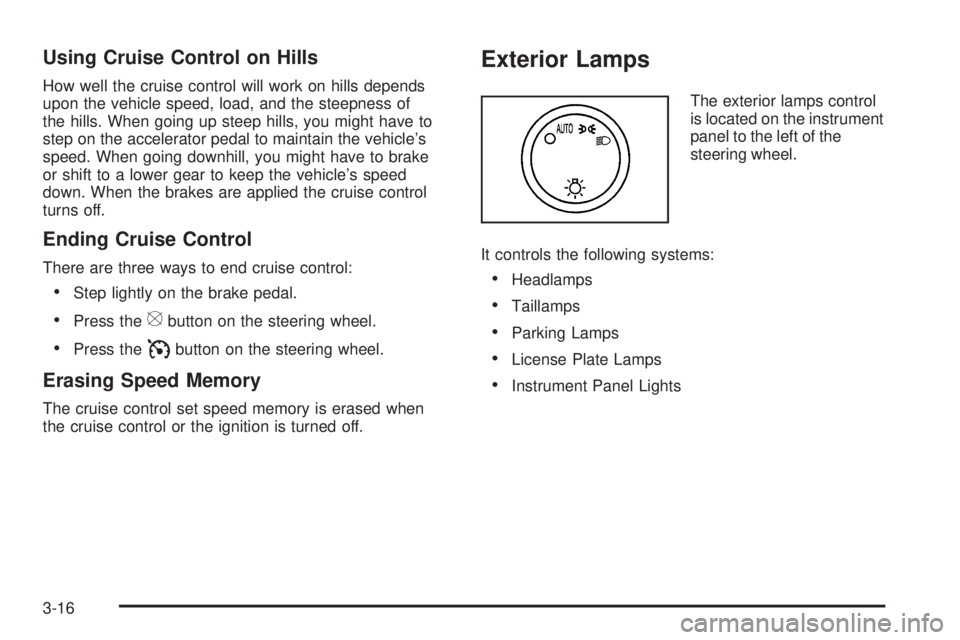
the cruise control or the ignition is turned off. Exterior Lamps The exterior lamps control
is located on the instrument
panel to the left of the
steering wheel.
It controls the following systems:
Headlamps
Taillamps
Parking Lamps
License Plate Lamps
Instrument Panel Lights
3-16
Page 185 of 602

The exterior lamps control has four positions:
9 (Off): Turns off the automatic headlamps and
daytime running lamps (DRL). Turning the headlamp
control to the off position again will turn the automatic
headlamps or DRL back on.
For vehicles rst sold in Canada, the off position only
works when the vehicle is shifted into the P (Park)
position.
AUTO (Automatic): Automatically turns on the
headlamps at normal brightness, together with the
following:
Parking Lamps
Instrument Panel Lights
Taillamps
License Plate Lamps
; (Parking Lamps): Turns on the parking lamps
together with the following:
Instrument Panel Lights
Taillamps
License Plate Lamps 2 (Headlamps): Turns on the headlamps together
with the following lamps listed below.
Parking Lamps
Instrument Panel Lights
Taillamps
License Plate Lamps
When the headlamps are turned on while the vehicle is
on, the headlamps will turn off automatically 10 minutes
after the ignition is turned off. When the headlamps
are turned on while the vehicle is off, the headlamps
will stay on for 10 minutes before automatically turning
off to prevent the battery from being drained. Turn the
headlamp control to off and then back to the headlamp
on position to make the headlamps stay on for an
additional 10 minutes.
3-17
Page 186 of 602
IntelliBeam ®
Intelligent High-Beam
Headlamp Control System For vehicles with this feature, be sure to read this entire
section before using it.
IntelliBeam ®
is an enhancement to the vehicle’s
headlamp system. Using a digital light sensor on the
rearview mirror, this system will turn the vehicle’s
high-beam headlamps on and off according to
surrounding traffic conditions.
The IntelliBeam ®
system turns the high-beam
headlamps on when it is dark enough, there is no other
traffic present, and the IntelliBeam ®
system is enabled.
Turning On and Enabling IntelliBeam ®
Press and release the IntelliBeam ®
button on the inside
rear view mirror. The IntelliBeam ®
indicator on the mirror
will turn on to let you know the system has been turned
on. Once the system has been turned on, it will remain
on each time the vehicle is started. Additionally, the
IntelliBeam ®
system must be enabled.
To enable the IntelliBeam ®
system, turn the exterior
lamp control to AUTO, with the turn signal/multifunction
lever in its neutral position. The High-Beam On Light
will appear on the instrument panel cluster when
the high-beams are on. See Highbeam On Light
on page 3-46 . Driving with IntelliBeam ®
IntelliBeam ®
will only activate your high-beams when
driving over 20 mph (32 km/h).
The high-beam headlamps will remain on, under the
automatic control of IntelliBeam ®
, until any of the
following situations occur:
The system detects an approaching vehicle’s
headlamps.
The system detects a preceding vehicle’s taillamps.
The outside light is bright enough that high-beam
headlamps are not required.
The vehicle’s speed drops below 15 mph (24 km/h).
The headlamp stalk is moved forward to the
high-beam position. See Headlamp High/Low-Beam
Changer on page 3-8 .
When either of these conditions occur, the
IntelliBeam ®
feature will be disabled and the
IntelliBeam ®
light in the mirror will turn off until the
high-beam stalk is returned to the neutral position.
If IntelliBeam ®
was using low-beams prior to
this action, the IntelliBeam ®
feature will be
temporarily disabled until the stalk is returned
to the neutral position.
3-18
Page 189 of 602

Headlamps on Reminder If a door is open, a reminder chime will sound when
the headlamps or parking lamps are manually turned on
and the key is out of the ignition. To turn off the chime,
turn the headlamp switch to off or AUTO and then back
on, or close and re-open the door. In the AUTO mode,
the headlamps turn off once the ignition is in LOCK/OFF
or may remain on until the headlamp delay ends
(if enabled in the DIC). See “Exit Lighting” under
DIC Vehicle Customization on page 3-65 .
Daytime Running Lamps (DRL) Daytime Running Lamps (DRL) can make it easier
for others to see the front of your vehicle during the day.
Fully functional daytime running lamps are required
on all vehicles rst sold in Canada.
The DRL system will come on when the following
conditions are met:
The ignition is on.
The exterior lamps control is in AUTO.
The transmission is not in P (Park).
The light sensor determines it is daytime.
When the DRL are on, only the DRL lamps will be on.
The taillamps, sidemarker, instrument panel lights,
and other lamps will not be on. When it begins to get dark, the automatic headlamp
system will switch from DRL to the headlamps.
To turn off the DRL lamps, turn the exterior
lamps control to the OFF position and then release.
For vehicles rst sold in Canada, the transmission must
be in the P (Park) position, before the DRL lamps can
be turned off.
Automatic Headlamp System When it is dark enough outside, the automatic headlamp
system turns on the headlamps at the normal brightness,
along with the taillamps, sidemarker, parking lamps,
and the instrument panel lights. The radio lights will
also be dim.
To turn off the automatic headlamp system, turn the
exterior lamps switch to the off position and then release
it. For vehicles rst sold in Canada, the transmission
must be in the P (Park) position, before the automatic
headlamp system can be turned off.
The vehicle has a light sensor located on the top of the
instrument panel in the defroster grille that regulates
when the automatic headlamps turn on. Do not cover
the sensor or the headlamps will come on whenever
the ignition is on.
The system may also turn on the headlamps when
driving through a parking garage, heavy overcast
weather, or a tunnel. This is normal.
3-21
Page 190 of 602

There is a delay in the transition between the daytime
and nighttime operation of the Daytime Running Lamps
(DRL) and the automatic headlamp systems so that
driving under bridges or bright overhead street lights
does not affect the system. The DRL and automatic
headlamp system is only affected when the light sensor
detects a change in lighting lasting longer than the delay.
If the vehicle is started in a dark garage, the automatic
headlamp system will come on immediately. Once the
vehicle leaves the garage, it takes approximately
one minute for the automatic headlamp system to
change to DRL if it is bright enough outside. During
that delay, the instrument panel cluster may not be
as bright as usual. Make sure the instrument panel
brightness control is in the full bright position.
See Instrument Panel Brightness on page 3-23 .
To idle the vehicle with the automatic headlamp system
off, turn the control to the off position.
The headlamps will also stay on after you exit the
vehicle. This feature can be programmed using the
Driver Information Center (DIC). See DIC Vehicle
Customization on page 3-65 .
The regular headlamp system can be turned on when
needed. Fog Lamps For vehicles with fog lamps, the control is located next
to the exterior lamps control on the instrument panel
to the left of the steering column.
# (Fog Lamps): Press the button to turn the fog lamps
on or off. A indicator light comes on in the instrument
panel cluster. The ignition must be in the ON/RUN
position for the fog lamps to come on.
When the fog lamps are turned on, the headlamps
automatically turn on.
When the headlamps are changed to high-beam, the
fog lamps also go off. When the high-beam headlamps
go off, the fog lamps will come on again.
Some localities have laws that require the headlamps to
be on along with the fog lamps.
3-22
Page 191 of 602

Instrument Panel Brightness D (Instrument Panel Brightness): This feature
controls the brightness of the instrument panel lights
and is located next to the exterior lamp control.
Push the knob to extend out and then it can be turned.
Turn the knob clockwise or counterclockwise to brighten
or dim the instrument panel lights. Turning the knob to the
farthest clockwise position turns on the dome lamps.
Dome Lamps The dome lamps come on when any door is opened.
They turn off after all the doors are closed.
The dome lamps can also be turned on by turning
the instrument panel brightness knob, located on the
instrument panel to the left of the steering column,
clockwise to the farthest position. In this position, the
dome lamps remain on whether a door is opened or
closed. Dome Lamp Override The dome lamp override button is located next to the
exterior lamps control.
k (Dome Off): Press the button in and the dome
lamps remain off when a door is opened. Press the button
again to return it to the extended position so that the
dome lamps come on when a door is opened.
Entry Lighting The vehicle has an illuminated entry feature.
When the doors are opened, the dome lamps will come
on if the dome override button is in the extended position.
If the dome override button is pressed in, the lamps will
not come on.
Exit Lighting The interior lamps come on when the key is
removed from the ignition. They turn off automatically
in 20 seconds. The lights do not come on if the dome
override button is pressed in.
3-23
Page 196 of 602

Automatic Operation AUTO (Automatic): When automatic operation is
active the system will control the inside temperature,
the air delivery, and the fan speed.
Use the steps below to place the entire system in
automatic mode:
1. Press the AUTO button.
When AUTO is selected, the display will change to
show the current temperature(s) and AUTO come on
the display. The current delivery mode and fan speed
will also be displayed for approximately ve seconds.
When AUTO is selected, the air conditioning
operation and air inlet will be automatically
controlled. The air conditioning compressor will
run when the outside temperature is over about
40°F (4°C). The air inlet will normally be set
to outside air. If it is hot outside, the air inlet may
automatically switch to recirculate inside air to
help quickly cool down the vehicle. The light on
the button comes on in recirculation. 2. Set the driver’s and passenger’s temperature.
To nd your comfort setting, start with a 74°F (23°C)
temperature setting and allow about 20 minutes for
the system to regulate. Use the driver or passenger
temperature buttons to adjust the temperature setting
as necessary. If a temperature setting of 60°F (15°C)
is chosen, the system remains at the maximum
cooling setting. If a temperature setting of 90°F
(32°C) is chosen, the system remains at the
maximum heat setting. Choosing either maximum
setting will not cause the vehicle to heat or cool
any faster.
Be careful not to cover the sensor located on the top of
the instrument panel near the windshield. This sensor
regulates air temperature based on sun load and
also turns on the headlamps.
To avoid blowing cold air in cold weather, the system
will delay turning on the fan until warm air is available.
The length of delay depends on the engine coolant
temperature. Pressing the fan switch will override
this delay and change the fan to a selected speed.
3-28
Page 197 of 602

Manual Operation
y9z (Fan Control): Press the up or down arrows
to increase or decrease the fan speed
Pressing this button when the system is off will turn the
system on.
Pressing either arrow while using automatic operation
will place the fan in manual operation. The fan setting will
display and the AUTO light will turn off. The air delivery
will remain in automatic operation.
N (Air Delivery Mode Control): Press to change the
direction of the airow in the vehicle. Repeatedly press
the button until the desired mode appears on the display.
When the system is turned off, the display goes blank
after displaying the current status of the system.
H (Vent): Air is directed to the instrument panel outlets.
) (Bi-Level): Air is divided between the instrument
panel and oor outlets. Some air is directed towards
the windshield and side window outlets. Cooler air
is directed to the upper vents and warmer air to the
oor vents. 6 (Floor): Air is directed to the oor outlets, with
some to the windshield, side window outlets, and second
row oor outlets. In this mode, the system automatically
selects outside air.
- (Defog): This mode clears the windows of fog or
moisture. Air is directed to the windshield, oor outlets,
and side window vents. In this mode, the system turns
off recirculation and runs the air conditioning compressor
unless the outside temperature is close to freezing.
The recirculation mode cannot be selected while in
the defog mode.
0 (Defrost): This mode removes fog or frost from the
windshield more quickly. Air is directed to the windshield
and side window vents, with some directed to the oor
vents. In this mode, the system automatically forces
outside air into the vehicle and runs the air conditioning
compressor unless the outside temperature is close to
freezing. The recirculation mode cannot be selected while
in the defrost mode.
Do not drive the vehicle until all the windows are clear.
3-29
Page 199 of 602

Rear Window Defogger The rear window defogger uses a warming grid to
remove fog from the rear window.
< (Rear Window Defogger): Press to turn the rear
window defogger on or off. It automatically turns off after
it has been activated. The defogger can also be turned off
by turning off the engine. Do not drive the vehicle until all
the windows are clear.
Notice: Do not use a razor blade or sharp object
to clear the inside rear window. Do not adhere
anything to the defogger grid lines in the rear glass.
These actions may damage the rear defogger.
Repairs would not be covered by your warranty.
Heated Mirrors: For vehicles with heated outside
rearview mirrors, the mirrors heat to help clear fog or
frost from the surface of the mirror when the rear window
defog button is pressed. See Outside Heated Mirrors
on page 2-42 .
Heated or Cooled Seats: For vehicles with heated
seats or heated and cooled seats, see Heated Seats on
page 1-5 or Heated and Cooled Seats on page 1-6 .Outlet Adjustment Use the air outlets located in the center and on the side
of the instrument panel to direct the airow.
Operation Tips
Keep the hood and front air inlets free of ice, snow,
or any other obstruction (such as leaves). The heater
and defroster will work far better, reducing the
chance of fogging the inside of the windows.
When you enter a vehicle in cold weather, press
the fan up button to the maximum fan level before
driving. This helps clear the intake ducts of snow
and moisture, and reduces the chance of fogging
the inside of the window.
Keep the air path under the front seats clear of
objects. This helps air to circulate throughout the
vehicle.
Adding outside equipment to the front of the
vehicle, such as hood-air deectors, may affect
the performance of the heating and air conditioning
system. Check with your dealer/retailer before
adding equipment to the outside of the vehicle.
3-31
Page 202 of 602
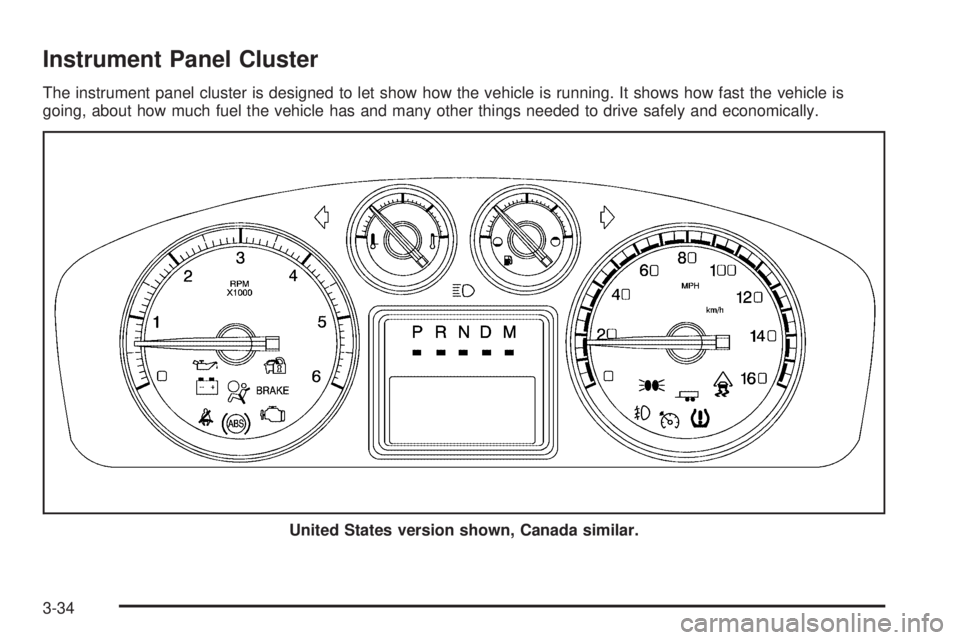
Instrument Panel Cluster The instrument panel cluster is designed to let show how the vehicle is running. It shows how fast the vehicle is
going, about how much fuel the vehicle has and many other things needed to drive safely and economically.
United States version shown, Canada similar.
3-34