instrument panel CADILLAC ESCALADE ESV 2009 Workshop Manual
[x] Cancel search | Manufacturer: CADILLAC, Model Year: 2009, Model line: ESCALADE ESV, Model: CADILLAC ESCALADE ESV 2009Pages: 602, PDF Size: 5.18 MB
Page 533 of 602
TEHAMA™ Leather The leather surface on the seat was not designed to be
aggressively cleaned using any commercial product. Use
a well wrung cloth dampened with water to remove dust.
Do not use a wet cloth or saturate the leather surface with
water. Allow the leather to dry naturally. If a soil occurs
that cannot be completely removed, allow it to become
part of the natural markings of the leather. The leather in
the vehicle was designed to have a natural appearance
and develop a more vintage appearance with use.
Do not use heat to dry. Never use steam to clean
leather. Never use spot lifters or spot removers
on leather. It is very important to not use any commercial
leather cleaners or coatings that are sold to preserve
and protect leather. Not only are those products
not necessary, they will permanently and adversely
change the appearance and feel of the leather. Never
use silicone or wax-based products, or those containing
organic solvents to clean the vehicle’s interior. Never
use shoe polish on leather. Instrument Panel, Vinyl, and Other
Plastic Surfaces A soft cloth dampened with water may be used to remove
dust. If a more thorough cleaning is necessary, a clean
soft cloth dampened with a mild soap solution can be
used to gently remove dust and dirt. Never use spot lifters
or removers on plastic surfaces. Many commercial
cleaners and coatings that are sold to preserve and
protect soft plastic surfaces may permanently change
the appearance and feel of the interior and are not
recommended. Do not use silicone or wax-based
products, or those containing organic solvents to
clean the vehicle’s interior because they can alter the
appearance by increasing the gloss in a non-uniform
manner.
Some commercial products may increase gloss on the
instrument panel. The increase in gloss may cause
annoying reections in the windshield and even make it
difficult to see through the windshield under certain
conditions.
6-99
Page 538 of 602
Underbody Maintenance Chemicals used for ice and snow removal and dust
control can collect on the underbody. If these are not
removed, corrosion and rust can develop on the
underbody parts such as fuel lines, frame, oor pan,
and exhaust system even though they have corrosion
protection.
At least every spring, ush these materials from the
underbody with plain water. Clean any areas where mud
and debris can collect. Dirt packed in close areas of the
frame should be loosened before being ushed. Your
dealer/retailer or an underbody car washing system can
do this.
Chemical Paint Spotting Some weather and atmospheric conditions can create a
chemical fallout. Airborne pollutants can fall upon and
attack painted surfaces on the vehicle. This damage can
take two forms: blotchy, ring-shaped discolorations, and
small, irregular dark spots etched into the paint surface.
Although no defect in the paint job causes this, we will
repair, at no charge to the owner, the surfaces of
new vehicles damaged by this fallout condition within
12 months or 12,000 miles (20 000 km) of purchase,
whichever occurs rst. Vehicle Identication Vehicle Identication Number (VIN)
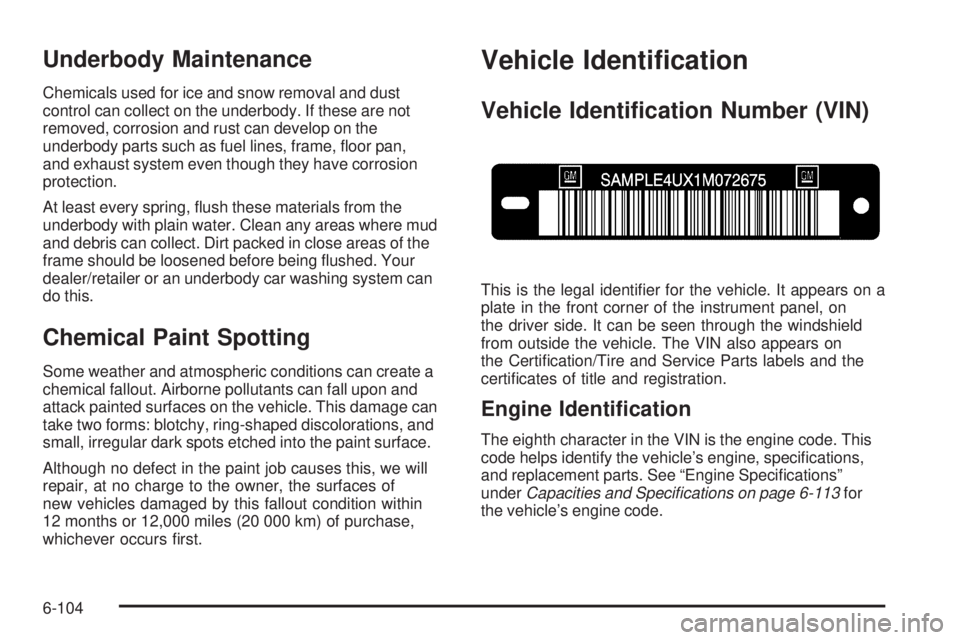
This is the legal identier for the vehicle. It appears on a
plate in the front corner of the instrument panel, on
the driver side. It can be seen through the windshield
from outside the vehicle. The VIN also appears on
the Certication/Tire and Service Parts labels and the
certicates of title and registration.
Engine Identication The eighth character in the VIN is the engine code. This
code helps identify the vehicle’s engine, specications,
and replacement parts. See “Engine Specications”
under Capacities and Specifications on page 6-113 for
the vehicle’s engine code.
6-104
Page 540 of 602
Fuses and Circuit Breakers If the vehicle is a Two-mode Hybrid, see the Two-mode
Hybrid manual for more information.
The wiring circuits in the vehicle are protected from
short circuits by a combination of fuses, circuit breakers
and fusible thermal links. This greatly reduces the
chance of res caused by electrical problems.
Look at the silver-colored band inside the fuse. If the
band is broken or melted, replace the fuse. Be sure you
replace a bad fuse with a new one of the identical size
and rating.
If you ever have a problem on the road and don’t have
a spare fuse, you can borrow one that has the same
amperage. Just pick some feature of your vehicle
that you can get along without – like the radio or
cigarette lighter – and use its fuse, if it is the correct
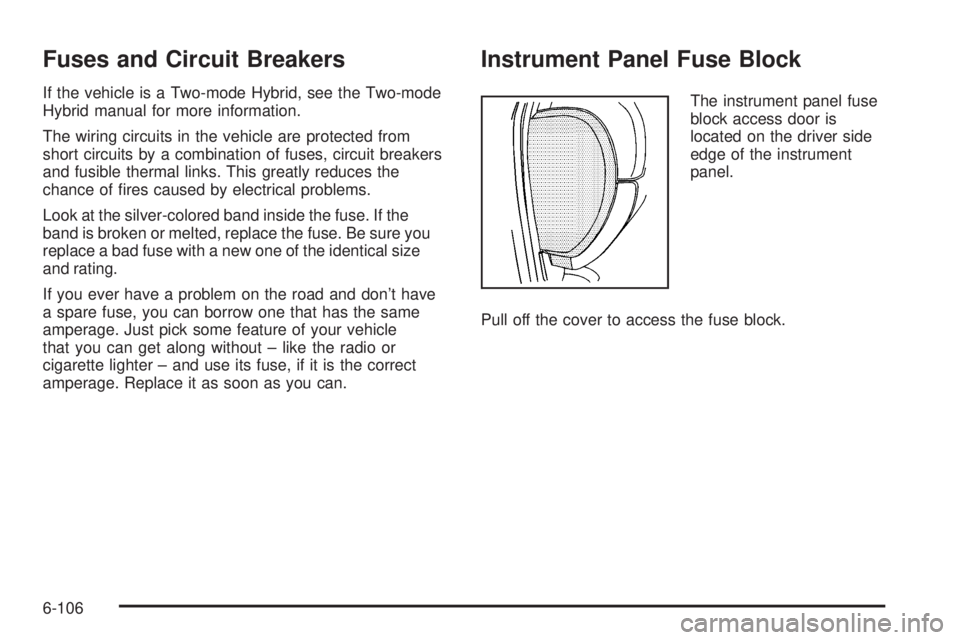
amperage. Replace it as soon as you can. Instrument Panel Fuse Block The instrument panel fuse
block access door is
located on the driver side
edge of the instrument
panel.
Pull off the cover to access the fuse block.
6-106
Page 541 of 602
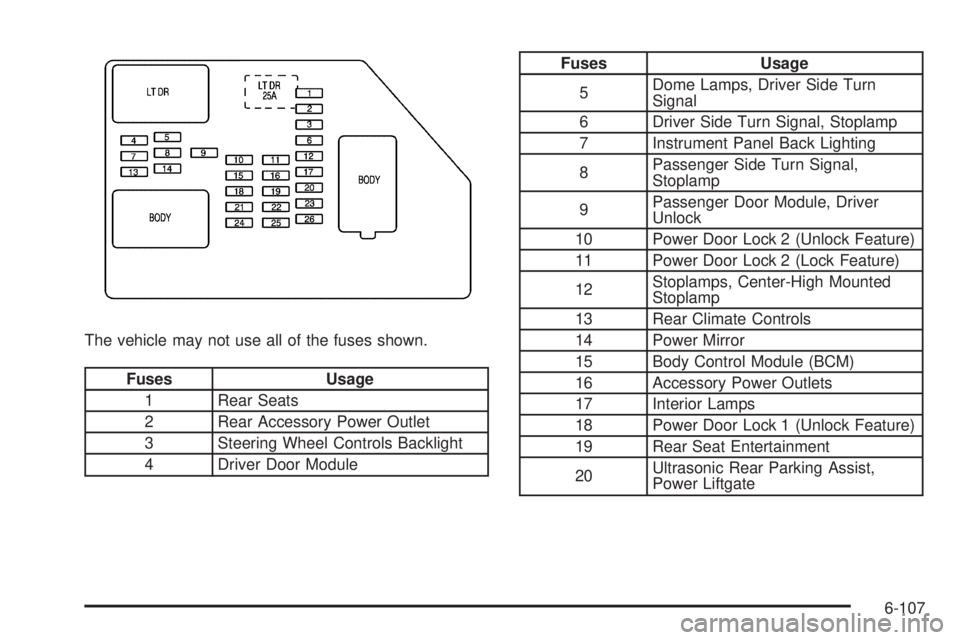
The vehicle may not use all of the fuses shown.
Fuses Usage
1 Rear Seats
2 Rear Accessory Power Outlet
3 Steering Wheel Controls Backlight
4 Driver Door Module Fuses Usage
5 Dome Lamps, Driver Side Turn
Signal
6 Driver Side Turn Signal, Stoplamp
7 Instrument Panel Back Lighting
8 Passenger Side Turn Signal,
Stoplamp
9 Passenger Door Module, Driver
Unlock
10 Power Door Lock 2 (Unlock Feature)
11 Power Door Lock 2 (Lock Feature)
12 Stoplamps, Center-High Mounted
Stoplamp
13 Rear Climate Controls
14 Power Mirror
15 Body Control Module (BCM)
16 Accessory Power Outlets
17 Interior Lamps
18 Power Door Lock 1 (Unlock Feature)
19 Rear Seat Entertainment
20 Ultrasonic Rear Parking Assist,
Power Liftgate
6-107
Page 542 of 602

Fuses Usage
21 Power Door Lock 1 (Lock Feature)
22 Driver Information Center (DIC)
23 Rear Wiper
24 Cooled Seats
25 Driver Seat Module, Remote
Keyless Entry System
26 Driver Power Door Lock
(Unlock Feature)
Circuit Breaker Usage
LT DR Driver Side Power Window Circuit
Breaker
Harness
Connector Usage
LT DR Driver Door Harness Connection
BODY Harness Connector
BODY Harness Connector Center Instrument Panel Fuse Block The center instrument panel fuse block is located
underneath the instrument panel, to the left of the
steering column.
Top View
Harness
Connector Usage
BODY 2 Body Harness Connector 2
BODY 1 Body Harness Connector 1
BODY 3 Body Harness Connector 3
6-108
Page 545 of 602

Fuses Usage
24 Fuel Injectors, Ignition Coils
(Left Side)
25 Trailer Park Lamps
26 Driver Side Park Lamps
27 Passenger Side Park Lamps
28 Fog Lamps
29 Horn
30 Passenger Side High-Beam
Headlamp
31 Daytime Running Lamps (DRL)
32 Driver Side High-Beam Headlamp
33 Daytime Running Lamps 2
34 Sunroof
35 Key Ignition System, Theft Deterrent
System
36 Windshield Wiper
37 SEO B2 Uptter Usage (Battery)
38 Electric Adjustable Pedals
39 Climate Controls (Battery)
40 Airbag System (Ignition)
41 Amplier
42 Audio System
43 Miscellaneous (Ignition), Cruise
Control Fuses Usage
44 Liftgate Release
45 Airbag System (Battery)
46 Instrument Panel Cluster
47 Not Used
48 Auxiliary Climate Control (Ignition)
49 Center High-Mounted Stoplamp
(CHMSL)
50 Rear Defogger
51 Heated Mirrors
52 SEO B1 Uptter Usage (Battery)
53 Cigarette Lighter, Auxiliary Power
Outlet
54 Automatic Level Control Compressor
Relay
55 Climate Controls (Ignition)
56 Engine Control Module, Secondary
Fuel Pump (Ignition)
J-Case Fuses Usage
57 Cooling Fan 1
58 Automatic Level Control Compressor
59 Heavy Duty Antilock Braking System
60 Cooling Fan 2
61 Antilock Brake System 1
6-111
Page 570 of 602

Customer Assistance and
Information Customer Satisfaction Procedure Your satisfaction and goodwill are important to
your dealer and to Cadillac. Normally, any concerns
with the sales transaction or the operation of the vehicle
will be resolved by the dealer’s sales or service
departments. Sometimes, however, despite the best
intentions of all concerned, misunderstandings can
occur. If your concern has not been resolved to your
satisfaction, the following steps should be taken:
STEP ONE: Discuss your concern with a member of
dealership management. Normally, concerns can be
quickly resolved at that level. If the matter has already
been reviewed with the sales, service or parts manager,
contact the owner of the dealership or the general
manager. STEP TWO: If after contacting a member of dealership
management, it appears your concern cannot be
resolved by the dealership without further help, in the
United States, call the Cadillac Customer Assistance
Center, 24 hours a day, at 1-800-458-8006. In Canada,
call the Canadian Cadillac Customer Communication
Centre at 1-888-446-2000.
We encourage you to call the toll-free number in order to
give your inquiry prompt attention. Have the following
information available to give the Customer Assistance
Representative:
Vehicle Identication Number (VIN). This is available
from the vehicle registration or title, or the plate at the
top left of the instrument panel and visible through
the windshield.
Dealership name and location.
Vehicle delivery date and present mileage.
When contacting Cadillac, remember that your concern
will likely be resolved at a dealer’s facility. That is why we
suggest following Step One rst.
8-2
Page 587 of 602

AAccessories and Modications ............................ 6-3
Accessory Power ............................................ 2-26
Accessory Power Outlets ................................. 3-25
Additional Required Services, Scheduled
Maintenance ................................................. 7-6
Additives, Fuel ................................................. 6-6
Add-On Electrical Equipment ........................... 6-105
Adjustable Throttle and Brake Pedal .................. 2-27
Air Cleaner/Filter, Engine ................................. 6-19
Airbag
Adding Equipment to Your Airbag-Equipped
Vehicle ................................................... 1-94
Airbag System
How Does an Airbag Restrain? ...................... 1-85
Passenger Sensing System ........................... 1-87
Servicing Your Airbag-Equipped Vehicle .......... 1-93
What Makes an Airbag Inate? ...................... 1-85
What Will You See After an Airbag Inates? .... 1-86
When Should an Airbag Inate? .................... 1-84
Where Are the Airbags? ............................... 1-81
Airbags
Passenger Status Indicator ........................... 3-37
Readiness Light .......................................... 3-36
System Check ............................................. 1-79 All-Wheel Drive ............................................... 6-45
All-Wheel-Drive (AWD) System ........................... 5-9
Analog Clock .................................................. 3-26
Antenna
Rear Side Window ..................................... 3-117
Antenna, XM™ Satellite Radio Antenna
System ..................................................... 3-117
Antilock Brake System (ABS) ............................. 5-5
Warning Light ............................................. 3-40
Appearance Care
Aluminum or Chrome-Plated Wheels ............. 6-102
Care of Safety Belts ................................... 6-100
Chemical Paint Spotting .............................. 6-104
Cleaning Exterior Lamps/Lenses .................. 6-101
Fabric/Carpet .............................................. 6-98
Finish Care ............................................... 6-101
Finish Damage .......................................... 6-103
Instrument
Panel, Vinyl, and Other Plastic
Surfaces ................................................. 6-99
Interior Cleaning .......................................... 6-96
Leather ...................................................... 6-98
Sheet Metal Damage .................................. 6-103
Speaker Covers ......................................... 6-100
Tires ........................................................ 6-103
Underbody Maintenance ............................. 6-104
Washing Your Vehicle ................................. 6-100
1
Page 589 of 602

Bulb Replacement ........................................... 6-53
Back-Up Lamps - Ambulance Body ................ 6-51
Fog Lamps ................................................. 3-22
Headlamp Aiming ........................................ 6-48
Headlamps ................................................. 6-51
High Intensity Discharge (HID) Lighting ........... 6-51
License Plate Lamps .................................... 6-53
Buying New Tires ........................................... 6-71
CCalibration ..................................................... 3-53
California
Perchlorate Materials Requirements ................. 6-4
Warning ....................................................... 6-4
California Fuel .................................................. 6-6
Camera, Rear Vision ....................................... 2-48
Canadian Owners ............................................... iii
Capacities and Specications .......................... 6-113
Carbon Monoxide ................................... 2-12, 2-14
Engine Exhaust ........................................... 2-38
Winter Driving ............................................. 5-29
Care of
Safety Belts .............................................. 6-100
Center Console Storage ................................... 2-63
Center Seat ................................................... 1-10
Chains, Tire ................................................... 6-76
Charging System Light .................................... 3-38
Check Engine Lamp ........................................ 3-42 Checking Things Under the Hood ...................... 6-12
Chemical Paint Spotting ................................. 6-104
Child Restraints
Infants and Young Children ........................... 1-55
Lower Anchors and Tethers for Children .......... 1-63
Older Children ............................................. 1-52
Securing a Child Restraint in a Rear
Seat Position ........................................... 1-71
Securing a Child Restraint in the Center
Front Seat Position ................................... 1-75
Securing a Child Restraint in the Right
Front Seat Position ................................... 1-76
Systems ..................................................... 1-59
Where to Put the Restraint ........................... 1-61
Cigarette Lighter ............................................. 3-26
Circuit Breakers ............................................ 6-106
Cleaning
Aluminum or Chrome-Plated Wheels ............. 6-102
Exterior Lamps/Lenses ................................ 6-101
Fabric/Carpet .............................................. 6-98
Finish Care ............................................... 6-101
Instrument Panel, Vinyl, and Other Plastic
Surfaces ................................................. 6-99
Interior ....................................................... 6-96
Leather ...................................................... 6-98
Speaker
Covers ......................................... 6-100
Tires ........................................................ 6-103
Underbody Maintenance ............................. 6-104
Washing Your Vehicle ................................. 6-100
3
Page 591 of 602
Drive Systems
All-Wheel Drive ........................................... 6-45
Driver Information Center (DIC) ......................... 3-47
DIC Operation and Displays .......................... 3-48
DIC Vehicle Customization ............................ 3-65
DIC Warnings and Messages ........................ 3-56
Driving
At Night ..................................................... 5-25
Before a Long Trip ...................................... 5-27
Better Fuel Economy ..................................... 5-2
Defensive ..................................................... 5-2
Drunk .......................................................... 5-3
Highway Hypnosis ....................................... 5-27
Hill and Mountain Roads .............................. 5-28
In Rain and on Wet Roads ........................... 5-26
Loss of Control ........................................... 5-12
Off-Road .................................................... 5-13
Off-Road Recovery ...................................... 5-11
Recovery Hooks .......................................... 5-32
Rocking Your Vehicle to Get it Out ................. 5-32
Winter ........................................................ 5-29
Dual Automatic Climate Control System ............. 3-27
DVD
Rear Seat Entertainment System ........... 3-87, 3-97E E85 Fuel ......................................................... 6-7
EDR ............................................................. 8-16
Electrical Equipment
Add-On Equipment ..................................... 6-105
Electrical System
Center Instrument Panel Fuse Block ............. 6-108
Fuses and Circuit Breakers ......................... 6-106
Instrument Panel Fuse Block ....................... 6-106
Power Windows and Other Power Options .... 6-105
Underhood Fuse Block ............................... 6-109
Windshield Wiper Fuses ............................. 6-105
Electronic Immobilizer
PASS-Key ®
III+ ........................................... 2-22
Electronic Immobilizer Operation
PASS-Key ®
III+ ........................................... 2-23
Engine
Air Cleaner/Filter ......................................... 6-19
Check and Service Engine Soon Lamp ........... 3-42
Compartment Overview ................................ 6-14
Coolant ...................................................... 6-25
Coolant Heater ............................................ 2-28
Coolant Temperature Gage ........................... 3-41
5