lock CADILLAC ESCALADE ESV 2010 Owners Manual
[x] Cancel search | Manufacturer: CADILLAC, Model Year: 2010, Model line: ESCALADE ESV, Model: CADILLAC ESCALADE ESV 2010Pages: 620, PDF Size: 7.4 MB
Page 412 of 620

Black plate (20,1)Cadillac Escalade/Escalade ESV Owner Manual - 2010 .
If the engine has stopped running, you need to
restart it. With the brake pedal pressed and the
parking brake still applied, shift the transmission
to P (Park) and restart the engine. Then, shift to
R (Reverse), release the parking brake, and slowly
back down the hill as straight as possible in
R (Reverse). .
While backing down the hill, put your left hand
on the steering wheel at the 12 o'clock position so
you can tell if the wheels are straight and can
maneuver as you back down. It is best to back
down the hill with the wheels straight rather than in
the left or right direction. Turning the wheel too far
to the left or right will increase the possibility of a
rollover.
Things not to do if the vehicle stalls, or is about to stall,
when going up a hill: .
Never attempt to prevent a stall by shifting into
N (Neutral) to rev-up the engine and regain forward
momentum. This will not work. The vehicle can roll
backward very quickly and could go out of control. .
Never try to turn around if about to stall when
going up a hill. If the hill is steep enough to stall
the vehicle, it is steep enough to cause it to roll
over. If you cannot make it up the hill, back straight
down the hill. If, after stalling, you try to back down the hill and decide
you just cannot do it, set the parking brake, put your
transmission in P (Park), and turn off the engine. Leave
the vehicle and go get some help. Exit on the uphill side
and stay clear of the path the vehicle would take if it
rolled downhill.
Driving Downhill When off-roading takes you downhill, consider: .
How steep is the downhill? Will I be able to
maintain vehicle control? .
What is the surface like? Smooth? Rough?
Slippery? Hard-packed dirt? Gravel? .
Are there hidden surface obstacles? Ruts? Logs?
Boulders? .
What is at the bottom of the hill? Is there a hidden
creek bank or even a river bottom with large
rocks?
If you decide you can go down a hill safely, try to keep
the vehicle headed straight down. Use a low gear so
engine drag can help the brakes so they do not have to
do all the work. Descend slowly, keeping the vehicle
under control at all times.
6-20
Page 420 of 620
Black plate (28,1)Cadillac Escalade/Escalade ESV Owner Manual - 2010
Winter Driving Driving on Snow or Ice Drive carefully when there is snow or ice between the
tires and the road, creating less traction or grip. Wet ice
can occur at about 0°C (32°F) when freezing rain
begins to fall, resulting in even less traction. Avoid
driving on wet ice or in freezing rain until roads can be
treated with salt or sand.
Drive with caution, whatever the condition. Accelerate
gently so traction is not lost. Accelerating too quickly
causes the wheels to spin and makes the surface under
the tires slick, so there is even less traction.
Try not to break the fragile traction. If you accelerate too
fast, the drive wheels will spin and polish the surface
under the tires even more.
The StabiliTrak ®
System on page 6 ‑ 6 improves the
ability to accelerate on slippery roads, but slow down
and adjust your driving to the road conditions. When
driving through deep snow, turn off the traction control
part of the StabiliTrak ®
System to help maintain vehicle
motion at lower speeds. The Antilock Brake System (ABS) on page 6 ‑ 5
improves vehicle stability during hard stops on a
slippery roads, but apply the brakes sooner than when
on dry pavement.
Allow greater following distance on any slippery road
and watch for slippery spots. Icy patches can occur on
otherwise clear roads in shaded areas. The surface of a
curve or an overpass can remain icy when the
surrounding roads are clear. Avoid sudden steering
maneuvers and braking while on ice.
Turn off cruise control, if equipped, on slippery surfaces.
Blizzard Conditions Being stuck in snow can be in a serious situation. Stay
with the vehicle unless there is help nearby. If possible,
use the Roadside Service
on page 9 ‑ 8 . To get help
and keep everyone in the vehicle safe: .
Turn on the Hazard Warning Flashers on
page 4 ‑ 3
. .
Tie a red cloth to an outside mirror.
6-28
Page 421 of 620

Black plate (29,1)Cadillac Escalade/Escalade ESV Owner Manual - 2010
{ WARNING: Snow can trap engine exhaust under the vehicle.
This may cause exhaust gases to get inside.
Engine exhaust contains carbon monoxide (CO)
which cannot be seen or smelled. It can cause
unconsciousness and even death.
If the vehicle is stuck in the snow: .
Clear away snow from around the base of
your vehicle, especially any that is blocking
the exhaust pipe. .
Check again from time to time to be sure
snow does not collect there. .
Open a window about 5 cm (two inches) on
the side of the vehicle that is away from the
wind to bring in fresh air. .
Fully open the air outlets on or under the
instrument panel. .
Adjust the Climate Control system to a setting
that circulates the air inside the vehicle and
set the fan speed to the highest setting. See
Climate Control System in the Index.
(Continued)WARNING: (Continued) For more information about carbon monoxide, see
Engine Exhaust on page 3 ‑ 41 .
Snow can trap exhaust gases under your vehicle.
This can cause deadly CO (carbon monoxide) gas
to get inside. CO could overcome you and kill you.
You cannot see it or smell it, so you might not
know it is in your vehicle. Clear away snow from
around the base of your vehicle, especially any
that is blocking the exhaust.
Run the engine for short periods only as needed to
keep warm, but be careful.
To save fuel, run the engine for only short periods as
needed to warm the vehicle and then shut the engine
off and close the window most of the way to save heat.
Repeat this until help arrives but only when you feel
really uncomfortable from the cold. Moving about to
keep warm also helps.
If it takes some time for help to arrive, now and then
when you run the engine, push the accelerator pedal
slightly so the engine runs faster than the idle speed.
This keeps the battery charged to restart the vehicle
and to signal for help with the headlamps. Do this as
little as possible to save fuel.
6-29
Page 424 of 620

Black plate (32,1)Cadillac Escalade/Escalade ESV Owner Manual - 2010
Loading the Vehicle It is very important to know how much weight your
vehicle can carry. This weight is called the vehicle
capacity weight and includes the weight of all
occupants, cargo, and all nonfactory-installed
options. Two labels on your vehicle show how
much weight it was designed to carry, the Tire and
Loading Information label and the Certification/Tire
label.
{ WARNING: Do not load the vehicle any heavier than the
Gross Vehicle Weight Rating (GVWR),
or either the maximum front or rear Gross
Axle Weight Rating (GAWR). If you do, parts
on the vehicle can break, and it can change
the way the vehicle handles. These could
cause you to lose control and crash. Also,
overloading can shorten the life of the
vehicle. Tire and Loading Information Label
Label Example
A vehicle specific Tire and Loading Information
label is attached to the center pillar (B-pillar).
With the driver's door open, you will find the label
attached below the door lock post (striker).
The tire and loading information label shows the
number of occupant seating positions (A), and the
maximum vehicle capacity weight (B) in kilograms
and pounds.
6-32
Page 430 of 620

Black plate (38,1)Cadillac Escalade/Escalade ESV Owner Manual - 2010
The system is activated when the ignition key is
turned to RUN and will automatically adjust
vehicle height thereafter. The system may exhaust
(lower vehicle height) for up to 10 minutes after
the ignition key has been turned to LOCK. You
may hear the air compressor operating when the
height is being adjusted.
If a weight-distributing hitch is being used, it is
recommended to allow the shocks to inflate,
thereby leveling the vehicle prior to adjusting the
height. See “ Weight distributing Hitches and
Weight Carrying Hitches ” under Towing a Trailer
on page 6 ‑ 42 .
Towing Towing Your Vehicle To avoid damage, the disabled vehicle should be towed
with all four wheels off the ground. Consult your dealer
or a professional towing service if the disabled vehicle
must be towed. See Roadside Service on page 9 ‑ 8 .
To tow the vehicle behind another vehicle for
recreational purposes (such as behind a motorhome),
see “ Recreational Vehicle Towing ” following. Recreational Vehicle Towing If the vehicle has a two – mode hybrid engine, see the
Two – mode Hybrid manual for more information.
Recreational vehicle towing means towing the vehicle
behind another vehicle – such as behind a motorhome.
The two most common types of recreational vehicle
towing are known as “ dinghy towing ” (towing the vehicle
with all four wheels on the ground) and “ dolly towing ”
(towing the vehicle with two wheels on the ground and
two wheels up on a device known as a “ dolly ” ).
Here are some important things to consider before
recreational vehicle towing: .
What is the towing capacity of the towing vehicle?
Be sure to read the tow vehicle manufacturer's
recommendations. .
What is the distance that will be travelled? Some
vehicles have restrictions on how far and how long
they can tow. .
Is the proper towing equipment going to be used?
See your dealer or trailering professional for
additional advice and equipment
recommendations. .
Is the vehicle ready to be towed? Just as preparing
the vehicle for a long trip, make sure the vehicle is
prepared to be towed. See Before Leaving on a
Long Trip on page 6 ‑ 26 .
6-38
Page 433 of 620
Black plate (41,1)Cadillac Escalade/Escalade ESV Owner Manual - 2010
Two-wheel-drive vehicles should not be towed with
the rear wheels on the ground. Two-wheel-drive
transmissions have no provisions for internal lubrication
while being towed.
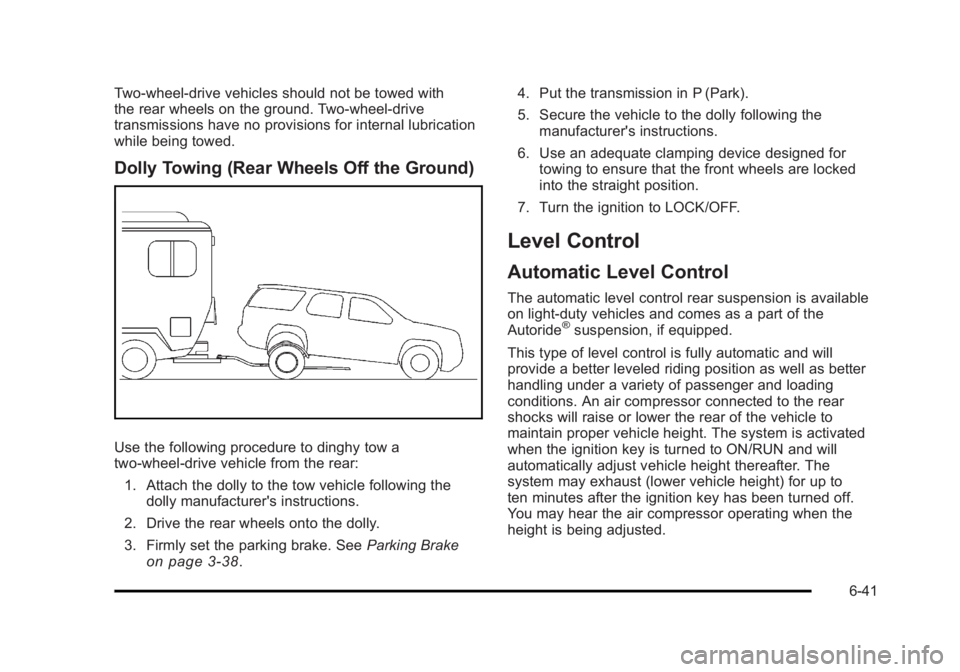
Dolly Towing (Rear Wheels Off the Ground)
Use the following procedure to dinghy tow a
two-wheel-drive vehicle from the rear:
1. Attach the dolly to the tow vehicle following the
dolly manufacturer's instructions.
2. Drive the rear wheels onto the dolly.
3. Firmly set the parking brake. See Parking Brake
on page 3 ‑ 38 . 4. Put the transmission in P (Park).
5. Secure the vehicle to the dolly following the
manufacturer's instructions.
6. Use an adequate clamping device designed for
towing to ensure that the front wheels are locked
into the straight position.
7. Turn the ignition to LOCK/OFF.
Level Control Automatic Level Control The automatic level control rear suspension is available
on light ‐ duty vehicles and comes as a part of the
Autoride ®
suspension, if equipped.
This type of level control is fully automatic and will
provide a better leveled riding position as well as better
handling under a variety of passenger and loading
conditions. An air compressor connected to the rear
shocks will raise or lower the rear of the vehicle to
maintain proper vehicle height. The system is activated
when the ignition key is turned to ON/RUN and will
automatically adjust vehicle height thereafter. The
system may exhaust (lower vehicle height) for up to
ten minutes after the ignition key has been turned off.
You may hear the air compressor operating when the
height is being adjusted.
6-41
Page 439 of 620

Black plate (47,1)Cadillac Escalade/Escalade ESV Owner Manual - 2010
Weight ‐ Distributing Hitch Adjustment
A: Body to Ground Distance
B: Front of Vehicle
When using a weight-distributing hitch, the spring bars
should be adjusted so the distance (A) is the same after
coupling the trailer to the tow vehicle and adjusting the
hitch. Hitch Cover The vehicle may have a hitch cover. To remove the
hitch cover:
1. Turn the fasteners on the lower tabs 90 degrees
counterclockwise.
2. Lift the lower edge of the cover about 45 degrees.
3. Pull the cover downward to disengage the upper
attachments.
6-47
Page 440 of 620

Black plate (48,1)Cadillac Escalade/Escalade ESV Owner Manual - 2010
To reinstall the hitch cover:
1. Hold the cover at a 45 degree angle to the vehicle
and push the upper tabs in the hitch cover into the
chrome slots in the fascia.
2. Move the bottom of the cover forward until the
lower tabs line up with the lower fascia slots.
3. Snap the hitch cover into place by pushing the
upper corners forward.
4. Turn the fasteners on the lower tabs 90 degrees
clockwise to lock the cover in place. Safety Chains Always attach chains between the vehicle and the
trailer. Cross the safety chains under the tongue of the
trailer to help prevent the tongue from contacting the
road if it becomes separated from the hitch. Instructions
about safety chains may be provided by the hitch
manufacturer or by the trailer manufacturer. If the trailer
being towed weighs up to 5,000 lbs (2 271 kg) with a
factory-installed step bumper, safety chains may be
attached to the attaching points on the bumper,
otherwise, safety chains should be attached to holes on
the trailer hitch platform. Always leave just enough
slack so the combination can turn. Never allow safety
chains to drag on the ground.
6-48
Page 451 of 620

Black plate (3,1)Cadillac Escalade/Escalade ESV Owner Manual - 2010
Section 7 Service and Appearance CareElectrical System . . . . . . . . . . . . . . . . . . . . . . . . . . . . . . . . 7-109
Add-On Electrical Equipment . . . . . . . . . . . . . . . . . 7-109
Windshield Wiper Fuses . . . . . . . . . . . . . . . . . . . . . . 7-109
Power Windows and Other Power Options . . . 7-110
Fuses and Circuit Breakers . . . . . . . . . . . . . . . . . . . 7-110 Instrument Panel Fuse Block . . . . . . . . . . . . . . . . . 7-110
Center Instrument Panel Fuse Block . . . . . . . . . . 7-112
Underhood Fuse Block . . . . . . . . . . . . . . . . . . . . . . . 7-113
Capacities and Specifications . . . . . . . . . . . . . . . . . . 7-117
7-3
Page 452 of 620
Black plate (4,1)Cadillac Escalade/Escalade ESV Owner Manual - 2010
Service For service and parts needs, visit your dealer. You will
receive genuine GM parts and GM-trained and
supported service people.
Genuine GM parts have one of these marks:
Accessories and Modifications When non ‐ dealer/non ‐ retailer accessories are added to
the vehicle, they can affect vehicle performance and
safety, including such things as airbags, braking,
stability, ride and handling, emissions systems,
aerodynamics, durability, and electronic systems like
antilock brakes, traction control, and stability control.
Some of these accessories could even cause
malfunction or damage not covered by the vehicle
warranty.
Damage to vehicle components resulting from the
installation or use of non ‐ GM certified parts, including
control module modifications, is not covered under the
terms of the vehicle warranty and may affect remaining
warranty coverage for affected parts.
7-4