brake fluid CADILLAC ESCALADE ESV 2010 Owners Manual
[x] Cancel search | Manufacturer: CADILLAC, Model Year: 2010, Model line: ESCALADE ESV, Model: CADILLAC ESCALADE ESV 2010Pages: 620, PDF Size: 7.4 MB
Page 5 of 620
Black plate (5,1)Cadillac Escalade/Escalade ESV Owner Manual - 2010
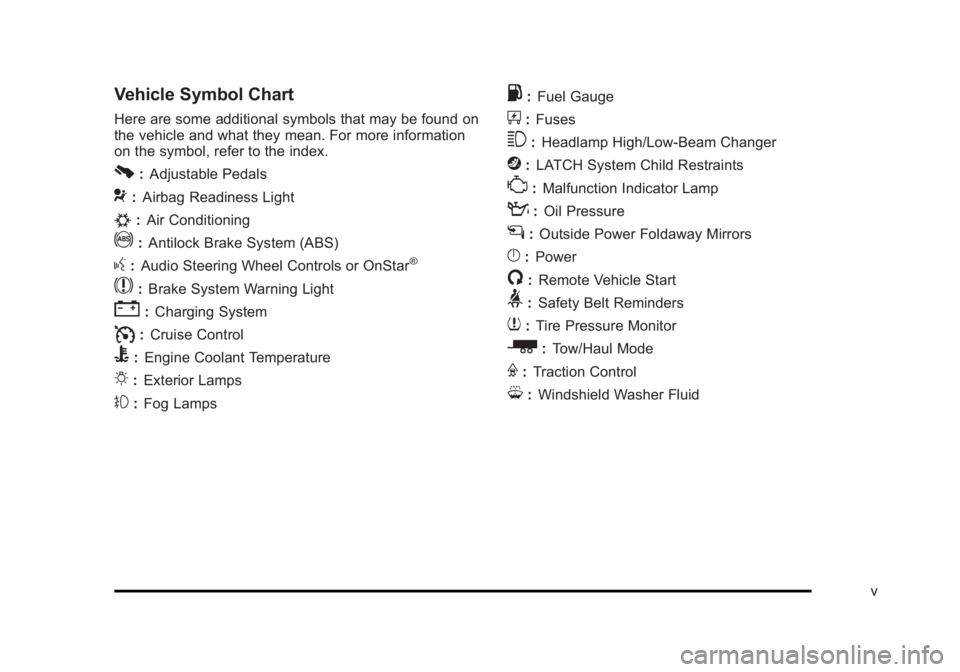
Vehicle Symbol Chart Here are some additional symbols that may be found on
the vehicle and what they mean. For more information
on the symbol, refer to the index.
0 : Adjustable Pedals
9 : Airbag Readiness Light
# : Air Conditioning
! : Antilock Brake System (ABS)
g : Audio Steering Wheel Controls or OnStar ®
$ : Brake System Warning Light
" : Charging System
I : Cruise Control
B : Engine Coolant Temperature
O : Exterior Lamps
# : Fog Lamps . : Fuel Gauge
+ : Fuses
3 : Headlamp High/Low-Beam Changer
j : LATCH System Child Restraints
* : Malfunction Indicator Lamp
: : Oil Pressure
g : Outside Power Foldaway Mirrors
} : Power
/ : Remote Vehicle Start
> : Safety Belt Reminders
7 : Tire Pressure Monitor
_ : Tow/Haul Mode
F : Traction Control
M : Windshield Washer Fluid
v
Page 201 of 620

Black plate (9,1)Cadillac Escalade/Escalade ESV Owner Manual - 2010
The cruise control buttons are located on left side of the
steering wheel.
T (On/Off): Turns the system on or off. The indicator
light is on when cruise control is on and turns off when
cruise control is off.
+ RES (Resume/Accelerate): Press to make the
vehicle accelerate or resume to a previously set speed.
SET − (Set/Coast): Press to set the speed or make the
vehicle decelerate.
[ (Cancel): Press to cancel cruise control without
erasing the set speed from memory.
Setting Cruise Control Cruise control will not work if the parking brake is set,
or if the master cylinder brake fluid level is low.
The cruise control light on the instrument panel cluster
comes on after the cruise control has been set to the
desired speed. { WARNING: If you leave your cruise control on when you are
not using cruise, you might hit a button and go
into cruise when you do not want to. You could be
startled and even lose control. Keep the cruise
control switch off until you want to use cruise
control.
1. Press the
I button.
2. Get up to the desired speed.
3. Press the SET − button located on the steering
wheel and release it.
4. Take your foot off the accelerator.
Resuming a Set Speed If the cruise control is set at a desired speed and then
the brakes are applied, this shuts off the cruise control.
But it does not need to be reset.
Once the vehicle speed reaches about 40 km/h
(25 mph) or more, press the +RES button on the
steering wheel. The vehicle returns to the previously set
speed and stays there.
4-9
Page 225 of 620
Black plate (33,1)Cadillac Escalade/Escalade ESV Owner Manual - 2010
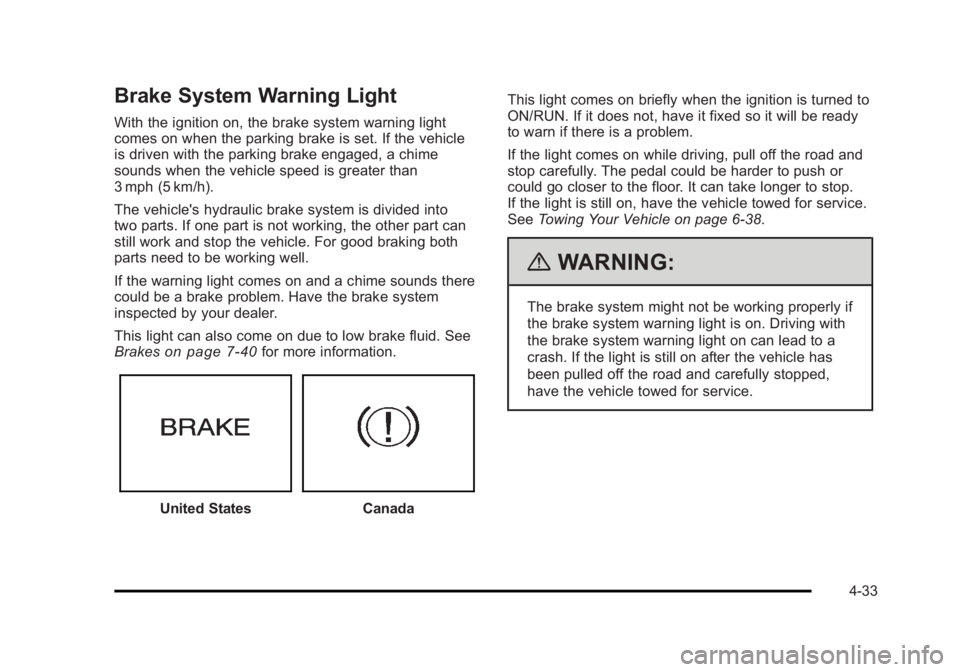
Brake System Warning Light With the ignition on, the brake system warning light
comes on when the parking brake is set. If the vehicle
is driven with the parking brake engaged, a chime
sounds when the vehicle speed is greater than
3 mph (5 km/h).
The vehicle's hydraulic brake system is divided into
two parts. If one part is not working, the other part can
still work and stop the vehicle. For good braking both
parts need to be working well.
If the warning light comes on and a chime sounds there
could be a brake problem. Have the brake system
inspected by your dealer.
This light can also come on due to low brake fluid. See
Brakes
on page 7 ‑ 40 for more information.
United States Canada This light comes on briefly when the ignition is turned to
ON/RUN. If it does not, have it fixed so it will be ready
to warn if there is a problem.
If the light comes on while driving, pull off the road and
stop carefully. The pedal could be harder to push or
could go closer to the floor. It can take longer to stop.
If the light is still on, have the vehicle towed for service.
See Towing Your Vehicle on page 6 ‑ 38 .
{ WARNING: The brake system might not be working properly if
the brake system warning light is on. Driving with
the brake system warning light on can lead to a
crash. If the light is still on after the vehicle has
been pulled off the road and carefully stopped,
have the vehicle towed for service.
4-33
Page 419 of 620

Black plate (27,1)Cadillac Escalade/Escalade ESV Owner Manual - 2010
Hill and Mountain Roads Driving on steep hills or through mountains is different
than driving on flat or rolling terrain. Tips for driving in
these conditions include: .
Keep the vehicle serviced and in good shape. .
Check all fluid levels and brakes, tires, cooling
system, and transmission. .
Going down steep or long hills, shift to a
lower gear.
{ WARNING: If you do not shift down, the brakes could get so
hot that they would not work well. You would then
have poor braking or even none going down a hill.
You could crash. Shift down to let the engine
assist the brakes on a steep downhill slope. { WARNING: Coasting downhill in N (Neutral) or with the
ignition off is dangerous. The brakes will have to
do all the work of slowing down and they could
get so hot that they would not work well. You
would then have poor braking or even none going
down a hill. You could crash. Always have the
engine running and the vehicle in gear when
going downhill. .
Stay in your own lane. Do not swing wide or cut
across the center of the road. Drive at speeds that
let you stay in your own lane. .
Top of hills: Be alert — something could be in your
lane (stalled car, accident). .
Pay attention to special road signs (falling rocks
area, winding roads, long grades, passing or
no-passing zones) and take appropriate action.
See Off-Road Driving
on page 6 ‑ 13 for information
about driving off-road.
6-27
Page 445 of 620

Black plate (53,1)Cadillac Escalade/Escalade ESV Owner Manual - 2010
4. Reapply the brake pedal. Then apply the parking
brake and shift into P (Park).
5. Release the brake pedal.
{ WARNING: It can be dangerous to get out of the vehicle if the
shift lever is not fully in P (Park) with the parking
brake firmly set. The vehicle can roll.
If the engine has been left running, the vehicle
can move suddenly. You or others could be
injured. To be sure the vehicle will not move, even
when on fairly level ground, always put the shift
lever fully in P (Park) with the parking brake
firmly set. Leaving After Parking on a Hill 1. Apply and hold the brake pedal.
2. Start the engine
3. Shift into a gear
4. Release the parking brake
5. Let up on the brake pedal.
6. Drive slowly until the trailer is clear of the chocks.
7. Stop and have someone pick up and store the
chocks.
Maintenance When Trailer Towing The vehicle needs service more often when pulling a
trailer. See this manual's Maintenance Schedule or
Index for more information. Things that are especially
important in trailer operation are automatic transmission
fluid, engine oil, axle lubricant, belts, cooling system
and brake system. It is a good idea to inspect these
before and during the trip.
Check periodically to see that all hitch nuts and bolts
are tight.
6-53
Page 449 of 620

Black plate (1,1)Cadillac Escalade/Escalade ESV Owner Manual - 2010
Section 7 Service and Appearance CareService . . . . . . . . . . . . . . . . . . . . . . . . . . . . . . . . . . . . . . . . . . . . . 7-4
Accessories and Modifications . . . . . . . . . . . . . . . . . . 7-4
California Proposition 65 Warning . . . . . . . . . . . . . . . 7-5
California Perchlorate Materials
Requirements . . . . . . . . . . . . . . . . . . . . . . . . . . . . . . . . . 7-5
Doing Your Own Service Work . . . . . . . . . . . . . . . . . . 7-6
Adding Equipment to the Outside of the
Vehicle . . . . . . . . . . . . . . . . . . . . . . . . . . . . . . . . . . . . . . . . 7-6
Fuel . . . . . . . . . . . . . . . . . . . . . . . . . . . . . . . . . . . . . . . . . . . . . . . . . 7-7
Gasoline Octane . . . . . . . . . . . . . . . . . . . . . . . . . . . . . . . . 7-8
Gasoline Specifications . . . . . . . . . . . . . . . . . . . . . . . . . 7-8
California Fuel . . . . . . . . . . . . . . . . . . . . . . . . . . . . . . . . . . 7-8
Additives . . . . . . . . . . . . . . . . . . . . . . . . . . . . . . . . . . . . . . . . 7-9
Fuel E85 (85% Ethanol) . . . . . . . . . . . . . . . . . . . . . . . . . 7-9
Fuels in Foreign Countries . . . . . . . . . . . . . . . . . . . . . 7-10
Filling the Tank . . . . . . . . . . . . . . . . . . . . . . . . . . . . . . . . . 7-11
Filling a Portable Fuel Container . . . . . . . . . . . . . . . 7-13
Checking Things Under the Hood . . . . . . . . . . . . . . . 7-14
Hood Release . . . . . . . . . . . . . . . . . . . . . . . . . . . . . . . . . 7-15
Engine Compartment Overview . . . . . . . . . . . . . . . . 7-16
Engine Oil . . . . . . . . . . . . . . . . . . . . . . . . . . . . . . . . . . . . . 7-17
Engine Oil Life System . . . . . . . . . . . . . . . . . . . . . . . . 7-20
Engine Air Cleaner/Filter . . . . . . . . . . . . . . . . . . . . . . . 7-22 Automatic Transmission Fluid . . . . . . . . . . . . . . . . . . 7-24
Cooling System . . . . . . . . . . . . . . . . . . . . . . . . . . . . . . . . 7-27
Engine Coolant . . . . . . . . . . . . . . . . . . . . . . . . . . . . . . . . 7-29
Engine Overheating . . . . . . . . . . . . . . . . . . . . . . . . . . . 7-34
Overheated Engine Protection
Operating Mode . . . . . . . . . . . . . . . . . . . . . . . . . . . . . 7-37
Engine Fan Noise . . . . . . . . . . . . . . . . . . . . . . . . . . . . . 7-37
Power Steering Fluid . . . . . . . . . . . . . . . . . . . . . . . . . . 7-38
Windshield Washer Fluid . . . . . . . . . . . . . . . . . . . . . . 7-39
Brakes . . . . . . . . . . . . . . . . . . . . . . . . . . . . . . . . . . . . . . . . . 7-40
Battery . . . . . . . . . . . . . . . . . . . . . . . . . . . . . . . . . . . . . . . . . 7-43
Jump Starting . . . . . . . . . . . . . . . . . . . . . . . . . . . . . . . . . . 7-44
All-Wheel Drive . . . . . . . . . . . . . . . . . . . . . . . . . . . . . . . . . . . 7-49
Rear Axle . . . . . . . . . . . . . . . . . . . . . . . . . . . . . . . . . . . . . . . . . 7-50
Front Axle . . . . . . . . . . . . . . . . . . . . . . . . . . . . . . . . . . . . . . . . . 7-51
Headlamp Aiming . . . . . . . . . . . . . . . . . . . . . . . . . . . . . . . . 7-52
Bulb Replacement . . . . . . . . . . . . . . . . . . . . . . . . . . . . . . . . 7-54
High Intensity Discharge (HID) Lighting . . . . . . . . 7-54
LED Lighting . . . . . . . . . . . . . . . . . . . . . . . . . . . . . . . . . . . 7-55
Back-Up Lamps . . . . . . . . . . . . . . . . . . . . . . . . . . . . . . . 7-55
License Plate Lamp . . . . . . . . . . . . . . . . . . . . . . . . . . . . 7-56
Replacement Bulbs . . . . . . . . . . . . . . . . . . . . . . . . . . . . 7-56
7-1
Page 462 of 620

Black plate (14,1)Cadillac Escalade/Escalade ESV Owner Manual - 2010
Checking Things Under
the Hood
{ WARNING: An electric fan under the hood can start up and
injure you even when the engine is not running.
Keep hands, clothing, and tools away from any
underhood electric fan.
{ WARNING: Things that burn can get on hot engine parts and
start a fire. These include liquids like fuel, oil,
coolant, brake fluid, windshield washer and other
fluids, and plastic or rubber. You or others could
be burned. Be careful not to drop or spill things
that will burn onto a hot engine.
7-14
Page 465 of 620

Black plate (17,1)Cadillac Escalade/Escalade ESV Owner Manual - 2010
A. Engine Air Cleaner/Filter on page 7 ‑ 22 .
B. Coolant Surge Tank and Pressure Cap. See
Cooling System on page 7 ‑ 27 .
C. Remote Positive (+) Terminal. See Jump Starting
on page 7 ‑ 44 .
D. Battery on page 7 ‑ 43 .
E. Engine Oil Fill Cap. See “ When to Add Engine Oil ”
under Engine Oil on page 7 ‑ 17 .
F. Automatic Transmission Dipstick (Out of View).
See “ Checking the Fluid Level ” under Automatic
Transmission Fluid on page 7 ‑ 24 .
G. Remote Negative ( − ) Terminal (GND) (Out of
View). See Jump Starting on page 7 ‑ 44 .
H. Engine Oil Dipstick (Out of View). See “ Checking
Engine Oil ” under Engine Oil on page 7 ‑ 17 .
I. Engine Cooling Fan (Out of View). See Cooling
System on page 7 ‑ 27 .
J. Power Steering Fluid Reservoir (Out of View). See
Power Steering Fluid on page 7 ‑ 38 .
K. Brake Master Cylinder Reservoir. See “ Brake
Fluid ” under Brakes on page 7 ‑ 40 . L. Underhood Fuse Block on page 7 ‑ 113 .
M. Windshield Washer Fluid Reservoir. See “ Adding
Washer Fluid ” under Windshield Washer Fluid
on
page 7 ‑ 39 .
Engine Oil Checking Engine Oil It is a good idea to check the engine oil level at each
fuel fill. In order to get an accurate reading, the oil must
be warm and the vehicle must be on level ground.
The engine oil dipstick handle is a yellow loop. See
Engine Compartment Overview on page 7 ‑ 16 for the
location of the engine oil dipstick.
1. Turn off the engine and give the oil several minutes
to drain back into the oil pan. If this is not done, the
oil dipstick might not show the actual level.
2. Pull out the dipstick and clean it with a paper towel
or cloth, then push it back in all the way. Remove it
again, keeping the tip down, and check the level.
7-17
Page 472 of 620

Black plate (24,1)Cadillac Escalade/Escalade ESV Owner Manual - 2010
Automatic Transmission Fluid When to Check and Change Automatic
Transmission Fluid It is usually not necessary to check the transmission
fluid level. The only reason for fluid loss is a
transmission leak or overheating the transmission.
If you suspect a small leak, then use the following
checking procedures to check the fluid level. However,
if there is a large leak, then it may be necessary to have
the vehicle towed to a dealer service department and
have it repaired before driving the vehicle further.
Notice: Use of the incorrect automatic transmission
fluid may damage the vehicle, and the damages may
not be covered by the vehicle's warranty. Always
use the automatic transmission fluid listed in
Recommended Fluids and Lubricants on page 8 ‑ 10 .
Change the fluid and filter at the intervals listed in the
Maintenance Schedule. See Scheduled Maintenance
on page 8 ‑ 3 . Be sure to use the transmission fluid
listed in Recommended Fluids and Lubricants on
page 8 ‑ 10
. How to Check Automatic Transmission
Fluid Notice: Too much or too little fluid can damage the
transmission. Too much can mean that some of the
fluid could come out and fall on hot engine parts or
exhaust system parts, starting a fire. Too little fluid
could cause the transmission to overheat. Be sure
to get an accurate reading if checking the
transmission fluid.
Before checking the fluid level, prepare the vehicle as
follows:
1. Start the engine and park the vehicle on a level
surface. Keep the engine running.
2. Apply the parking brake and place the shift lever in
P (Park).
3. With your foot on the brake pedal, move the shift
lever through each gear range, pausing for about
three seconds in each range. Then, move the shift
lever back to P (Park).
7-24
Page 473 of 620

Black plate (25,1)Cadillac Escalade/Escalade ESV Owner Manual - 2010
4. Allow the engine to idle (500 – 800 rpm) for at least
one minute. Slowly release the brake pedal.
5. Keep the engine running and press the Trip/Fuel
button or trip odometer reset stem until TRANS
TEMP (Transmission Temperature) displays on the
Driver Information Center (DIC).
6. Using the TRANS TEMP reading, determine and
perform the appropriate check procedure. If the
TRANS TEMP reading is not within the required
temperature ranges, allow the vehicle to cool,
or operate the vehicle until the appropriate
transmission fluid temperature is reached.
Cold Check Procedure Use this procedure only as a reference to determine if
the transmission has enough fluid to be operated safely
until a hot check procedure can be made. The hot
check procedure is the most accurate method to check
the fluid level. Perform the hot check procedure at the
first opportunity. Use this cold check procedure to check
fluid level when the transmission temperature is
between 80°F and 90°F (27°C and 32°C). 1. Locate the
transmission dipstick at
the rear of the engine
compartment, on the
passenger side of the
vehicle.
See Engine Compartment Overview
on page 7 ‑ 16
for more information.
2. Flip the handle up and then pull out the dipstick
and wipe it with a clean rag or paper towel.
3. Install the dipstick by pushing it back in all the way,
wait three seconds, and then pull it back out again.
4. Check both sides of the dipstick and read the lower
level. Repeat the check procedure to verify the
reading.
7-25