ad blue CADILLAC ESCALADE ESV 2012 User Guide
[x] Cancel search | Manufacturer: CADILLAC, Model Year: 2012, Model line: ESCALADE ESV, Model: CADILLAC ESCALADE ESV 2012Pages: 538, PDF Size: 8.42 MB
Page 262 of 538

Black plate (80,1)Cadillac Escalade/Escalade ESV Owner Manual - 2012 - 2nd CRC - 11/29/11
7-80 Infotainment System database and routing by
coordinates is not available, the
GO and Map buttons gray out
and routing will not be available.
Press the blue OnStar button for
further assistance. .
The Call button grays out when
there is no phone number
available for your destination
and while connected to OnStar.
Map Destination Screen Functions
If the map screen is used to show
destination, it will have map screen
capabilities such as GO, Mark,
Zoom, Scroll, etc. The address is
shown at the top of the screen. Destination Map Screen Getting Started on Your Route Once a destination has been
entered, there are several functions
that can be performed. Press DEST
to access the Route screen.
Page 285 of 538
Black plate (103,1)Cadillac Escalade/Escalade ESV Owner Manual - 2012 - 2nd CRC - 11/29/11
Infotainment System 7-103
Phone Bluetooth For vehicles equipped with
Bluetooth capability, the system can
interact with many cell phones,
allowing: .
Placement and receipt of calls in
a hands-free mode. .
Sharing of the cell phone ’ s
address book or contact list with
the vehicle.
To minimize driver distraction,
before driving, and with the vehicle
parked: .
Become familiar with the
features of the cell phone.
Organize the phone book and
contact lists clearly and delete
duplicate or rarely used entries.
If possible, program speed dial
or other shortcuts. .
Review the controls and
operation of the infotainment
system. .
Pair cell phone(s) to the vehicle.
The system may not work with
all cell phones. See “ Pairing ” in
this section for more information. .
If the cell phone has voice
dialing capability, learn to use
that feature to access the
address book or contact list. See
“ Voice Pass-Thru ” in this section
for more information. .
See “ Storing and Deleting Phone
Numbers ” in this section for
more information.
{ WARNING
When using a cell phone, it can
be distracting to look too long or
too often at the screen of the
phone or the infotainment
(navigation) system. Taking your
eyes off the road too long or too
often could cause a crash
resulting in injury or death. Focus
your attention on driving. A Bluetooth system can use a
Bluetooth ‐ capable cell phone with a
Hands ‐ Free Profile to make and
receive phone calls. The system
can be used while the key is in the
ON/RUN or ACC/ACCESSORY
position. The range of the Bluetooth
system can be up to 9.1 m (30 ft).
Not all phones support all functions,
and not all phones work with the
in-vehicle Bluetooth system. See
www.gm.com/bluetooth for more
information on compatible phones.
Voice Recognition The Bluetooth system uses voice
recognition to interpret voice
commands to dial phone numbers
and name tags.
For additional information, say
“ Help ” while you are in a voice
recognition menu.
Noise: Keep interior noise levels to
a minimum. The system may not
recognize voice commands if there
is too much background noise.
Page 286 of 538

Black plate (104,1)Cadillac Escalade/Escalade ESV Owner Manual - 2012 - 2nd CRC - 11/29/11
7-104 Infotainment System When to Speak: A short tone
sounds after the system responds
indicating when it is waiting for a
voice command. Wait until the tone
and then speak.
How to Speak: Speak clearly in a
calm and natural voice.
Audio System When using the in ‐ vehicle Bluetooth
system, sound comes through the
vehicle's front audio system
speakers and overrides the audio
system. Use the audio system
volume knob, during a call, to
change the volume level. The
adjusted volume level remains in
memory for later calls. To prevent
missed calls, a minimum volume
level is used if the volume is turned
down too low.
Bluetooth Controls
Use the buttons located on the
steering wheel to operate the
in ‐ vehicle Bluetooth system. See
Steering Wheel Controls on
page 5 ‑ 2 for more information. b /
g (Push To Talk): Press to
answer incoming calls, confirm
system information, and start
speech recognition.
c /
x (End): Press to end a call,
reject a call, or cancel an operation.
Pairing A Bluetooth enabled cell phone
must be paired to the Bluetooth
system and then connected to the
vehicle before it can be used. See
the cell phone manufacturer's user
guide for Bluetooth functions before
pairing the cell phone. If a Bluetooth
phone is not connected, calls will be
made using OnStar Hands ‐ Free
Calling, if equipped. See OnStar
Overview on page 14 ‑ 1 for more
information.
Pairing Information .
A Bluetooth phone with MP3
capability cannot be paired to
the vehicle as a phone and an
MP3 player at the same time. .
Up to five cell phones can be
paired to the Bluetooth system. .
The pairing process is disabled
when the vehicle is moving. .
Pairing only needs to be
completed once, unless the
pairing information on the cell
phone changes or the cell phone
is deleted from the system. .
Only one paired cell phone can
be connected to the Bluetooth
system at a time. .
If multiple paired cell phones are
within range of the system, the
system connects to the first
available paired cell phone in the
order that they were first paired
to the system. To connect to a
different paired phone, see
“ Connecting to a Different
Phone ” later in this section.
Page 287 of 538

Black plate (105,1)Cadillac Escalade/Escalade ESV Owner Manual - 2012 - 2nd CRC - 11/29/11
Infotainment System 7-105Pairing a Phone
1. Press and hold
b /
g for
two seconds.
2. Say “ Bluetooth. ” This command
can be skipped.
3. Say “ Pair. ” The system responds
with instructions and a four ‐ digit
Personal Identification Number
(PIN). The PIN is used in Step 5.
4. Start the pairing process on the
cell phone that you want to pair.
For help with this process, see
the cell phone manufacturer's
user guide.
5. Locate the device named “ Your
Vehicle ” in the list on the cell
phone. Follow the instructions
on the cell phone to enter the
PIN provided in Step 3. After the
PIN is successfully entered, the
system prompts you to provide a
name for the paired cell phone.
This name will be used to
indicate which phones are
paired and connected to the
vehicle. The system responds with “
successfully paired ” after the
pairing process is complete.
6. Repeat Steps 1 through 5 to pair
additional phones.
Listing All Paired and Connected
Phones
The system can list all cell phones
paired to it. If a paired cell phone is
also connected to the vehicle, the
system responds with “ is connected ”
after that phone name.
1. Press and hold
b /
g for
two seconds.
2. Say “ Bluetooth. ”
3. Say “ List. ”
Deleting a Paired Phone
If the phone name you want to
delete is unknown, see “ Listing All
Paired and Connected Phones. ”
1. Press and hold
b /
g for
two seconds.
2. Say “ Bluetooth. ” 3. Say “ Delete. ” The system asks
which phone to delete.
4. Say the name of the phone you
want to delete.
Connecting to a Different Phone
To connect to a different cell phone,
the Bluetooth system looks for the
next available cell phone in the
order in which all the available cell
phones were paired. Depending on
which cell phone you want to
connect to, you may have to use
this command several times.
1. Press and hold
b /
g for
two seconds.
2. Say “ Bluetooth. ”
3. Say “ Change phone. ” .
If another cell phone is
found, the response will be
“
connected. ” .
If another cell phone is not
found, the original phone
remains connected.
Page 288 of 538
Black plate (106,1)Cadillac Escalade/Escalade ESV Owner Manual - 2012 - 2nd CRC - 11/29/11
7-106 Infotainment System Storing and Deleting Phone
Numbers The system can store up to
30 phone numbers as name tags in
the Hands ‐ Free Directory that is
shared between the Bluetooth and
OnStar systems, if equipped.
The following commands are used
to delete and store phone numbers.
Store: This command will store a
phone number, or a group of
numbers as a name tag.
Digit Store: This command allows
a phone number to be stored as a
name tag by entering the digits one
at a time.
Delete: This command is used to
delete individual name tags.
Delete All Name Tags: This
command deletes all stored name
tags in the Hands ‐ Free Calling
Directory and the OnStar
Turn ‐ by ‐ Turn Destinations Directory,
if equipped. Using the “ Store ” Command
1. Press and hold
b /
g for
two seconds.
2. Say “ Store. ”
3. Say the phone number or group
of numbers you want to store all
at once with no pauses, then
follow the directions given by the
system to save a name tag for
this number.
Using the “ Digit Store ” Command
If an unwanted number is
recognized by the system, say
“ Clear ” at any time to clear the last
number.
To hear all of the numbers
recognized by the system, say
“ Verify ” at any time.
1. Press and hold
b /
g for
two seconds.
2. Say “ Digit Store. ”
3. Say each digit, one at a time,
that you want to store. After
each digit is entered, the system repeats back the digit it heard
followed by a tone. After the last
digit has been entered, say
“ Store, ” and then follow the
directions given by the system to
save a name tag for this number.
Using the “ Delete ” Command
1. Press and hold
b /
g for
two seconds.
2. Say “ Delete. ”
3. Say the name tag you want to
delete.
Using the “ Delete All Name Tags ”
Command
This command deletes all stored
name tags in the Hands ‐ Free
Calling Directory and the OnStar
Turn ‐ by ‐ Turn Destinations Directory,
if equipped.
To delete all name tags:
1. Press and hold
b /
g for
two seconds.
2. Say “ Delete all name tags. ”
Page 290 of 538

Black plate (108,1)Cadillac Escalade/Escalade ESV Owner Manual - 2012 - 2nd CRC - 11/29/11
7-108 Infotainment System Receiving a Call When an incoming call is received,
the audio system mutes and a ring
tone is heard in the vehicle. .
Press
b /
g to answer the call..
Press
c /
x to ignore a call.
Call Waiting Call waiting must be supported on
the cell phone and enabled by the
wireless service carrier. .
Press
b /
g to answer an
incoming call when another call
is active. The original call is
placed on hold. .
Press
b /
g again to return to
the original call. .
To ignore the incoming call, no
action is required. .
Press
c /
x to disconnect the
current call and switch to the call
on hold. Three ‐ Way CallingThree ‐ way calling must be
supported on the cell phone and
enabled by the wireless service
carrier.
1. While on a call, press
b /
g .
2. Say “ Three ‐ way call. ”
3. Use the dial or call command to
dial the number of the third party
to be called.
4. Once the call is connected,
press
b /
g to link all callers
together.
Ending a Call
Press
c /
x to end a call. Muting a Call During a call, all sounds from inside
the vehicle can be muted so that the
person on the other end of the call
cannot hear them. .
To mute a call, press
b /
g , and
then say “ Mute call. ” .
To cancel mute, press
b /
g ,
and then say “ Un ‐ mute call. ”
Transferring a Call Audio can be transferred between
the Bluetooth system and the cell
phone.
The cell phone must be paired and
connected with the Bluetooth
system before a call can be
transferred. The connection process
can take up to two minutes after the
ignition is turned to ON/RUN.
Page 291 of 538

Black plate (109,1)Cadillac Escalade/Escalade ESV Owner Manual - 2012 - 2nd CRC - 11/29/11
Infotainment System 7-109Transferring Audio from the
Bluetooth System to a Cell Phone
During a call with the audio in the
vehicle:
1. Press
b /
g .
2. Say “ Transfer Call. ”
Transferring Audio to the
Bluetooth System from a Cell
Phone
During a call with the audio on the
cell phone, press
b /
g . The audio
transfers to the vehicle. If the audio
does not transfer to the vehicle, use
the audio transfer feature on the
cell phone. See your cell phone
manufacturer's user guide for more
information. Voice Pass-Thru Voice pass ‐ thru allows access to the
voice recognition commands on the
cell phone. See your cell phone
manufacturer's user guide to see if
the cell phone supports this feature.
To access contacts stored in the cell
phone:
1. Press and hold
b /
g for
two seconds.
2. Say “ Bluetooth. ” This command
can be skipped.
3. Say “ Voice. ” The system
responds “ OK, accessing
The cell phone's normal prompt
messages will go through their cycle
according to the phone's operating
instructions. Dual Tone Multi-Frequency
(DTMF) Tones The Bluetooth system can send
numbers and the numbers stored as
name tags during a call. You can
use this feature when calling a
menu ‐ driven phone system.
Account numbers can also be
stored for use.
Sending a Number or Name Tag
During a Call
1. Press
b /
g . The system
responds “ Ready, ” followed by
a tone.
2. Say “ Dial. ”
3. Say the number or name tag
to send.
Page 292 of 538

Black plate (110,1)Cadillac Escalade/Escalade ESV Owner Manual - 2012 - 2nd CRC - 11/29/11
7-110 Infotainment System Clearing the System Unless information is deleted out of
the in ‐ vehicle Bluetooth system, it
will be retained indefinitely. This
includes all saved name tags in the
phone book and phone pairing
information. For information on how
to delete this information, see the
previous section “ Deleting a Paired
Phone ” and the previous sections
on deleting name tags. Other Information The Bluetooth ®
word mark and
logos are owned by the Bluetooth ®
SIG, Inc. and any use of such marks
by General Motors is under license.
Other trademarks and trade names
are those of their respective owners.
See Radio Frequency Statement on
page 13 ‑ 21 for information
regarding Part 15 of the Federal
Communications Commission (FCC)
rules and Industry Canada
Standards RSS-GEN/210/220/310.
Page 367 of 538

Black plate (67,1)Cadillac Escalade/Escalade ESV Owner Manual - 2012 - 2nd CRC - 11/29/11
Driving and Operating 9-67Trailer Brakes A loaded trailer that weighs more
than 900 kg (2,000 lbs) needs to
have its own brake system that is
adequate for the weight of the
trailer. Be sure to read and follow
the instructions for the trailer brakes
so they are installed, adjusted and
maintained properly.
Do not tap into the vehicle's
hydraulic system. Trailer Wiring Harness Heavy-Duty Trailer Wiring Harness
Package
The vehicle has a seven-pin
universal heavy-duty trailer
connector attached to the rear
bumper beam next to the integrated
trailer hitch. The seven-wire harness contains
the following trailer circuits: .
Yellow: Left Stop/Turn Signal .
Dark Green: Right Stop/Turn
Signal .
Brown: Taillamps .
White: Ground .
Light Green: Back-up Lamps .
Red: Battery Feed* .
Dark Blue: Trailer Brake*
*The fuses for these two circuits are
installed in the underhood electrical
center, but the wires are not
connected. They should be
connected by your dealer or a
qualified service center.
If charging a remote (non-vehicle)
battery, press the tow/haul mode
button located at the end of the shift
lever. This will boost the vehicle
system voltage and properly charge
the battery. If the trailer is too light
for tow/haul mode, turn on the
Page 368 of 538
Black plate (68,1)Cadillac Escalade/Escalade ESV Owner Manual - 2012 - 2nd CRC - 11/29/11
9-68 Driving and Operating headlamps as a second way to
boost the vehicle system and
charge the battery.
Electric Brake Control Wiring
Provisions These wiring provisions are
included with the vehicle as part of
the trailer wiring package. These
provisions are for an electric brake
controller. The instrument panel
contains blunt cut wires near the
data link connector for the trailer
brake controller. The harness
contains the following wires: .
Dark Blue: Brake Signal to
Trailer Connector .
Red/Black: Battery .
Light Blue/White: Brake Switch .
White: Ground
It should be installed by your dealer
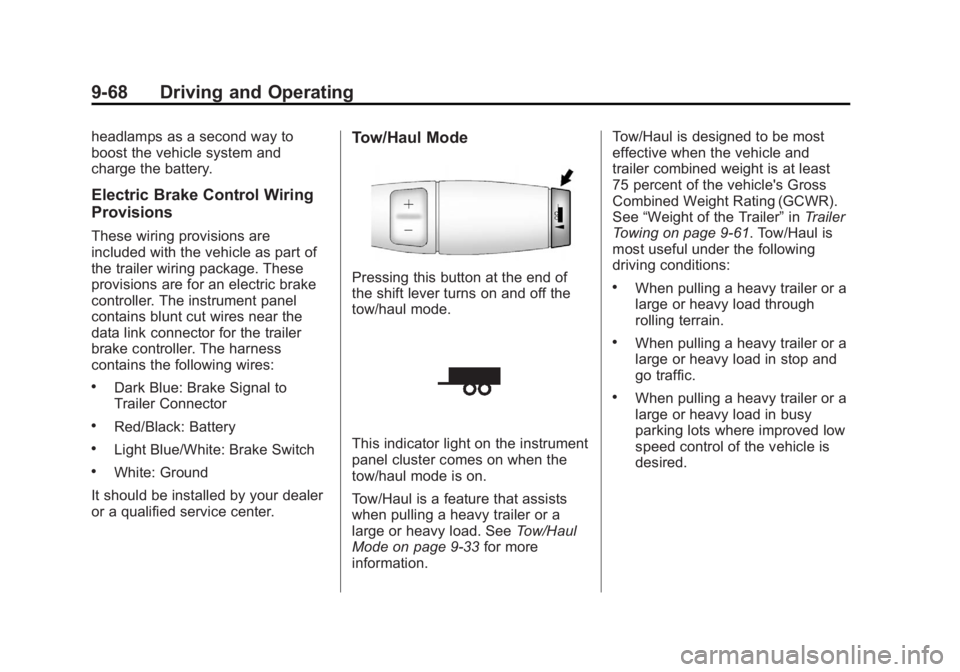
or a qualified service center. Tow/Haul Mode
Pressing this button at the end of
the shift lever turns on and off the
tow/haul mode.
This indicator light on the instrument
panel cluster comes on when the
tow/haul mode is on.
Tow/Haul is a feature that assists
when pulling a heavy trailer or a
large or heavy load. See Tow/Haul
Mode on page 9 ‑ 33 for more
information. Tow/Haul is designed to be most
effective when the vehicle and
trailer combined weight is at least
75 percent of the vehicle's Gross
Combined Weight Rating (GCWR).
See “ Weight of the Trailer ” in Trailer
Towing on page 9 ‑ 61 . Tow/Haul is
most useful under the following
driving conditions: .
When pulling a heavy trailer or a
large or heavy load through
rolling terrain. .
When pulling a heavy trailer or a
large or heavy load in stop and
go traffic. .
When pulling a heavy trailer or a
large or heavy load in busy
parking lots where improved low
speed control of the vehicle is
desired.