seats CADILLAC ESCALADE EXT 2003 2.G User Guide
[x] Cancel search | Manufacturer: CADILLAC, Model Year: 2003, Model line: ESCALADE EXT, Model: CADILLAC ESCALADE EXT 2003 2.GPages: 473, PDF Size: 3.31 MB
Page 31 of 473
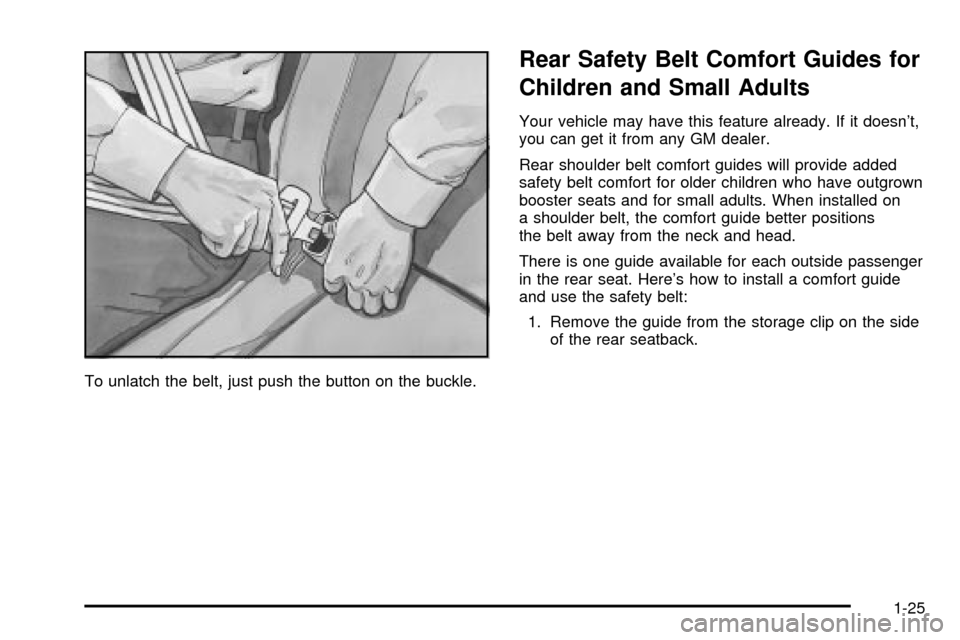
To unlatch the belt, just push the button on the buckle.
Rear Safety Belt Comfort Guides for
Children and Small Adults
Your vehicle may have this feature already. If it doesn't,
you can get it from any GM dealer.
Rear shoulder belt comfort guides will provide added
safety belt comfort for older children who have outgrown
booster seats and for small adults. When installed on
a shoulder belt, the comfort guide better positions
the belt away from the neck and head.
There is one guide available for each outside passenger
in the rear seat. Here's how to install a comfort guide
and use the safety belt:
1. Remove the guide from the storage clip on the side
of the rear seatback.
1-25
Page 34 of 473
Child Restraints
Older Children
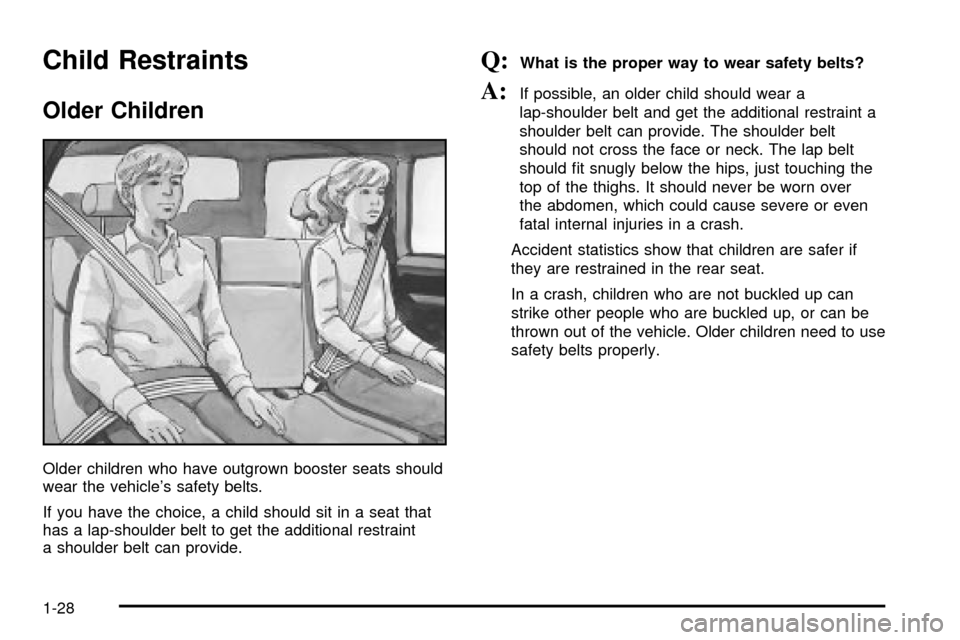
Older children who have outgrown booster seats should
wear the vehicle's safety belts.
If you have the choice, a child should sit in a seat that
has a lap-shoulder belt to get the additional restraint
a shoulder belt can provide.
Q:What is the proper way to wear safety belts?
A:If possible, an older child should wear a
lap-shoulder belt and get the additional restraint a
shoulder belt can provide. The shoulder belt
should not cross the face or neck. The lap belt
should ®t snugly below the hips, just touching the
top of the thighs. It should never be worn over
the abdomen, which could cause severe or even
fatal internal injuries in a crash.
Accident statistics show that children are safer if
they are restrained in the rear seat.
In a crash, children who are not buckled up can
strike other people who are buckled up, or can be
thrown out of the vehicle. Older children need to use
safety belts properly.
1-28
Page 43 of 473
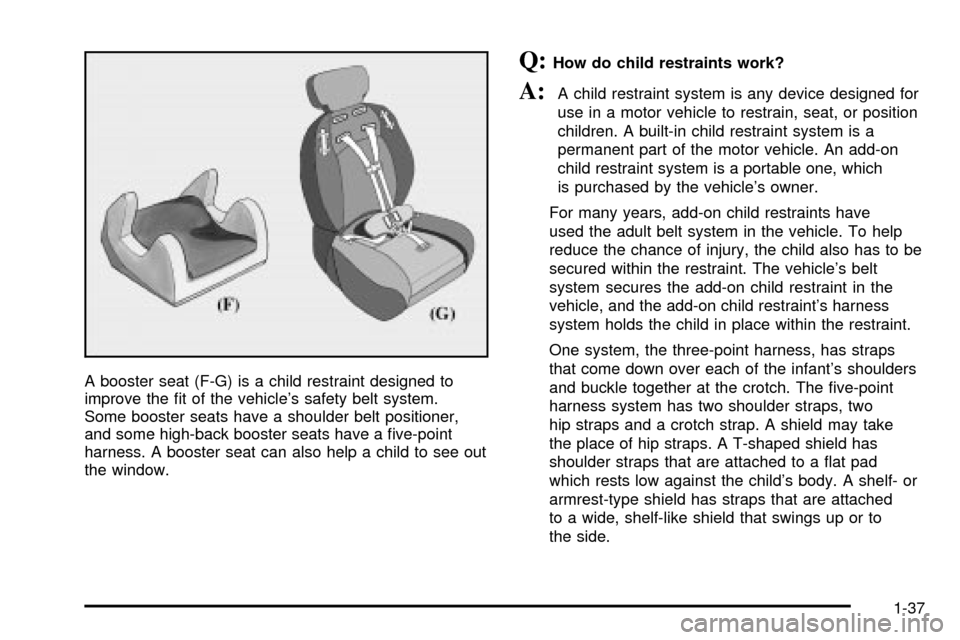
A booster seat (F-G) is a child restraint designed to
improve the ®t of the vehicle's safety belt system.
Some booster seats have a shoulder belt positioner,
and some high-back booster seats have a ®ve-point
harness. A booster seat can also help a child to see out
the window.
Q:How do child restraints work?
A:A child restraint system is any device designed for
use in a motor vehicle to restrain, seat, or position
children. A built-in child restraint system is a
permanent part of the motor vehicle. An add-on
child restraint system is a portable one, which
is purchased by the vehicle's owner.
For many years, add-on child restraints have
used the adult belt system in the vehicle. To help
reduce the chance of injury, the child also has to be
secured within the restraint. The vehicle's belt
system secures the add-on child restraint in the
vehicle, and the add-on child restraint's harness
system holds the child in place within the restraint.
One system, the three-point harness, has straps
that come down over each of the infant's shoulders
and buckle together at the crotch. The ®ve-point
harness system has two shoulder straps, two
hip straps and a crotch strap. A shield may take
the place of hip straps. A T-shaped shield has
shoulder straps that are attached to a ¯at pad
which rests low against the child's body. A shelf- or
armrest-type shield has straps that are attached
to a wide, shelf-like shield that swings up or to
the side.
1-37
Page 54 of 473
You'll be using the lap-shoulder belt. SeeTop Strap on
page 1-40if the child restraint has one. Be sure to
follow the instructions that came with the child restraint.
Secure the child in the child restraint when and as
the instructions say.
1. Because your vehicle has a right front passenger
air bag, always move the seat as far back as it will
go before securing a child restraint, if you need
to secure a forward-facing child restraint in the right
front seat position. See
Power Seats on page 1-2.
If your vehicle has the passenger sensing system
and you are using a rear-facing child restraint in this
seat, make sure the frontal air bag is off. See
Passenger Sensing System on page 1-60.
When the passenger sensing system has turned off
the right front passenger's frontal air bag, the off
indicator on the inside rearview mirror will be lit and
stay lit when you turn the ignition to RUN or START.
2. Put the restraint on the seat.
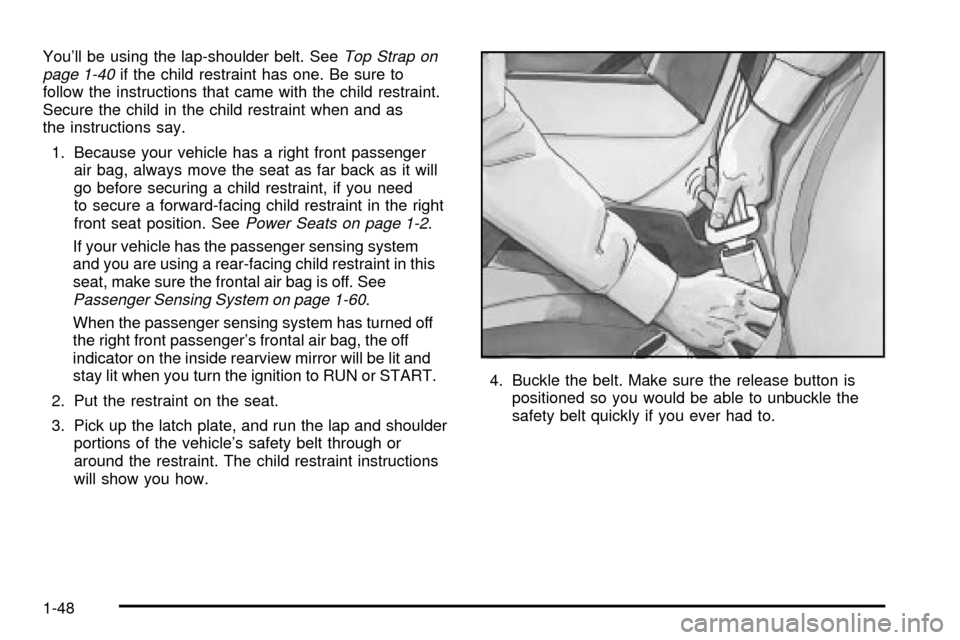
3. Pick up the latch plate, and run the lap and shoulder
portions of the vehicle's safety belt through or
around the restraint. The child restraint instructions
will show you how.4. Buckle the belt. Make sure the release button is
positioned so you would be able to unbuckle the
safety belt quickly if you ever had to.
1-48
Page 62 of 473

Side impact air bags are designed to in¯ate in moderate
to severe side crashes. A side impact air bag will
in¯ate if the crash severity is above the system's
designed ªthreshold level.º The threshold level can vary
with speci®c vehicle design. Side impact air bags are
not designed to in¯ate in frontal or near-frontal impacts,
rollovers or rear impacts, because in¯ation would not
help the occupant. A side impact air bag will only deploy
on the side of the vehicle that is struck.
In any particular crash, no one can say whether an air
bag should have in¯ated simply because of the damage
to a vehicle or because of what the repair costs were.
For frontal air bags, in¯ation is determined by the angle
of the impact and how quickly the vehicle slows down
in frontal and near-frontal impacts. For side impact
air bags, in¯ation is determined by the location
and severity of the impact.The air bag system is designed to work properly under
a wide range of conditions, including off-road usage.
Observe safe driving speeds, especially on rough
terrain. As always, wear your safety belt. See
Operating
Your All-Wheel-Drive Vehicle Off Paved Roads on
page 4-18
for tips on off-road driving.
Seat Position Sensors
Vehicle's with dual stage air bags are also equipped
with special sensors which enable the sensing system to
monitor the position of both the driver and passenger
front seats. The seat position sensor provides
information which is used to determine if the air bags
should deploy at a reduced level or at full depoyment.
1-56
Page 86 of 473

Rear Glass Removal and Storage
{CAUTION:
If the removable rear glass is not stored
properly, it could be thrown about the vehicle
in a crash or sudden maneuver. People in the
vehicle could be injured. Whenever you store
the rear glass in the vehicle, always be sure
that it is stored securely in the midgate
storage pocket.
Do not remove the rear glass when the rear defroster
is on. If you remove the rear glass with the rear defroster
on, you may see a discharge spark coming from the
latch area.
To remove the rear glass do the following:
1. Fold the rear seats. See
Rear Seat Operation on
page 1-6for more information. The front seats
may have to be moved forward slightly to allow the
rear seats to fold completely.Although the rear glass can be removed without
folding the rear seats, you will not be able to access
the rear glass storage pocket. Be sure to fold the
seats
beforeremoving the rear glass.
2. Squeeze and pull down the latch levers (A), located
near the upper corners of the rear glass, so they
unlatch. After both latch levers are unlatched,
the glass-catch release button (C) will catch the
rear glass and prevent it from falling forward.
Follow the next step to release the button and
remove the rear glass.
2-14
Page 89 of 473

Once both glass lock knobs are in the locked
position, the rear glass is securely stored.
7. Push both latch levers (A) up to the locked position.
You should hear a click when each latch lever locks
correctly.
Rear seats can be returned to the normal position
when the rear glass is out and stored properly in the
storage pocket.
Reinstalling the Rear Glass
To reinstall the rear glass, do the following:
1. Squeeze and pull down the latch levers (A), located
near the upper corners of the rear glass, so they
unlatch.
2. Hold the rear glass in place with one hand and turn
the glass lock knobs, located at both top corners of
the glass storage pocket, to the unlocked position.
3. Pull the rear glass out from the storage pocket using
the grab handles.
2-17
Page 91 of 473
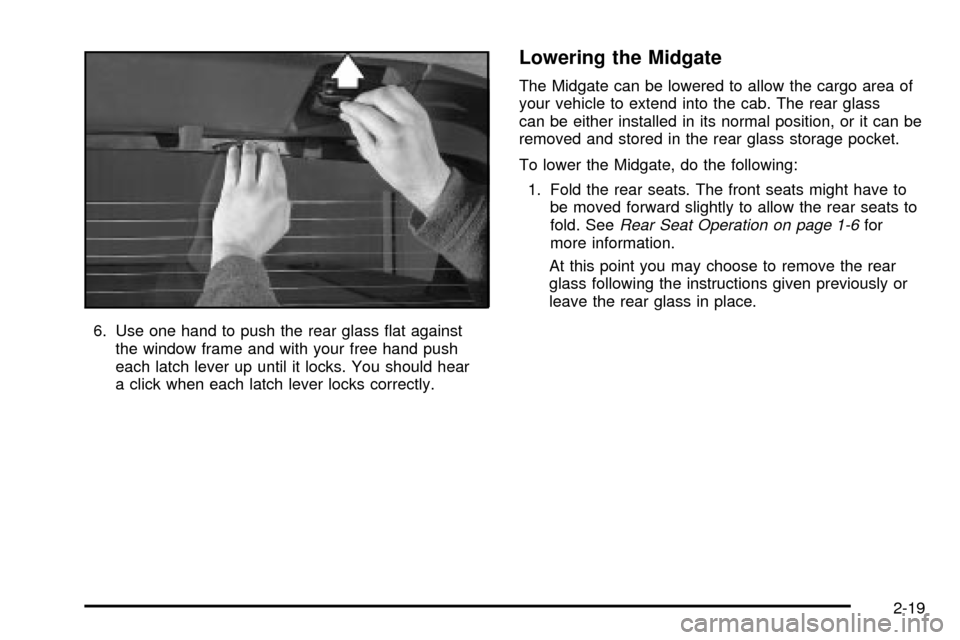
6. Use one hand to push the rear glass ¯at against
the window frame and with your free hand push
each latch lever up until it locks. You should hear
a click when each latch lever locks correctly.
Lowering the Midgate
The Midgate can be lowered to allow the cargo area of
your vehicle to extend into the cab. The rear glass
can be either installed in its normal position, or it can be
removed and stored in the rear glass storage pocket.
To lower the Midgate, do the following:
1. Fold the rear seats. The front seats might have to
be moved forward slightly to allow the rear seats to
fold. See
Rear Seat Operation on page 1-6for
more information.
At this point you may choose to remove the rear
glass following the instructions given previously or
leave the rear glass in place.
2-19
Page 116 of 473
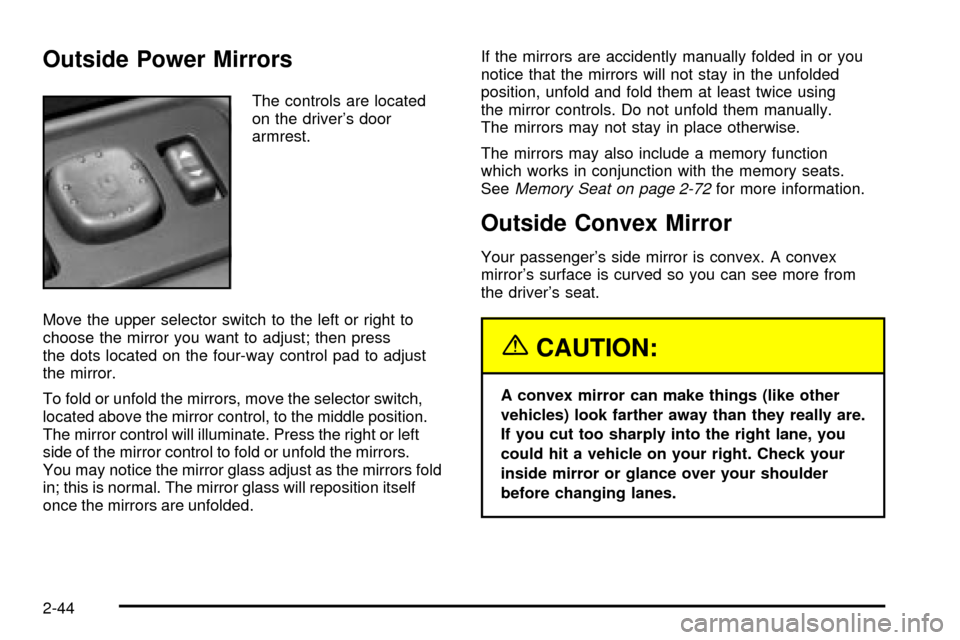
Outside Power Mirrors
The controls are located
on the driver's door
armrest.
Move the upper selector switch to the left or right to
choose the mirror you want to adjust; then press
the dots located on the four-way control pad to adjust
the mirror.
To fold or unfold the mirrors, move the selector switch,
located above the mirror control, to the middle position.
The mirror control will illuminate. Press the right or left
side of the mirror control to fold or unfold the mirrors.
You may notice the mirror glass adjust as the mirrors fold
in; this is normal. The mirror glass will reposition itself
once the mirrors are unfolded.If the mirrors are accidently manually folded in or you
notice that the mirrors will not stay in the unfolded
position, unfold and fold them at least twice using
the mirror controls. Do not unfold them manually.
The mirrors may not stay in place otherwise.
The mirrors may also include a memory function
which works in conjunction with the memory seats.
See
Memory Seat on page 2-72for more information.
Outside Convex Mirror
Your passenger's side mirror is convex. A convex
mirror's surface is curved so you can see more from
the driver's seat.
{CAUTION:
A convex mirror can make things (like other
vehicles) look farther away than they really are.
If you cut too sharply into the right lane, you
could hit a vehicle on your right. Check your
inside mirror or glance over your shoulder
before changing lanes.
2-44
Page 125 of 473

Center Console Storage Area
Your vehicle has a console compartment between the
bucket seats.
To open it, press the button on the side of the console
and swing the console lid open.
The console may be equipped with an accessory
power outlet inside. See
Accessory Power Outlets on
page 3-22.
The rear of the console also has a cupholder that
swings down for the rear seat passengers to use.
Luggage Carrier
You can load things on top of your vehicle if it has this
feature.
The luggage carrier has slats and siderails attached
to the roof and may have crossrails which can be moved
back and forth to help secure cargo. Tie the load to
the siderails or siderail supports.
Notice:Loading cargo that weighs more than
200 lbs. (91 kg) on the luggage carrier may damage
your vehicle. When you carry large things, never
let them hang over the rear or the sides of your
vehicle. Load your cargo so that it rests on the
slats and does not scratch or damage the vehicle.
Put the cargo against the side rails and fasten
it securely to the luggage carrier. Put the main
weight as far forward as you can.
Don't exceed the maximum vehicle capacity when
loading your vehicle. For more information on vehicle
capacity and loading, see
Loading Your Vehicle on
page 4-48.
2-53