lock CADILLAC ESCALADE EXT 2007 3.G Owners Manual
[x] Cancel search | Manufacturer: CADILLAC, Model Year: 2007, Model line: ESCALADE EXT, Model: CADILLAC ESCALADE EXT 2007 3.GPages: 580, PDF Size: 3.01 MB
Page 429 of 580
{CAUTION:
Adding only plain water to your cooling
system can be dangerous. Plain water, or
some other liquid such as alcohol, can
boil before the proper coolant mixture will.
Your vehicle’s coolant warning system is
set for the proper coolant mixture. With
plain water or the wrong mixture, your
engine could get too hot but you would
not get the overheat warning. Your engine
could catch re and you or others could
be burned. Use a 50/50 mixture of clean,
drinkable water and DEX-COOL
®coolant.
Notice:In cold weather, water can freeze and
crack the engine, radiator, heater core and
other parts. Use the recommended coolant and
the proper coolant mixture.
{CAUTION:
You can be burned if you spill coolant on
hot engine parts. Coolant contains
ethylene glycol and it will burn if the
engine parts are hot enough. Do not spill
coolant on a hot engine.
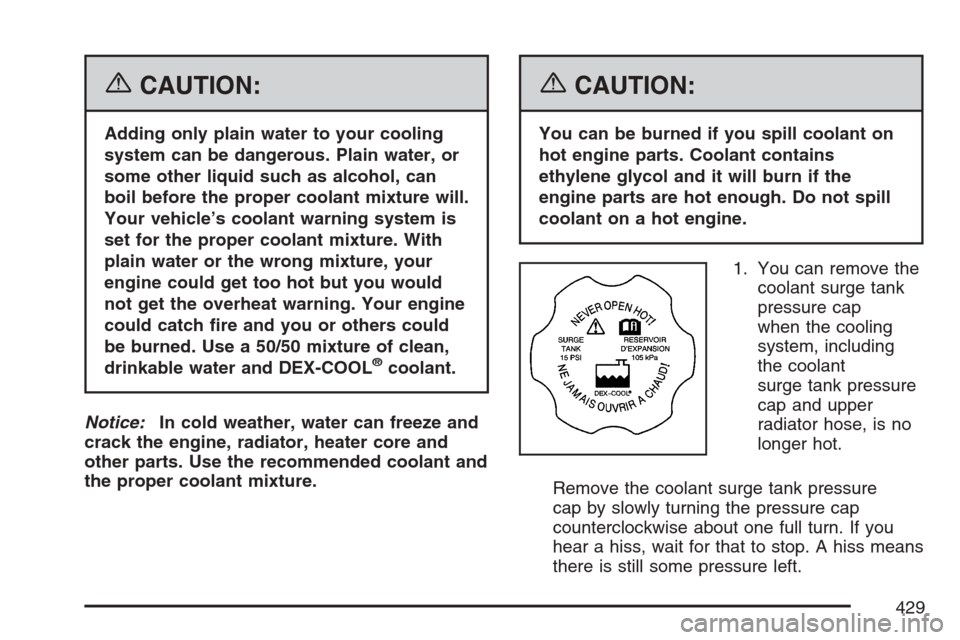
1. You can remove the
coolant surge tank
pressure cap
when the cooling
system, including
the coolant
surge tank pressure
cap and upper
radiator hose, is no
longer hot.
Remove the coolant surge tank pressure
cap by slowly turning the pressure cap
counterclockwise about one full turn. If you
hear a hiss, wait for that to stop. A hiss means
there is still some pressure left.
429
Page 449 of 580
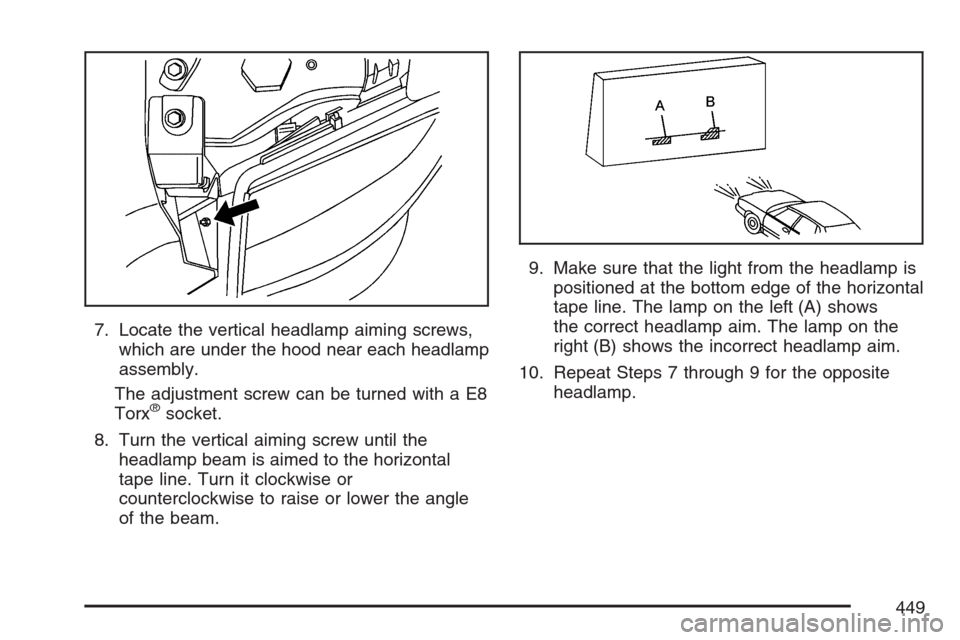
7. Locate the vertical headlamp aiming screws,
which are under the hood near each headlamp
assembly.
The adjustment screw can be turned with a E8
Torx
®socket.
8. Turn the vertical aiming screw until the
headlamp beam is aimed to the horizontal
tape line. Turn it clockwise or
counterclockwise to raise or lower the angle
of the beam.9. Make sure that the light from the headlamp is
positioned at the bottom edge of the horizontal
tape line. The lamp on the left (A) shows
the correct headlamp aim. The lamp on the
right (B) shows the incorrect headlamp aim.
10. Repeat Steps 7 through 9 for the opposite
headlamp.
449
Page 451 of 580
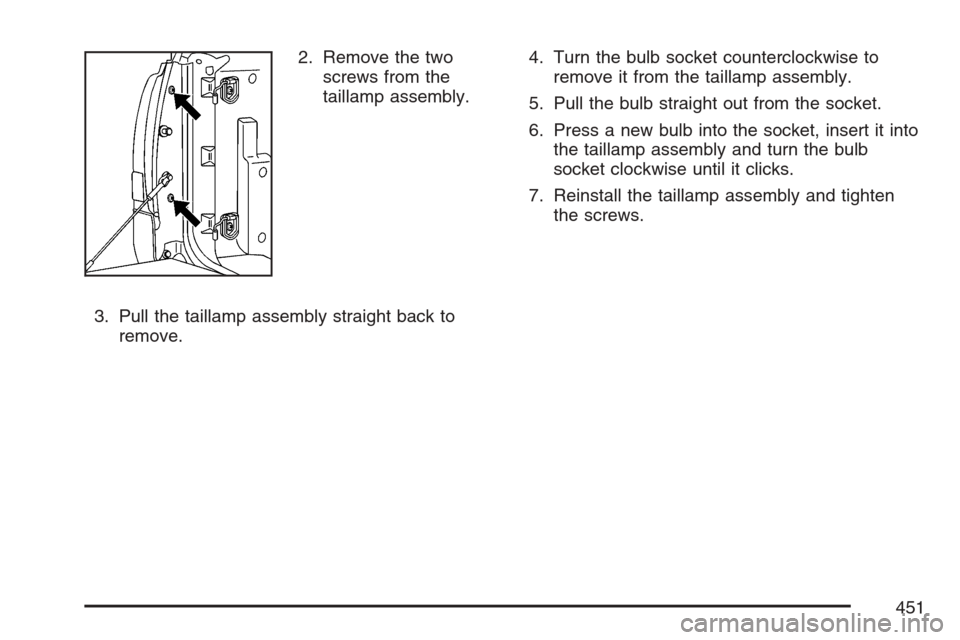
2. Remove the two
screws from the
taillamp assembly.
3. Pull the taillamp assembly straight back to
remove.4. Turn the bulb socket counterclockwise to
remove it from the taillamp assembly.
5. Pull the bulb straight out from the socket.
6. Press a new bulb into the socket, insert it into
the taillamp assembly and turn the bulb
socket clockwise until it clicks.
7. Reinstall the taillamp assembly and tighten
the screws.
451
Page 452 of 580
License Plate Lamp
To replace one of these bulbs, do the following:
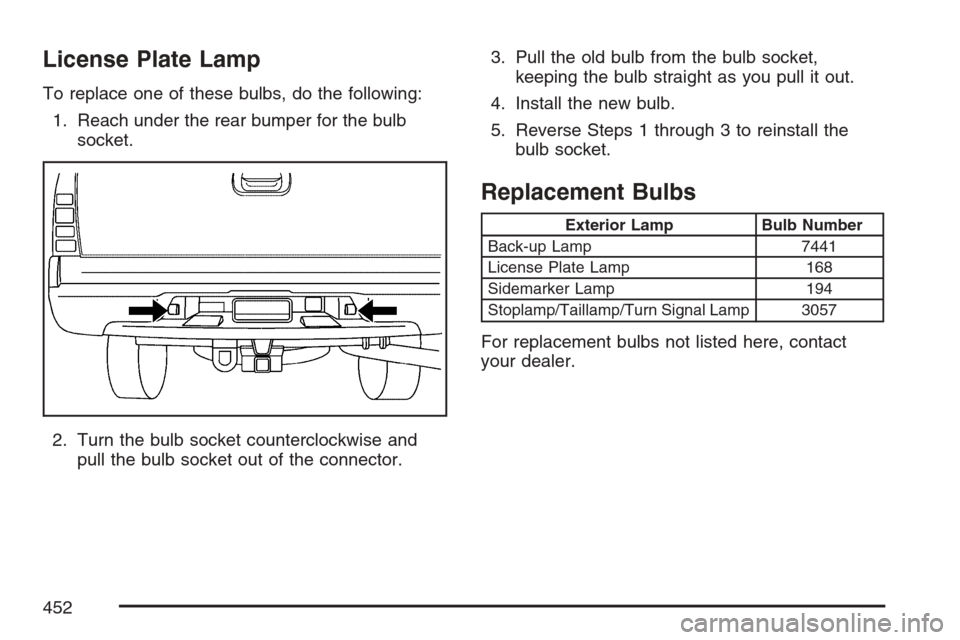
1. Reach under the rear bumper for the bulb
socket.
2. Turn the bulb socket counterclockwise and
pull the bulb socket out of the connector.3. Pull the old bulb from the bulb socket,
keeping the bulb straight as you pull it out.
4. Install the new bulb.
5. Reverse Steps 1 through 3 to reinstall the
bulb socket.
Replacement Bulbs
Exterior Lamp Bulb Number
Back-up Lamp 7441
License Plate Lamp 168
Sidemarker Lamp 194
Stoplamp/Taillamp/Turn Signal Lamp 3057
For replacement bulbs not listed here, contact
your dealer.
452
Page 453 of 580
Windshield Wiper Blade
Replacement
Windshield wiper blades should be inspected for
wear or cracking. SeeScheduled Maintenance
on page 523.
Replacement blades come in different types and
are removed in different ways. To replace the
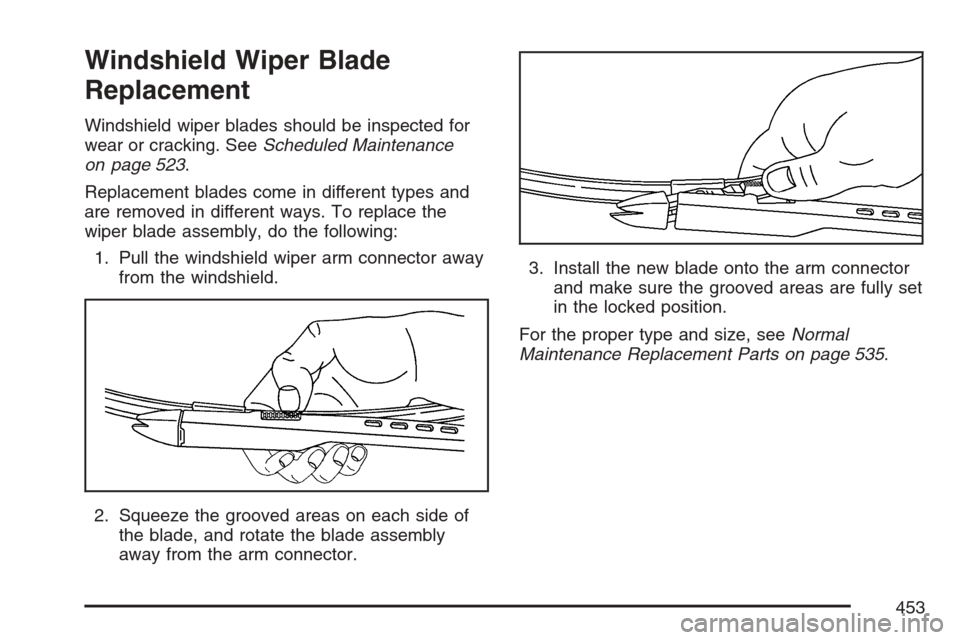
wiper blade assembly, do the following:
1. Pull the windshield wiper arm connector away
from the windshield.
2. Squeeze the grooved areas on each side of
the blade, and rotate the blade assembly
away from the arm connector.3. Install the new blade onto the arm connector
and make sure the grooved areas are fully set
in the locked position.
For the proper type and size, seeNormal
Maintenance Replacement Parts on page 535.
453
Page 461 of 580
A Tire and Loading Information label is attached to
the vehicle’s center pillar (B-pillar), below the
driver’s door lock post (striker). This label lists your
vehicle’s original equipment tires and their
recommended cold tire ination pressures. The
recommended cold tire ination pressure,
shown on the label, is the minimum amount of air
pressure needed to support your vehicle’s
maximum load carrying capacity.
For additional information regarding how much
weight your vehicle can carry, and an example of
the tire and loading information label, see
Loading Your Vehicle on page 372.
When to Check
Check your tires once a month or more. Do not
forget to check the spare tire. For additional
information regarding the spare tire, seeSpare
Tire on page 495.
How to Check
Use a good quality pocket-type gage to check tire
pressure. You cannot tell if your tires are
properly inated simply by looking at them. Radial
tires may look properly inated even when
they’re underinated. Check the tire’s ination
pressure when the tires are cold. Cold means your
vehicle has been sitting for at least three hours
or driven no more than 1 mile (1.6 km).
Remove the valve cap from the tire valve stem.
Press the tire gage rmly onto the valve to
get a pressure measurement. If the cold tire
ination pressure matches the recommended
pressure on the Tire and Loading Information
label, no further adjustment is necessary. If the
ination pressure is low, add air until you reach the
recommended amount.
If you overll the tire, release air by pushing on
the metal stem in the center of the tire valve.
Recheck the tire pressure with the tire gage.
Be sure to put the valve caps back on the valve
stems. They help prevent leaks by keeping out dirt
and moisture.
461
Page 466 of 580
6. Remove the valve cap from the valve cap
stem. Activate the TPMS sensor by
increasing or decreasing the tire’s air pressure
for ve seconds, or until a horn chirp
sounds. The horn chirp, which make take up
to 30 seconds to sound, conrms that the
sensor identication code has been matched
to this tire and wheel position. To decrease
air-pressure out of a tire you can use the
pointed end of the valve cap, a pencil-style air
pressure gage, or a key.
7. Proceed to the passenger’s side front tire, and
repeat the procedure in Step 6.
8. Proceed to the passenger’s side rear tire, and
repeat the procedure in Step 6.
9. Proceed to the driver’s side rear tire, and
repeat the procedure in Step 6.10. After hearing the conrming horn chirp for the
driver’s side rear tire, the horn chirp will sound
two more times to signal the tire learning
mode is no longer active. Turn the ignition
switch to LOCK.
11. Set all four tires to the recommended air
pressure level as indicated on the Tire
and Loading Information label.
12. Put the valve caps back on the valve stems
The spare tire does not have a TPMS sensor.
If you replace one of the road tires with the spare,
the SERVICE TIRE MONITOR message will be
displayed on the DIC screen. This message should
go off once you re-install the road tire containing
the TPMS sensor.
466
Page 472 of 580
Different Size Tires and Wheels
If you add wheels or tires that are a different size
than your original equipment wheels and tires,
this may affect the way your vehicle performs,
including its braking, ride and handling
characteristics, stability, and resistance to rollover.
Additionally, if your vehicle has electronic
systems such as, anti-lock brakes, traction control,
and electronic stability control, the performance
of these systems can be affected.{CAUTION:
If you add different sized wheels, your
vehicle may not provide an acceptable
level of performance and safety if tires not
recommended for those wheels are
selected. You may increase the chance
that you will crash and suffer serious
injury. Only use GM specic wheel and
tire systems developed for your vehicle,
and have them properly installed by a GM
certied technician.
SeeBuying New Tires on page 470and
Accessories and Modications on page 397for
additional information.
472
Page 477 of 580
{CAUTION:
Lifting a vehicle and getting under it to do
maintenance or repairs is dangerous
without the appropriate safety equipment
and training. The jack provided with your
vehicle is designed only for changing a
at tire. If it is used for anything else, you
or others could be badly injured or killed
if the vehicle slips off the jack. Use the
jack provided with your vehicle only for
changing a at tire.
If a tire goes at, the next part shows how to use
the jacking equipment to change a at tire
safely.
Changing a Flat Tire
If a tire goes at, avoid further tire and wheel
damage by driving slowly to a level place. Turn on
your vehicle’s hazard warning ashers. See
Hazard Warning Flashers on page 194for more
information.
{CAUTION:
Changing a tire can be dangerous. The
vehicle can slip off the jack and roll over
or fall on you or other people. You and
they could be badly injured or even killed.
Find a level place to change your tire. To
help prevent the vehicle from moving:
1. Set the parking brake rmly.
2. Put the shift lever in PARK (P).
3. Turn off the engine and do not restart
while the vehicle is raised.
4. Do not allow passengers to remain in
the vehicle.
To be even more certain the vehicle will
not move, you should put blocks at the
front and rear of the tire farthest away
from the one being changed. That would
be the tire, on the other side, at the
opposite end of the vehicle.
477
Page 478 of 580
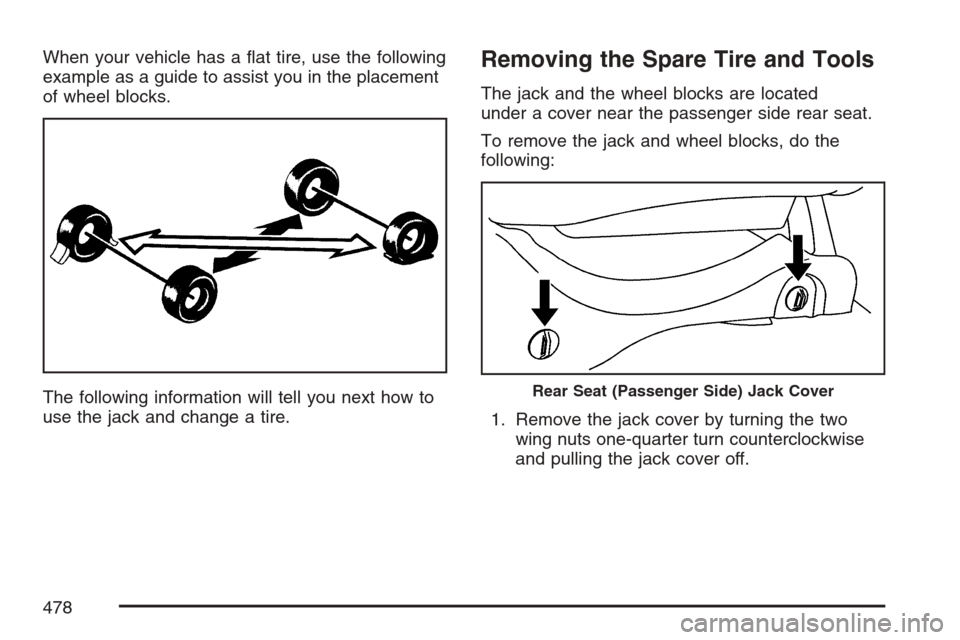
When your vehicle has a at tire, use the following
example as a guide to assist you in the placement
of wheel blocks.
The following information will tell you next how to
use the jack and change a tire.Removing the Spare Tire and Tools
The jack and the wheel blocks are located
under a cover near the passenger side rear seat.
To remove the jack and wheel blocks, do the
following:
1. Remove the jack cover by turning the two
wing nuts one-quarter turn counterclockwise
and pulling the jack cover off.
Rear Seat (Passenger Side) Jack Cover
478