height CADILLAC ESCALADE EXT 2010 3.G Owners Manual
[x] Cancel search | Manufacturer: CADILLAC, Model Year: 2010, Model line: ESCALADE EXT, Model: CADILLAC ESCALADE EXT 2010 3.GPages: 580, PDF Size: 6.23 MB
Page 13 of 580
Seat Adjustment
Front Seats
Power Seats
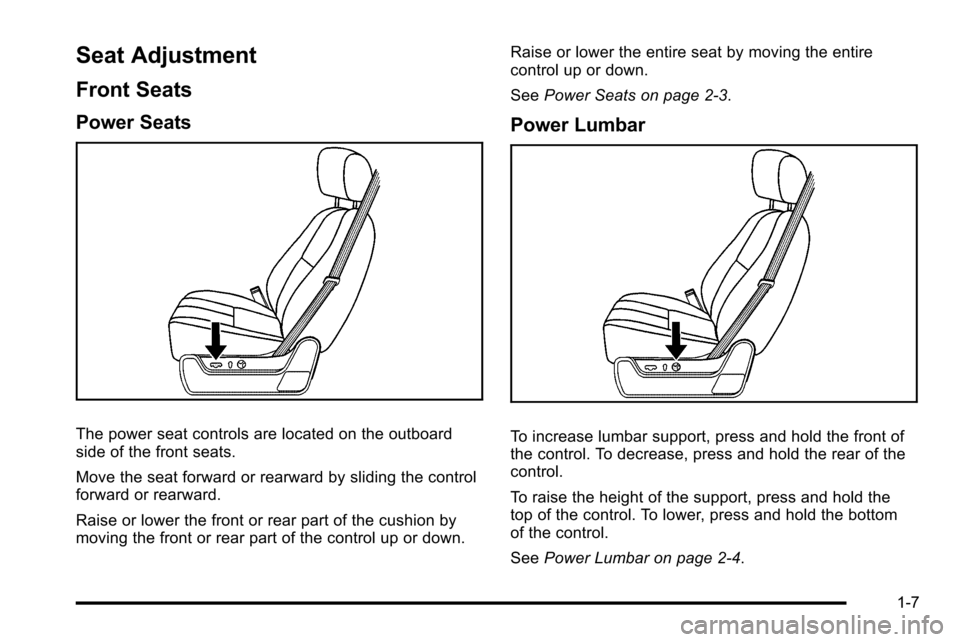
The power seat controls are located on the outboard
side of the front seats.
Move the seat forward or rearward by sliding the control
forward or rearward.
Raise or lower the front or rear part of the cushion by
moving the front or rear part of the control up or down.Raise or lower the entire seat by moving the entire
control up or down.
See
Power Seats on page 2‑3.
Power Lumbar
To increase lumbar support, press and hold the front of
the control. To decrease, press and hold the rear of the
control.
To raise the height of the support, press and hold the
top of the control. To lower, press and hold the bottom
of the control.
SeePower Lumbar on page 2‑4.
1-7
Page 36 of 580
Head Restraints
The front seats have adjustable head restraints in the
outboard seating positions.
{WARNING:
With head restraints that are not installed and
adjusted properly, there is a greater chance that
occupants will suffer a neck/spinal injury in a
crash. Do not drive until the head restraints for all
occupants are installed and adjusted properly.
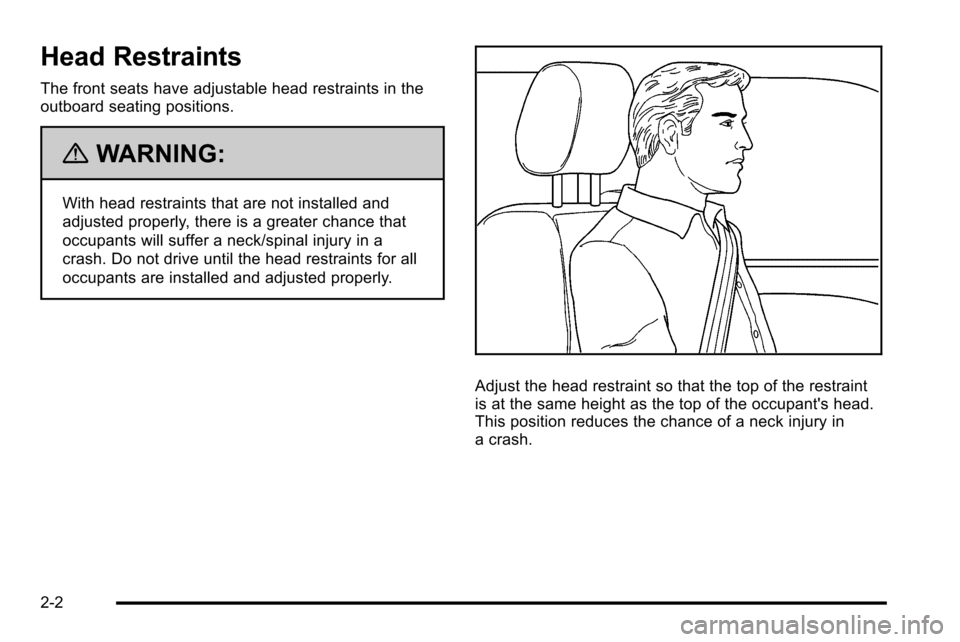
Adjust the head restraint so that the top of the restraint
is at the same height as the top of the occupant's head.
This position reduces the chance of a neck injury in
a crash.
2-2
Page 38 of 580
.Raise or lower the rear part of the seat cushion by
moving the rear of the control up or down.
.Raise or lower the entire seat by moving the entire
control up or down.
The power reclining seatback control is located behind
the power seat control on the outboard side of the
seats. See Power Reclining Seatbacks on page 2‑7.
Your vehicle has a memory function which allows seat
settings to be saved and recalled. See Memory
Features on page 2‑6.
Power Lumbar
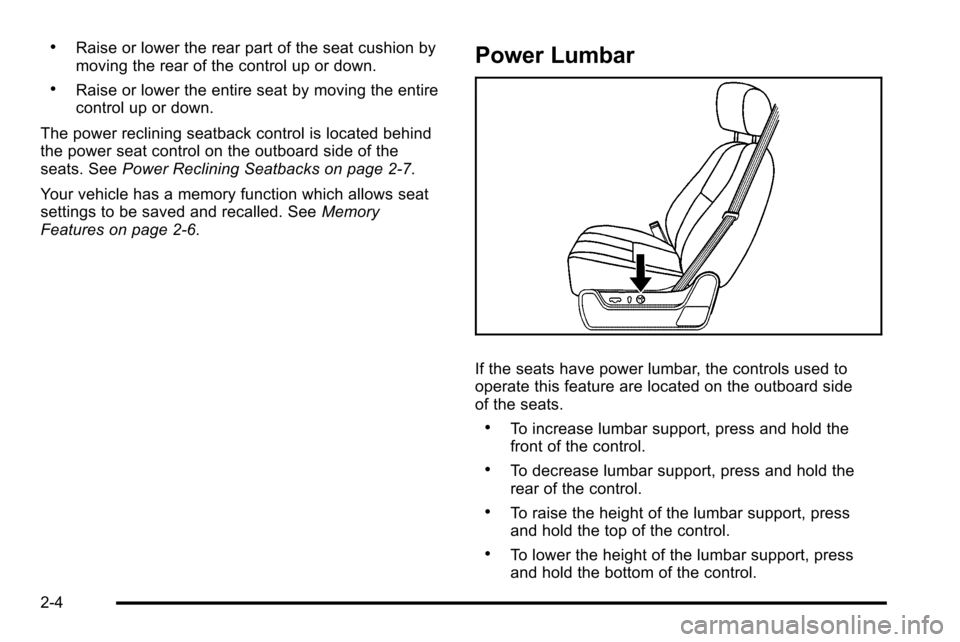
If the seats have power lumbar, the controls used to
operate this feature are located on the outboard side
of the seats.
.To increase lumbar support, press and hold the
front of the control.
.To decrease lumbar support, press and hold the
rear of the control.
.To raise the height of the lumbar support, press
and hold the top of the control.
.To lower the height of the lumbar support, press
and hold the bottom of the control.
2-4
Page 59 of 580

4. If equipped with a shoulder belt height adjuster,move it to the height that is right for you. See
“Shoulder Belt Height Adjustment” later in this
section for instructions on use and important safety
information.
5. To make the lap part tight, pull up on the shoulder belt.
It may be necessary to pull stitching on the safety
belt through the latch plate to fully tighten the lap
belt on smaller occupants.
To unlatch the belt, push the button on the buckle.
The belt should return to its stowed position.
Before a door is closed, be sure the safety belt is out of
the way. If a door is slammed against a safety belt,
damage can occur to both the belt and the vehicle.
2-25
Page 60 of 580
Shoulder Belt Height Adjuster
The vehicle has a shoulder belt height adjuster for the
driver and right front passenger positions.
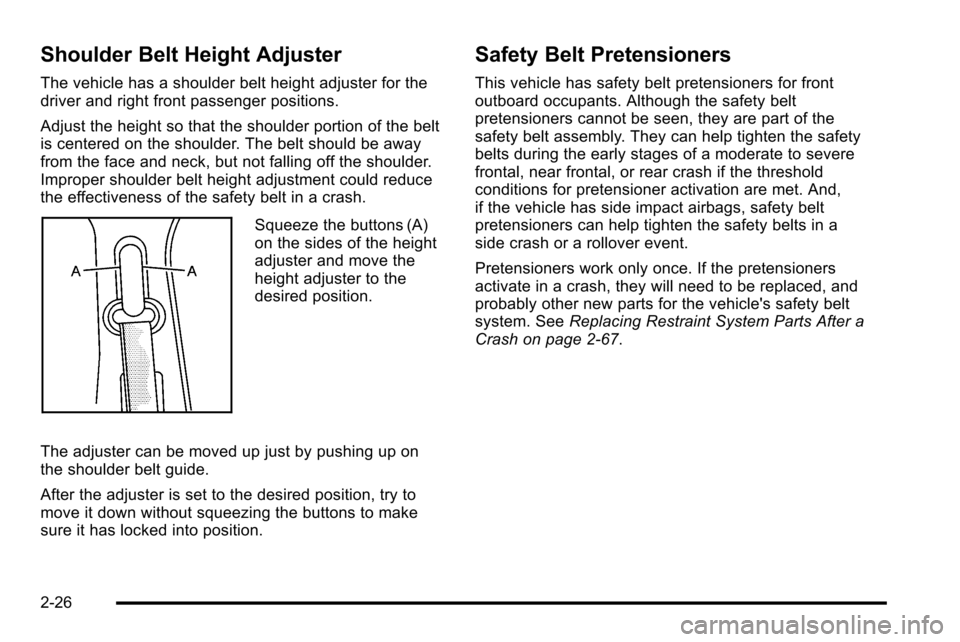
Adjust the height so that the shoulder portion of the belt
is centered on the shoulder. The belt should be away
from the face and neck, but not falling off the shoulder.
Improper shoulder belt height adjustment could reduce
the effectiveness of the safety belt in a crash.
Squeeze the buttons (A)
on the sides of the height
adjuster and move the
height adjuster to the
desired position.
The adjuster can be moved up just by pushing up on
the shoulder belt guide.
After the adjuster is set to the desired position, try to
move it down without squeezing the buttons to make
sure it has locked into position.
Safety Belt Pretensioners
This vehicle has safety belt pretensioners for front
outboard occupants. Although the safety belt
pretensioners cannot be seen, they are part of the
safety belt assembly. They can help tighten the safety
belts during the early stages of a moderate to severe
frontal, near frontal, or rear crash if the threshold
conditions for pretensioner activation are met. And,
if the vehicle has side impact airbags, safety belt
pretensioners can help tighten the safety belts in a
side crash or a rollover event.
Pretensioners work only once. If the pretensioners
activate in a crash, they will need to be replaced, and
probably other new parts for the vehicle's safety belt
system. See Replacing Restraint System Parts After a
Crash on page 2‑67.
2-26
Page 64 of 580
Child Restraints
Older Children
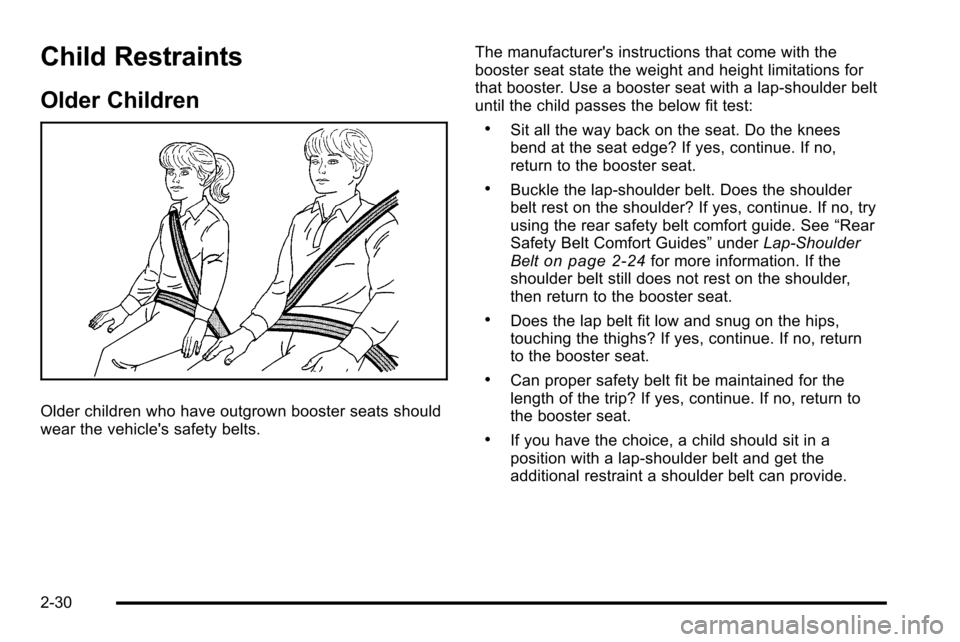
Older children who have outgrown booster seats should
wear the vehicle's safety belts.The manufacturer's instructions that come with the
booster seat state the weight and height limitations for
that booster. Use a booster seat with a lap-shoulder belt
until the child passes the below fit test:
.Sit all the way back on the seat. Do the knees
bend at the seat edge? If yes, continue. If no,
return to the booster seat.
.Buckle the lap-shoulder belt. Does the shoulder
belt rest on the shoulder? If yes, continue. If no, try
using the rear safety belt comfort guide. See
“Rear
Safety Belt Comfort Guides” underLap-Shoulder
Belt
on page 2‑24for more information. If the
shoulder belt still does not rest on the shoulder,
then return to the booster seat.
.Does the lap belt fit low and snug on the hips,
touching the thighs? If yes, continue. If no, return
to the booster seat.
.Can proper safety belt fit be maintained for the
length of the trip? If yes, continue. If no, return to
the booster seat.
.If you have the choice, a child should sit in a
position with a lap-shoulder belt and get the
additional restraint a shoulder belt can provide.
2-30
Page 69 of 580
Q: What are the different types of add-on childrestraints?
A: Add-on child restraints, which are purchased by the
vehicle's owner, are available in four basic types.
Selection of a particular restraint should take into
consideration not only the child's weight, height, and
age but also whether or not the restraint will be
compatible with the motor vehicle in which it will
be used.
For most basic types of child restraints, there are
many different models available. When purchasing a
child restraint, be sure it is designed to be used in a
motor vehicle. If it is, the restraint will have a label
saying that it meets federal motor vehicle safety
standards.
The restraint manufacturer's instructions that come
with the restraint state the weight and height
limitations for a particular child restraint. In addition,
there are many kinds of restraints available for
children with special needs.
{WARNING:
To reduce the risk of neck and head injury during
a crash, infants need complete support. This is
because an infant's neck is not fully developed
(Continued)
WARNING: (Continued)
and its head weighs so much compared with
the rest of its body. In a crash, an infant in a
rear-facing child restraint settles into the restraint,
so the crash forces can be distributed across the
strongest part of an infant's body, the back and
shoulders. Infants should always be secured in
rear-facing child restraints.
{WARNING:
A young child's hip bones are still so small that
the vehicle's regular safety belt may not remain
low on the hip bones, as it should. Instead, it may
settle up around the child's abdomen. In a crash,
the belt would apply force on a body area that is
unprotected by any bony structure. This alone
could cause serious or fatal injuries. To reduce the
risk of serious or fatal injuries during a crash,
young children should always be secured in
appropriate child restraints.
2-35
Page 99 of 580
Adding Equipment to Your
Airbag-Equipped Vehicle
Q: Is there anything I might add to or change aboutthe vehicle that could keep the airbags from
working properly?
A: Yes. If you add things that change the vehicle's
frame, bumper system, height, front end or side
sheet metal, they may keep the airbag system from
working properly. Changing or moving any parts of
the front seats, safety belts, the airbag sensing and
diagnostic module, steering wheel, instrument panel,
roof-rail airbag modules, ceiling headliner or pillar
garnish trim, overhead console, front sensors, side
impact sensors, rollover sensor module, or airbag
wiring can affect the operation of the airbag system.
In addition, the vehicle may have a passenger
sensing system for the right front passenger
position, which includes sensors that are part of the
passenger seat. The passenger sensing system
may not operate properly if the original seat trim is
replaced with non-GM covers, upholstery or trim,
or with GM covers, upholstery or trim designed for a
different vehicle. Any object, such as an aftermarket
seat heater or a comfort enhancing pad or device,
installed under or on top of the seat fabric, could
also interfere with the operation of the passenger sensing system. This could either prevent proper
deployment of the passenger airbag(s) or prevent
the passenger sensing system from properly turning
off the passenger airbag(s). See
Passenger Sensing
System on page 2‑60.
If you have any questions, call Customer
Assistance. The phone numbers and addresses
for Customer Assistance are in Step Two of the
Customer Satisfaction Procedure in this manual.
See Customer Satisfaction Procedure on page 9‑2.
If the vehicle has rollover roof-rail airbags, see
Different Size Tires and Wheels
on page 7‑74for
additional important information.
Q: Because I have a disability, I have to get my vehicle modified. How can I find out whether
this will affect my airbag system?
A: If you have questions, call Customer Assistance.
The phone numbers and addresses for Customer
Assistance are in Step Two of the Customer
Satisfaction Procedure in this manual. See
Customer Satisfaction Procedure on page 9‑2.
In addition, your dealer/retailer and the service manual
have information about the location of the airbag
sensors, sensing and diagnostic module and airbag
wiring.
2-65
Page 398 of 580

There is also important loading information for
off-road driving in this manual. See“Loading Your
Vehicle for Off-Road Driving” underOff-Road
Driving
on page 6‑13.
Add-On Equipment
When you carry removable items, you may need
to put a limit on how many people you can carry
inside the vehicle. Be sure to weigh the vehicle
before you buy and install the new equipment.
Notice :Overloading the vehicle may cause
damage. Repairs would not be covered by the
vehicle warranty. Do not overload the vehicle.
Remember not to exceed the Gross Axle Weight
Rating (GAWR) of the front or rear axle.
The Cargo Weight Rating (CWR) is the maximum
weight of the load the vehicle can carry. It does
not include the weight of the people inside. But
you can figure about 150 lbs (68 kg) for each seat.
The total cargo load must not be more than the
vehicle's CWR.
Automatic Level Control
The automatic level control rear suspension
comes as a part of the Road Sensing Suspension.
See Road Sensing Suspension
on page 6‑9.
This type of level control is fully automatic and will
provide a better leveled riding position as well as
better handling under a variety of passenger and
loading conditions. An air compressor connected
to the rear shocks will raise or lower the rear of
the vehicle to maintain proper vehicle height.
The system is activated when the ignition key is
turned to ON/RUN and will automatically adjust
vehicle height thereafter. The system may exhaust
(lower vehicle height) for up to 10 minutes after
the ignition key has been turned to OFF/LOCK.
You may hear the air compressor operating when
the height is being adjusted.
6-38
Page 399 of 580
If a weight-distributing hitch is being used, it is
recommended to allow the shocks to inflate,
thereby leveling the vehicle prior to adjusting the
height. See“Weight Distributing Hitches and
Weight Carrying Hitches” underTowing a Trailer
on page 6‑42.
Truck-Camper Loading Information
The vehicle was neither designed nor intended to
carry a slide-in type camper.
Notice :Adding a slide-in camper or similar
equipment to the vehicle can damage it, and
the repairs would not be covered by the
vehicle warranty. Do not install a slide-in
camper or similar equipment on the vehicle.
Towing
Towing Your Vehicle
To avoid damage, the disabled vehicle should be towed
with all four wheels off the ground. Consult your dealer/
retailer or a professional towing service if the disabled
vehicle must be towed. See Roadside Service
on
page 9‑8.
To tow the vehicle behind another vehicle for
recreational purposes (such as behind a motorhome),
see “Recreational Vehicle Towing” following.
Recreational Vehicle Towing
Recreational vehicle towing means towing the vehicle
behind another vehicle–such as behind a motorhome.
The two most common types of recreational vehicle
towing are known as dinghy towing and dolly towing.
Dinghy towing is towing the vehicle with all four wheels
on the ground. Dolly towing is towing the vehicle with
two wheels on the ground and two wheels up on a
device known as a dolly.
6-39