transmission CADILLAC ESCALADE HYBRID 2012 User Guide
[x] Cancel search | Manufacturer: CADILLAC, Model Year: 2012, Model line: ESCALADE HYBRID, Model: CADILLAC ESCALADE HYBRID 2012Pages: 90, PDF Size: 1.62 MB
Page 33 of 90
Black plate (9,1)Cadillac Escalade Hybrid - 2012
Driving and Operating 9-9Notice: Shifting out of P (Park)
or N (Neutral) with the engine
running at high speed may
damage the transmission. The
repairs would not be covered by
the vehicle warranty. Be sure the
engine is not running at high
speed when shifting the vehicle.
D (Drive): This position is for
normal driving. It provides the best
fuel economy. If you need more
power for passing, and you are: .
Going less than about 55 km/h
(35 mph), push the accelerator
pedal about halfway down. .
Going about 55 km/h (35 mph) or
more, push the accelerator all
the way down.
D (Drive) or M (Manual Mode) can
be used when towing a trailer,
carrying a heavy load, driving
on steep hills, or for off-road
driving. You may want to shift the
transmission to a lower gear
selection if the transmission shifts
too often. Downshifting the transmission in
slippery road conditions could result
in skidding. See “ Loss of Control ” in
the owner manual.
When temperatures are very cold,
the transmission's gear shifting may
be delayed, providing more stable
shifts until the engine warms up.
Shifts may be more noticeable with
a cold transmission. This difference
in shifting is normal.
M (Manual Mode): This position
lets drivers select the range of
gears appropriate for current driving
conditions. If the vehicle has this
feature, see Manual Mode on
page 9 ‑ 10 . Notice: Spinning the tires
or holding the vehicle in
one place on a hill using only the
accelerator pedal may damage
the transmission. The repair will
not be covered by the vehicle
warranty. If you are stuck, do not
spin the tires. When stopping on
a hill, use the brakes to hold the
vehicle in place.
The vehicle has a shift stabilization
feature that adjusts the transmission
shifting to the current driving
conditions to reduce rapid upshifts
and downshifts. If the shift
stabilization feature determines that
a current vehicle speed cannot be
maintained, the transmission does
not upshift. In some cases, this
may appear to be a delayed shift,
however the transmission is
operating normally.
Page 34 of 90

Black plate (10,1)Cadillac Escalade Hybrid - 2012
9-10 Driving and Operating
Manual Mode Range Selection Mode
The Range Selection Mode controls
the vehicle's transmission.
To use this feature:
1. Move the shift lever to the
M (Manual Mode).
2. Press the plus/minus button to
upshift or downshift selecting the
desired range of gears.
A number displays next to the M,
indicating the current gear that
has been selected. The number
displayed in the gear indicator is
the highest gear that can be used. The vehicle can automatically shift
to lower gears as it adjusts to
driving conditions. When 3 (Third) is
selected, 1 (First) through 3 (Third)
gears are automatically shifted by
the vehicle, but 4 (Fourth) cannot be
used until it is selected.
The Range Selection Mode controls
the vehicle and engine speed while
driving down a hill or towing a trailer,
by allowing you to select a desired
range of gears.
When you move the shift lever
into M, the transmission will default
to M4. In this gear range, effective
engine braking occurs at speeds
above 72 km/h (45 mph).
Pushing the minus ( − ) button on the
shift lever reduces the gear range. In the M3 gear range, effective
engine braking occurs at speeds
above 56 km/h (35 mph).
In the M2 gear range, effective
engine braking occurs at speeds
above 40 km/h (25 mph).
In the M1 gear range, effective
engine braking occurs at speeds
above 16 km/h (10 mph).
When operating in M (Manual
Mode), Auto Stop is disabled.
For better vehicle efficiency,
operate the vehicle in D (Drive)
not M (Manual Mode).
Cruise control can be used while
using the Range Selection Mode.
Page 36 of 90

Black plate (12,1)Cadillac Escalade Hybrid - 2012
9-12 Driving and Operating If the lights do not come on, you
should take the vehicle to your
dealer for service. An indicator light
will flash while shifting. It will stay on
when the shift is completed. If for
some reason the transfer case
cannot make a requested shift, it will
return to the last chosen setting.
2
m (Two-Wheel Drive High): This
setting is used for driving in most
street and highway situations.
The front axle is not engaged in
two-wheel drive. This setting also
provides the best fuel economy.
AUTO (Automatic Four-Wheel
Drive): This setting is ideal for
use when road surface traction
conditions are variable. When
driving your vehicle in AUTO, the
front axle is engaged, but the
vehicle's power is primarily sent to
the rear wheels. When the vehicle's
software determines a need for
more traction, the system will
transfer more power to the front wheels. Driving in this mode results
in slightly lower fuel economy than
Two-Wheel Drive High.
4
m (Four-Wheel Drive High): Use
the four-wheel high position when
you need extra traction, such as
on snowy or icy roads or in most
off-road situations. This setting also
engages the front axle to help drive
the vehicle. This is the best setting
to use when plowing snow.
4
n (Four-Wheel Drive Low): This
setting also engages the front axle
and delivers extra torque. You may
never need this setting. It sends
maximum power to all four wheels.
You might choose Four-Wheel Drive
Low if you are driving off-road in
deep sand, deep mud, deep snow,
and while climbing or descending
steep hills.
The vehicle has StabiliTrak. Shifting
into Four-Wheel-Drive Low will turn
Traction Control and StabiliTrak off.
See “ StabiliTrak System ” in the
owner manual. { WARNINGShifting the transfer case to
N (Neutral) can cause the vehicle
to roll even if the transmission is
in P (Park). You or someone else
could be seriously injured. Be
sure to set the parking brake
before placing the transfer case in
N (Neutral). See “ Parking Brake ”
in the owner manual for more
information.
N (Neutral): Shift the vehicle's
transfer case to N (Neutral) only
when towing the vehicle. See
“ Recreational Vehicle Towing ” or
“ Towing Your Vehicle ” in the owner
manual.
If the SERVICE 4 WHEEL DRIVE
message stays on, you should
take the vehicle to your dealer
for service. See Transmission
Messages on page 5 ‑ 7 .
Page 37 of 90
Black plate (13,1)Cadillac Escalade Hybrid - 2012
Driving and Operating 9-13Shifting Into Four-Wheel Drive
High or AUTO (Automatic
Four-Wheel Drive)
Turn the knob to the Four-Wheel
High or AUTO position. This can be
done at any speed, except when
shifting from Four-Wheel Drive Low.
The indicator light will flash while
shifting. It will remain on when the
shift is completed.
Shifting Into Two-Wheel
Drive High
Turn the knob to the Two-Wheel
High position. This can be done at
any speed, except when shifting
from Four-Wheel Drive Low.
See “ Shifting Out of Four-Wheel
Drive Low ” in this section for more
information.
Shifting Into Four-Wheel
Drive Low
When Four-Wheel Low is engaged,
vehicle speed should be kept below
64 km/h (40 mph). Extended high-speed operation in 4L may
damage or shorten the life of the
drivetrain.
To shift to the Four-Wheel Drive
Low position, the ignition must be in
ON/RUN and the vehicle must be
stopped or moving less than 5 km/h
(3 mph) with the transmission in
N (Neutral). The preferred method
for shifting into Four-Wheel Drive
Low is to have the vehicle moving
1.6 to 3.2 km/h (1 to 2 mph). Turn
the knob to the Four-Wheel Drive
Low position. You must wait for the
Four-Wheel Drive Low indicator
light to stop flashing and remain on
before shifting the transmission
into gear.
Notice: Shifting the transmission
into gear before the requested
mode indicator light has stopped
flashing could damage the
transfer case. To help avoid
damaging the vehicle, always wait
for the mode indicator lights to
stop flashing before shifting the
transmission into gear. The vehicle may have significant
engagement noise and bump when
shifting between Four-Wheel Drive
Low and Four-Wheel Drive High
ranges or from N (Neutral) while the
engine is running.
If the knob is turned to the
Four-Wheel Drive Low position
when the vehicle is in gear and/or
moving more than 5 km/h (3 mph),
the Four-Wheel Drive Low indicator
light will flash for 30 seconds
and not complete the shift. After
30 seconds the transfer case
will shift to Four-Wheel Drive
High mode.
Shifting Out of Four-Wheel
Drive Low
To shift from Four-Wheel Drive
Low to Four-Wheel Drive High,
AUTO, or Two-Wheel Drive High,
the vehicle must be stopped or
moving less than 5 km/h (3 mph)
with the transmission in N (Neutral)
and the ignition in ON/RUN.
Page 38 of 90
Black plate (14,1)Cadillac Escalade Hybrid - 2012
9-14 Driving and Operating The preferred method for shifting
out of Four-Wheel Drive Low is to
have your vehicle moving 1.6 to
3.2 km/h (1 to 2 mph). Turn the knob
to the Four-Wheel Drive High,
AUTO, or Two-Wheel Drive High
position. You must wait for the
Four-Wheel Drive High, AUTO,
or Two-Wheel Drive High indicator
light to stop flashing and remain on
before shifting the transmission
into gear.
Notice: Shifting the transmission
into gear before the requested
mode indicator light has stopped
flashing could damage the
transfer case. To help avoid
damaging the vehicle, always wait
for the mode indicator lights to
stop flashing before shifting the
transmission into gear.
The vehicle may have significant
engagement noise and bump when
shifting between Four-Wheel Drive
Low and Four-Wheel Drive High
ranges or from N (Neutral) while the
engine is running. If the knob is turned to the
Four-Wheel Drive High, AUTO,
or Two-Wheel Drive High switch
position when the vehicle is in gear
and/or moving more than 5 km/h
(3 mph), the Four-Wheel Drive
High, AUTO or Two-Wheel Drive
High indicator light will flash for
30 seconds but will not complete the
shift.
Shifting into Neutral
To shift the transfer case into
N (Neutral):
1. Make sure the vehicle is parked
so that it will not roll.
2. Set the parking brake and apply
the regular brake pedal. See
“ Parking Brake ” in the owner
manual.
3. Start the vehicle or turn the
ignition to ON/RUN.
4. Put the transmission in
N (Neutral).
5. Shift the transfer case to
Two-Wheel Drive High. 6. Turn the transfer case dial
clockwise to N (Neutral) until
it stops and hold it there until
the N (Neutral) light starts
blinking. This will take at least
10 seconds. Then slowly release
the dial to the Four ‐ Wheel Drive
Low position. The N (Neutral)
light will come on when the
transfer case shift to N (Neutral)
is complete.
7. If the engine is running, verify
that the transfer case is in
N (Neutral) by shifting the
transmission to R (Reverse)
for one second, then shift the
transmission to D (Drive) for
one second.
8. Turn the ignition to ACC/
ACCESSORY, which will turn
the engine off.
9. Place the transmission shift
lever in P (Park).
10. Release the parking brake prior
to moving the vehicle.
11. Turn the ignition to LOCK/OFF.
Page 39 of 90

Black plate (15,1)Cadillac Escalade Hybrid - 2012
Driving and Operating 9-15Shifting Out of Neutral
To shift the transfer case out of
N (Neutral):
1. Set the parking brake and apply
the regular brake pedal.
2. Turn the ignition to ON/RUN with
the engine off, and shift the
transmission to N (Neutral).
3. Turn the transfer case dial to the
desired transfer case shift
position (Two-Wheel Drive High,
Four-Wheel Drive High, AUTO).
After the transfer case has
shifted out of N (Neutral), the
N (Neutral) light will go out.
4. Release the parking brake prior
to moving the vehicle. Notice: Shifting the transmission
into gear before the Four-Wheel
Drive Low indicator light has
stopped flashing could damage
the transfer case. To help avoid
damaging the vehicle, always wait
for the Four-Wheel Drive Low
indicator light to stop flashing
before shifting the transmission
into gear.
5. Start the engine and shift the
transmission to the desired
position.
Excessively shifting the transfer
case into or out of the different
modes may cause the transfer case
to enter the shift protection mode.
This will protect the transfer case
from possible damage and will only
allow the transfer case to respond
to one shift per 10 seconds. The
transfer case may stay in this mode
for up to three minutes. Brakes Regenerative Braking Regenerative braking is a hybrid
technology that enables the electric
drive motor to operate as a
generator when coasting or braking.
Energy from the moving vehicle
recharges the hybrid battery.
The hydraulic disc brakes work with
the regenerative braking to insure
effective braking, such as when a
high braking demand is requested.
The braking system is computer
controlled and blends the
regenerative braking with the
conventional hydraulic disc brakes
to meet any requirements for
deceleration. The controller
interprets the braking request
and uses regenerative braking,
conventional hydraulic braking or a
combination of both as necessary.
Page 43 of 90
Black plate (1,1)Cadillac Escalade Hybrid - 2012
Vehicle Care 10-1
Vehicle Care Vehicle Checks Doing Your Own
Service Work . . . . . . . . . . . . . . . 10-2
Engine Compartment
Overview . . . . . . . . . . . . . . . . . . . 10-4
Automatic Transmission
Fluid . . . . . . . . . . . . . . . . . . . . . . . 10-5
Drive Motor/Generator Control
Module (DMCM) Coolant
Surge Tank
Pressure Cap . . . . . . . . . . . . . . 10-8
Drive Motor/Generator Control
Module (DMCM) Cooling
System . . . . . . . . . . . . . . . . . . . . . 10-8
Battery . . . . . . . . . . . . . . . . . . . . . . 10-11
Four-Wheel Drive . . . . . . . . . . . 10-12 Electrical System High Voltage Devices and
Wiring . . . . . . . . . . . . . . . . . . . . . 10-13
Fuses and Circuit
Breakers . . . . . . . . . . . . . . . . . . 10-13
Engine Compartment Fuse
Block . . . . . . . . . . . . . . . . . . . . . 10-14
Wheels and Tires Tire Pressure . . . . . . . . . . . . . . . 10-16
Tire Pressure Monitor
Operation . . . . . . . . . . . . . . . . . 10-17
Tire Rotation . . . . . . . . . . . . . . . 10-20
If a Tire Goes Flat . . . . . . . . . . 10-20
Tire Sealant and
Compressor Kit . . . . . . . . . . . 10-22
Storing the Tire Sealant and
Compressor Kit . . . . . . . . . . . 10-29 Jump Starting Jump Starting . . . . . . . . . . . . . . 10-29
Towing Recreational Vehicle
Towing . . . . . . . . . . . . . . . . . . . . 10-33
Appearance Care Exterior Care . . . . . . . . . . . . . . . 10-37
Page 47 of 90
Black plate (5,1)Cadillac Escalade Hybrid - 2012
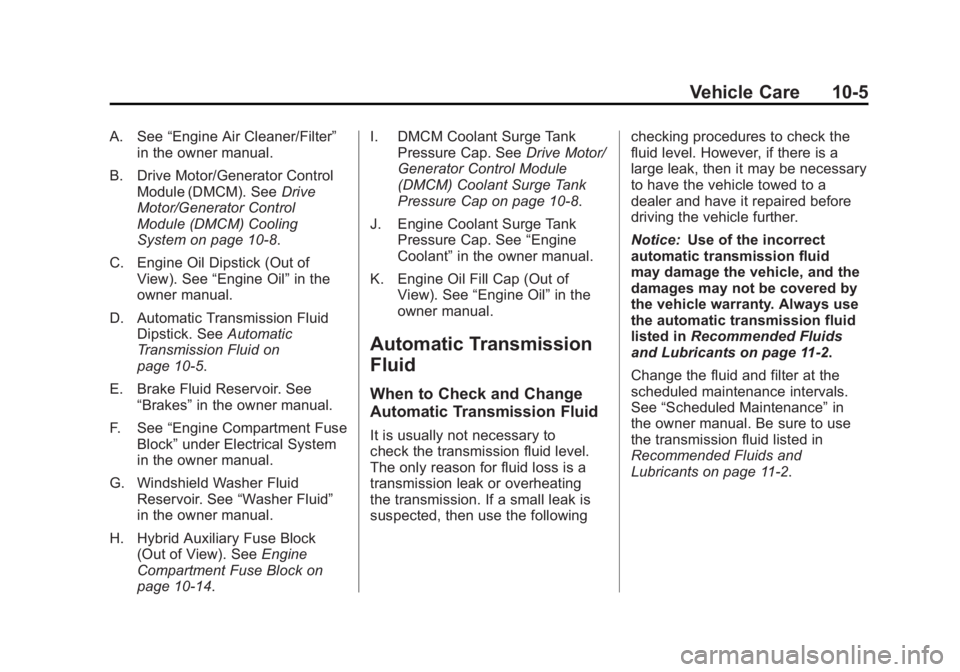
Vehicle Care 10-5A. See “ Engine Air Cleaner/Filter ”
in the owner manual.
B. Drive Motor/Generator Control
Module (DMCM). See Drive
Motor/Generator Control
Module (DMCM) Cooling
System on page 10 ‑ 8 .
C. Engine Oil Dipstick (Out of
View). See “ Engine Oil ” in the
owner manual.
D. Automatic Transmission Fluid
Dipstick. See Automatic
Transmission Fluid on
page 10 ‑ 5 .
E. Brake Fluid Reservoir. See
“ Brakes ” in the owner manual.
F. See “ Engine Compartment Fuse
Block ” under Electrical System
in the owner manual.
G. Windshield Washer Fluid
Reservoir. See “ Washer Fluid ”
in the owner manual.
H. Hybrid Auxiliary Fuse Block
(Out of View). See Engine
Compartment Fuse Block on
page 10 ‑ 14 . I. DMCM Coolant Surge Tank
Pressure Cap. See Drive Motor/
Generator Control Module
(DMCM) Coolant Surge Tank
Pressure Cap on page 10 ‑ 8 .
J. Engine Coolant Surge Tank
Pressure Cap. See “ Engine
Coolant ” in the owner manual.
K. Engine Oil Fill Cap (Out of
View). See “ Engine Oil ” in the
owner manual.
Automatic Transmission
Fluid When to Check and Change
Automatic Transmission Fluid It is usually not necessary to
check the transmission fluid level.
The only reason for fluid loss is a
transmission leak or overheating
the transmission. If a small leak is
suspected, then use the following checking procedures to check the
fluid level. However, if there is a
large leak, then it may be necessary
to have the vehicle towed to a
dealer and have it repaired before
driving the vehicle further.
Notice: Use of the incorrect
automatic transmission fluid
may damage the vehicle, and the
damages may not be covered by
the vehicle warranty. Always use
the automatic transmission fluid
listed in Recommended Fluids
and Lubricants on page 11 ‑ 2 .
Change the fluid and filter at the
scheduled maintenance intervals.
See “ Scheduled Maintenance ” in
the owner manual. Be sure to use
the transmission fluid listed in
Recommended Fluids and
Lubricants on page 11 ‑ 2 .
Page 48 of 90
Black plate (6,1)Cadillac Escalade Hybrid - 2012
10-6 Vehicle Care How to Check Automatic
Transmission Fluid Notice: Too much or too
little fluid can damage the
transmission. Too much can
mean that some of the fluid could
come out and fall on hot engine
parts or exhaust system parts,
starting a fire. Too little fluid
could cause the transmission to
overheat. Be sure to get an
accurate reading if checking the
transmission fluid.
Before checking the fluid level,
prepare the vehicle as follows:
1. Start the engine and park the
vehicle on a level surface. Keep
the engine running.
2. Apply the parking brake and
place the shift lever in P (Park).
3. With your foot on the brake
pedal, move the shift lever
through each gear range,
pausing for about three seconds
in each range. Then, move the
shift lever back to P (Park). 4. Allow the engine to idle
(500 – 800 RPM) for at least
one minute. Slowly release the
brake pedal.
5. Keep the engine running and
press the Trip/Fuel button or
trip odometer reset stem until
TRANS TEMP (Transmission
Temperature) displays on the
Driver Information Center (DIC).
6. Using the TRANS TEMP
reading, determine and perform
the appropriate check
procedure. If the TRANS TEMP
reading is not within the required
temperature ranges, allow the
vehicle to cool, or operate the
vehicle until the appropriate
transmission fluid temperature is
reached. Cold Check Procedure
Use this procedure only as a
reference to determine if the
transmission has enough fluid
to be operated safely until a hot
check procedure can be made.
The hot check procedure is the
most accurate method to check the
fluid level. Perform the hot check
procedure at the first opportunity.
Use this cold check procedure
to check fluid level when the
transmission temperature is
between 24°C and 34°C
(75°F and 93°F).
1. Locate the transmission dipstick
at the rear of the engine
compartment, on the passenger
side of the vehicle.
Page 49 of 90
Black plate (7,1)Cadillac Escalade Hybrid - 2012
Vehicle Care 10-7See Engine Compartment
Overview on page 10 ‑ 4 for more
information.
2. Pull out the dipstick and wipe it
with a clean rag or paper towel.
3. Install the dipstick by pushing
it back in all the way, wait
three seconds, and then pull it
back out again.
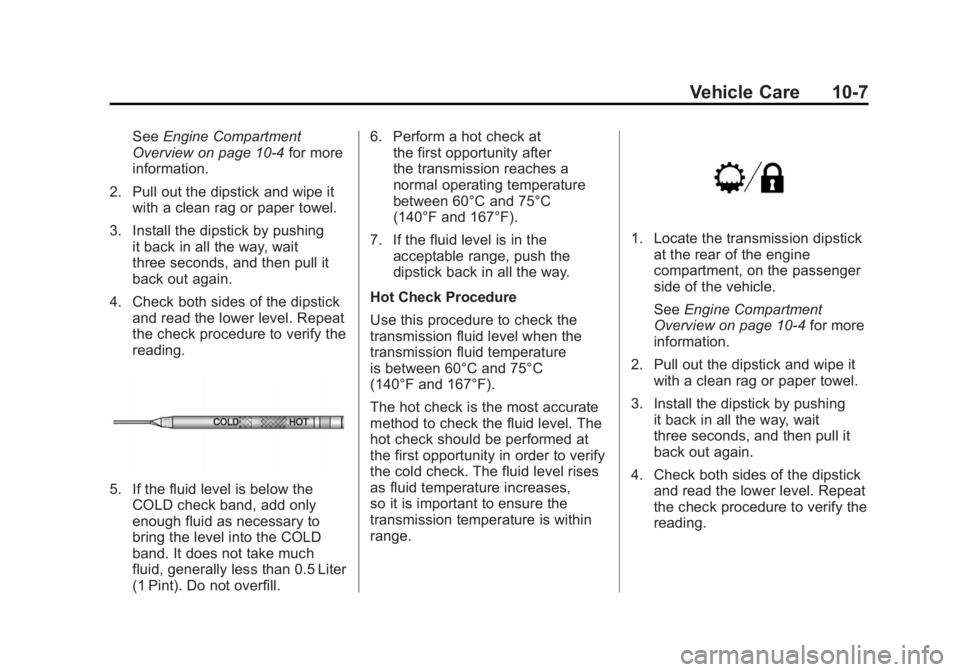
4. Check both sides of the dipstick
and read the lower level. Repeat
the check procedure to verify the
reading.
5. If the fluid level is below the
COLD check band, add only
enough fluid as necessary to
bring the level into the COLD
band. It does not take much
fluid, generally less than 0.5 Liter
(1 Pint). Do not overfill. 6. Perform a hot check at
the first opportunity after
the transmission reaches a
normal operating temperature
between 60°C and 75°C
(140°F and 167°F).
7. If the fluid level is in the
acceptable range, push the
dipstick back in all the way.
Hot Check Procedure
Use this procedure to check the
transmission fluid level when the
transmission fluid temperature
is between 60°C and 75°C
(140°F and 167°F).
The hot check is the most accurate
method to check the fluid level. The
hot check should be performed at
the first opportunity in order to verify
the cold check. The fluid level rises
as fluid temperature increases,
so it is important to ensure the
transmission temperature is within
range. 1. Locate the transmission dipstick
at the rear of the engine
compartment, on the passenger
side of the vehicle.
See Engine Compartment
Overview on page 10 ‑ 4 for more
information.
2. Pull out the dipstick and wipe it
with a clean rag or paper towel.
3. Install the dipstick by pushing
it back in all the way, wait
three seconds, and then pull it
back out again.
4. Check both sides of the dipstick
and read the lower level. Repeat
the check procedure to verify the
reading.