transmission CADILLAC ESCALADE HYBRID 2012 Owner's Manual
[x] Cancel search | Manufacturer: CADILLAC, Model Year: 2012, Model line: ESCALADE HYBRID, Model: CADILLAC ESCALADE HYBRID 2012Pages: 90, PDF Size: 1.62 MB
Page 50 of 90
Black plate (8,1)Cadillac Escalade Hybrid - 2012
10-8 Vehicle Care
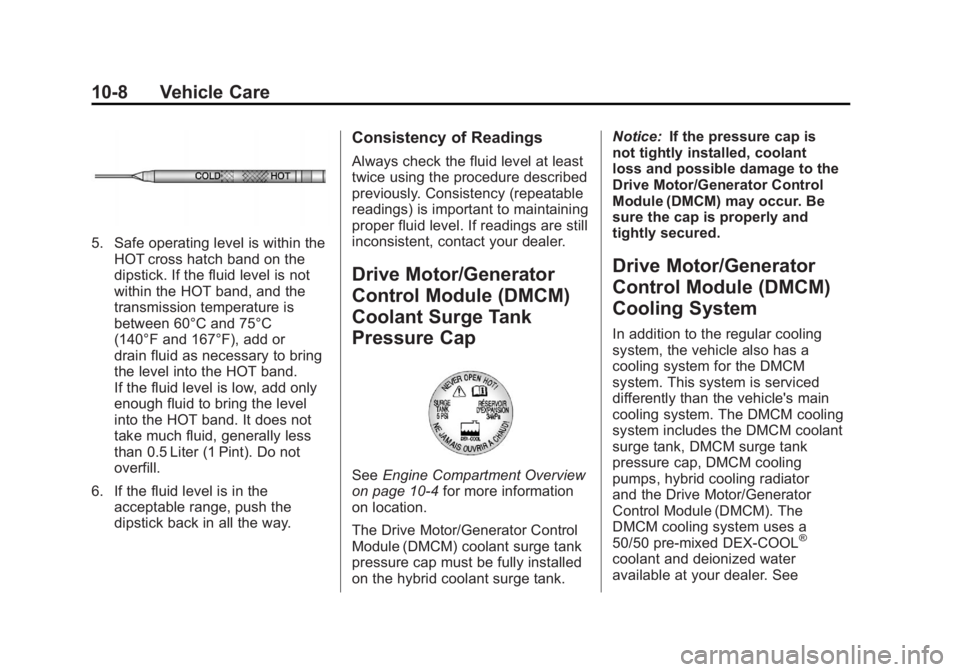
5. Safe operating level is within the
HOT cross hatch band on the
dipstick. If the fluid level is not
within the HOT band, and the
transmission temperature is
between 60°C and 75°C
(140°F and 167°F), add or
drain fluid as necessary to bring
the level into the HOT band.
If the fluid level is low, add only
enough fluid to bring the level
into the HOT band. It does not
take much fluid, generally less
than 0.5 Liter (1 Pint). Do not
overfill.
6. If the fluid level is in the
acceptable range, push the
dipstick back in all the way. Consistency of Readings Always check the fluid level at least
twice using the procedure described
previously. Consistency (repeatable
readings) is important to maintaining
proper fluid level. If readings are still
inconsistent, contact your dealer.
Drive Motor/Generator
Control Module (DMCM)
Coolant Surge Tank
Pressure Cap
See Engine Compartment Overview
on page 10 ‑ 4 for more information
on location.
The Drive Motor/Generator Control
Module (DMCM) coolant surge tank
pressure cap must be fully installed
on the hybrid coolant surge tank. Notice: If the pressure cap is
not tightly installed, coolant
loss and possible damage to the
Drive Motor/Generator Control
Module (DMCM) may occur. Be
sure the cap is properly and
tightly secured.
Drive Motor/Generator
Control Module (DMCM)
Cooling System In addition to the regular cooling
system, the vehicle also has a
cooling system for the DMCM
system. This system is serviced
differently than the vehicle's main
cooling system. The DMCM cooling
system includes the DMCM coolant
surge tank, DMCM surge tank
pressure cap, DMCM cooling
pumps, hybrid cooling radiator
and the Drive Motor/Generator
Control Module (DMCM). The
DMCM cooling system uses a
50/50 pre-mixed DEX-COOL ®
coolant and deionized water
available at your dealer. See
Page 57 of 90
Black plate (15,1)Cadillac Escalade Hybrid - 2012
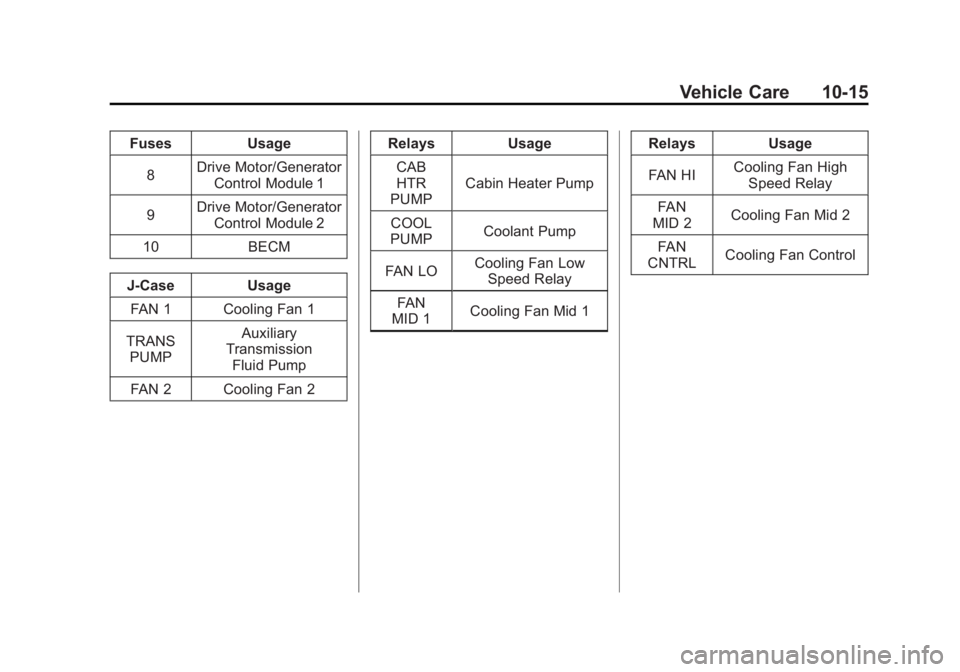
Vehicle Care 10-15Fuses Usage
8 Drive Motor/Generator
Control Module 1
9 Drive Motor/Generator
Control Module 2
10 BECM
J ‐ Case Usage
FAN 1 Cooling Fan 1
TRANS
PUMP Auxiliary
Transmission
Fluid Pump
FAN 2 Cooling Fan 2 Relays Usage
CAB
HTR
PUMP Cabin Heater Pump
COOL
PUMP Coolant Pump
FAN LO Cooling Fan Low
Speed Relay
FAN
MID 1 Cooling Fan Mid 1 Relays Usage
FAN HI Cooling Fan High
Speed Relay
FAN
MID 2 Cooling Fan Mid 2
FAN
CNTRL Cooling Fan Control
Page 72 of 90
Black plate (30,1)Cadillac Escalade Hybrid - 2012
10-30 Vehicle Care If the vehicle's 12 ‐ volt battery has
run down, you may want to use
another vehicle and some jumper
cables to start your vehicle. Use the
following steps to do it safely.
{ WARNINGBatteries can hurt you. They can
be dangerous because: .
They contain acid that can
burn you. .
They contain gas that can
explode or ignite. .
They contain enough
electricity to burn you.
If you do not follow these steps
exactly, some or all of these
things can hurt you.
Notice: Ignoring these steps
could result in costly damage to
the vehicle that would not be
covered by the warranty. Trying to start the vehicle by
pushing or pulling it will not
work, and it could damage the
vehicle.
1. Check the other vehicle. It must
have a 12 ‐ volt battery with a
negative ground system.
Notice: Only use a vehicle that
has a 12-volt system with a
negative ground for jump
starting. If the other vehicle does
not have a 12-volt system with a
negative ground, both vehicles
can be damaged.
2. Get the vehicles close enough
so the jumper cables can reach,
but be sure the vehicles are not
touching each other. It could
cause a ground connection you
do not want. You would not be
able to start your vehicle, and
the bad grounding could damage
the electrical systems.
To avoid the possibility of the
vehicles rolling, set the parking
brake firmly on both vehicles
involved in the jump start procedure. Put the automatic
transmission in P (Park) or
a manual transmission in
N (Neutral) before setting the
parking brake. If you have a
four-wheel-drive vehicle, be sure
the transfer case is in a drive
gear, not in N (Neutral).
Notice: If any accessories are left
on or plugged in during the jump
starting procedure, they could be
damaged. The repairs would
not be covered by the vehicle
warranty. Whenever possible,
turn off or unplug all accessories
on either vehicle when jump
starting the vehicle.
3. Turn off the ignition on both
vehicles. Unplug unnecessary
accessories plugged into the
cigarette lighter or the accessory
power outlets. Turn off the radio
and all the lamps that are not
needed.
This avoids sparks and helps
save both batteries. It could
save the radio!
Page 76 of 90
Black plate (34,1)Cadillac Escalade Hybrid - 2012
10-34 Vehicle Care Here are some important things to
consider before recreational vehicle
towing: .
What is the towing capacity
of the towing vehicle? Be
sure to read the tow
vehicle manufacturer's
recommendations. .
What is the distance that will be
travelled? Some vehicles have
restrictions on how far and how
long they can tow. .
Is the proper towing equipment
going to be used? See your
dealer or trailering professional
for additional advice and
equipment recommendations. .
Is the vehicle ready to be
towed? Just as preparing the
vehicle for a long trip, make sure
the vehicle is prepared to be
towed. Dinghy Towing
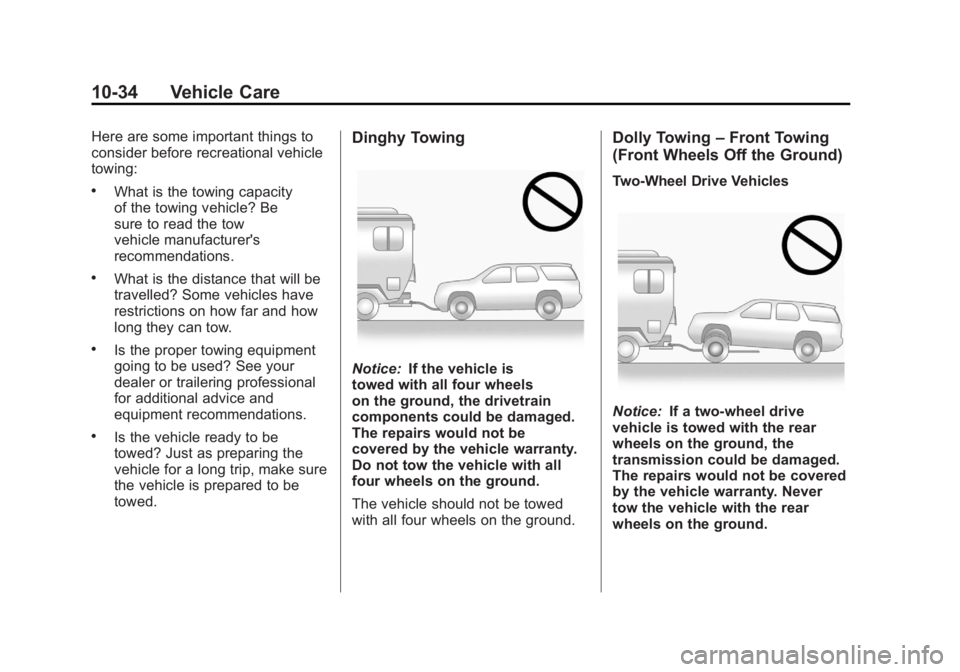
Notice: If the vehicle is
towed with all four wheels
on the ground, the drivetrain
components could be damaged.
The repairs would not be
covered by the vehicle warranty.
Do not tow the vehicle with all
four wheels on the ground.
The vehicle should not be towed
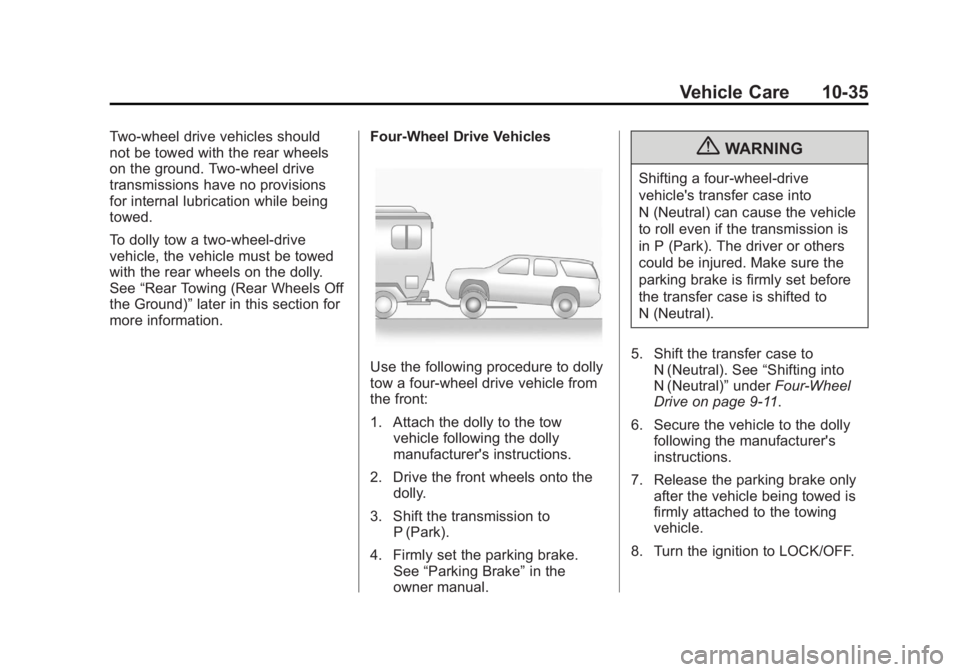
with all four wheels on the ground. Dolly Towing – Front Towing
(Front Wheels Off the Ground) Two-Wheel Drive Vehicles
Notice: If a two-wheel drive
vehicle is towed with the rear
wheels on the ground, the
transmission could be damaged.
The repairs would not be covered
by the vehicle warranty. Never
tow the vehicle with the rear
wheels on the ground.
Page 77 of 90
Black plate (35,1)Cadillac Escalade Hybrid - 2012
Vehicle Care 10-35Two-wheel drive vehicles should
not be towed with the rear wheels
on the ground. Two-wheel drive
transmissions have no provisions
for internal lubrication while being
towed.
To dolly tow a two ‐ wheel ‐ drive
vehicle, the vehicle must be towed
with the rear wheels on the dolly.
See “ Rear Towing (Rear Wheels Off
the Ground) ” later in this section for
more information. Four-Wheel Drive Vehicles
Use the following procedure to dolly
tow a four-wheel drive vehicle from
the front:
1. Attach the dolly to the tow
vehicle following the dolly
manufacturer's instructions.
2. Drive the front wheels onto the
dolly.
3. Shift the transmission to
P (Park).
4. Firmly set the parking brake.
See “ Parking Brake ” in the
owner manual.{ WARNINGShifting a four-wheel-drive
vehicle's transfer case into
N (Neutral) can cause the vehicle
to roll even if the transmission is
in P (Park). The driver or others
could be injured. Make sure the
parking brake is firmly set before
the transfer case is shifted to
N (Neutral).
5. Shift the transfer case to
N (Neutral). See “ Shifting into
N (Neutral) ” under Four-Wheel
Drive on page 9 ‑ 11 .
6. Secure the vehicle to the dolly
following the manufacturer's
instructions.
7. Release the parking brake only
after the vehicle being towed is
firmly attached to the towing
vehicle.
8. Turn the ignition to LOCK/OFF.
Page 78 of 90
Black plate (36,1)Cadillac Escalade Hybrid - 2012
10-36 Vehicle Care After towing, see “ Shifting Out of
N (Neutral) ” under Four-Wheel Drive
on page 9 ‑ 11 .
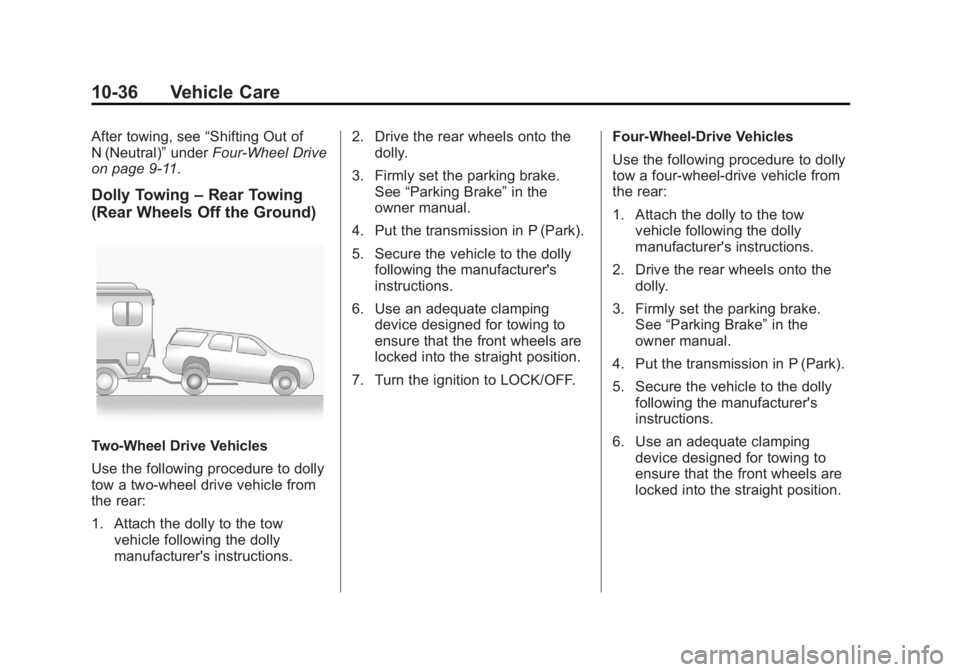
Dolly Towing – Rear Towing
(Rear Wheels Off the Ground)
Two ‐ Wheel Drive Vehicles
Use the following procedure to dolly
tow a two-wheel drive vehicle from
the rear:
1. Attach the dolly to the tow
vehicle following the dolly
manufacturer's instructions. 2. Drive the rear wheels onto the
dolly.
3. Firmly set the parking brake.
See “ Parking Brake ” in the
owner manual.
4. Put the transmission in P (Park).
5. Secure the vehicle to the dolly
following the manufacturer's
instructions.
6. Use an adequate clamping
device designed for towing to
ensure that the front wheels are
locked into the straight position.
7. Turn the ignition to LOCK/OFF. Four ‐ Wheel ‐ Drive Vehicles
Use the following procedure to dolly
tow a four-wheel-drive vehicle from
the rear:
1. Attach the dolly to the tow
vehicle following the dolly
manufacturer's instructions.
2. Drive the rear wheels onto the
dolly.
3. Firmly set the parking brake.
See “ Parking Brake ” in the
owner manual.
4. Put the transmission in P (Park).
5. Secure the vehicle to the dolly
following the manufacturer's
instructions.
6. Use an adequate clamping
device designed for towing to
ensure that the front wheels are
locked into the straight position.
Page 79 of 90
Black plate (37,1)Cadillac Escalade Hybrid - 2012
Vehicle Care 10-37
{ WARNINGShifting a four-wheel-drive
vehicle's transfer case into
N (Neutral) can cause the vehicle
to roll even if the transmission is
in P (Park). The driver or others
could be injured. Make sure the
parking brake is firmly set before
the transfer case is shifted to
N (Neutral). 7. Shift the transfer case to
N (Neutral). See “ Shifting into
N (Neutral) ” under Four-Wheel
Drive on page 9 ‑ 11 .
8. Turn the ignition to LOCK/OFF.
After towing, see “ Shifting Out of
N (Neutral) ” under Four-Wheel Drive
on page 9 ‑ 11 .
Appearance Care Exterior Care When scraping the windshield glass
to remove ice and snow, stay clear
of the hybrid decal.
To have the hybrid decals removed
from the vehicle, please see your
dealer.
Page 84 of 90
Black plate (2,1)Cadillac Escalade Hybrid - 2012
12-2 Technical Data
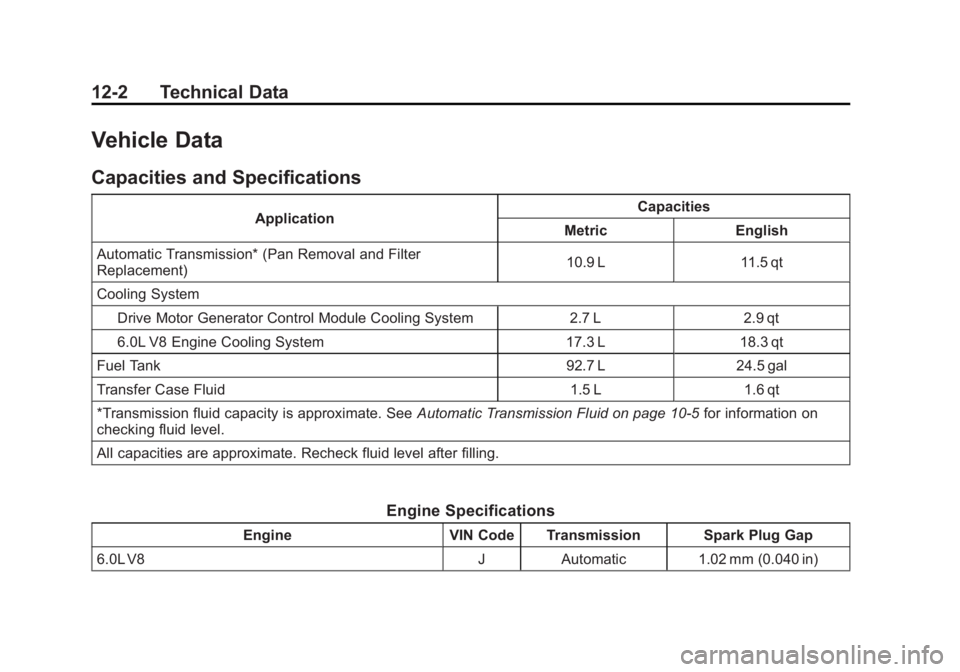
Vehicle Data Capacities and Specifications Application Capacities
Metric English
Automatic Transmission* (Pan Removal and Filter
Replacement) 10.9 L 11.5 qt
Cooling System
Drive Motor Generator Control Module Cooling System 2.7 L 2.9 qt
6.0L V8 Engine Cooling System 17.3 L 18.3 qt
Fuel Tank 92.7 L 24.5 gal
Transfer Case Fluid 1.5 L 1.6 qt
*Transmission fluid capacity is approximate. See Automatic Transmission Fluid on page 10 ‑ 5 for information on
checking fluid level.
All capacities are approximate. Recheck fluid level after filling.
Engine Specifications
Engine VIN Code Transmission Spark Plug Gap
6.0L V8 J Automatic 1.02 mm (0.040 in)
Page 87 of 90
Black plate (1,1)Cadillac Escalade Hybrid - 2012
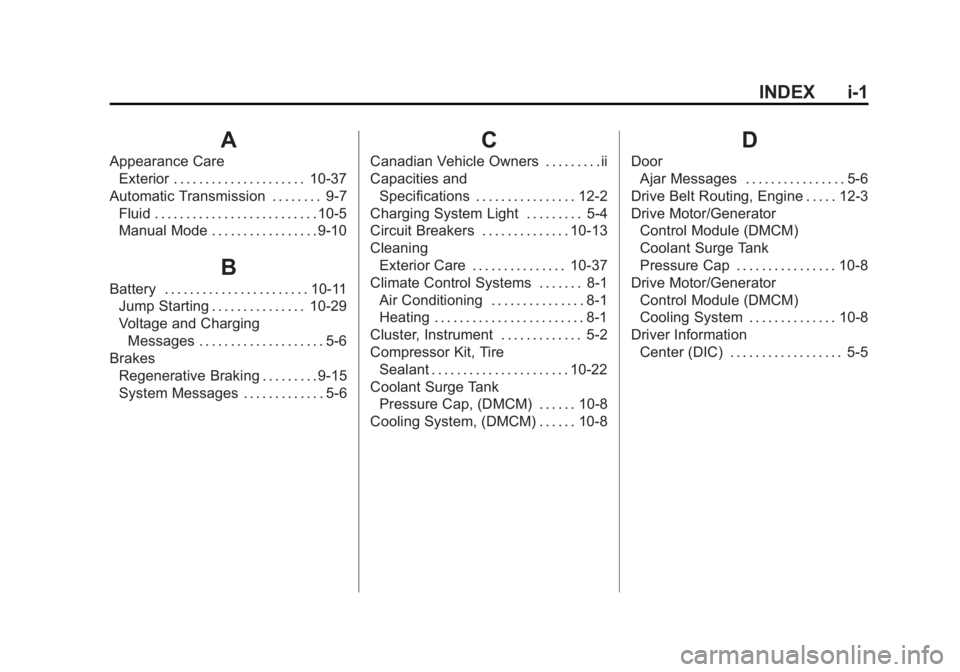
INDEX i-1
AAppearance Care
Exterior . . . . . . . . . . . . . . . . . . . . . 10-37
Automatic Transmission . . . . . . . . 9-7
Fluid . . . . . . . . . . . . . . . . . . . . . . . . . . 10-5
Manual Mode . . . . . . . . . . . . . . . . . 9-10
BBattery . . . . . . . . . . . . . . . . . . . . . . . 10-11
Jump Starting . . . . . . . . . . . . . . . 10-29
Voltage and Charging
Messages . . . . . . . . . . . . . . . . . . . . 5-6
Brakes
Regenerative Braking . . . . . . . . . 9-15
System Messages . . . . . . . . . . . . . 5-6 C Canadian Vehicle Owners . . . . . . . . . ii
Capacities and
Specifications . . . . . . . . . . . . . . . . 12-2
Charging System Light . . . . . . . . . 5-4
Circuit Breakers . . . . . . . . . . . . . . 10-13
Cleaning
Exterior Care . . . . . . . . . . . . . . . 10-37
Climate Control Systems . . . . . . . 8-1
Air Conditioning . . . . . . . . . . . . . . . 8-1
Heating . . . . . . . . . . . . . . . . . . . . . . . . 8-1
Cluster, Instrument . . . . . . . . . . . . . 5-2
Compressor Kit, Tire
Sealant . . . . . . . . . . . . . . . . . . . . . . 10-22
Coolant Surge Tank
Pressure Cap, (DMCM) . . . . . . 10-8
Cooling System, (DMCM) . . . . . . 10-8 D Door
Ajar Messages . . . . . . . . . . . . . . . . 5-6
Drive Belt Routing, Engine . . . . . 12-3
Drive Motor/Generator
Control Module (DMCM)
Coolant Surge Tank
Pressure Cap . . . . . . . . . . . . . . . . 10-8
Drive Motor/Generator
Control Module (DMCM)
Cooling System . . . . . . . . . . . . . . 10-8
Driver Information
Center (DIC) . . . . . . . . . . . . . . . . . . 5-5
Page 88 of 90
Black plate (2,1)Cadillac Escalade Hybrid - 2012
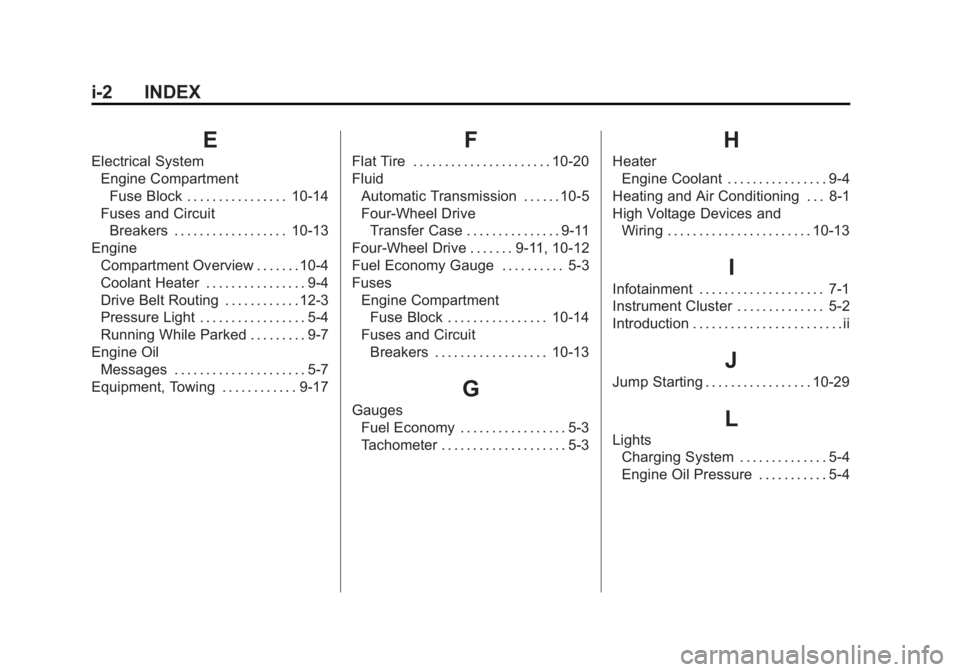
i-2 INDEX
EElectrical System
Engine Compartment
Fuse Block . . . . . . . . . . . . . . . . 10-14
Fuses and Circuit
Breakers . . . . . . . . . . . . . . . . . . 10-13
Engine
Compartment Overview . . . . . . . 10-4
Coolant Heater . . . . . . . . . . . . . . . . 9-4
Drive Belt Routing . . . . . . . . . . . . 12-3
Pressure Light . . . . . . . . . . . . . . . . . 5-4
Running While Parked . . . . . . . . . 9-7
Engine Oil
Messages . . . . . . . . . . . . . . . . . . . . . 5-7
Equipment, Towing . . . . . . . . . . . . 9-17 F Flat Tire . . . . . . . . . . . . . . . . . . . . . . 10-20
Fluid
Automatic Transmission . . . . . . 10-5
Four-Wheel Drive
Transfer Case . . . . . . . . . . . . . . . 9-11
Four-Wheel Drive . . . . . . . 9-11, 10-12
Fuel Economy Gauge . . . . . . . . . . 5-3
Fuses
Engine Compartment
Fuse Block . . . . . . . . . . . . . . . . 10-14
Fuses and Circuit
Breakers . . . . . . . . . . . . . . . . . . 10-13
G Gauges
Fuel Economy . . . . . . . . . . . . . . . . . 5-3
Tachometer . . . . . . . . . . . . . . . . . . . . 5-3 H Heater
Engine Coolant . . . . . . . . . . . . . . . . 9-4
Heating and Air Conditioning . . . 8-1
High Voltage Devices and
Wiring . . . . . . . . . . . . . . . . . . . . . . . 10-13
I Infotainment . . . . . . . . . . . . . . . . . . . . 7-1
Instrument Cluster . . . . . . . . . . . . . . 5-2
Introduction . . . . . . . . . . . . . . . . . . . . . . . . ii
J Jump Starting . . . . . . . . . . . . . . . . . 10-29
L Lights
Charging System . . . . . . . . . . . . . . 5-4
Engine Oil Pressure . . . . . . . . . . . 5-4