service CADILLAC ESCALADE HYBRID 2012 Owner's Manual
[x] Cancel search | Manufacturer: CADILLAC, Model Year: 2012, Model line: ESCALADE HYBRID, Model: CADILLAC ESCALADE HYBRID 2012Pages: 90, PDF Size: 1.62 MB
Page 61 of 90

Black plate (19,1)Cadillac Escalade Hybrid - 2012
Vehicle Care 10-19TPMS Sensor Matching
Process Each TPMS sensor has a unique
identification code. The identification
code needs to be matched to a new
tire/wheel position after rotating the
vehicle ’ s tires or replacing one or
more of the TPMS sensors. Also,
the TPMS sensor matching process
should be performed after replacing
a spare tire with a road tire
containing the TPMS sensor. The
malfunction light and the DIC
message should go off at the next
ignition cycle. The sensors are
matched to the tire/wheel positions,
using a TPMS relearn tool, in the
following order: driver side front tire,
passenger side front tire, passenger
side rear tire, and driver side rear.
See your dealer for service or to
purchase a relearn tool.
There are two minutes to match
the first tire/wheel position, and
five minutes overall to match all
four tire/wheel positions. If it takes
longer, the matching process stops
and must be restarted. The TPMS sensor matching
process is:
1. Set the parking brake.
2. Turn the ignition to ON/RUN with
the engine off.
3. Press
Q and
K on the
Remote Keyless Entry (RKE)
transmitter at the same time for
approximately five seconds. The
horn sounds twice to signal the
receiver is in relearn mode and
TIRE LEARNING ACTIVE
message displays on the DIC
screen.
4. Start with the driver side
front tire.
5. Place the relearn tool against
the tire sidewall, near the valve
stem. Then press the button to
activate the TPMS sensor.
A horn chirp confirms that the
sensor identification code has
been matched to this tire and
wheel position. 6. Proceed to the passenger
side front tire, and repeat the
procedure in Step 5.
7. Proceed to the passenger side
rear tire, and repeat the
procedure in Step 5.
8. Proceed to the driver side rear
tire, and repeat the procedure
in Step 5. The horn sounds
two times to indicate the sensor
identification code has been
matched to the driver side rear
tire, and the TPMS sensor
matching process is no longer
active. The TIRE LEARNING
ACTIVE message on the DIC
display screen goes off.
9. Turn the ignition to LOCK/OFF.
10. Set all four tires to the
recommended air pressure
level as indicated on the Tire
and Loading Information label.
Page 63 of 90
Black plate (21,1)Cadillac Escalade Hybrid - 2012
Vehicle Care 10-21It is unusual for a tire to blowout
while driving, especially if the tires
are maintained properly. If air goes
out of a tire, it is much more likely to
leak out slowly. But if there ever is a
blowout, here are a few tips about
what to expect and what to do:
If a front tire fails, the flat tire
creates a drag that pulls the vehicle
toward that side. Take your foot off
the accelerator pedal and grip the
steering wheel firmly. Steer to
maintain lane position, and then
gently brake to a stop, well off the
road, if possible.
A rear blowout, particularly on a
curve, acts much like a skid and
may require the same correction as
used in a skid. Stop pressing the
accelerator pedal and steer to
straighten the vehicle. It may be
very bumpy and noisy. Gently
brake to a stop, well off the road,
if possible. { WARNINGDriving on a flat tire will cause
permanent damage to the tire.
Re-inflating a tire after it has
been driven on while severely
underinflated or flat may cause
a blowout and a serious crash.
Never attempt to re-inflate a tire
that has been driven on while
severely underinflated or flat.
Have your dealer or an authorized
tire service center repair or
replace the flat tire as soon as
possible.
If a tire goes flat, avoid further tire
and wheel damage by driving slowly
to a level place and stopping, well
off the road, if possible. Then
do this:
1. Turn on the hazard warning
flashers.
2. Park the vehicle. Set the parking
brake firmly and put the shift
lever in P (Park). 3. Turn off the engine.
4. Inspect the flat tire.
If the tire has been separated from
the wheel or has damaged sidewalls
or large tears that allow rapid air
loss, call a tire repair facility. See
“ Roadside Assistance Program ” or
“ Roadside Service ” in the owner
manual.
If the flat tire is due to a slow leak
caused by a nail or other similar
road hazard, the tire inflator kit may
be used to repair the damaged tire
temporarily. The kit uses a liquid tire
sealant to seal small punctures in
the tread area of the tire.
After repairing a tire with the tire
inflator kit, take the vehicle to an
authorized dealer to have the tire
inspected and repaired as soon
as possible. The tire sealant is a
temporary repair only. See Tire
Sealant and Compressor Kit on
page 10 ‑ 22 .
Page 64 of 90
Black plate (22,1)Cadillac Escalade Hybrid - 2012
10-22 Vehicle Care
Tire Sealant and
Compressor Kit
{ WARNINGIdling a vehicle in an enclosed
area with poor ventilation is
dangerous. Engine exhaust may
enter the vehicle. Engine exhaust
contains Carbon Monoxide (CO)
which cannot be seen or smelled.
It can cause unconsciousness
and even death. Never run the
engine in an enclosed area that
has no fresh air ventilation. For
more information, see ” Engine
Exhaust ” in the owner manual. { WARNINGOverinflating a tire could cause
the tire to rupture and you or
others could be injured. Be
sure to read and follow the tire
sealant and compressor kit
instructions and inflate the tire to
its recommended pressure. Do
not exceed the recommended
pressure.
{ WARNINGStoring the tire sealant and
compressor kit or other
equipment in the passenger
compartment of the vehicle could
cause injury. In a sudden stop or
collision, loose equipment could
strike someone. Store the tire
sealant and compressor kit in its
original location. If this vehicle has a tire sealant and
compressor kit, there may not be a
spare tire, tire changing equipment,
and on some vehicles there may not
be a place to store a tire.
The tire sealant and compressor
can be used to temporarily seal
punctures up to 6 mm (¼ inch) in
the tread area of the tire. It can
also be used to inflate an under
inflated tire.
If the tire has been separated from
the wheel, has damaged sidewalls,
or has a large puncture, the tire is
too severely damaged for the tire
sealant and compressor kit to be
effective. See “ Roadside Assistance
Program ” or “ Roadside Service ” in
the owner manual.
Page 67 of 90
Black plate (25,1)Cadillac Escalade Hybrid - 2012
Vehicle Care 10-25the accessory power outlet and
unscrew the inflating hose from
the tire valve. See “ Roadside
Assistance Program ” or
“ Roadside Service ” in the owner
manual.
10. Press the on/off button (D) to
turn the tire sealant and
compressor kit off.
The tire is not sealed and
will continue to leak air until
the vehicle is driven and
the sealant is distributed in
the tire, therefore, Steps 11
through 17 must be done
immediately after Step 10.
Be careful while handling the
tire sealant and compressor kit
as it could be warm after
usage.
11. Unplug the power plug (C) from
the accessory power outlet in
the vehicle.
12. Turn the sealant/air hose (G)
counterclockwise to remove it
from the tire valve stem. 13. Replace the tire valve
stem cap.
14. Replace the sealant/air
hose (G), and the power
plug (C) back in their original
location.
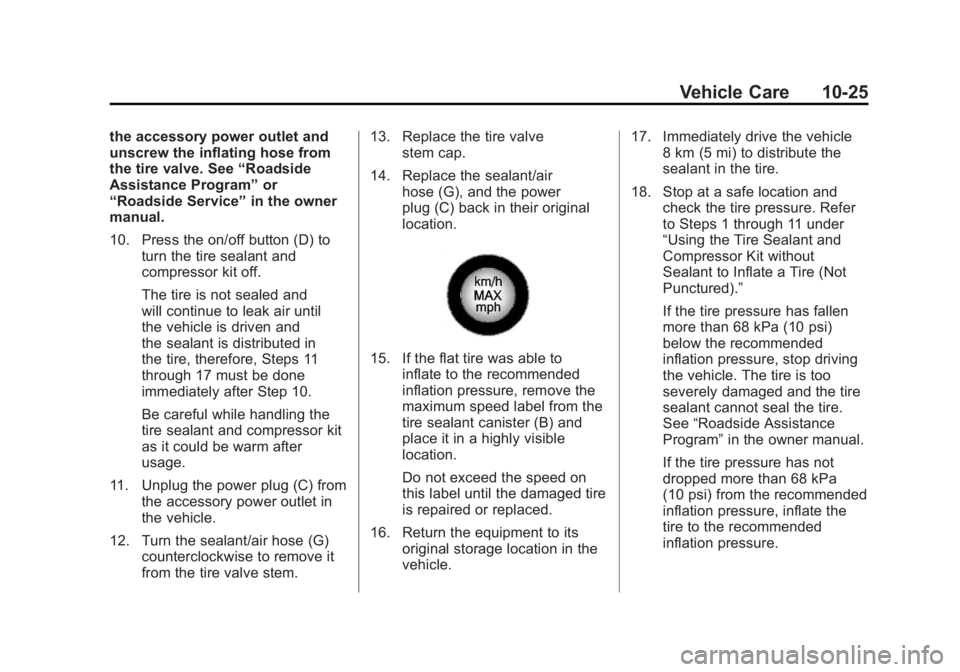
15. If the flat tire was able to
inflate to the recommended
inflation pressure, remove the
maximum speed label from the
tire sealant canister (B) and
place it in a highly visible
location.
Do not exceed the speed on
this label until the damaged tire
is repaired or replaced.
16. Return the equipment to its
original storage location in the
vehicle. 17. Immediately drive the vehicle
8 km (5 mi) to distribute the
sealant in the tire.
18. Stop at a safe location and
check the tire pressure. Refer
to Steps 1 through 11 under
“ Using the Tire Sealant and
Compressor Kit without
Sealant to Inflate a Tire (Not
Punctured). ”
If the tire pressure has fallen
more than 68 kPa (10 psi)
below the recommended
inflation pressure, stop driving
the vehicle. The tire is too
severely damaged and the tire
sealant cannot seal the tire.
See “ Roadside Assistance
Program ” in the owner manual.
If the tire pressure has not
dropped more than 68 kPa
(10 psi) from the recommended
inflation pressure, inflate the
tire to the recommended
inflation pressure.
Page 74 of 90
Black plate (32,1)Cadillac Escalade Hybrid - 2012
10-32 Vehicle Care
{ WARNINGFans or other moving engine
parts can injure you badly. Keep
your hands away from moving
parts once the engine is running.
6. Check that the jumper cables
do not have loose or missing
insulation. If they do, you could
get a shock. The vehicles could
be damaged too.
Before you connect the cables,
here are some basic things you
should know. Positive (+) goes
to positive (+) or to a remote
positive (+) terminal if the vehicle
has one. Negative ( − ) will go to a
heavy, unpainted metal engine
part or a solid engine ground.
Do not connect positive (+) to
negative ( − ) or you will get a
short that would damage the
battery and maybe other parts
too. Do not connect the
negative ( − ) cable to the negative ( − ) terminal on the dead
battery because this can cause
sparks.
7. Connect the red positive (+)
cable to the positive (+) terminal
of the vehicle with the dead
battery. Use a remote
positive (+) if the vehicle
has one.
8. Do not let the other end touch
metal. Connect it to the
positive (+) terminal of the
good battery. Use a remote
positive (+) if the vehicle
has one.
9. Now connect the black
negative ( − ) cable to the
negative ( − ) terminal of the
good battery. Use a remote
negative ( − ) if the vehicle
has one.
Do not let the other end touch
anything until the next step. The
other end of the negative ( − )
cable does not go to the dead
battery. It goes to a heavy,
unpainted metal engine part or to the remote negative ( − )
terminal on the vehicle with the
dead battery.
10. Connect the other end of the
negative ( − ) cable to the
remote negative ( − ) terminal,
on the vehicle with the dead
battery.
11. Now start the vehicle with the
good battery and run the
engine for a while.
12. Try to start the vehicle that
had the dead battery. If it will
not start after a few tries, it
probably needs service.
Notice: If the jumper cables are
connected or removed in the
wrong order, electrical shorting
may occur and damage the
vehicle. The repairs would not be
covered by the vehicle warranty.
Always connect and remove the
jumper cables in the correct
order, making sure that the
cables do not touch each other or
other metal.
Page 81 of 90
Black plate (1,1)Cadillac Escalade Hybrid - 2012
Service and Maintenance 11-1
Service and
Maintenance Recommended Fluids,
Lubricants, and Parts Recommended Fluids and
Lubricants . . . . . . . . . . . . . . . . . . 11-2
Page 82 of 90
Black plate (2,1)Cadillac Escalade Hybrid - 2012
11-2 Service and Maintenance
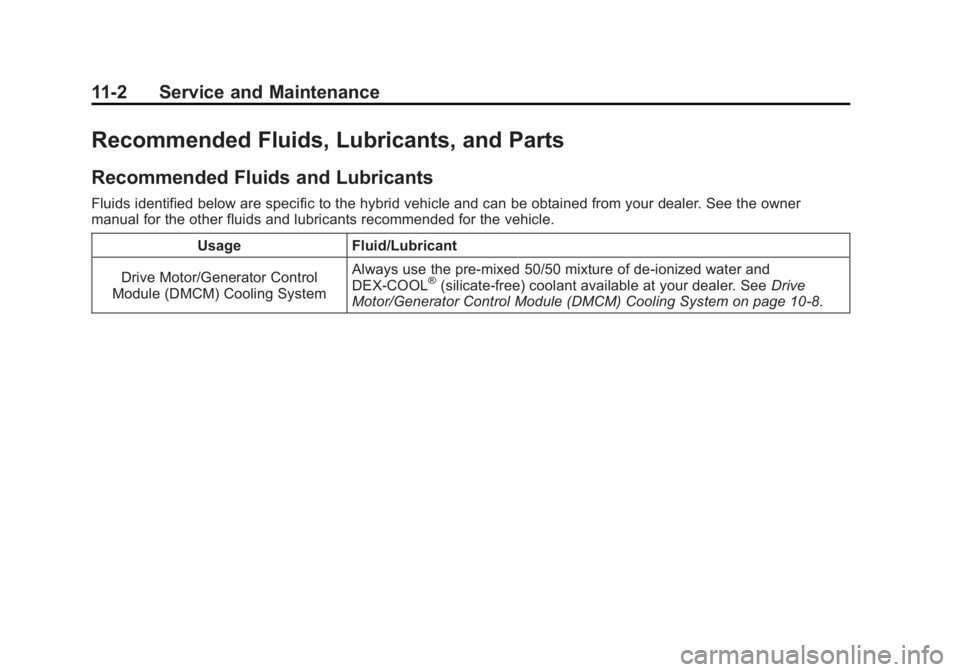
Recommended Fluids, Lubricants, and Parts Recommended Fluids and Lubricants Fluids identified below are specific to the hybrid vehicle and can be obtained from your dealer. See the owner
manual for the other fluids and lubricants recommended for the vehicle.
Usage Fluid/Lubricant
Drive Motor/Generator Control
Module (DMCM) Cooling System Always use the pre-mixed 50/50 mixture of de ‐ ionized water and
DEX-COOL ®
(silicate-free) coolant available at your dealer. See Drive
Motor/Generator Control Module (DMCM) Cooling System on page 10 ‑ 8 .
Page 89 of 90
Black plate (3,1)Cadillac Escalade Hybrid - 2012
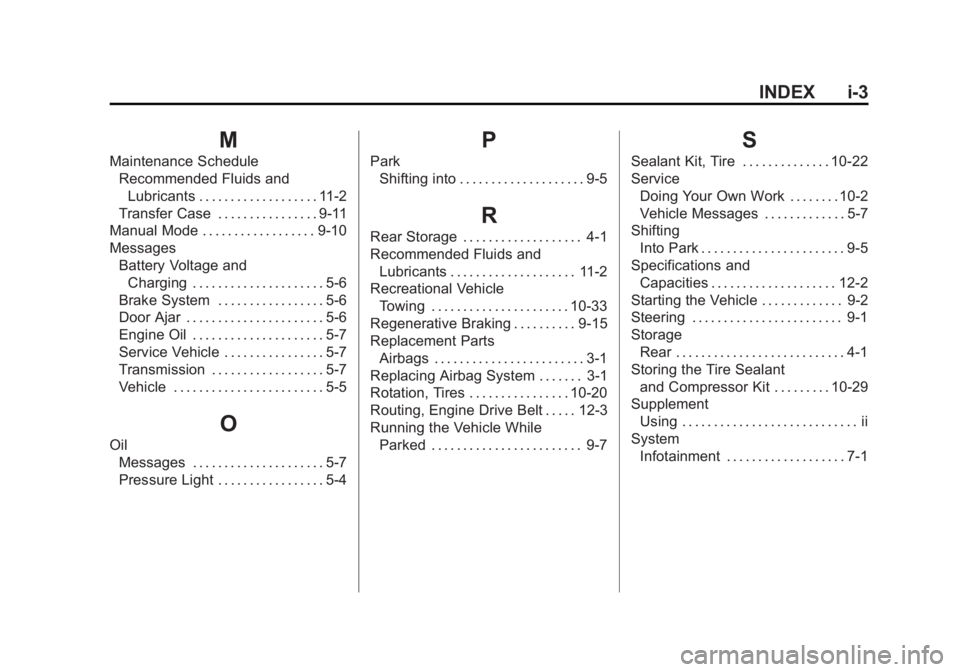
INDEX i-3
MMaintenance Schedule
Recommended Fluids and
Lubricants . . . . . . . . . . . . . . . . . . . 11-2
Transfer Case . . . . . . . . . . . . . . . . 9-11
Manual Mode . . . . . . . . . . . . . . . . . . 9-10
Messages
Battery Voltage and
Charging . . . . . . . . . . . . . . . . . . . . . 5-6
Brake System . . . . . . . . . . . . . . . . . 5-6
Door Ajar . . . . . . . . . . . . . . . . . . . . . . 5-6
Engine Oil . . . . . . . . . . . . . . . . . . . . . 5-7
Service Vehicle . . . . . . . . . . . . . . . . 5-7
Transmission . . . . . . . . . . . . . . . . . . 5-7
Vehicle . . . . . . . . . . . . . . . . . . . . . . . . 5-5
OOil
Messages . . . . . . . . . . . . . . . . . . . . . 5-7
Pressure Light . . . . . . . . . . . . . . . . . 5-4 P Park
Shifting into . . . . . . . . . . . . . . . . . . . . 9-5
R Rear Storage . . . . . . . . . . . . . . . . . . . 4-1
Recommended Fluids and
Lubricants . . . . . . . . . . . . . . . . . . . . 11-2
Recreational Vehicle
Towing . . . . . . . . . . . . . . . . . . . . . . 10-33
Regenerative Braking . . . . . . . . . . 9-15
Replacement Parts
Airbags . . . . . . . . . . . . . . . . . . . . . . . . 3-1
Replacing Airbag System . . . . . . . 3-1
Rotation, Tires . . . . . . . . . . . . . . . . 10-20
Routing, Engine Drive Belt . . . . . 12-3
Running the Vehicle While
Parked . . . . . . . . . . . . . . . . . . . . . . . . 9-7 S Sealant Kit, Tire . . . . . . . . . . . . . . 10-22
Service
Doing Your Own Work . . . . . . . . 10-2
Vehicle Messages . . . . . . . . . . . . . 5-7
Shifting
Into Park . . . . . . . . . . . . . . . . . . . . . . . 9-5
Specifications and
Capacities . . . . . . . . . . . . . . . . . . . . 12-2
Starting the Vehicle . . . . . . . . . . . . . 9-2
Steering . . . . . . . . . . . . . . . . . . . . . . . . 9-1
Storage
Rear . . . . . . . . . . . . . . . . . . . . . . . . . . . 4-1
Storing the Tire Sealant
and Compressor Kit . . . . . . . . . 10-29
Supplement
Using . . . . . . . . . . . . . . . . . . . . . . . . . . . . ii
System
Infotainment . . . . . . . . . . . . . . . . . . . 7-1