light CADILLAC FLEETWOOD 1993 2.G Manual Online
[x] Cancel search | Manufacturer: CADILLAC, Model Year: 1993, Model line: FLEETWOOD, Model: CADILLAC FLEETWOOD 1993 2.GPages: 386, PDF Size: 19.17 MB
Page 227 of 386
Downloaded from www.Manualslib.com manuals search engine - Following Distance
Stay at least twice as far behind the vehicle ahead as you would when
driving your vehicle without a trailer. This can help you avoid situations
- that require heavy braking and sudden turns.
Passing
I_
You’ll need more passing distance up ahead when you’re towing a trailer.
And, because you’re a good deal longer, you’ll need to go much farther
beyond the passed vehicle before you can return to your lane.
-
Backing Up
_- Hold the bottom of the steering wheel with one hand. Then, to move the
trailer to the left, just move that hand to the left.
To move the trailer to
the right, move your hand
to the right. Always back up slowly and, if
- possible, have someone guide you.
Making Turns
When you’re turning with a trailer, make wider turns than normal. Do
this so your trailer won’t strike soft shoulders, curbs, road signs, trees, or
other objects. Avoid jerky or sudden maneuvers. Signal well in advance.
1urn Signals When Towing a Trailer
When you tow a trailer, your vehicle has to have a different turn signal
flasher and extra wiring. The green arrows on your instrument panel will
flash whenever you signal a turn or lane change. Properly hooked up, the
trailer lights will also flash, telling other drivers you’re about to turn, -
- change lanes or stop.
213
When towing a trailer, the green arrows on your instrument panel will
flash for turns even
if the bulbs on the trailer are burned out. Thus, you
may think drivers behind you are seeing your signal when they are not.
It’s important to check occasionally to be sure the trailer bulbs are still
working. p__-_.
Page 231 of 386
Downloaded from www.Manualslib.com manuals search engine -- I
I
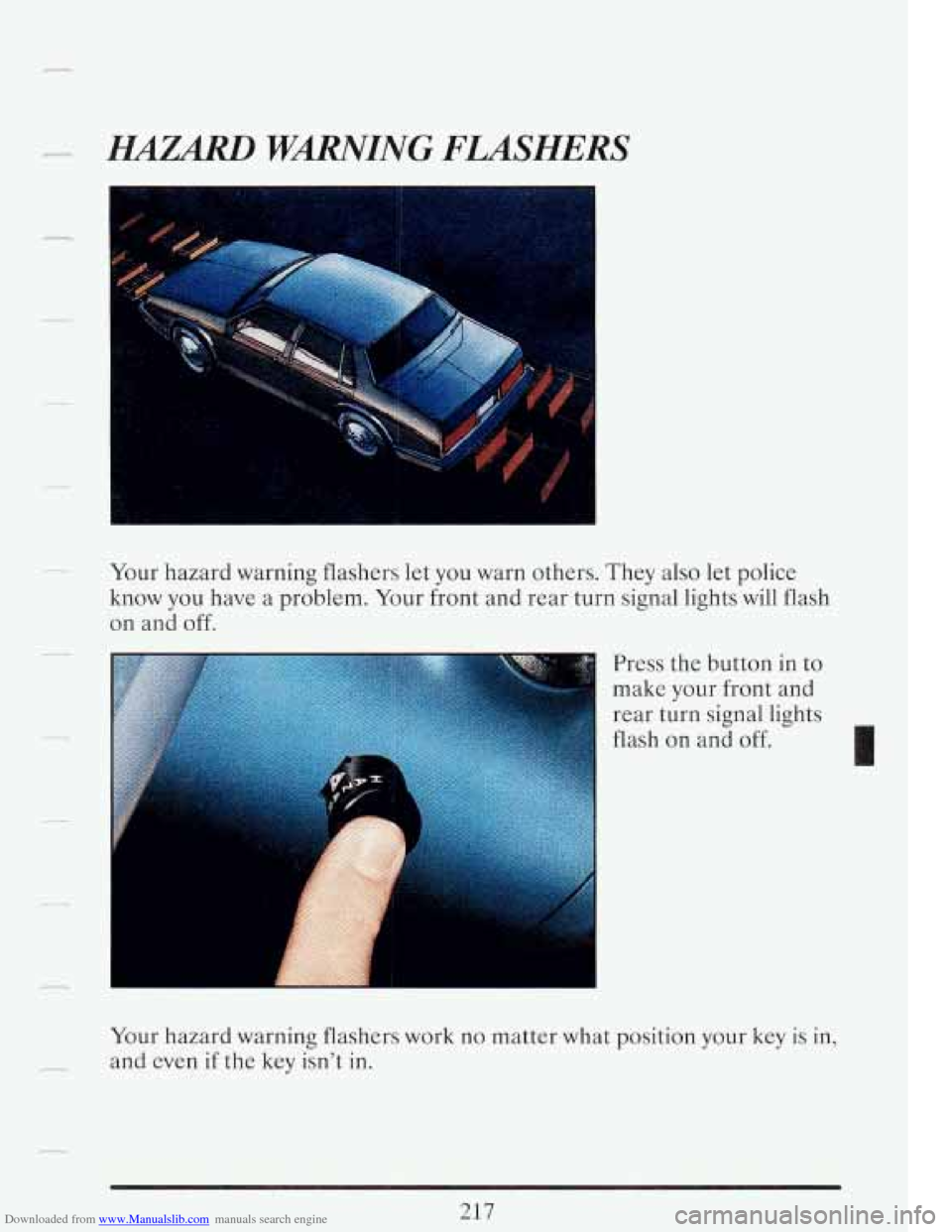
- Your hazard warning flashers let you warn others. They also let police
know you have a problem. Your front and rear turn signal lights will flash
on and
off.
Press the button in to
make your front and
rear turn signal lights
flash on and
off.
Your hazard warning flashers work no matter what position your key is in,
and even if the key isn’t in.
iI
Page 233 of 386
Downloaded from www.Manualslib.com manuals search engine - TO JUMP START YOUR CDILLAC:
1. Check the other vehicle. It must have a 12-volt battery with a negative
ground system.
- 2. Get the vehicles close enough so the jumper cables can reach, but be
sure the vehicles aren’t touching each other.
If they are, it could cause
a ground connection you don’t want. You wouldn’t be able to start
your Cadillac, and the bad grounding could damage the electrical
systems.
r
A CAUTION:
I You could be injured if the vehicles roll. Set the parking brake
firmly on each vehicle. Put an automatic transmission in
“P”
(Park) or a manual transmission in “N” ‘Ye1 ’ ,alj.
I -
3. Turn off the ignition on both vehicles. Turn off all lights that aren’t
needed, and radios. This will avoid sparks and help save both
batteries. And it could save your radio!
219
Page 234 of 386
Downloaded from www.Manualslib.com manuals search engine I I
4. Open the hoods and locate the batteries.
and can injure you. Keep hands, clothing and tools away from
any underhood electric fan.
I
I A CAUTION:
Using a match near a battery can cause battery gas to explode.
People have been hurt doing this, and some have been blinded.
Use
a flashlight if you need more light.
Be sure the battery has enough water. You don’t need to add
water to the Delco Freedom@ battery installed in every new
GM
vehicle. But if a battery has filler caps, be sure the right amount
of fluid is there.
If it is low, add water to take care of that first. If
you don’t, explosive gas could be present.
Battery fluid contains acid that can burn you. Don’t get it on
you.
If you accidentally get it in your eyes or on your skin, flush
the place with water and get medical help immediately.
I
5. Check that the jumper cables don’t have loose or missing insulation. If
they do, you could get a shock. The vehicles could be damaged, too.
Before you connect the cables, here are
some basic things you should
know. Positive
(+) will go to positive (+) and negative (-) will go to
negative
(-) or a metal engine part. Don’t connect (+) to (-) or you’ll
get a short that would damage the battery and maybe other parts, too.
n
W #E
cup
220
Page 262 of 386
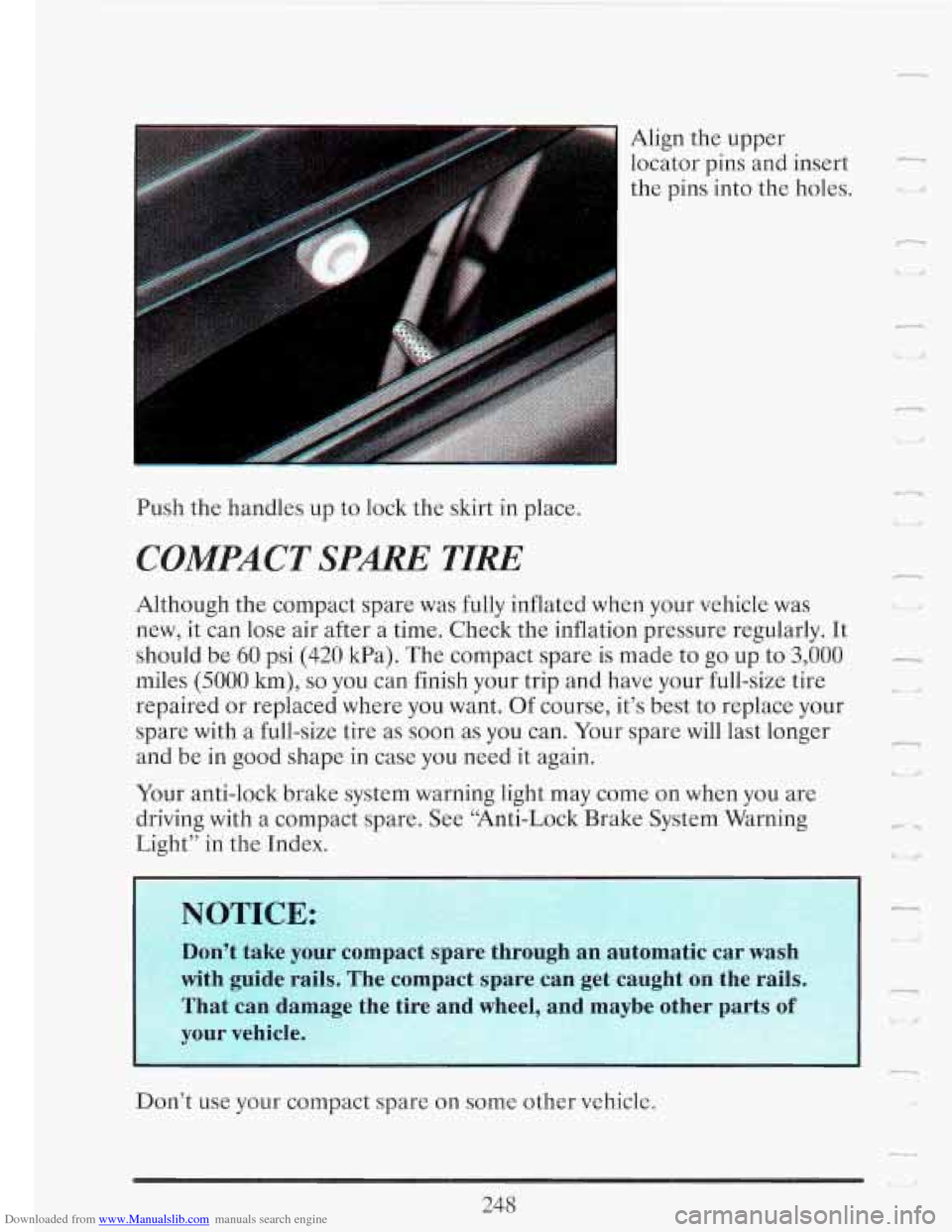
Downloaded from www.Manualslib.com manuals search engine Align the upper
locator pins and insert
-
the pins into the holes. .
n
Push the handles up to lock the skirt in place.
COMPACT SPARE TIRE
Although the compact spare was fully inflated when your vehicle was
new, it can lose air after a time. Check the inflation pressure regularly. It
should be
60 psi (420 kPa). The compact spare is made to go up to 3,000 -
miles (5000 km), so you can finish your trip and have your full-size tire i* u
repaired or replaced where you want. Of course, it’s best to replace your I
spare with a full-size tire as soon as you can. Your spare will last longer
and be in good shape in case you need it again.
Your anti-lock brake system warning light may come on when
you are
driving with a compact spare. See “Anti-Lock Brake System Warning
Light” in the Index.
Don’t use your compact spare on some other vehicle.
248
Page 264 of 386
Downloaded from www.Manualslib.com manuals search engine L Rocking your vehicle to get it out:
a’ I
First, turn your steering wheel left and right. That will clear the area
around your front wheels. Then shift back and forth between
“R7
(Reverse) and a forward gear , spinning the wheels as little as possible.
Release the accelerator pedal while you shift, and press lightly on the
accelerator pedal when the transmission
is in gear. If that doesn’t get you
out after a
few tries, you may need to be towed out. If you do need to be
towed out, see “Towing Your Cadillac” in the Index.
--
250
Page 272 of 386
Downloaded from www.Manualslib.com manuals search engine A CAUTION:
An electric fan under the hood can start up and injure you even
when the engine is not running. Keep hands, clothing and tools
away from any underhood electric fan.
A CAUTION:
Things that burn can get on hot engine parts and start a fire.
These include liquids like oil, coolant, brake fluid, windshield
washer and other fluids, and plastic or rubber.
You or others
could be burned. Be careful not to drop or spill things that will
burn onto
a hot engine.
I
Before closing the hood, be sure all the filler caps are on properly. Then
just pull the hood down and close it firmly.
ENGINE OIL
If the “Low Oil Level” light on the instrument panel comes on, it means
you need to check your engine oil level right away. You should check your
engine oil
level regularly; the light is an added reminder.
It’s a good idea to check your engine oil every time you get
fuel. In order
to get an accurate reading, the oil must be warm and the vehicle must be
on level ground. c1
u
Page 273 of 386
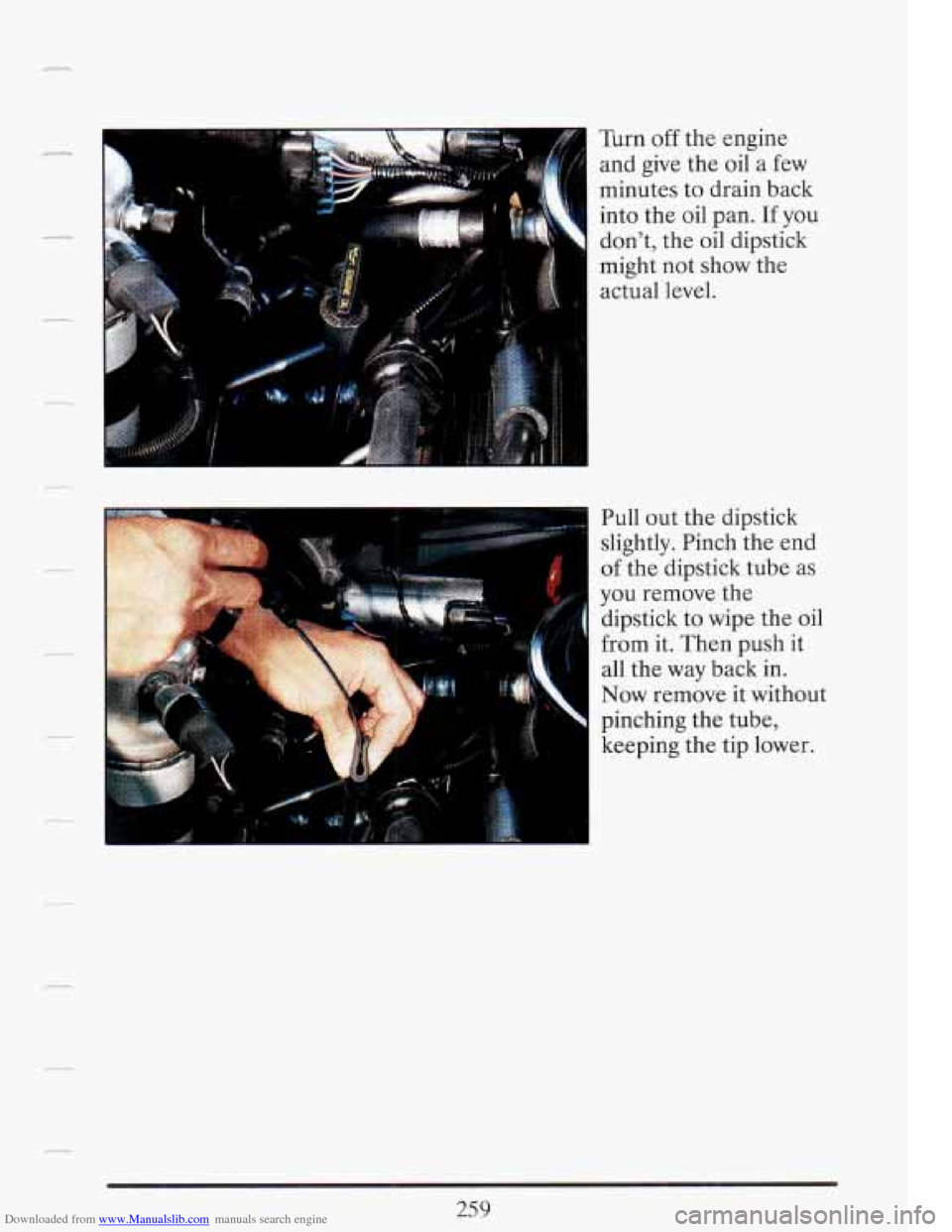
Downloaded from www.Manualslib.com manuals search engine Turn off the engine
and give the
oil a few
minutes to drain back
into the oil pan.
If you
don’t, the oil dipstick
might not show the
4
actual level.
Pull out the dipstick
slightly. Pinch the end
of the dipstick tube as
you remove the
dipstick to wipe the oil
from it. Then push it
all the way back in.
Now remove it without
a pinching the tube,
I
keepingthe tip lower.
Page 277 of 386
Downloaded from www.Manualslib.com manuals search engine .-
Oils with these words on the container will help you save fuel.
This doughnut-shaped logo (symbol) is used on most oil containers to
help you select the correct oil.
You should look for this on the
oil container, and use only those oils that
display the logo.
GM Goodwrench@ oil (in Canada, GM Engine Oil) meets all the
requirements for your vehicle.
Engine Oil Additives: Don’t add anything to your oil. Your Cadillac
dealer
is ready to advise if you think something should be added.
When to Change Engine Oil: Your vehicle is equipped with an engine oil
life indicator (EOLI) feature. Oil change intervals are determined by the
EOLI and will usually fall at, or between, the two recommended
alternative intervals of
3,000 miles (5,000 kilometers) and 7,500 miles
(12,500 kilometers), but could be shorter than 3,000 miles (5,000
kilometers) under some very severe driving conditions shown in Schedule
I. The system will also indicate the need for an oil change
if 7,500 miles
(12,500 kilometers).
When the oil life index reaches
0, the “CHANGE OII? light come on.
This indicates that no oil life remains and the oil should be changed as
soon as possible, but certainly within the next
200 miles (320 km).
The EOLI will not detect excessively dusty conditions or engine
malfunctions which may effect the
oil. If you drive in dusty areas, change
the engine oil after every
3,000 miles (5,000 kilometers) or 3 months
(whichever comes first), unless instructed to do
so sooner by the
“CHANGE
OW light.
263
Page 278 of 386
Downloaded from www.Manualslib.com manuals search engine Engine Block Heater Option: An engine block heater can be a big help if
you have to park outside in
very cold weather, 0°F (-18OC) or colder. If
your vehicle has this option, see “Engine Block Heater”
in the Index.
How
To Reset the Oil Life Indicator: After the oil has been changed,
you’ll need to reset your system.
To do that, turn the ignition switch to the
“ON” position with the engine stopped fully depress and release the
accelerator pedal
3 times within 5 seconds.
If the “CHANGE OIC‘ light comes on and stays on for 5 seconds, it did
not reset. You’ll need to reset the system again.
What to
Do with Used Oil:
A CAUTION:
Used engine oil contains things that have caused skin cancer in
laboratory animals. Don’t let used oil stay on your skin for very
long. Clean your skin and nails with soap and water, or a good
hand cleaner. Wash or properly throw away clothing or rags
containing used engine oil.
Used oil can be a real threat to the environment. If you change your own
oil, be sure to drain all free-flowing oil from the filter before disposal.
-
Don’t ever dispose of oil by pouring it on the ground, into sewers, or into
streams or bodies of water. Instead, recycle it by taking
it to a place that
collects used oil. If you have a problem properly disposing of your used
oil, ask your dealer, a service station or
a local recycling center for help.
1:
n
264
I