light CADILLAC FLEETWOOD 1993 2.G Repair Manual
[x] Cancel search | Manufacturer: CADILLAC, Model Year: 1993, Model line: FLEETWOOD, Model: CADILLAC FLEETWOOD 1993 2.GPages: 386, PDF Size: 19.17 MB
Page 190 of 386
Downloaded from www.Manualslib.com manuals search engine Traction Control System
~ This feature is deleted
on Coach Builder
limousines and
funeral coach
packages. I
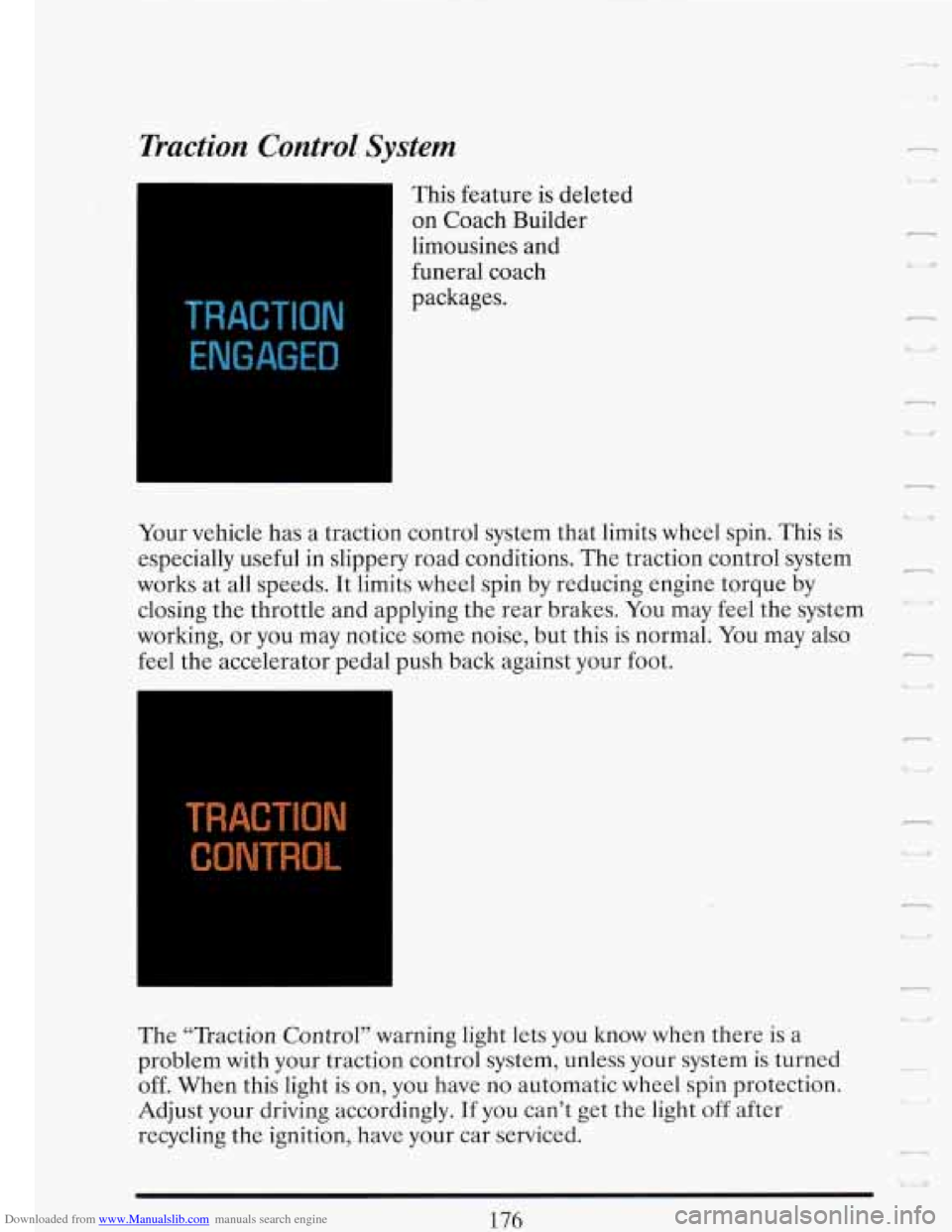
TRACTION
ENGAGED
Your vehicle has a traction control system that limits wheel spin. This is
especially useful in slippery road conditions. The traction control system
works at all speeds. It limits wheel spin by reducing engine torque by
closing the throttle and applying the rear brakes. You may feel the system
working, or you may notice some noise, but this is normal. You may also
feel the accelerator pedal push back against your foot.
I ~
i
TRACTION
I: I
The “Traction Control” warning light lets you know when there is a
problem with your traction control system, unless your system is turned
off. When this light is on,
you have no automatic wheel spin protection.
Adjust your driving accordingly. If you can’t get the light off after
recycling the ignition, have your car serviced.
n
u
c ‘I W
n
U
I
LrJ
-
L
..
r
1
L 7
I
UI
Page 191 of 386
Downloaded from www.Manualslib.com manuals search engine To limit wheel spin, especially in slippery road conditions, you should
always leave your traction control system on. But you can turn the
traction control system off
if you ever need to.
TRACTION
CONTROL
DISABLE
SWITCH
3
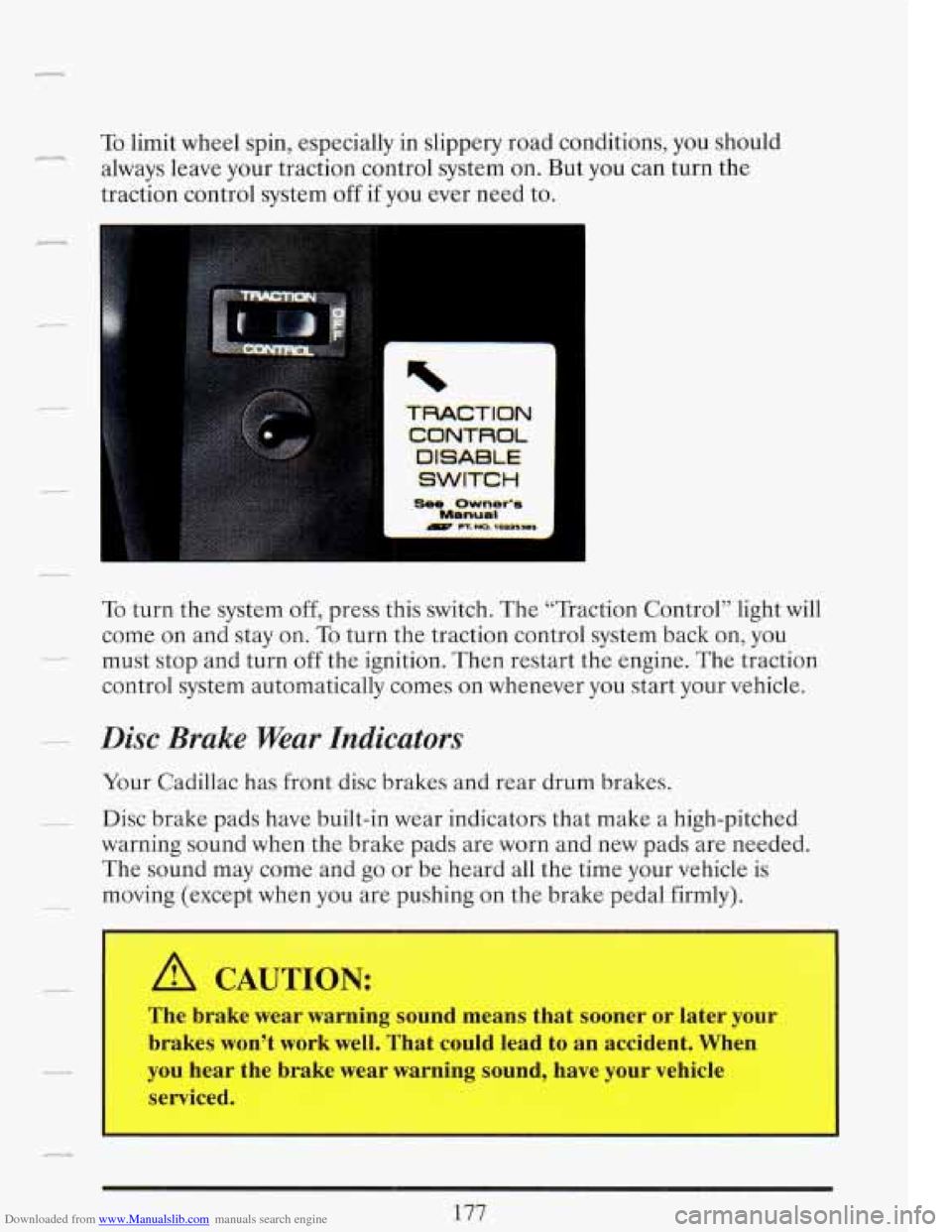
To turn the system off, press this switch. The “Traction Control” light will
come on and stay on. To turn the traction control system back on, you
must stop and turn off the ignition. Then restart the engine. The traction
control system automatically comes on whenever you start your vehicle.
-
Disc Brake Wear Indicators
Your Cadillac has front disc brakes and rear drum brakes.
-- Disc brake pads have built-in wear indicators that make a high-pitched
warning sound when the brake pads are worn and new pads are needed.
The sound may come and go or be heard all the time your vehicle is
.. - moving (except when you are pushing on the brake pedal firmly).
I
A CAUTION:
The brake wear warning sound means that sooner or later your
brakes won’t work well. That could lead to an accident. When
you hear the brake wear warning sound, have your vehicle
serviced. I
Page 192 of 386
Downloaded from www.Manualslib.com manuals search engine IY OTICE:
-I
1
L
Continuing to drive with worn-out brake pads could result in
costly brake repair.
-
Some driving conditions or climates may cause a brake squeal when the
brakes are first applied or lightly applied. This does not mean something
is wrong with your brakes.
Rear Drum Brakes
F
c I
Your rear drum brakes don’t have wear indicators, but if you ever hear a
rear brake rubbing noise, have the rear brake linings inspected.
Also, the
rear brake drums should be removed and inspected each time the tires
are removed for rotation or changing. When you have the front brakes
replaced, have the rear brakes inspected,
too.
11
Brake linings should always be replaced as complete axle sets.
Brake Pedal Travel
See your dealer if the brake pedal does not return to normal height, or if c r
there is a rapid increase in pedal travel. This could be a sign of brake
trouble.
Brake Adjustment
Every time you make a moderate brake stop, your disc brakes adjust for
wear.
If you rarely make a moderate or heavier stop, then your brakes might
not adjust correctly. If you drive in that way, then
-- very carefully -- make
a few moderate brake stops about every
1000 miles (1600 km), so your -i
brakes will adjust properly.
,
-1
If your brake pedal goes down farther than normal, your rear drum
brakes may need adjustment. Adjust them
by backing up and firmly
applying the brakes a few times.
7
Page 194 of 386
Downloaded from www.Manualslib.com manuals search engine c 1
Speed limit signs near curves warn that you should adjust your speed. Of
course, the posted speeds are based on good weather and road
conditions. Under less favorable conditions you’ll want to go slower.
If you need to reduce your speed as you approach a curve, do it before
you enter the curve, while your front wheels are straight ahead.
Try to adjust your speed so you can “drive” through the curve. Maintain a
reasonable, steady speed. Wait to accelerate until you are out of the
curve, and then accelerate gently into the straightaway.
When you drive into a curve at night, it’s harder to see the road ahead of
you because it bends away from the straight beams of your lights. This is
one good reason to drive slower.
n
cz;
n
Steering in Emergencies
There are times when steering can be more effective than braking. For
example, you come over a hill and find a truck stopped in your lane, or a
car suddenly pulls out from nowhere, or a child darts out from between
parked cars and stops right in front
of you. You can avoid these problems
by braking
-- if you can stop in time. But sometimes you can’t; there isn’t
room. That’s the time for evasive action
-- steering around the problem. -
-
Your Cadillac can perform very well in emergencies like these. First apply
your brakes. It is better to remove as much speed as you can from a
possible collision. Then steer around the problem, to the left or right
depending on the space available. I,
An emergency like this requires close attention and a quick decision. If
you are holding the steering wheel at the recommended
9 and 3 o’clock
positions, you can turn it a full
180 degrees very quickly without removing ‘ i’
either hand. But you have to act fast, steer quickly, and just as quickly
straighten the wheel once you have avoided the object. You must then be
-
7
prepared to steer back to your original lane and then brake to a
controlled stop.
Depending on your speed, this can be rather violent for an unprepared
driver. This is one of the reasons driving experts recommend that you use
your safety belts and keep both hands
on the steering wheel.
-1
r P
180
Page 195 of 386
Downloaded from www.Manualslib.com manuals search engine c
7
The fact that such emergency situations are always possible is a good
reason to practice defensive driving at all times.
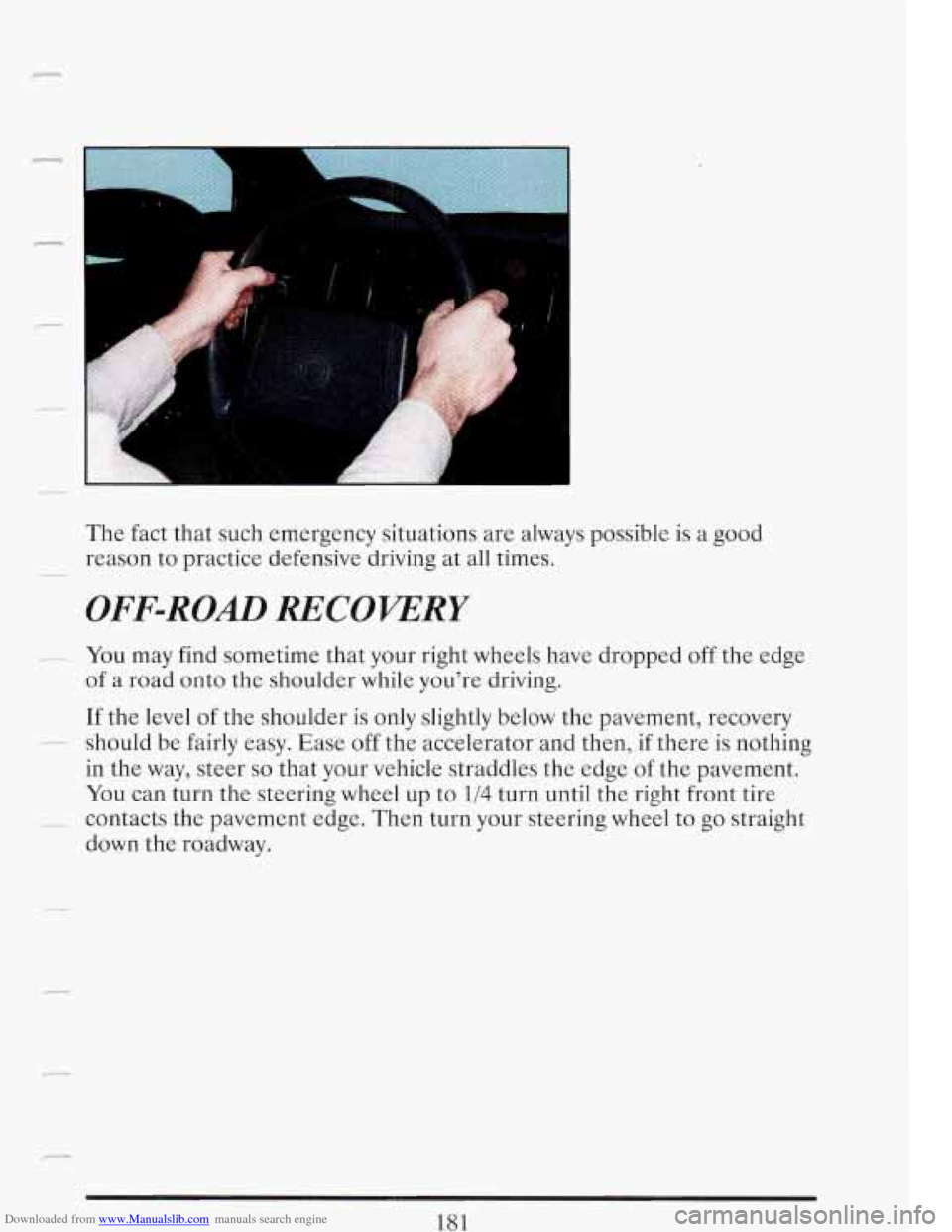
OFF-ROAD RECOVERY
You may find sometime that your right wheels have dropped off the edge
of a road onto the shoulder while you’re driving.
If the level of the shoulder is only slightly below the pavement, recovery
should be fairly easy. Ease
off the accelerator and then, if there is nothing
in the way, steer
so that your vehicle straddles the edge of the pavement.
You can turn the steering wheel up to
1/4 turn until the right front tire
contacts the pavement edge. Then turn
your steering wheel to go straight
down the roadway.
181
Page 198 of 386
Downloaded from www.Manualslib.com manuals search engine Try not to pass more than one vehicle at a time on two-lane roads.
Reconsider before passing the next vehicle.
Don’t overtake a slowly moving vehicle too rapidly. Even though the
brake lights are
not flashing, it may be slowing down or starting to
turn.
If you’re being passed, make it easy for the following driver to get
ahead
of you. Perhaps you can ease a little to the right.
LOSS OF CONTROL
i
r
I/ U
Let’s review what driving experts say about what happens when the three
control systems (brakes, steering and acceleration) don’t have enough
’; I I
friction where the tires meet the road to do what the driver has asked.
r
In any emergency, don’t give up. Keep trying to steer and constantly seek
an escape route or area
of less danger.
-
le
Skidding
In a skid, a driver can lose control of the vehicle. Defensive drivers avoid
most skids by taking reasonable care suited to existing conditions, and by
._
not “overdriving” those conditions. But skids are always possible. < .,
The three types of skids correspond to your Cadillac’s three control
systems. In the braking skid your wheels aren’t rolling.
In the steering or
cornering skid, too much speed or steering in a curve causes tires to slip
and lose cornering force. And in the acceleration skid too much throttle
causes the driving wheels to spin.
A cornering skid is best handled by easing your foot off the accelerator
pedal.
If your traction control system is off or disabled, an acceleration
skid is best handled in the same way.
If your vehicle starts to slide (as when you turn a corner on a wet, snow-
or ice-covered road), ease your foot off the accelerator pedal as soon as
you feel the vehicle start to slide. Quickly steer the way you want the
vehicle to
go. If you start steering quickly enough, your vehicle will
straighten out.
As it does, straighten the front wheels.
Of course, traction is reduced when water, snow, ice, gravel, or other
material is on the road. For safety, you’ll want to slow down and adjust
your driving to these conditions. It is important to slow down on slippery
Lj
il t
1
-.
184
Page 200 of 386
Downloaded from www.Manualslib.com manuals search engine 0
0
0
0
0
Adjust your inside rearview mirror to reduce the glare from headlights
behind you. -
Since you can’t see as well, you may need to slow down and keep more
space between you and other vehicles. It’s hard to tell how fast the
vehicle ahead is going just by looking at its taillights.
Slow down, especially on higher speed roads. Your headlights can light
up only
so much road ahead.
In remote areas, watch for animals.
If you’re tired, pull off the road in a safe place and rest.
Night Vision
f-I
i
No one can see as well at night as in the daytime. But as we get older -
these differences increase. A 50-year-old driver may require at least twice i,
as much light to see the same thing at night as a 20-year-old.
What you do in the daytime can also affect your night vision. For
example, if you spend the day in bright sunshine you are wise to wear
sunglasses. Your eyes will have less trouble adjusting to night.
But if you’re driving, don’t wear sunglasses at night. They may cut down
on glare from headlights, but they also make a lot of things invisible that
should remain visible
- such as parked cars, obstacles, pedestrians, or
even trains blocking railway crossings.
You may want to put on your
sunglasses after you have pulled into a brightly-lighted service or
refreshment area. Eyes shielded from that glare may adjust more quickly
to darkness back on the road. But be sure to remove your sunglasses
before you leave the service area.
I
3:
You can be temporarily blinded by approaching lights. It can take a
second or
two, or even several seconds, for your eyes to readjust to the r
dark. When you are faced with severe glare (as from a driver who doesn’t
lower the high beams, or a vehicle with misaimed headlights), slow down
a little. Avoid staring directly into the approaching lights.
If there is a line
of opposing traffic, make occasional glances over the line of headlights to
make certain that one of the vehicles isn’t starting to move into your lane.
Once you are past the bright lights, give your eyes time to readjust before
resuming speed.
I.-
-
i*
It 81
186
Page 201 of 386
Downloaded from www.Manualslib.com manuals search engine r High Beams
If the vehicle approaching you has its high beams on, signal by flicking
yours to high and then back to low beam. This is the usual signal to lower
the headlight beams.
If the other driver still doesn’t lower the beams,
resist the temptation to put your high beams on. This only
makes two
half-blinded drivers.
- On a freeway, use your high beams only in remote areas where you won’t
impair approaching drivers. In some places, like cities, using high beams
is illegal.
When you follow another vehicle on a freeway or highway, use low
beams. True, most vehicles now have day-night mirrors that enable the
driver to reduce glare. But outside mirrors are not of this type and high
beams from behind can bother the driver ahead.
-
-
A Few More Night Driving Suggestions
-
Keep your windshield and all the glass on your vehicle clean -- inside and
out. Glare at night is made much worse by dirt on the glass. Even the
inside
of the glass can build up a film caused by dust. Tobacco smoke also
makes inside glass surfaces very filmy and can be a vision hazard
if it’s left
there. -
~ Dirty glass makes lights dazzle and flash more than clean glass would,
making the pupils
of your eyes contract repeatedly. You might even want
to keep a cloth and some glass cleaner in your vehicle if you need to clean
your glass frequently.
Remember that your headlights light up far less
of a roadway when you
are in a turn or curve.
-
_- Keep your eyes moving; that way, it’s easier to pick out dimly lighted
objects.
Just as your headlights should be checked regularly for proper aim, so
blindness
-- the inability to see in dim light -- and aren’t even aware of it.
- should your eyes be examined regularly. Some drivers suffer from night
187
Page 203 of 386
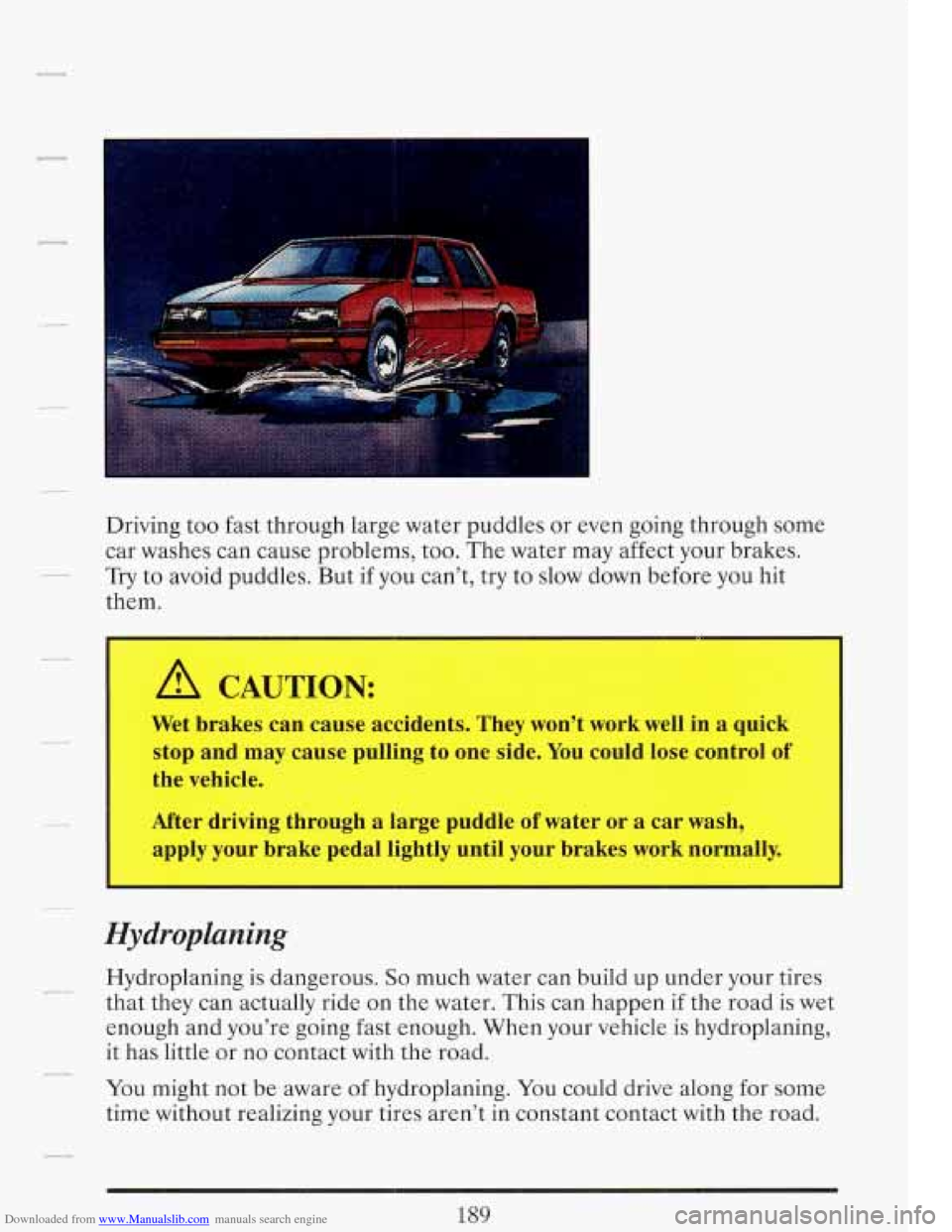
Downloaded from www.Manualslib.com manuals search engine Driving too fast through large water puddles or even going through some
car washes can cause problems, too. The water may affect your brakes.
them.
--- Try to avoid puddles. But if you can’t, try to slow down before you hit
-I
I A CAUTION:
Wet brakes can cause accidents. They won’t work well in a quick
I stop and may cause pulling to one side. You could lose control of
the vehicle.
I After driving through a large puddle of water or a car wash,
apply your brake pedal lightly until your brakes work normally.
Hydroplaning
- Hydroplaning is dangerous. So much water can build up under your tires
that they can actually ride on the water. This can happen
if the road is wet
enough and you’re going fast enough. When your vehicle is hydroplaning,
it has little or no contact with the road.
_I
You might not be aware of hydroplaning. You could drive along for some
time without realizing your tires aren’t in constant contact with the road.
189
Page 204 of 386
Downloaded from www.Manualslib.com manuals search engine You could find out the hard way: when you have to slow, turn, move out
to pass
-- or if you get hit by a gust of wind. You could suddenly find
yourself out of control.
Hydroplaning doesn’t happen often. But it can if your tires haven’t much
tread or if the pressure in one or more is low. It can happen if a lot of
water is standing on the road.
If you can see reflections from trees,
telephone poles, or other vehicles, and raindrops “dimple” the water’s
surface, there could be hydroplaning.
Hydroplaning usually. happens at higher speeds. There just isn’t a hard
and fast rule about hydroplaning. The best advice is to slow down when it
is raining, and be careful.
Some Other Rainy Weather Tips
Turn on your headlights -- not just your parlung lights -- to help make
you more visible to others.
0 Look for hard-to-see vehicles coming from behind. You may want to
use your headlights even in daytime if it’s raining hard.
Besides slowing down, allow some extra following distance. And be
especially careful when you pass another vehicle. Allow yourself more
clear room ahead, and be prepared to have your view restricted by
road spray.
If the road spray is so heavy you are actually blinded, drop
back. Don’t pass until conditions improve. Going more slowly is better
-
than having an accident. I
L1
I
Use your defogger if it helps.
0 Have good tires with proper tread depth. (See “Tires” in the Index.)
-
Y
190 I