lights CADILLAC FLEETWOOD 1994 Owner's Manual
[x] Cancel search | Manufacturer: CADILLAC, Model Year: 1994, Model line: FLEETWOOD, Model: CADILLAC FLEETWOOD 1994Pages: 398, PDF Size: 19.19 MB
Page 198 of 398
slide. You may not realize the surface is slippery until your vehicle is
skidding. Learn to recognize warning clues
-- such as enough water, ice or
packed snow on the road to make a “mirrored surface”
-- and slow down
when you have any doubt.
Remember: Any anti-lock braking system
(ABS) helps avoid only the
braking skid.
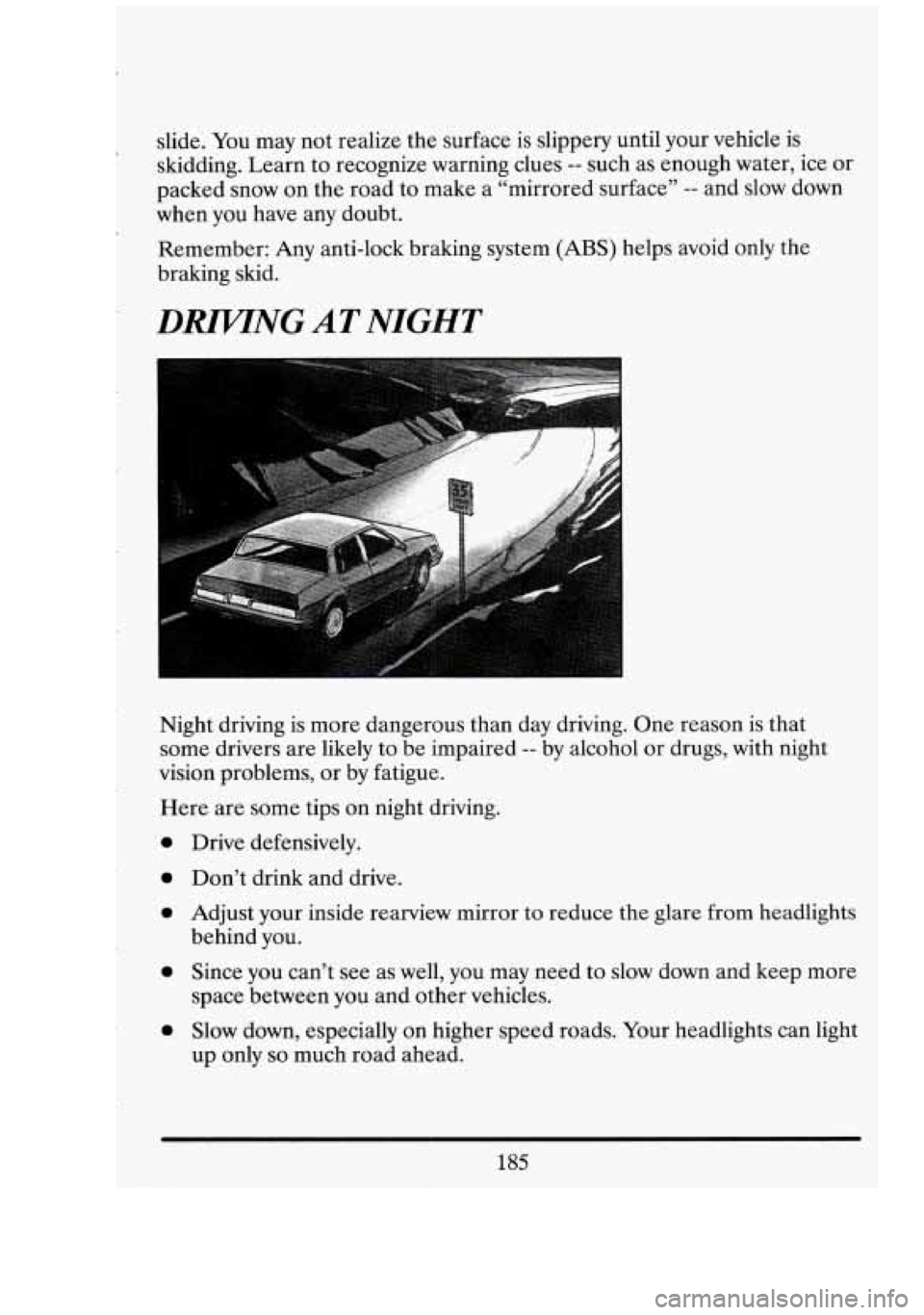
DRZWNG AT NIGHT
Night driving is more dangerous than day driving. One reason is that
some drivers are likely to be impaired
-- by alcohol or drugs, with night
vision problems, or by fatigue.
Here are some tips on night driving.
0
0
0
0
0
Drive defensively.
Don’t drink and drive.
Adjust your inside rearview mirror to reduce the glare from headlights
behind you.
Since you can’t see as well, you may need to slow down and keep more
space between you and other vehicles.
Slow down, especially on higher speed roads. Your headlights can light
up only
so much road ahead.
185
Page 199 of 398
0 In remote areas, watch for animals.
If you’re tired, pull off the road in a safe place and rest.
Night Vision
No one can see as well at night as in the daytime. But as we get older
these differences increase. A 50-year-old driver may require at least twice
as much light to see the same thing at night as a 20-year-old.
What you do in the daytime can also affect your night vision. For
example, if you spend the day in bright sunshine you are wise to wear
sunglasses. Your eyes will have less trouble adjusting to night. But if
you’re driving, don’t wear sunglasses at night. They may cut down on
glare from headlights, but they also make a lot
of things invisible.
You can be temporarily blinded by approaching lights. It can take a
second or
two, or even several seconds, for your eyes to readjust to the
dark. When you are faced with severe glare (as from a driver who doesn’t
lower the high beams,
or a vehicle with misaimed headlights), slow down
a little. Avoid staring directly into the approaching lights.
Keep your windshield and all the glass on your vehicle clean
-- inside and
out. Glare at night is made much worse by dirt on the glass. Even the
inside
of the glass can build up a film caused by dust. Dirty glass makes
lights dazzle and flash more than clean glass would, making the pupils
of
your eyes contract repeatedly.
Remember that your headlights light up far less
of a roadway when you
are in
a turn or curve. Keep your eyes moving; that way, it’s easier to pick
out dimly lighted objects. Just as your headlights should be checked
regularly for proper aim,
so should your eyes be examined regularly.
Some drivers suffer from night blindness
-- the inability to see in dim light
-- and aren’t even aware of it.
186
c3
I
Page 202 of 398
Hydroplaning
Hydroplaning is dangerous. So much water can build up under your tires
that they can actually ride on the water. This can happen
if the road is wet
enough and you’re going fast enough. When your vehicle is hydroplaning,
it has little or no contact with the road.
Hydroplaning doesn’t happen often. But it can
if your tires haven’t much
tread or
if the pressure in one or more is low. It can happen if a lot of
water is standing on the road. If you can see reflections from trees,
telephone poles, or other vehicles, and raindrops “dimple” the water’s
surface, there could be hydroplaning.
Hydroplaning usually happens at higher speeds. There just isn’t a hard
and fast rule about hydroplaning. The best advice is to slow down when it
is raining.
Some Other Rainy Weather Tips
0 Turn on your low-beam headlights -- not just your parking lights -- to
help make you more visible to others.
Besides slowing down, allow some extra following distance. And be
especially careful when you pass another vehicle. Allow yourself more
clear room ahead, and be prepared to have your view restricted by
road spray.
Have good tires with proper tread depth. (See “Tires” in the Index.)
189
Page 205 of 398
I
Once you are moving on the freeway, make certain you allow a
reasonable following distance. Expect to move slightly slower at night.
When you want to leave the freeway, move to the proper lane well in
advance.
If you miss your exit do not, under any circumstances, stop and
back up. Drive on to the next exit.
The exit ramp can be curved, sometimes quite sharply.
The exit speed is usually posted.
Reduce your speed according to your speedometer, not to your sense of
motion. After driving for any distance at higher speeds, you may tend to
think you are going slower than you actually are.
BEFORE LEAWNG ONA LONG TMP
Make sure you’re ready. Try to be well rested. If you must start when
you’re not fresh
-- such as after a day’s work -- don’t plan to make too
many,miles that first part of the journey. Wear comfortable clothing and
shoes you can easily drive in.
Is your vehicle ready for a long.trip? If you keep it serviced and
maintained, it’s ready to go.
If it needs service, have it done before
starting out. Of course, you’ll find experienced and able service experts
in
Cadillac dealerships all across North America. They’ll be ready and
willing to help if you need it.
Here are some things you can check before a trip:
Windshield Washer Fluid: Is the reservoir full? Are all windows clean
Wiper Blades: Are they in good shape?
Fuel, EnEine Oil. Other Fluids: Have you checked all levels?
Lights: Are they all working? Are the lenses clean?
inside
and outside?
Tires: They are vitally important to a safe, trouble-free trip. Is the
tread good enough for long-distance driving?
Are the tires all inflated
to the recommended pressure?
Ql
cl‘ I
GI
192
Page 213 of 398
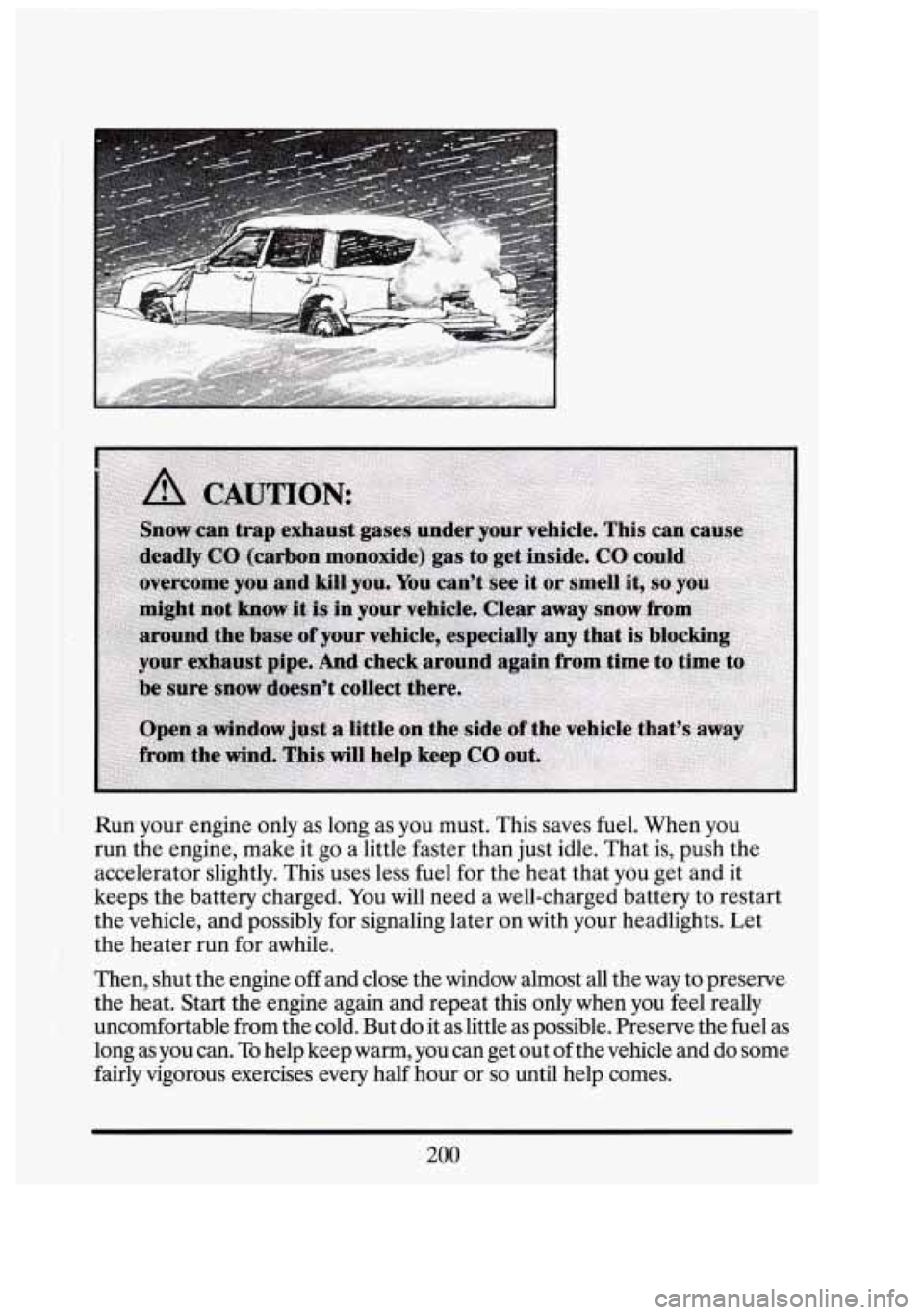
Run- your engine only as long as you must. This saves fuel. When you
run the engine, make it go a little faster than just idle. That is, push the
accelerator slightly. This uses less fuel for the heat that you-get and it
keeps the battery charged. You will need a well-charged battery to restart
the vehicle, and possibly for signaling later .on with your headlights. Let
the heater run for awhile.
Then, shut the engine
off and close the window almost all the way to preserve
the heat. Start the engine again and repeat this only when you feel really
uncomfortable
from the cold. But do it aslittle as possible. Preserve the fuel as
long as you can.
To help keep warm, you can get out of the vehicle and do some
fairly vigorous exercises every half hour or so until help comes.
200
Page 221 of 398
I
Trailer Wiring Harness
I
If your Fleetwood is equipped with one of the heavy duty trailering
options, a
5 wire trailering harness is located in the trunk. You may have
to have it wired to your vehicle.
These trailer harness color codes should be followed when connecting to
your trailer:
White: Direct Trailer Ground for Trailer Lights
Brown: Park Lamps
Yellow: Left Turn and Stop Lamps
Dark Green: Right Tuh and Stop Lights
Dark Blue: Auxiliary Circuit
DRIFTNG WTHA TWLER
Safe trailer towing requires a certain amount of experience. Before
setting out
for the open road, you'll want to get to know your rig.
Acquaint-yourself with the feel
of handling and braking with the added
weight of the trailer. Always keep in mind that the vehicle you are driving
is longer and not nearly as responsive as your vehicle is by itself.
Before you start, check the trailer hitch and safety chains, electrical
connector, lights, tires and mirror adjustment.
If the trailer has electric
brakes, start your vehicle and trailer moving and apply the trailer brakes
by hand to be sure the brakes are working. This also checks your
electrical connection at the same time.
During your trip check occasionally to be sure that the load is secure and
that the lights and trailer brakes are operating correctly.
Following Distance
Stay at least twice as far behind the vehicle ahead as you would when
driving your vehicle without a trailer. This can help you avoid situations
that require heavy braking and sudden turns.
208
I
I
Page 222 of 398
Passing
You’ll need more passing distance ahead when you’re towing a trailer.
Because you’re longer, you’ll need to go much farther beyond the passed
vehicle before you can return to your lane.
Backing Up
Hold the bottom of the steering wheel with one hand. Then, to move the
trailer to the left, just move that hand to the left.
To move the trailer to
the right, move your hand to the right. Always back up slowly and, if
possible, have someone guide you.
Making Turns
When you’re turning with a trailer, make wider turns than normal. Do
this so your trailer won’t strike soft shoulders, curbs, road signs, trees, or
other objects. Avoid jerky or sudden maneuvers. Signal well in advance.
Turn Signals When Towing a Trailer
When you tow a trailer, your vehicle has to have a different turn signal
flasher and extra wiring. The green arrows on your instrument panel will
flash whenever you signal a turn or lane change. Properly hooked up, the
trailer lights will also flash, telling other drivers you’re about to turn,
change lanes or stop.
When towing a trailer, the green arrows on your instrument panel will
flash for turns even if the bulbs on the trailer are burned out. Thus, you
may think drivers behind you are seeing your signal when they are not.
It’s important to check occasionally to be sure the trailer bulbs are still
working.
Driving On Grades
Reduce speed and shift to a lower gear before you start down a long or
steep downgrade.
If you don’t shift down, you might have to use your
brakes
so much that they get hot and no longer work well.
209
Page 226 of 398
ELUARD WMING FLASHERS
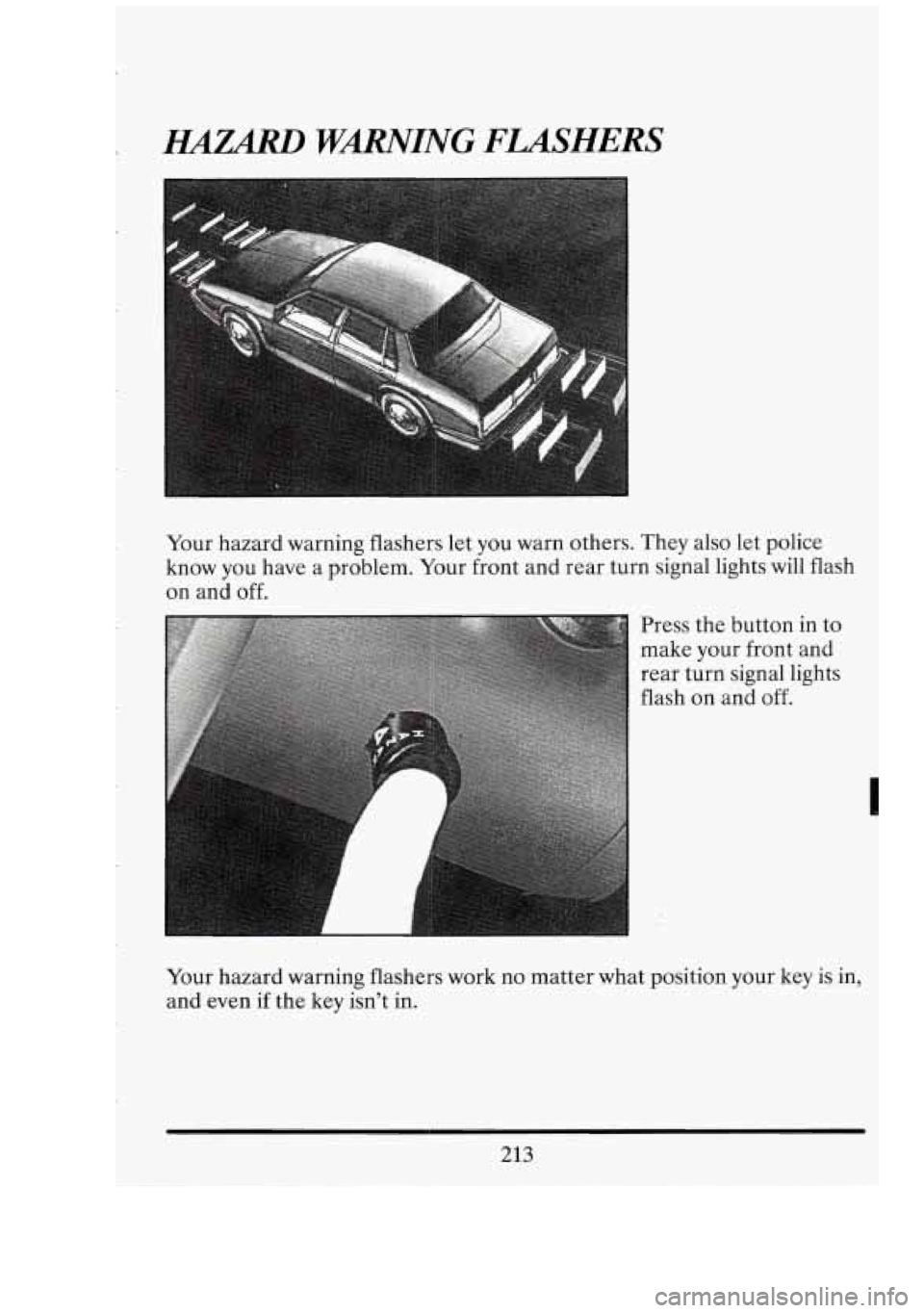
Your hazard warning flashers let you warn others. They also let police
know you have a problem. Your front and rear turn signal lights will flash
on and off.
I
I
make your front and
rear turn signal lights
flash on and off.
Your hazard warning flashers work no matter what position your key is in,
and even
if the key isn’t in.
Page 228 of 398
I r NOTICE:
Ignoring these steps could result in costly damage to your
vehicle that wouldn’t be covered by your warranty.
ming to start. your Cadillac by pushing or pulling it won’t
work, and
it could damage your vehicle.
TO JUMP START YOUR CXDILLAC:
1. Check the other vehicle. It must have a 12-volt battery with a negative
ground system.
NOTICE:
If the other system isn’t a 12-volt system with a negative ground,
both vehicles can be damaged.
2. Get the vehicies close enough
so the jumper cables can reach, but be
sure the vehicles aren’t touching each other. If they are, it could cause
a ground connection you don’t want. You wouldn’t be able to start
your Cadillac, and the bad grounding could damage the electrical
systems.
You could be injured
if the vehicles roll. Set the parking brake firmly
on each vehicle. Put
an automatic transmission in “P” (Park) or a
manual transmission in
“N” (Neutral).
needed, and radios. This will avoid sparks and help save both
batteries. And it could save your radio!
3. Turn off the ignition on both vehicles. Turn off all lights that aren’t
NOTICE:
If you leave your radio on, it could be badly damaged. The
repairs wouldn’t be covered
by your warranty.
215
Page 262 of 398
r
r
treadmill. These procedures ensure that each vehicle is tested under
identical conditions.
There are
two different fuel economy estimates for each vehicle, one Ior
city driving and one for highway driving.
To develop these two estimates,
separate tests are used to represent typical everyday city and rural
driving.
The test used to determine the city fuel economy estimate simulates a
7.5 mile (12 km), stop and go trip with an average speed of 20 mph
(32
km/h). The trip takes 23 minutes and has 18 stops. About one fifth
of the time is spent idling, as in waiting at traffic lights or in rush hour
traffic. Two kinds of engine starts are used: a cold start, which is similar to
starting a car in the morning after it has been parked all night and a hot
start, which is similar to restarting a vehicle after it has been warmed up,
driven and stopped for a short time.
The test used to determine the highway fuel economy estimate
represents a mixture of “non-city” driving. Segments corresponding to
different kinds
of rural roads and interstate highways are included. The
test simulates a 10 mile (17 km) trip with an average speed of 48 mph
(77 km/h). The test is run from a hot start and has little idling time and
no stops.
To assure that the fuel economy numbers are most useful for consumers,
the
EPA adjusts these laboratory test results to account for the difference
between controlled laboratory conditions and actual driving on the road.
The laboratory fuel economy results are adjusted downward
to arrive at
the estimates on the fuel economy window sticker and the Gas Mileage
Y Guide. The city estimate is lowered by 10 percent and the highwq
estimate
is lowered by 22 percent from the laboratory test results.
Experience has proven that these adjustments make the mileage
estimates correspond more closely to the actual fuel economy rea
by the average driver. lized
249