climate control CADILLAC FLEETWOOD 1994 Owners Manual
[x] Cancel search | Manufacturer: CADILLAC, Model Year: 1994, Model line: FLEETWOOD, Model: CADILLAC FLEETWOOD 1994Pages: 398, PDF Size: 19.19 MB
Page 151 of 398
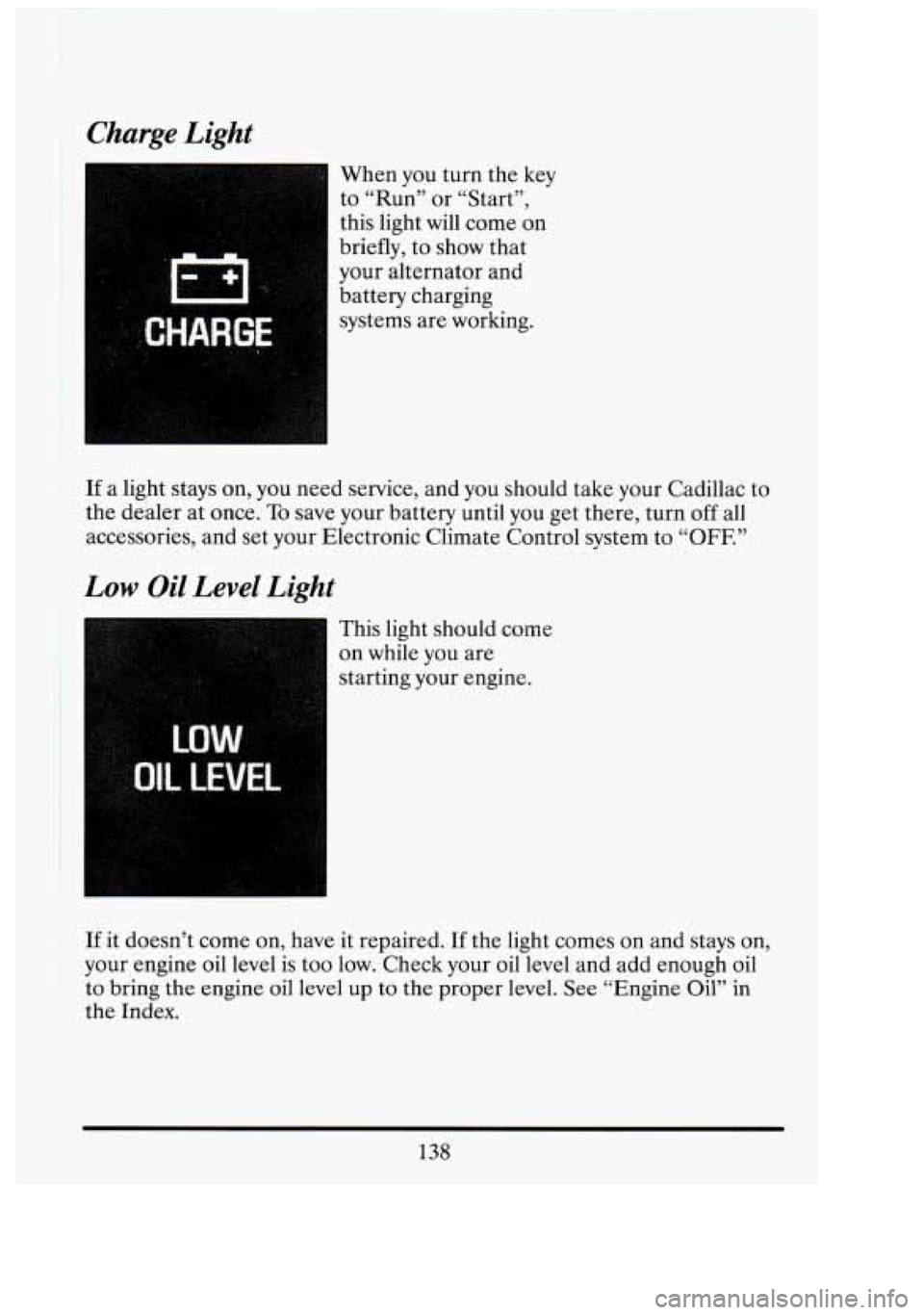
Charge Light
When you turn the key
to “Run” or “Start”,
this light
will come on
briefly, to show that
your alternator and
battery charging
systems are working. n
Cf
n
-1
If a light stays on, you need service, and you should take your Cadillac to
the dealer at once.
To save your battery until you get there, turn off all
accessories, and set your Electronic Climate Control system to
“OFF.”
Low Oil Level Light
If it doesn’t come on, have it repaired. If the light comes on and stays on,
your engine oil level is too low. Check your oil level and add enough oil
to bring the engine oil level
up to the proper level. See “Engine Oil” in
the Index.
138
-
1
Page 159 of 398
SECTION 3
COMFORT CONTROLS AND AUDIO SYSTEMS
In this section you’ll find out how to operate the comfort control systems
and audio systems offered with your Cadillac.
YOUR CXLIILUCAIR SYSTEM
This part tells you how to make your Electronic Climate Control (ECC)
work for you.
Outside Air
Outside air always flows through your Cadillac when the car is moving.
Even
if the car is not moving, you can always get outside air to flow
through by selecting any air choice (except the rear window defogger).
The Electronic Climate Control System may automatically recirculate the
inside air
of your vehicle, to provide maximum air conditioning. During
recirculation, a louder blower noise may be heard until the system returns
to outside air.
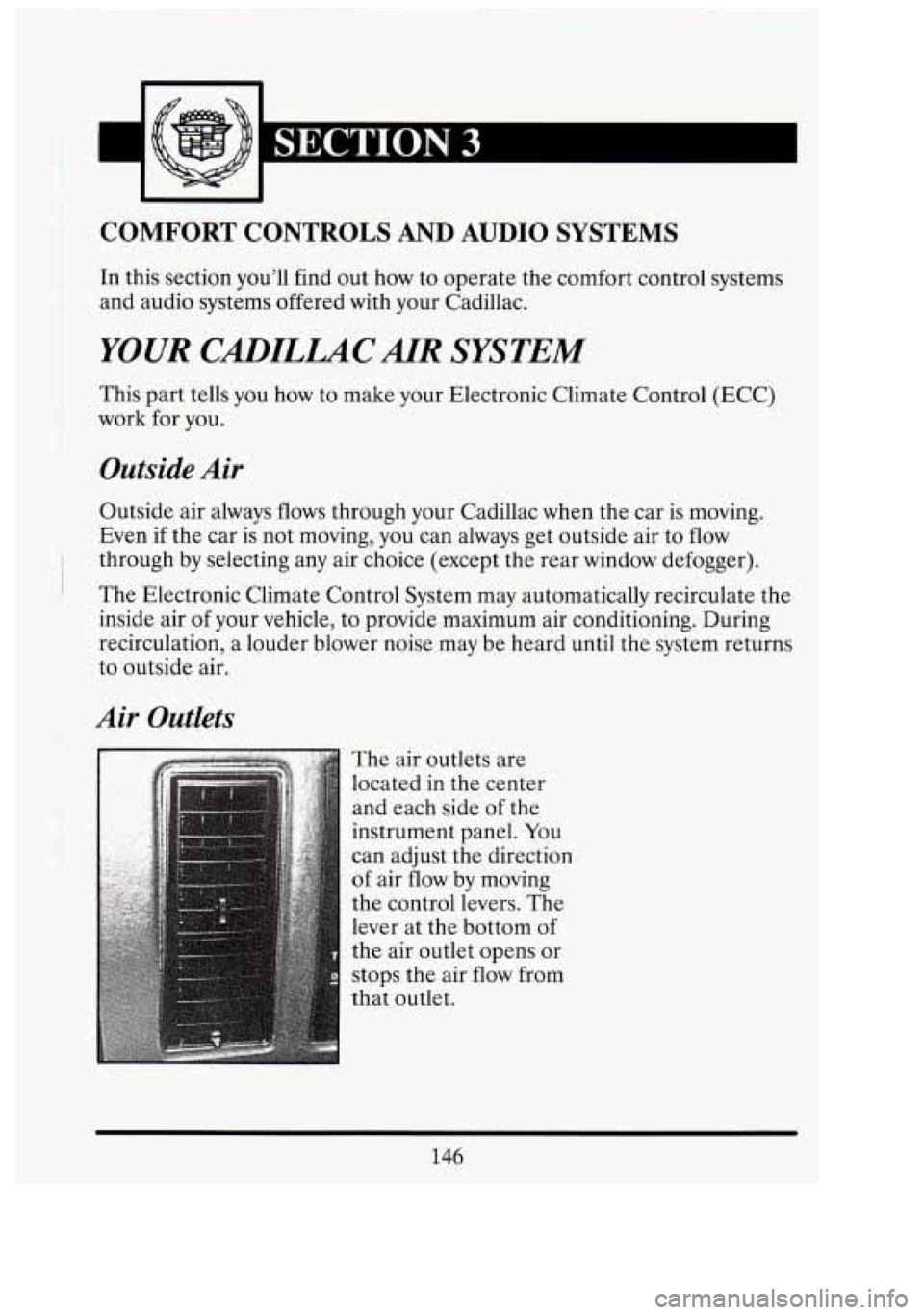
Air Outlets
The air outlets are
located
in the center
and each side of the
instrument panel. You
can adjust
the direction
of air flow by moving
the control levers. The
lever at the bottom of
the air outlet opens
or
stops the air flow from
that outlet.
146
(1
L
L
I
Ei
n L
Page 161 of 398
I
OFF
Nothing is on, but air will flow through your Cadillac if the the car is
moving. The air flow will be felt through the heater ducts.
ECON
Use this in cold or cool weather to save fuel. It won’t cool or remove
humidity from the air. However, the system will try to keep the air at the
chosen temperature.
If it’s so warm outside that you need to cool the air, use the next choice.
I AUTO
With this setting the system automatically controls the temperature, air
distribution and fan speeds. In cold conditions the the fan well not come
on until the system senses that the engine has started to warm up. This
prevents cold air from blowing on you and your occupants.
I
I FAN
The fan speed is controlled automatically if you have the Electronic
Climate Control set
on “AUTO.” However, if you want the fan to run at a
lower speed, push the lower portion of the fan switch.
If you want the blower to run at a fixed higher speed, push the upper
portion of the fan switch until you see
“HI” on the display.
If you want the fan to run at a fixed low speed, push the switch until “LO”
is shown on the display.
If you want the fan speed to be automatic but you like the fan to be
higher or lower than the
“AUTO” settings, just push the switch until
either
“HI AUTO” or “AUTO LO” is displayed.
If the Fahrenheit (F’) or Celsius (C”) symbol begins to flash, or flashes
when you turn
on the ignition, it indicates an electrical problem with your
148
G
I
1
q: LI
Page 163 of 398
I
Electronic Solar Sensor
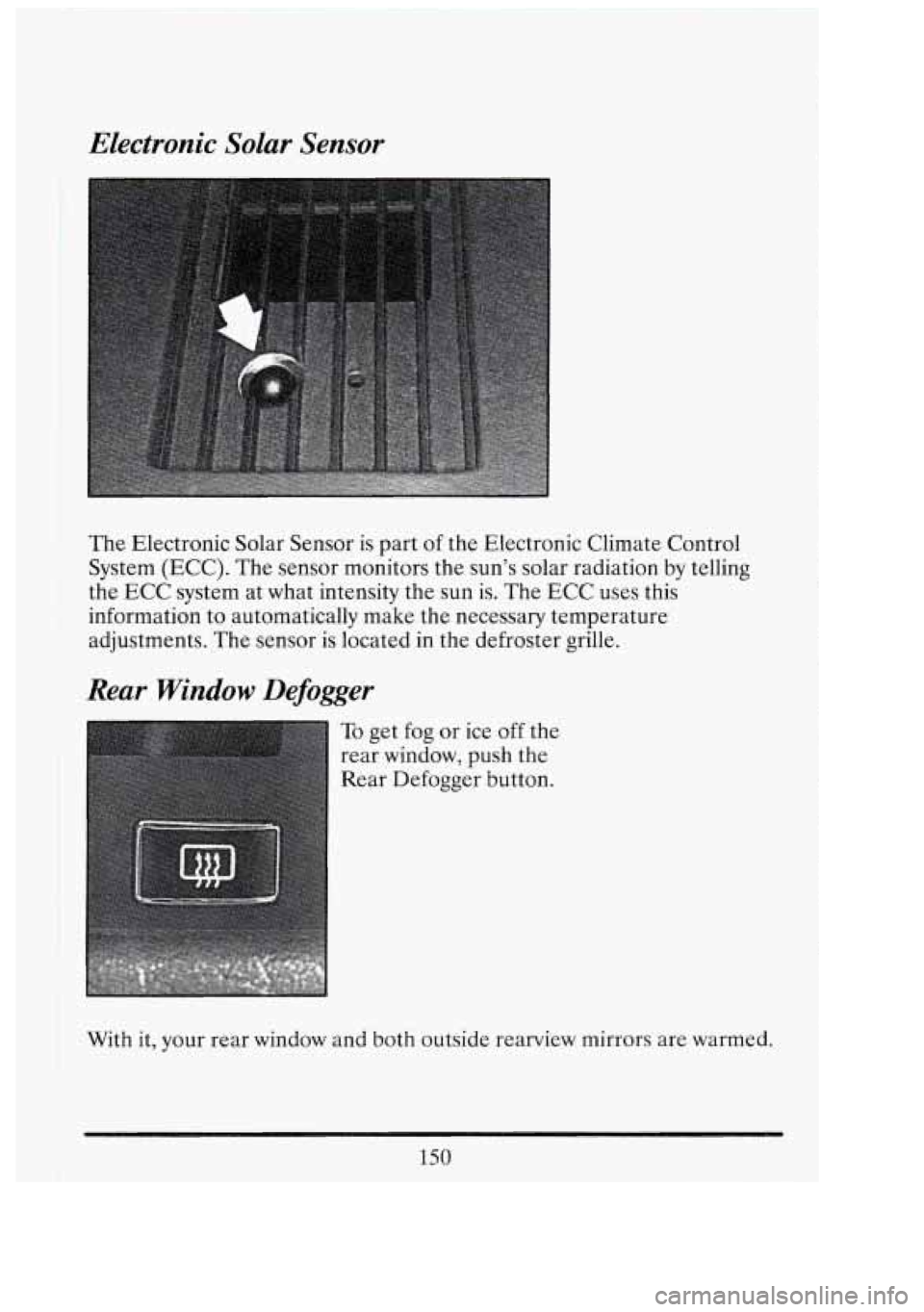
The Electronic Solar Sensor is part of the Electronic Climate Control
System (ECC). The sensor monitors the sun's solar radiation
by telling
information to automatically make the necessary temperature
adjustments. The sensor is located
in the defroster grille.
I the ECC system at what intensity the sun is. The ECC uses this
Rear Window Defogger
To get fog or ice off the
rear window, push the
Rear Defogger button.
With it,
your rear window and both outside rearview mirrors are warmed.
ni
CTI
'L1 I
150
Page 224 of 398
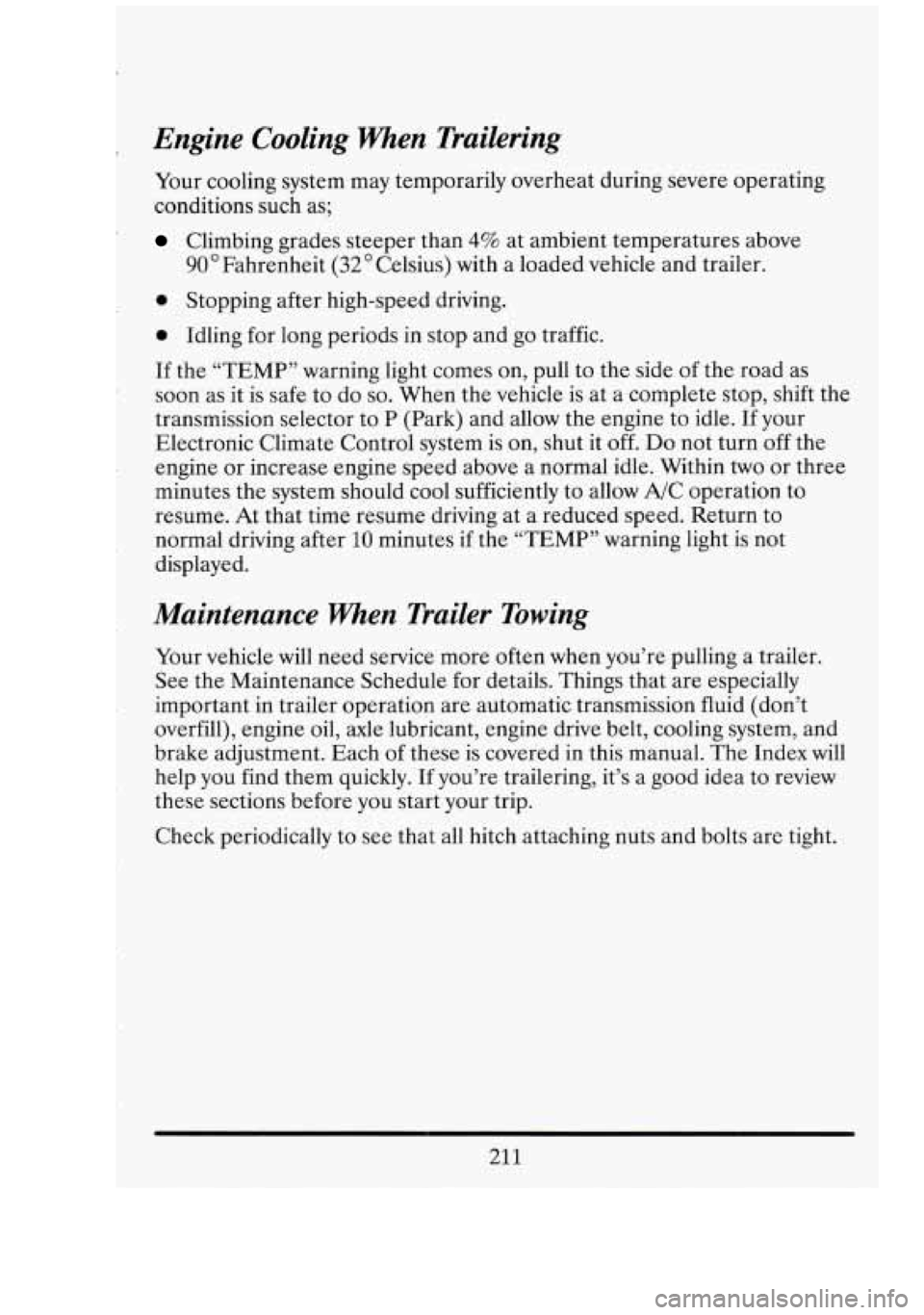
Engine Cooling When Trailering
Your cooling system may temporarily overheat during severe operating
conditions such as;
Climbing grades steeper than 4% at ambient temperatures above
90’Fahrenheit (32O Celsius)
with a loaded vehicle and trailer.
0 Stopping after high-speed driving.
0 Idling for long periods in stop and go traffic.
If the “TEMP” warning light comes on, pull
to the side of the road as
soon as it is safe to do
so. When the vehicle is at a complete stop, shift the
transmission selector to P (Park) and allow the engine to idle. If your
Electronic Climate Control system is on, shut it
off. Do not turn off the
engine or increase engine speed above a normal idle. Within
two or three
minutes the system should cool sufficiently to allow A/C operation to
resume. At that time resume driving at a reduced speed. Return to
normal driving after
10 minutes if the “TEMP” warning light is not
displayed.
Maintenance when Trailer Towing
Your vehicle will need service more often when you’re pulling a trailer.
See the Maintenance Schedule for details. Things that are especially
important in trailer operation are automatic transmission fluid (don’t
overfill), engine oil, axle lubricant, engine drive belt, cooling system, and
brake adjustment. Each of these is covered in this manual. The Index will
help you find them quickly. If you’re trailering, it’s a good idea to review
these sections before you start your trip.
Check periodically to
see that all hitch attaching nuts and bolts are tight.
21
1
Page 310 of 398
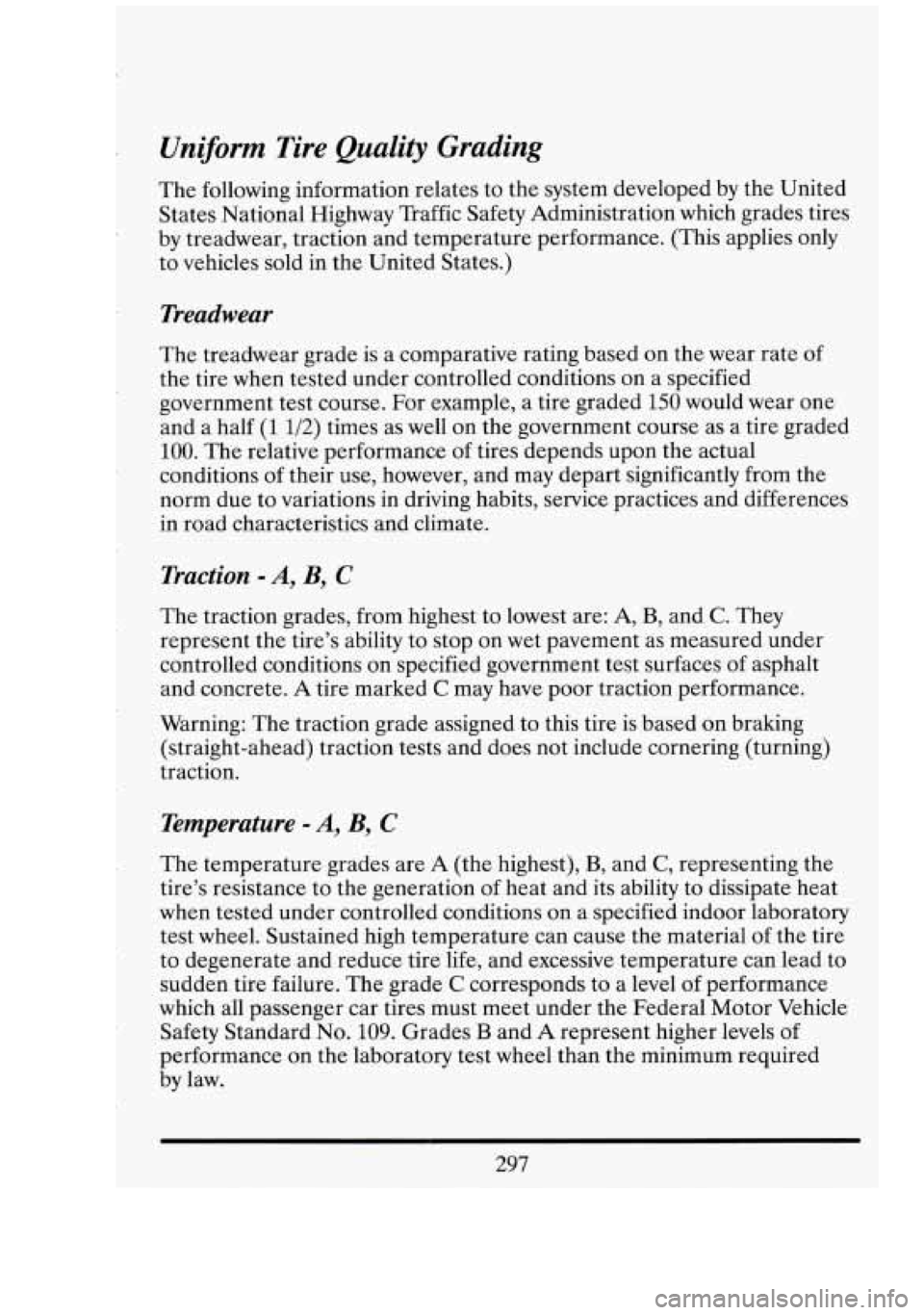
Uniform Tire Quality Grading
The following information relates to the system developed by the United
States National Highway Traffic Safety Administration which grades tires
by treadwear, traction and temperature performance. (This applies only
to vehicles sold
in the United States.)
Treadwear
The treadwear grade is a comparative rating based on the wear rate of
the tire when tested under controlled conditions on a specified
government test course. For example, a tire graded 150 would wear one
and
a half (1 1/2) times as well on the government course as a tire graded
100. The relative performance of tires depends upon the actual
conditions of their use, however, and may depart significantly from the
norm due to variations in driving habits, service practices and differences
in road characteristics and climate.
Traction - A, B, C
The traction grades, from highest to lowest are: A, B, and C. They
represent the tire’s ability to stop on wet pavement as measured under
controlled conditions on specified government test surfaces
of asphalt
and concrete. A tire marked
C may have poor traction performance.
Warning: The traction grade assigned to this tire is based
on braking
(straight-ahead) traction tests and does not include cornering (turning)
traction.
Temperature - A, B, C
The temperature grades are A (the highest), B, and C, representing the
tire’s resistance to the generation of heat and its ability to dissipate heat
when tested under controlled conditions on a specified indoor laboratory
test wheel. Sustained high temperature can cause the material of the tire
to degenerate and reduce tire
life, and excessive temperature can lead to
sudden tire failure. The grade
C corresponds to a level of performance
which all passenger car tires must meet under the Federal Motor Vehicle
Safety Standard No. 109. Grades
B and A represent higher levels of
performance on
the laboratory test wheel than the minimum required
by law.
297
Page 384 of 398
.
n
I
.
.
.
1
. .
.
.
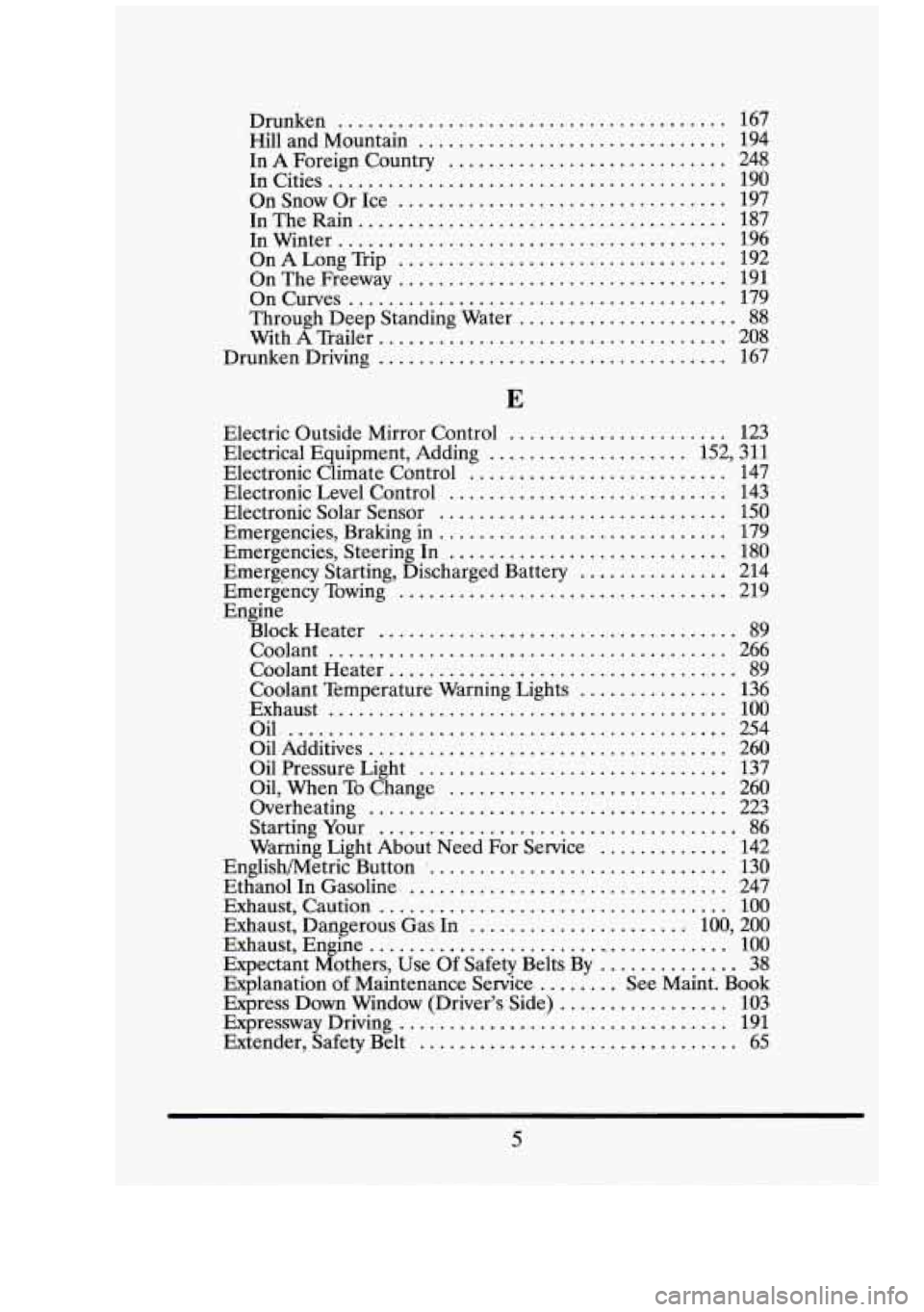
Drunken ....................................... 167
Hill and Mountain
............................... 194
In A Foreign Country
............................ 248
In Cities
........................................ 190
On Snow Or Ice
................................. 197
In The Rain
..................................... 187
InWinter
....................................... 196
On A Long Trip
................................. 192
On The Freeway
................................. 191
OnCurves
...................................... 179
Through Deep Standing Water
...................... 88
With A Trailer ................................... 208
Drunken Driving
................................... 167
Electric Outside Mirror Control
...................... 123
Electrical Equipment. Adding
.................... 152. 311
Electronic Climate Control
.......................... 147
Electronic Level Control
............................ 143
Electronic Solar Sensor
............................. 150
Emergencies. Braking in
............................. 179
Emergencies. Steering In
............................ 180
Emergency Starting. Discharged Battery ............... 214
Emergency Towing
................................. 219
Engine Block Heater
.................................... 89
Coolant
........................................ 266
Coolant Heater
................................... 89
Exhaust
........................................ 100
Oil
............................................ 254
Oil Additives
.................................... 260
Oil Pressure Light ............................... 137
Oil. When
To Change ............................. 260
Overheating
.................................... 223
Warning Light About Need For Service
............. 142
Englishwetric Button
............................... 130
Ethanol In Gasoline
................................ 247
Exhaust. Caution
................................... 100
Exhaust. Dangerous Gas In ...................... 100. 200
Exhaust. Engine
.................................... 100
Expectant Mothers. Use Of Safety Belts By
.............. 38
Explanation
of Maintenance Service ........ See Maint . Book
Express Down Window (Driver’s Side)
................. 103
Expressway Driving
................................. 191
Extender. Safety Belt
................................ 65
Coolant Temperature
Warning Lights
............... 136
StartingYour
.................................... 86
5