engine CADILLAC FLEETWOOD 1994 Owners Manual
[x] Cancel search | Manufacturer: CADILLAC, Model Year: 1994, Model line: FLEETWOOD, Model: CADILLAC FLEETWOOD 1994Pages: 398, PDF Size: 19.19 MB
Page 6 of 398
r Standardization o-pened the eyes of
the industrial world and was the cor-
ner-stone of modern
1: assembly lir
production. From this achievemc---
evolved the reference to Cadillac as
“Standard
of the World:
In
1909 Cadillac was purchased
by the then new General Motors
Corporation. Convenience, clean-
liness and all-weather comfort were
greatly enhanced in
1910 when Cad-
illac became the first manufacturer
to offer closed bodies as standard
equipment.
“The Penalty of Leadership”
first appeared in the January
2, 1915
issue of The Saturday Evening Post
r
c-
c-
c-
as an expression of the Cadillac com-
mitment to leadership, quality, and
innovation.
It is widely regarded as
one of the finest documents ever
written and was published following
the introduction of the first produc-
tion
V8 engine. The V8 was stan-
dard in
all 1915 model Cadillacs.
Many Cadillac “firsts” have fol-
lowed over the years, including the
synchro-mech clashless transmis-
sion, a nation-wide comprehensive
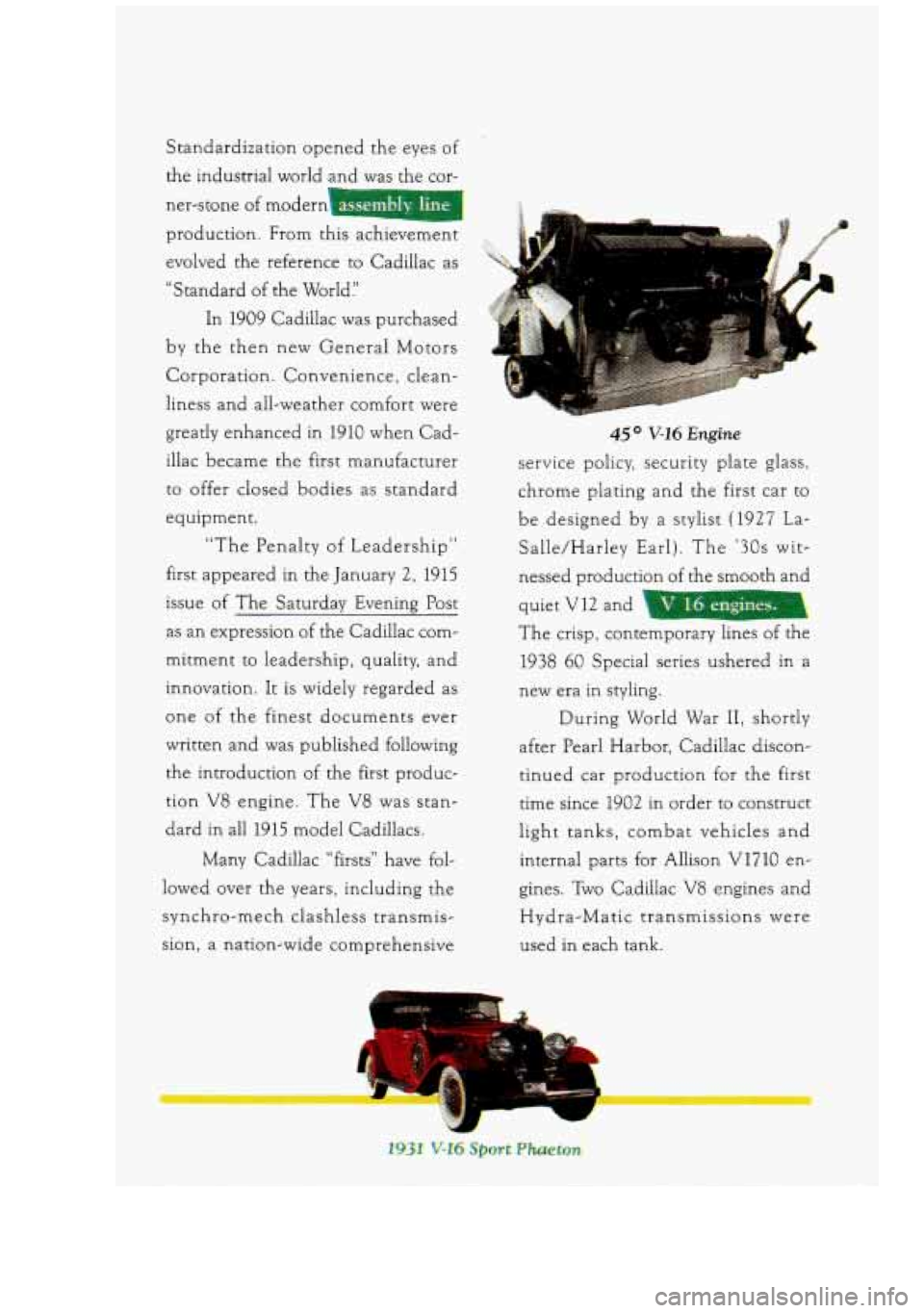
45 O V-16 Engine
service policy, security plate glass,
chrome plating and the first car to
be designed
by a stylist (1927 La-
Salle/Harley Earl). The
’30s wit-
quiet
V12 and
The crisp, contemporary lmes ot the
1938 60 Special series ushered in a
new era in styling.
During World War
11, shortly
after Pearl Harbor, Cadillac discon-
tinued car production for the first
time since
1902 in order to construct
light tanks, combat vehicles and
internal parts for Allison
V1710 en-
gines. Two Cadillac
V8 engines and
Hydra-Matic transmissions were
used in each tank.
Page 9 of 398
b.
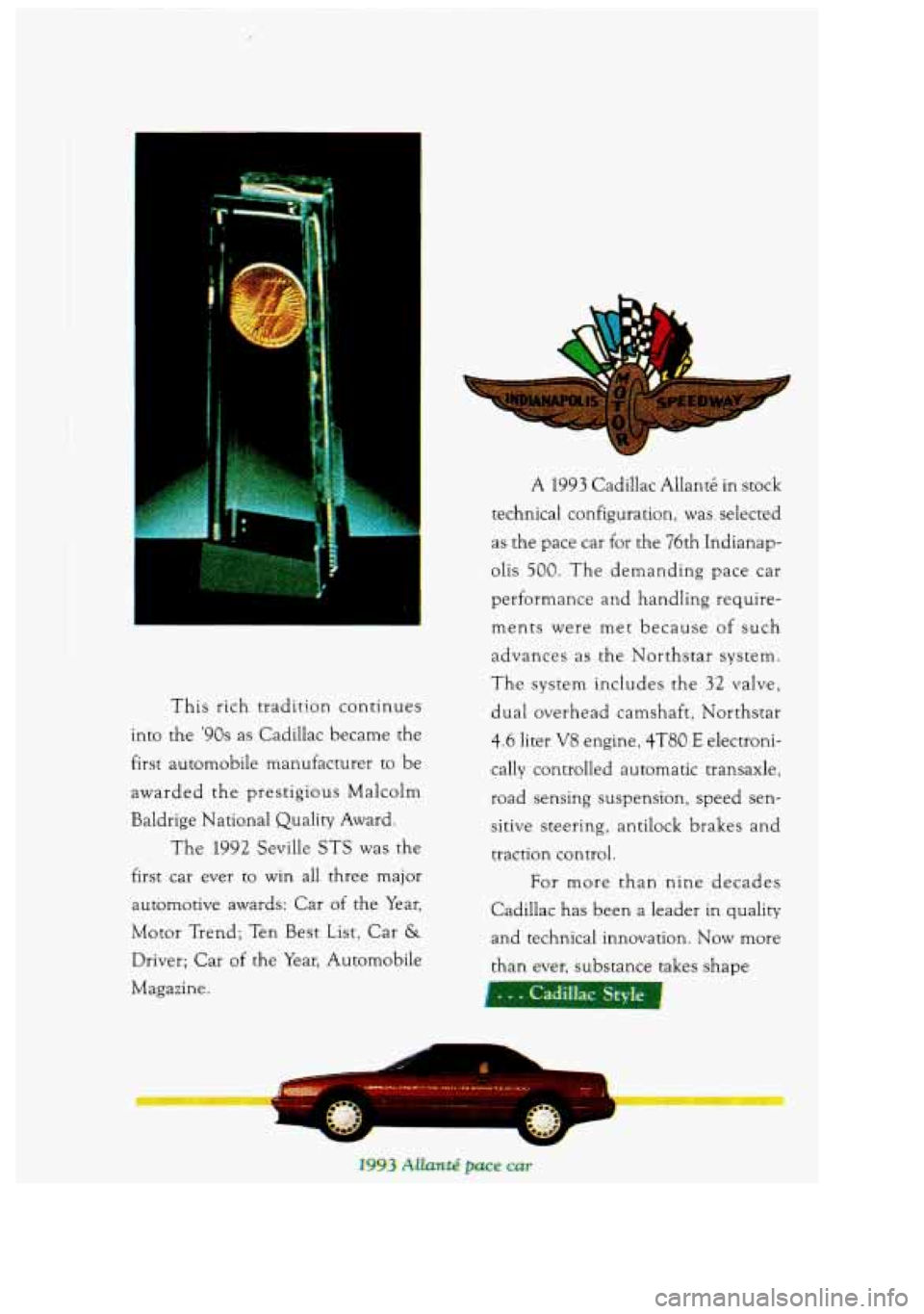
This rich traditi.on continues
into the
'90s as Cadillac became the
first automobile manufacturer to be
awarded the prestigious Malcolm
Baldrige National Quality Award.
The
1992 Seville STS was the
first car ever to win
all three major
automotive awards: Car of the Year,
Motor Trend; Ten Best List, Car
&
Driver; Car of the' Year, Automobile
Magazine.
A
A 1993 Cadillac Allant6 in stock
technical configuration, was selected
as the pace car for the 76th Indianap-
olis
500. The demanding pace car
performance and handling require- ments were met because of such
advances as the Northstar system.
The system includes the
32 valve,
dual overhead camshaft, Northstar
4.6 liter V8 engine, 4T80 E electroni-
cally controlled automatic transaxle,
road sensing suspension, speed sen-
sitive steering, antilock brakes and
traction control.
For more than nine decades
Cadillac has been
a leader in quality
and technical innovation. Now more
than ever, substance takes shape
-1
JI I
-
Page 12 of 398
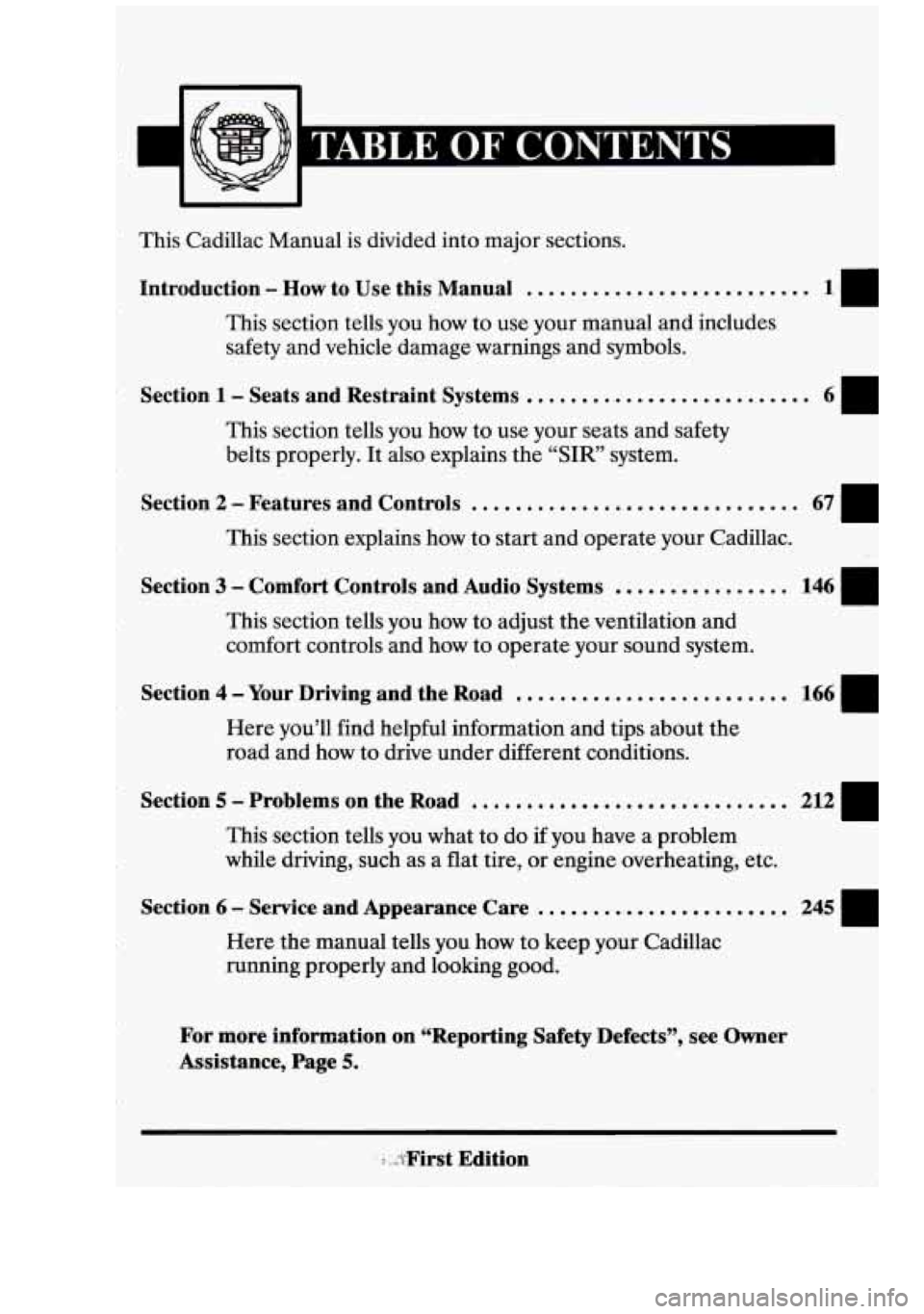
This Cadillac Manual is divided into major sections.
Introduction - How to Use this Manual .......................... lrn
This section tells you how to use your manual and includes
safety and vehicle damage warnings and symbols.
- Section 1 - Seats and Restraint Systems ..........................
This section tells you how to use your seats and safety
belts properly. It also explains the
“SIR” system.
Section 2 - Features and Controls ..............................
This section explains how to start and operate your Cadillac.
67
Section 3 - Comfort Controls and Audio Systems ................ 146 1-1
This section tells you how to adjust the ventilation and
comfort controls and how to operate your sound system.
Section 4 -Your Driving and the Road ......................... 166
Here you’ll find helpful information and tips about the
road and how to drive under different conditions.
-
Section 5 - Problems on the Road ............................. 212
This section tells you what to do if you have a problem
while driving, such as a flat tire, or engine overheating, etc.
Section 6 - Service and Appearance Care ....................... 245 n
Here the manual tells you how to keep your Cadillac
running properly and looking good.
For more information on “Reporting Safety Defects”, see Owner
Assistance, Page
5.
:d?irst Edition
Page 18 of 398
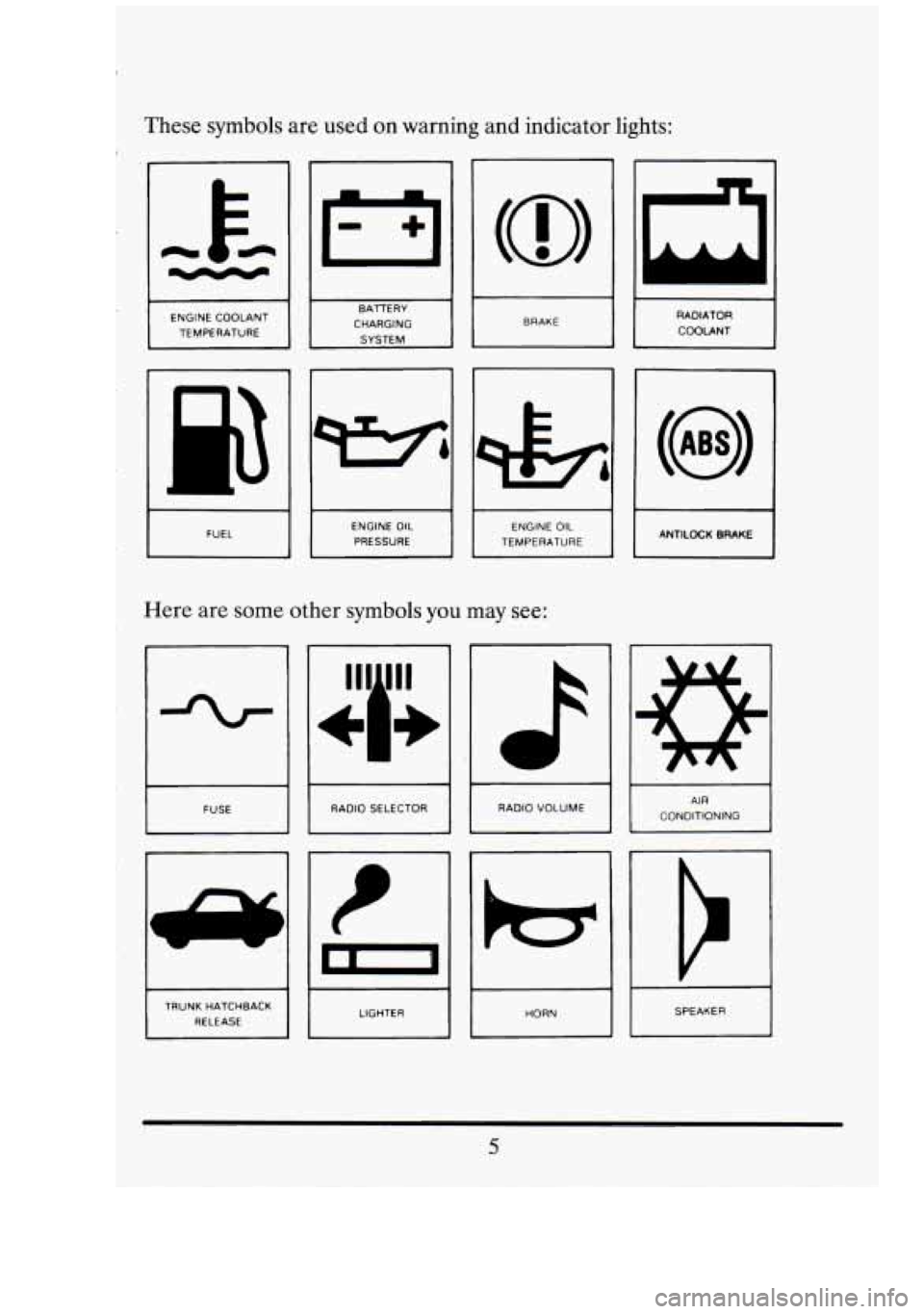
These symbols are used on warning and indicator lights:
-I
I BRAKE I
I
ENGINE COOLANT
TEMPERATURE RADIATOR
COOLANT
CHARGING
1 FUEL 1 I
ENGINE OIL
PRESSURE 1 I
ENGINE OIL
TEMPERATURE I I I ANTILOCK BRAKE
.Here are some other symbols you may see:
-%r
FUSE I RADIO SELECTOR I
RADIO VOLUME AIR
CONDITIONING I
TRUNK HATCHBACK RELEASE SPEAKER
I
Page 86 of 398
Illuminated Entry System
When you lift the door handle, the lights inside your Cadillac will go on.
They’ll go off when you start your engine, or when 30 seconds have
passed. If you vehicle has the Remote Keyless Entry feature, just push
any button on the transmitter.
Leaving Your Vehicle
If you are leaving the vehicle, take your keys, open your door and set the
locks from inside. Then get out and close the door.
If your vehicle has a theft deterrent system, see “Universal Theft
Deterrent’’ in the Index.
Glove Box
The glove box is directly in front of the front passenger seat. To unlock
the door, insert the door key into the lock cylinder and turn it
to the left.
To lock the door, turn the key to the right and remove athe key. The key
may be removed in the locked or unlocked position.
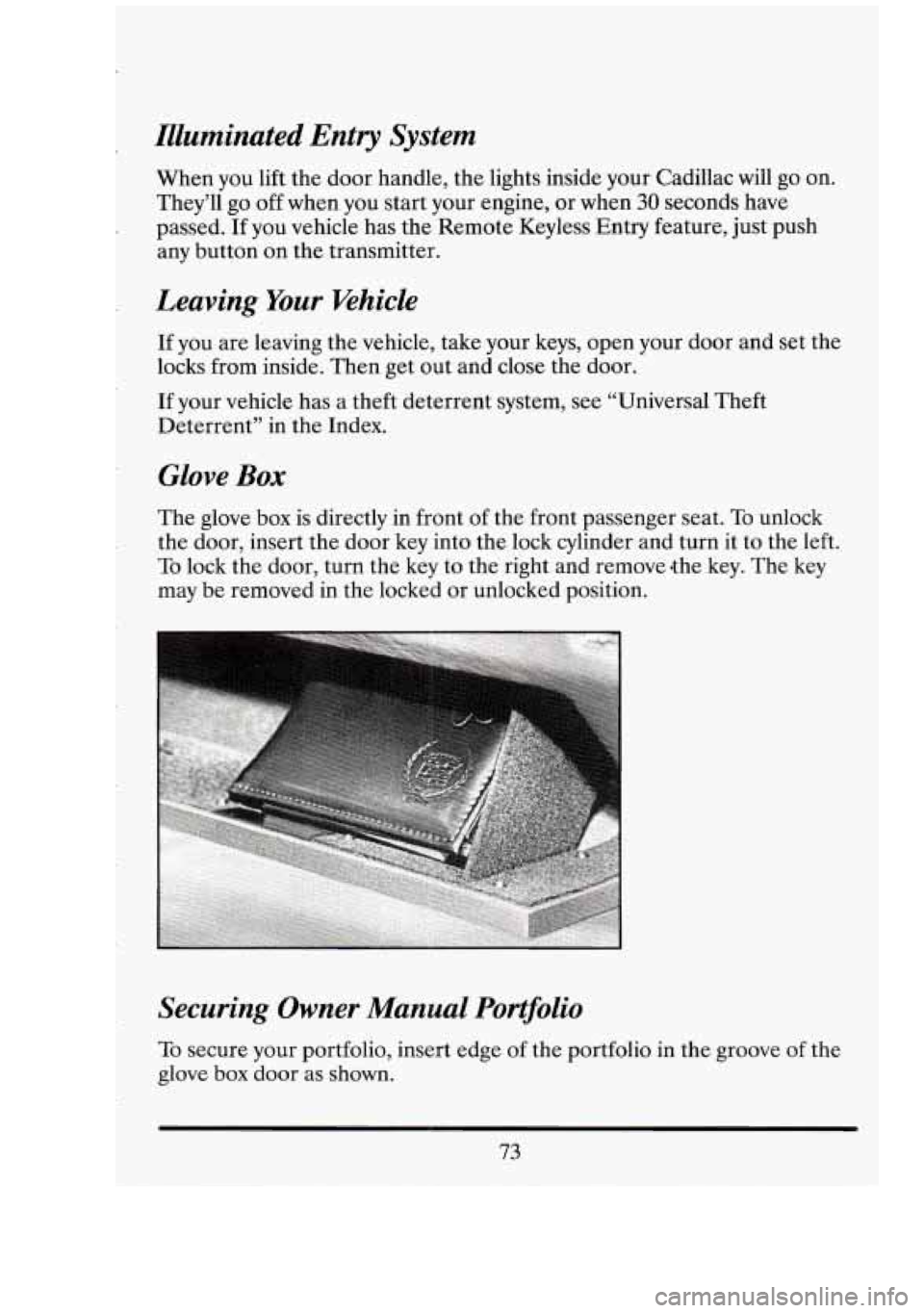
Securing Owner Manual Portfolio
To secure your portfolio, insert edge of the portfolio in the groove of the
glove box door as shown.
73
Page 96 of 398
The alarm won’t stop if you try to unlock a door any other way.
How to Test The Alarm
r 0 From inside the vehicle roll down your window, then get out of your
vehicle keeping the door open.
0 From outside the vehicle with the door open, lock the vehicle using
the power door lock or the Keyless Entry System and close the door.
0 Once the interior lights are off, reach in and unlock the door using the
manual lock. Open the door, the horn will sound and your headlights
will flash.
If the alarm does not sound when it should, check to see
if the horn
works. The horn fuse may be blown. To replace the fuse, see “Fuses and
Circuit Breakers” in the Index.
To reduce the possibility of theft, always arm the theft deterrent system
when leaving your vehicle.
PASS-KEY@II
Your vehicle is equipped with the PASS-Key@II (Personalized
Automotive Security System) theft deterrent system. PASS-Key@II
is a
passive theft deterrent system. This means you don’t have to do anything
different to arm or disarm the system. It works when you insert or remove
the
key from the ignition. PASS-Key@II uses a resistor pellet in the
ignition key that matches a decoder in your vehicle.
When the PASS-Key@II system senses that someone is using the wrong
key, it shuts down the vehicle’s starter and fuel systems. For about three
minutes, the starter won’t work and fuel won’t
go to the engine. If
someone tries to start your vehicle again or uses another key during this
time, the vehicle will not start. This discourages someone from randomly
trying different keys with different resistor pellets in an attempt to make a
match.
The ignition
key must be clean and dry before it’s inserted in the ignition
or the engine may not start. If the engine does not start and and the
“PASS
KEY FAULT” light comes on, the key may be dirty or wet. Turn
the ignition off.
83
Page 97 of 398
Clean and dry the key. If the starter still won’t work, and the key appears
to be clean and dry, wait about three minutes and try the other ignition
key. At this time, you may also want to check the (see “Fuses and Circuit
Breakers” in the Index). If the starter won’t work with the other key, your
vehicle needs service. If your vehicle does start, the first ignition key may
be faulty. See your Cadillac dealer or a locksmith who can service the
PASS-Key@II.
If you accidentally use a
key that has a damaged or missing resistor pellet,
the starter won’t work But you don’t have to wait three minutes before
trying one of the other ignition keys.
See your Cadillac dealer or a locksmith who can service the PASS-Key@II
to have
a new key made.
If you’re ever driving and the “PASS KEY FAULT” light comes on and
stays on, you will be able to restart your engine if you turn it off. Your
PASS-Key@II system, however, is not working properly and must be
serviced by your Cadillac dealer. Your vehicle is not protected by the
PASS-Key@II system.
If you lose or damage a PASS-Key@II ignition ke
, see your Cadillac
dealer or a locksmith who can service PASS-Key I1 to have a new key
made. J
o/
‘U I
84
Page 99 of 398
I
The other positions let you perform these functions:
ACC: Accessory lets you use things like the radio and the windshield
wipers when the engine is
off. To get into “ACC”, push in the key and turn
it toward
you. Yoursteeringwheel will remain locked, just as it was
before you inserted the key.
OFF: This position lets you turn off the engine but still turn the steering
wheel. It doesn’t lock the steering wheel like “Lock.” Use “Off”
if you
must have your car in motion while the engine is
off (for example, if your
car is being pushed).
RUN This is the position for driving.
START This starts your engine.
NOTICE:
If your key seems stuck in “Lock” and you can’t turn it, be sure
it
is all the way in. If it is, then turn the steering wheel left and
right while. you turn the key hard. But turn the key only with
your hand. Using
a tool to force it could break the key or the
ignition switch.
If none of this works, then your vehicle needs
service.
STARTING YOUR ENGINE
Move your shift lever to “P” (Park) or “N” (Neutral). Your,,engine won’t
start in
any other position -- that’s a safety feature. To restart when you’re
already moving, use “N” (Neutral) only.
NOTICE:
Don’t try to shift to “P” (Park).. if your Cadillae is moving. If you
do, you could .damage the transmission. Shift to “P” (Park) only
when your vehicle
is stopped. ”. .
1
W I
D
I
I
-
Page 100 of 398
To start vour V8 engine:
1. Without pushing the accelerator pedal, turn your ignition key to
“Start.” When the engine starts, let
go of the key. The idle speed will
go down as your engine gets warm.
NOTICE:
Holding your key in “Start” for longer than 15 seconds at a time
will cause your battery to be drained much sooner.
And the
excessive heat can damage your starter motor.
2. If it doesn’t start within 3 seconds, push the accelerator pedal about
one-third of the way down, while you hold the ignition key
in “Start.”
When the engine starts, let go of the
key and let up on the accelerator
pedal. Wait about
15 seconds between each try to help avoid draining
your battery.
When starting your engine in very cold weather (below
O°F or -18 C), do
this:
1. With your foot off the accelerator pedal, turn the ignition key to
“Start” and hold it there. After two seconds, push the accelerator
pedal about one-third of the way down. When the engine starts, let go
of the key. Use the accelerator pedal to maintain engine speed, if you
have to, until your engine has run for a while.
2. If your engine still won’t start (or starts but then stops), it could be
flooded with too much gasoline. Try pushing your a,ccelerator pedal all
the way to the floor and holding it there as you hold the key in “Start”
for about three seconds.
If the vehicle starts briefly but then stops
again, do the same thing, but this time keep the pedal down for five or
six seconds. This clears the extra gasoline from the engine.
87
Page 101 of 398
NOTICE:
Your engine is designed to work with the electronics in your
vehicle.
If you add electrical parts or accessories, you could
change the
way the fuel injection system operates. Before
adding electrical equipment, check with your dealer.
If you
don’t, your engine might not perform properly.
If you ever have to have your vehicle towed, see the part
of this
manual that tells how to do it without damaging your vehicle.
See “Towing Your Vehicle’’ in the Index.
I
L
DmNG THROUGH DEEP STMDING
WATER
NOTICE:
If you drive too quickly through deep puddles or standing water,
water can come in through your engine’s
air intake and badly
damage your engine.
If you can’t avoid deep puddles or standing
water, drive through them very slowly.