overheating CADILLAC FLEETWOOD 1994 Owners Manual
[x] Cancel search | Manufacturer: CADILLAC, Model Year: 1994, Model line: FLEETWOOD, Model: CADILLAC FLEETWOOD 1994Pages: 398, PDF Size: 19.19 MB
Page 12 of 398
This Cadillac Manual is divided into major sections.
Introduction - How to Use this Manual .......................... lrn
This section tells you how to use your manual and includes
safety and vehicle damage warnings and symbols.
- Section 1 - Seats and Restraint Systems ..........................
This section tells you how to use your seats and safety
belts properly. It also explains the
“SIR” system.
Section 2 - Features and Controls ..............................
This section explains how to start and operate your Cadillac.
67
Section 3 - Comfort Controls and Audio Systems ................ 146 1-1
This section tells you how to adjust the ventilation and
comfort controls and how to operate your sound system.
Section 4 -Your Driving and the Road ......................... 166
Here you’ll find helpful information and tips about the
road and how to drive under different conditions.
-
Section 5 - Problems on the Road ............................. 212
This section tells you what to do if you have a problem
while driving, such as a flat tire, or engine overheating, etc.
Section 6 - Service and Appearance Care ....................... 245 n
Here the manual tells you how to keep your Cadillac
running properly and looking good.
For more information on “Reporting Safety Defects”, see Owner
Assistance, Page
5.
:d?irst Edition
Page 25 of 398
3
firmly pull the restraint forward again until it releases to the
full-rearward position.
Now slowly move the restraint forward until
you reach a comfortable position.
You should hear a clicking sound as 1
the restraint moves forward.
-
Articulating: Head restraint can be adjusted by holding both sides and 7
gently rotating in a fore/aft direction. I*
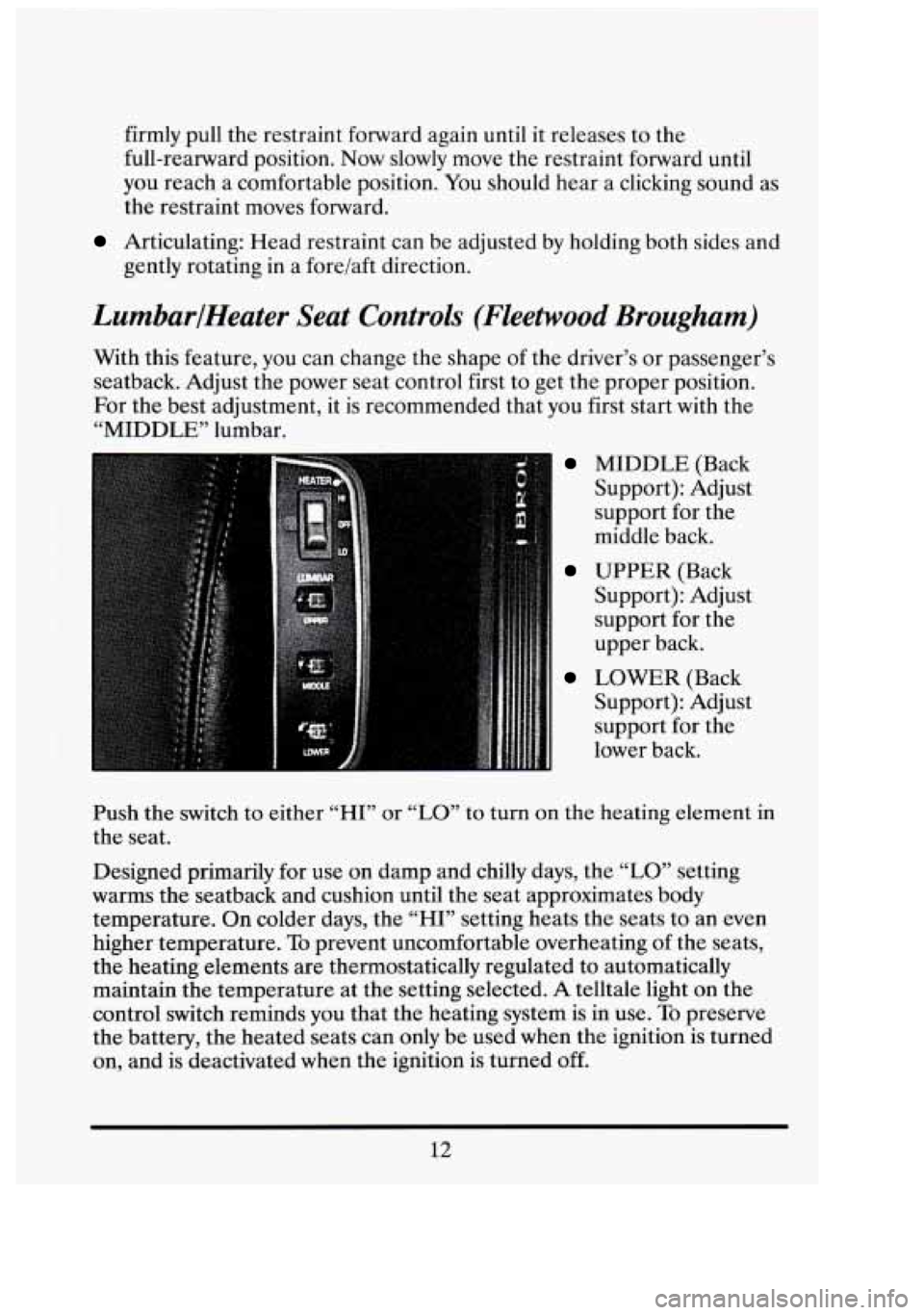
LumbarIHeater Seat Controls (Fleetwood Brougham)
With this feature, you can change the shape of the driver’s or passenger’s
seatback. Adjust the power seat control first to get the proper position.
For the best adjustment, it is recommended that you first start with the
“MIDDLE” lumbar.
MIDDLE (Back
Support): Adjust
support for the
middle back.
UPPER (Back
Support): Adjust
support for the
upper back.
LOWER (Back
Support): Adjust
support for the
lower back.
Push the switch to either
“HI” or “LO” to turn on the heating element in
the seat.
Designed primarily for use on damp and chilly days, the
“LO” setting
warms the seatback and cushion until the seat approximates body
temperature.
On colder days, the “HI” setting heats the seats to an even
higher temperature.
To prevent uncomfortable overheating of the seats,
the heating elements are thermostatically regulated to automatically
maintain the temperature at the setting selected. A telltale light on the
control switch reminds
you that the heating system is in use. To preserve
the battery, the heated seats can only be used when the ignition is turned
on, and is deactivated when the ignition is turned
off.
12
- 9
-1
2
I
1
’!
3
Page 149 of 398
NOTICE:
Spinning your wheels when the “Tkaction Disabled” light comes
on can destroy parts of your vehicle .as well as the tires. If you
spin your .wheels
too fast while shifting your transmission back
and forth, you can destroy your transmission. When you’re
stuck., spin the wheels as little as possible.
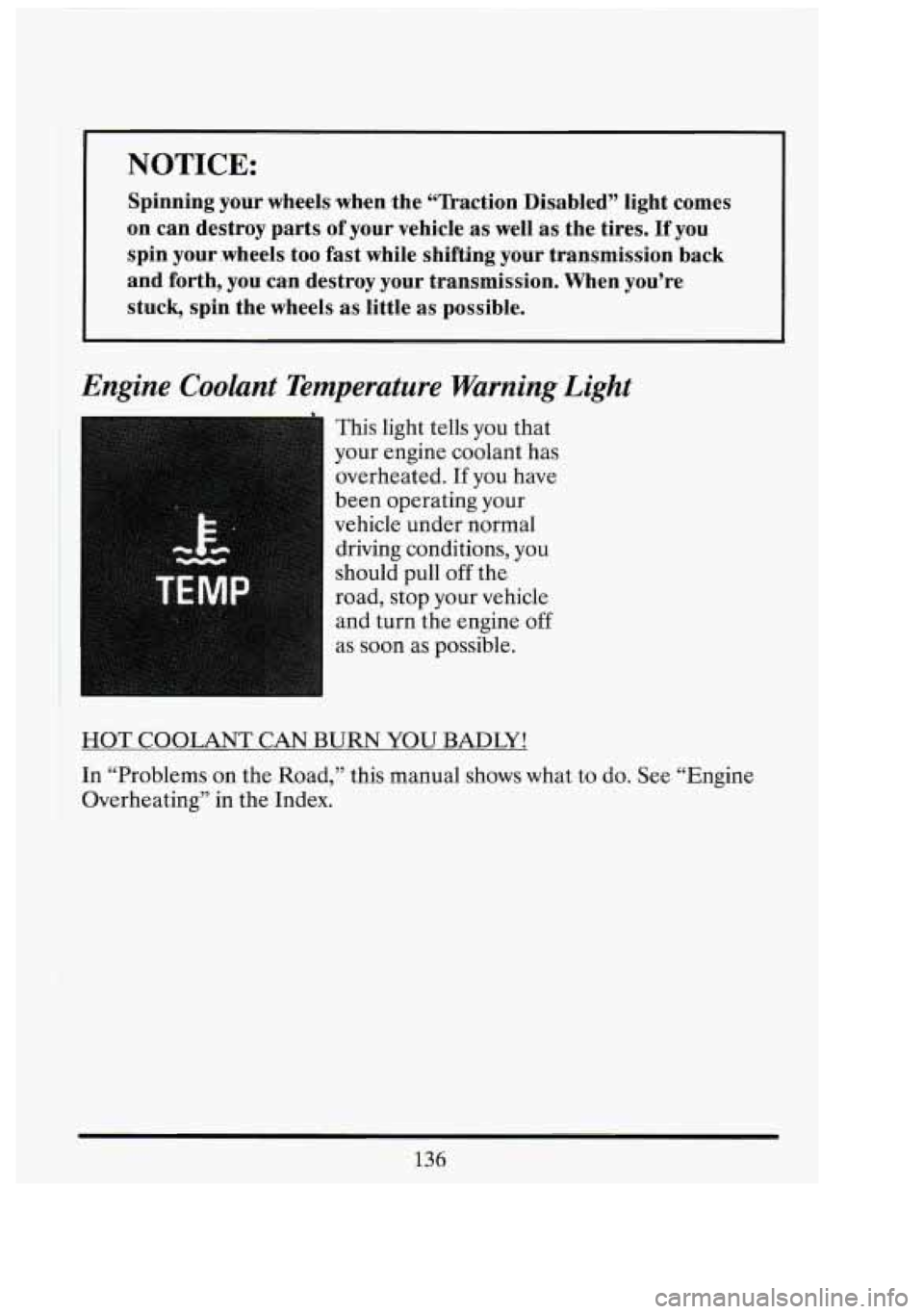
Engine Coolant Temperature Warning’Light
This light tells you that
your engine coolant has
overheated.
If you have
been operating your
vehicle under normal
driving conditions, you
should pull
off the
road, stop your vehicle
and turn the engine
off
as soon as possible.
HOT COOLANT CAN BURN YOU BADLY!
In “Problems
on the Road,” this manual shows what to do. See “Engine
Overheating” in the Index.
136
3
n
u
n
141
i
Page 223 of 398
On a long uphill grade, shift down to a lower gear and reduce your speed
and reduce your speed to around
45 mph (70 km/h) to reduce the
possibility of engine and transmission overheating.
If your trailer weighs more than
2,000 pounds (908 kg), you should drive
in “D or 3” instead of Overdrive. This allows the torque convertor clutch
to engage and allowing the transmission to run cooler.
Parking on Hills
You really should not park your vehicle, and trailer on a hill. If something
goes wrong your rig could start to move. People can be injured and both
I your vehicle and the trailer can be damaged.
If you eve1 have to park your rig on a hill, here’s how to do it:
Apply your regular brakes, but don’t shift into “P7, (Park) yet.
I Have someone place chocks (tapered triangular blocks) under the
downhill side the trailer wheels.
When the wheel chocks are in place, release the regular brakes until
Reapply the regular brakes. Then shift into “P” (Park) and apply the
Release the regular brakes.
the
chocks absorb the load.
parking brake.
When You Are Ready to Leave Afier Parking on a Hill
1. Apply your regular brakes and hold the pedal down while you:
Start your engine;
Shift into a gear; and
Be sure the parking brake has released.
2. Release the brake pedal.
3. Drive slowly until the trailer is clear of the chocks.
iI;
n
Gi
I B
h I1
-1
l
U1
a‘ I
210
4. Stop and have someone pick up and store the chocks.
Page 239 of 398
I
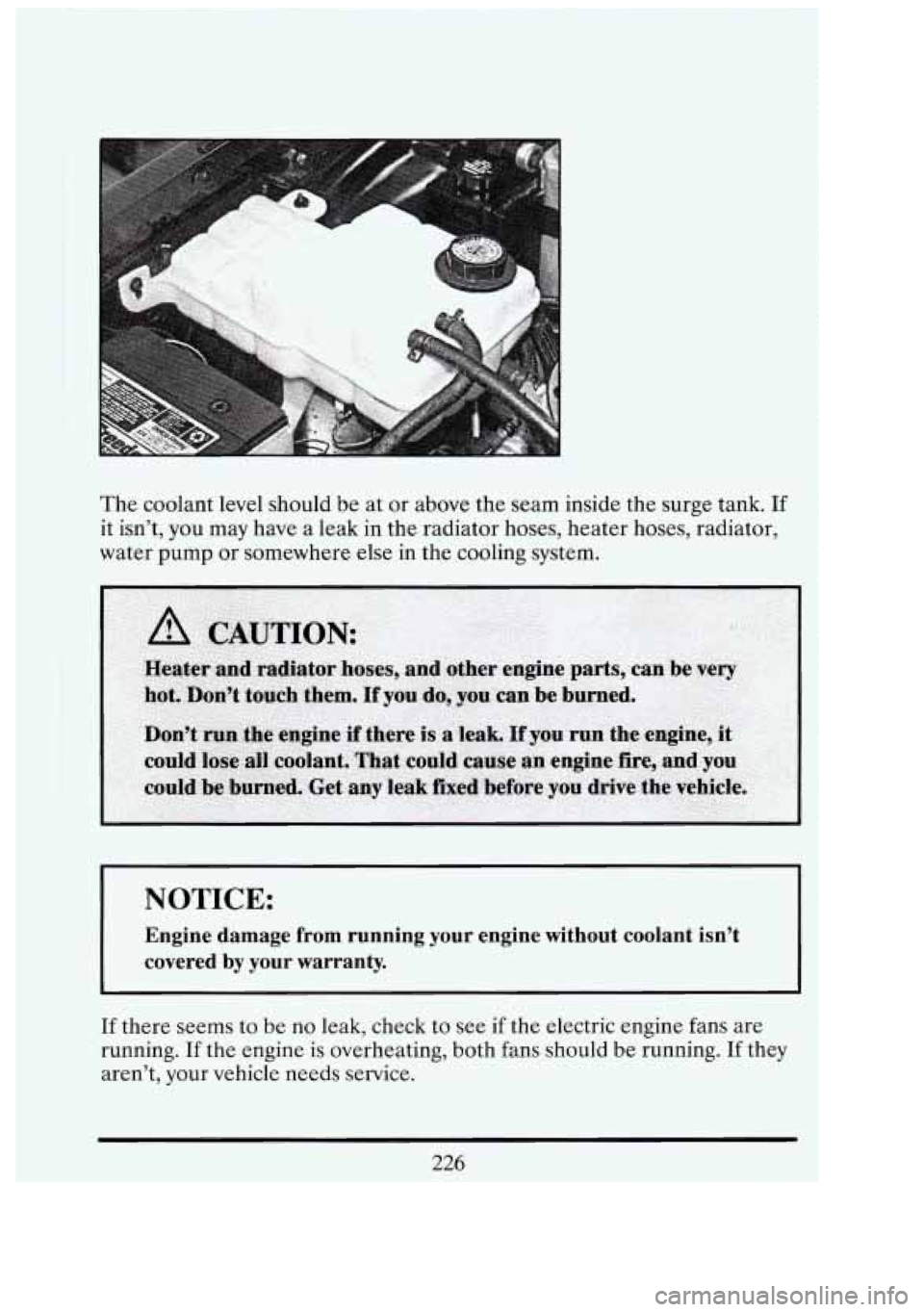
The coolant level should be at or above the seam inside the surge tank. If
it isn’t, you may have a leak in the radiator hoses, heater hoses, radiator,
water pump or somewhere else in the cooling system.
NOTICE:
Engine damage from running your engine without coolant isn’t \
covered
by your warranty.
If there seems to be no leak, check to see if the electric engine fans are
running.
If the engine is overheating, both fans should be running. If they
aren’t, your vehicle needs service.
226
Pl i
Page 279 of 398
What to Use
Standard Differential
Use Axle Lubricant (GM Part No. 1052271) or SAE 8OW-90 GL-5 gear
lubricant.
ENGINE COOLANT
The following explains your cooling system and how to add coolant when
it is low. If you have a problem with engine overheating, see “Engine
Overheating” in the Index.
The proper coolant for your Cadillac
will:
Give freezing protection down to -34 F (-37 C).
Give boiling protection up to 262 F (128 C).
Protect against rust and corrosion.
Help keep the proper engine temperature.
I Let the warning lights work as they should.
1 What to Use
Use a mixture of one-half clean water (preferably distilled) and one-half
antifreeze that meets “GM Specification 1825-M,” which won’t damage
aluminum parts.
You can also use a recycled coolant conforming to GM
Specification 1825-M with a complete coolant flush and refill. Use GM
Engine Coolant Supplement (sealer) with any complete coolant change.
If you use this mixture, you don’t need to add anything else.
c
I
I
31
Page 282 of 398
When replacing the pressure cap, make sure it is tight.
SURGE TANK PRESSURE CAP
NOTICE:
Your surge tank cap is a 15 psi (105 kPa) pressure-type cap and
must be tightly installed to prevent coolant loss and possible
engine damage from overheating. Be sure the arrows on the cap \
line up with the
overflow tube on the radiator filler neck.
When you replace your surge tank pressure cap, an GM cap is
recommended.
THERMOSTAT
Engine coolant temperature is controlled by a thermostat in the engine
coolant system. The thermostat stops the
flow of coolant through the
radiator until the coolant reaches a preset temperature.
When you replace your thermostat, an
AC@ thermostat is recommended.
269
Page 384 of 398
.
n
I
.
.
.
1
. .
.
.
Drunken ....................................... 167
Hill and Mountain
............................... 194
In A Foreign Country
............................ 248
In Cities
........................................ 190
On Snow Or Ice
................................. 197
In The Rain
..................................... 187
InWinter
....................................... 196
On A Long Trip
................................. 192
On The Freeway
................................. 191
OnCurves
...................................... 179
Through Deep Standing Water
...................... 88
With A Trailer ................................... 208
Drunken Driving
................................... 167
Electric Outside Mirror Control
...................... 123
Electrical Equipment. Adding
.................... 152. 311
Electronic Climate Control
.......................... 147
Electronic Level Control
............................ 143
Electronic Solar Sensor
............................. 150
Emergencies. Braking in
............................. 179
Emergencies. Steering In
............................ 180
Emergency Starting. Discharged Battery ............... 214
Emergency Towing
................................. 219
Engine Block Heater
.................................... 89
Coolant
........................................ 266
Coolant Heater
................................... 89
Exhaust
........................................ 100
Oil
............................................ 254
Oil Additives
.................................... 260
Oil Pressure Light ............................... 137
Oil. When
To Change ............................. 260
Overheating
.................................... 223
Warning Light About Need For Service
............. 142
Englishwetric Button
............................... 130
Ethanol In Gasoline
................................ 247
Exhaust. Caution
................................... 100
Exhaust. Dangerous Gas In ...................... 100. 200
Exhaust. Engine
.................................... 100
Expectant Mothers. Use Of Safety Belts By
.............. 38
Explanation
of Maintenance Service ........ See Maint . Book
Express Down Window (Driver’s Side)
................. 103
Expressway Driving
................................. 191
Extender. Safety Belt
................................ 65
Coolant Temperature
Warning Lights
............... 136
StartingYour
.................................... 86
5