lock CADILLAC FLEETWOOD 1996 2.G User Guide
[x] Cancel search | Manufacturer: CADILLAC, Model Year: 1996, Model line: FLEETWOOD, Model: CADILLAC FLEETWOOD 1996 2.GPages: 306, PDF Size: 15.72 MB
Page 65 of 306
Downloaded from www.Manualslib.com manuals search engine 'Keyless Entry System
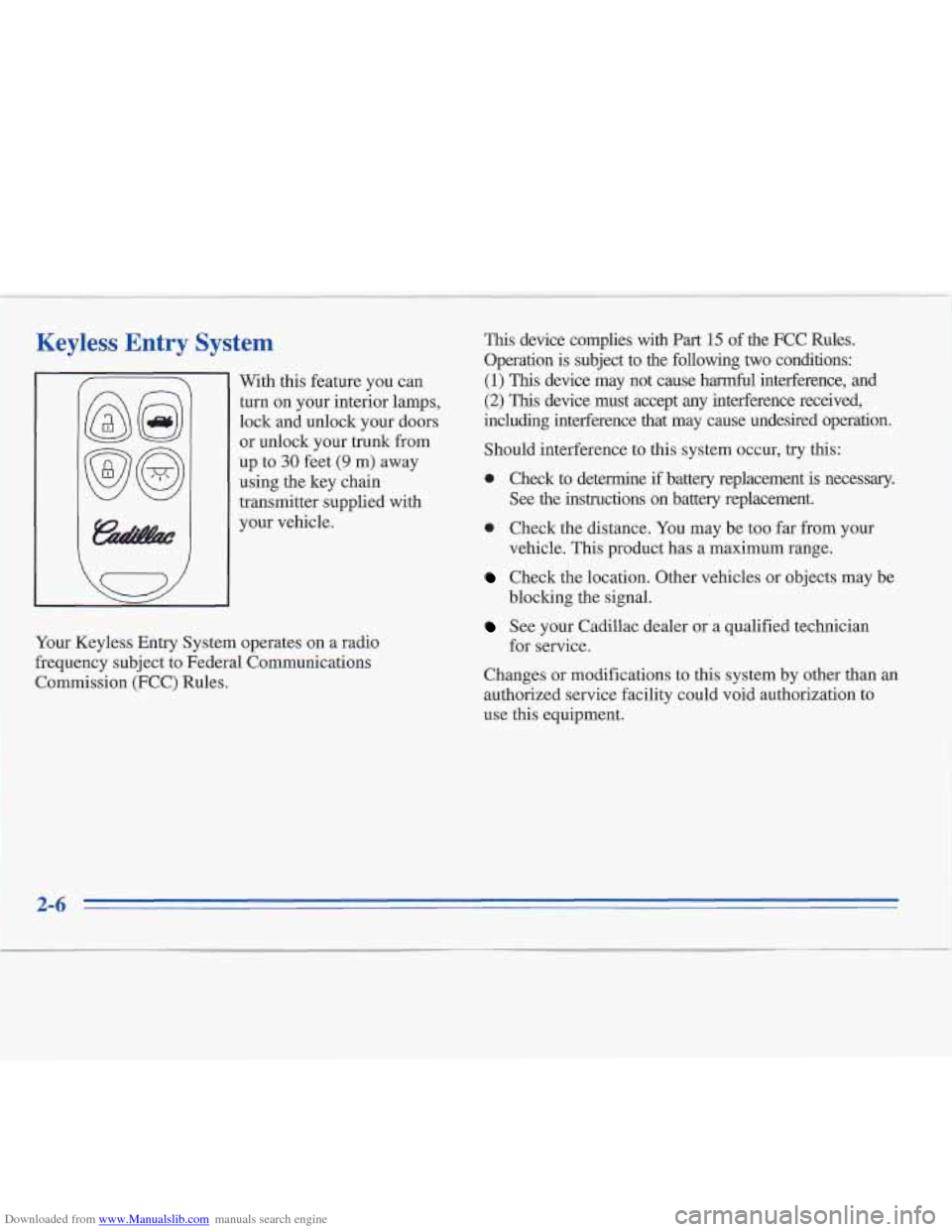
With this feature you can
turn on your interior lamps,
lock and unlock your doors
or unlock your trunk G-om
up
to 30 feet (9 m) away
using the key chain
transmitter supplied with
your vehicle.
Your Keyless Entry System operates on
a radio
frequency subject to Federal Communications
Commission (FCC) Rules.
This device complies with Part 15 of the FCC Rules.
Operation is subject to the following two conditions:
(1) This device may not cause harmful interference, and
(2) This device must accept any interference received,
including interference that may cause undesired operation.
Should interference
to this system occur, try this:
0 Check to determine if battery replacement is necessary.
See the instructions on battery replacement.
0 Check the distance. You may be too far from your
vehicle. This product has a maximum range.
Check the location. Other vehicles or objects may be
blocking the signal.
See your Cadillac dealer or a qualified technician
for service.
Changes or modifications to this system by other than an authorized service facility could void authorization to
use this equipment.
2-6
Page 66 of 306
Downloaded from www.Manualslib.com manuals search engine Operation
Press the unlock symbol to unlock the driver’s door.
Press
it again within five seconds to unlock the other
doors. Pressing this symbol will also disarm the optional
Theft-Deterrent System and
turn on the interior lamps.
Press the lock symbol to lock your doors. This also arms
the optional Theft-Deterrent System.
Press the opened trunk symbol to open the trunk.
Press the lamp symbol to turn on the interior lamps only.
Matching Transmitter(s) To Your Vehicle
Each key chain transmitter is coded to prevent another
transmitter from unlocking your vehicle.
If a transmitter
is lost or stolen,
a replacement can be purchased through
your dealer. Remember to bring any remaining
transmitters with you when you go to your dealer. When
the dealer matches the replacement transmitter to your
vehicle, any remaining transmitters must also be
matched. Once the new transmitter is coded, the lost
transmitter will not unlock your vehicle. Each vehicle
can have only two transmitters matched to it.
Battery Replacement
Under normal use, the batteries in your key chain
transmitter should last about two years.
You can tell the batteries are weak if the transmitter
won’t work at the normal range in any location. If you
have to get close to your vehicle before the transmitter
works, it’s probably time to change the batteries.
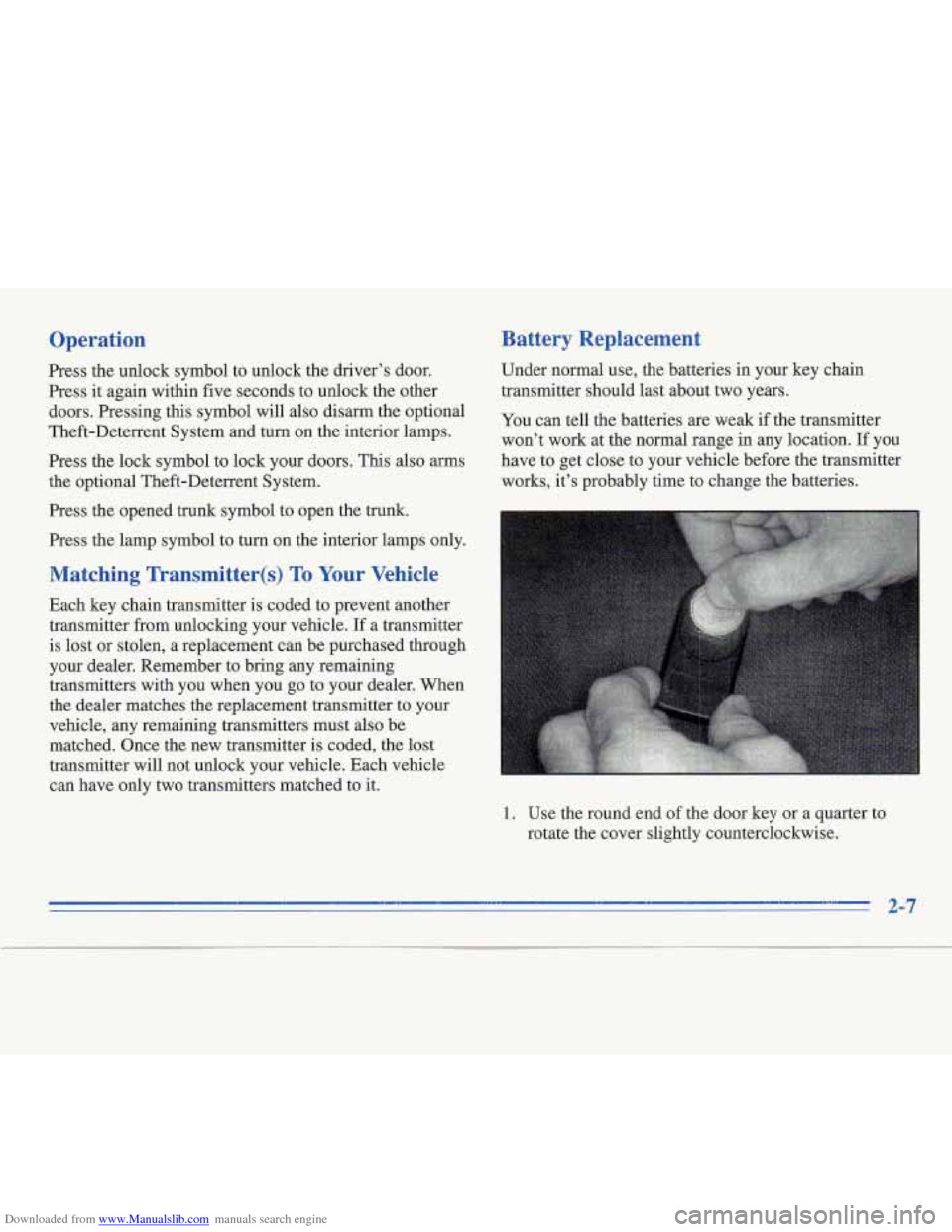
1. Use the round end of the door key or a quarter to
rotate the cover slightly counterclockwise.
Page 69 of 306
Downloaded from www.Manualslib.com manuals search engine Theft Parking at Night
Vehicle theft is big business, especially in some cities.
Although your Cadillac has a number of theft-deterrent
features, we know that nothing we put
on it can make it
impossible to steal. However, there are ways you can help.
Key in the Ignition
If you leave your vehicle with the keys inside, it’s an
easy target for joy riders or professional thieves
-- so
don’t do it.
When you park your Cadillac and open the driver’s
door, you’ll hear a chime reminding you to remove your
key from the ignition and take it with you. Always do
this. Your
steering wheel will be locked, and so will
your ignition and transmission. And remember to lock
the doors. Park in
a lighted spot, close all windows and lock your
vehicle. Remember to keep your valuables out of sight.
Put them in a storage area, or take them with you.
Parking Lots
If you park in a lot where someone will be watching
your vehicle, it’s best to lock
it up and take your keys.
But what if you have to leave your ignition key? What if
you have to leave something valuable in your vehicle?
Put your valuables in a storage area, like your trunk
or glove box.
0 Lock the glove box.
Lock all the doors except the driver’s.
Then take the door key and Keyless Entry key chain
with you.
Page 70 of 306
Downloaded from www.Manualslib.com manuals search engine Tbeft-Deterrent System (Option)
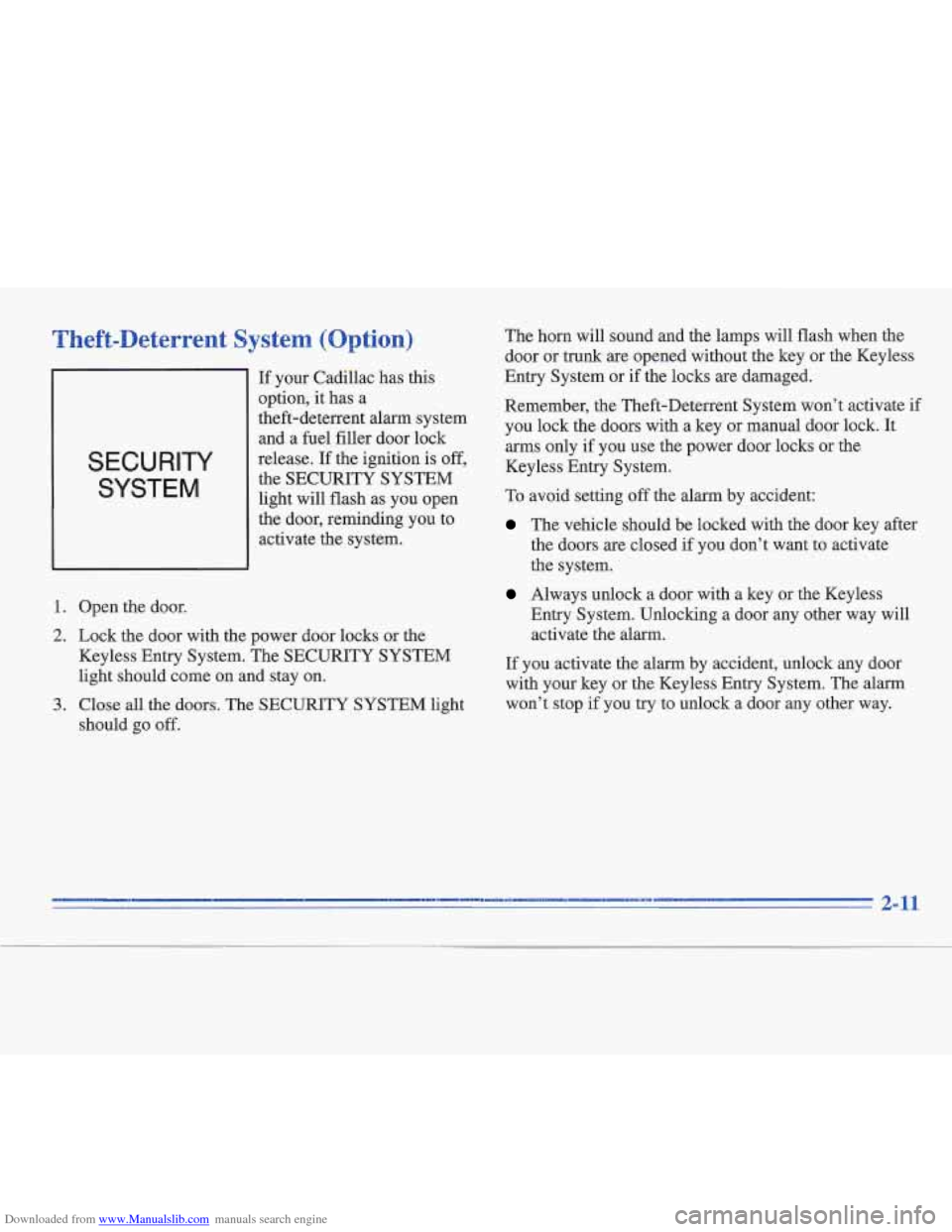
SECURITY
SYSTEM
If your Cadillac has this
option, it has a
theft-deterrent alarm system
and a
fuel filler door lock
release.
If the ignition is off,
the SECURITY SYSTEM
light will flash as you open
the door, reminding you to
activate the system.
1. Open the door.
2. Lock the door with the power door locks or the
Keyless Entry System. The SECURITY SYSTEM
light should come on and stay on.
3. Close all the doors. The SECURITY SYSTEM light
should go
off.
The horn will sound and the lamps will flash when the
door or trunk are opened without the key or the Keyless
Entry System or if the locks are damaged.
Remember, the Theft-Deterrent System won’t activate if
you lock the doors with a key or manual door lock. It
arms only
if you use the power door locks or the
Keyless Entry System.
To avoid setting off the alarm by accident:
The vehicle should be locked with the door key after
the doors are closed
if you don’t want to activate
the system.
Always unlock a door with a key or the Keyless
Entry System. Unlocking a door any other way will
activate the alarm.
If you activate the alarm by accident, unlock any door
with your key or the Keyless Entry System. The alarm
won’t
stop if you try to unlock a door any other way.
Page 71 of 306
Downloaded from www.Manualslib.com manuals search engine Testing the Alarm
1.
2.
3.
From inside the vehicle, roll down your window,
then get out of your vehicle, keeping the door open.
From outside the vehicle with the door open, lock
the vehicle using the power door lock or the Keyless
Entry System and close the door.
Once the interior lamps are
off, reach in and unlock
the door using the manual lock. Open the door and
the horn will sound and your headlamps will flash.
If the alarm does not sound when it should, check to see if
the horn works. The
horn fuse may be blown. To replace
the fuse, see “Fuses and Circuit Breakers” in the Index. \
To reduce the possibility of theft, always arm the
Theft-Deterrent System when leaving your vehicle.
PASS-K~J~ 11
Your vehicle is equipped
with the PASS-Key
I1
(Personalized Automotive
Security System)
theft-deterrent system.
PASS-Key
I1 is a passive
theft-deterrent system. It
works when you insert or
remove the key from
the ignition.
PASS-Key
II uses a resistor pellet in the ignition key
that matches a decoder in your vehicle.
When the PASS-Key
11 system senses that someone is
using the wrong key, it shuts down
the vehicle’s starter and
fuel systems. For about three minutes, the starter won’t
work and fuel won’t go to the engine.
If someone tries to
start your vehicle again or uses another key during this
time, the vehicle will not start. This discourages someone
from randomly trying different keys
with different resistor
pellets
in an attempt to make a match.
2-12
I
Page 72 of 306
Downloaded from www.Manualslib.com manuals search engine The ignition key must be clean and dry before it’s inserted
in the ignition or the engine may not start. If the engine
does not
start and the PASS KEY FAULT light comes on,
the key may be
drty or wet. Turn the ignition off.
Clean and dry the key. Wait about three minutes and try
again. The PASS KEY FAULT light may remain on
during this time. If the starter still won’t work, and the
key appears to be clean and dry, wait about three
minutes and try another ignition key. At this time, you
may also want to check the fuse (see “Fuses and Circuit
Breakers” in the Index).
If the starter won’t work with
the other key, your vehicle needs service.
If your vehicle
does start, the first ignition key may be faulty. See your
Cadillac dealer or a locksmith who can service the
PASS-Key
II.
If you accidentally use a key that has a damaged or
missing resistor pellet, the starter won’t work and the
PASS
KEY FAULT light will flash. But you don’t have
to wait three minutes before trying another ignition key.
See your Cadillac dealer or a locksmith who can service
the PASS-Key
11 to have a new key made.
If you’re ever driving and the PASS KEY FAULT light
comes on and stays on, you will be able to restart your
engine if you turn
it off. Your PASS-Key I1 system,
however, is not working properly and must be serviced
by your Cadillac dealer. Your vehicle
is not protected by
the PASS-Key
11 system.
If
you lose or damage a PASS-Key 11 ignition key, see
your Cadillac dealer or a locksmith who can service
PASS-Key
11 to have a new key made.
2-13
Page 73 of 306
Downloaded from www.Manualslib.com manuals search engine Ignition Key Positions
NOTICE:
Your modern Cadillac doesn’t need an elaborate
“break-in.” But
it will perform better in the long
run
if you follow these guidelines:
Keep your speed at 55 mph (88 km/h) or
less for the first
500 miles (804 km).
Don’t drive at any one speed -- fast or
slow
-- for the first 500 miles (804 km).
Don’t make full-throttle starts.
200 miles (322 km) or so. During this time
your new brake linings aren’t yet broken
in. Hard stops with new linings can mean
premature wear and earlier replacement.
Follow this breaking-in guideline every
time you get new brake linings.
* Don’t tow a trailer during break-in. See
“Towing a Trailer” in the Index for more
information.
Avoid making hard stops for the first
C
A E
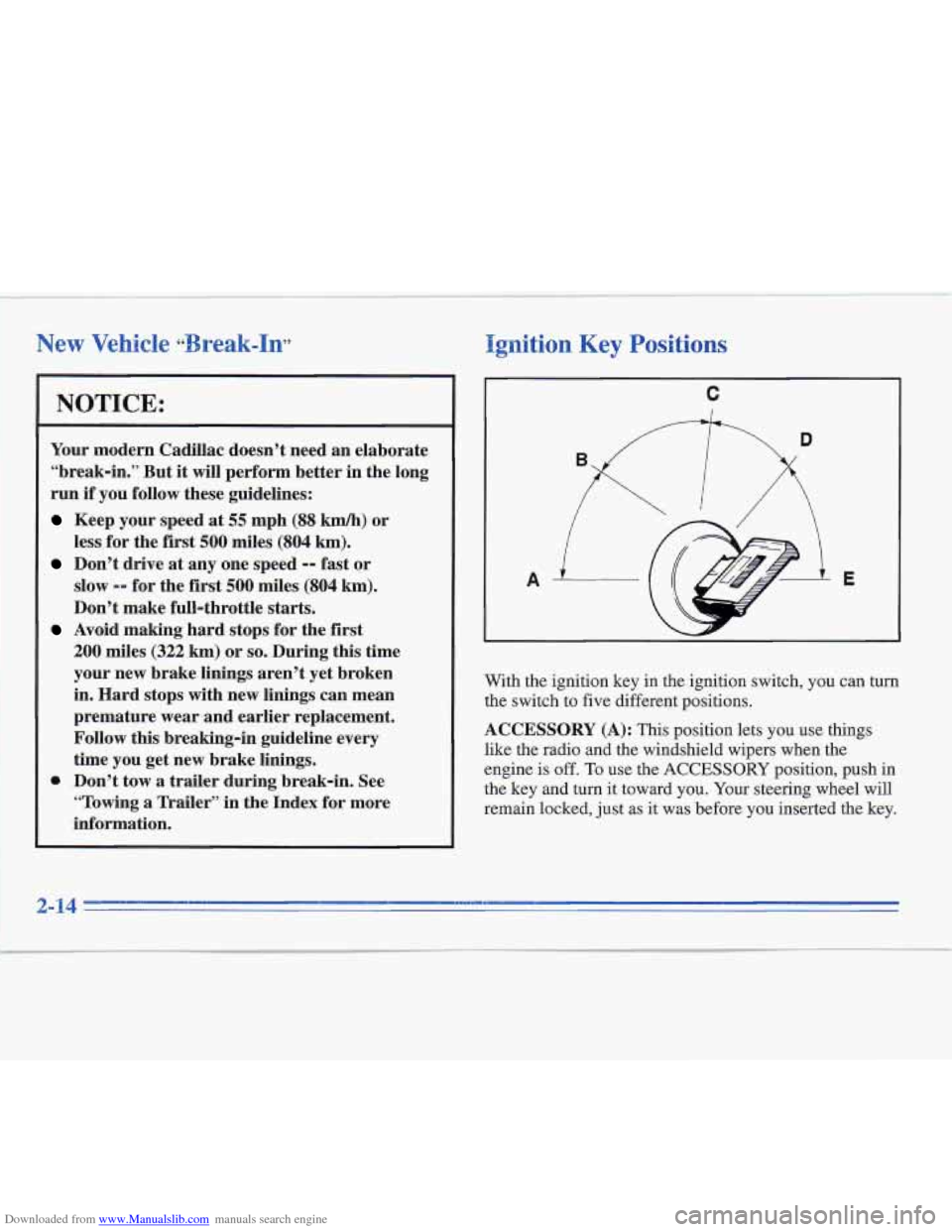
With the ignition key in the ignition switch, you can turn
the switch to five different positions.
ACCESSORY (A): This position lets you use things
like the radio and the windshield wipers when the
engine is off.
To use the ACCESSORY position, push in
the key and turn it toward you. Your steering wheel will
remain locked, just
as it was before you inserted the key.
Page 74 of 306
Downloaded from www.Manualslib.com manuals search engine LOCK (B): Before you put the key in, your ignition
will be in the
LOCK position. This is the only position
in which you can remove the key. This position locks
your ignition, steering wheel and transmission. It’s a
theft-deterrent feature.
OFF (C): This position unlocks the steering wheel,
ignition and transmission but doesn’t send electrical
power to any accessories. Turn the key
to the OFF
position if you must have your vehicle in motion while
the engine is
off.
RUN (D): This is the position for driving.
START (E): This key position starts your engine.
Note that even if
the engine is not running, the positions
ACCESSORY and RUN allow you to operate your
electrical accessories, such as the radio and ventilation fan.
.~ ~
NOTICE:
If your key seems stuck in LOCK and you can’t
turn it, be sure it
is all the way in. If it is, then
turn the steering wheel left and right while you
turn the key hard. But turn the key only with
your hand. Using a tool to force
it could break
the key or the ignition switch.
If none of this
works, then your vehicle needs service.
Page 83 of 306
Downloaded from www.Manualslib.com manuals search engine 4
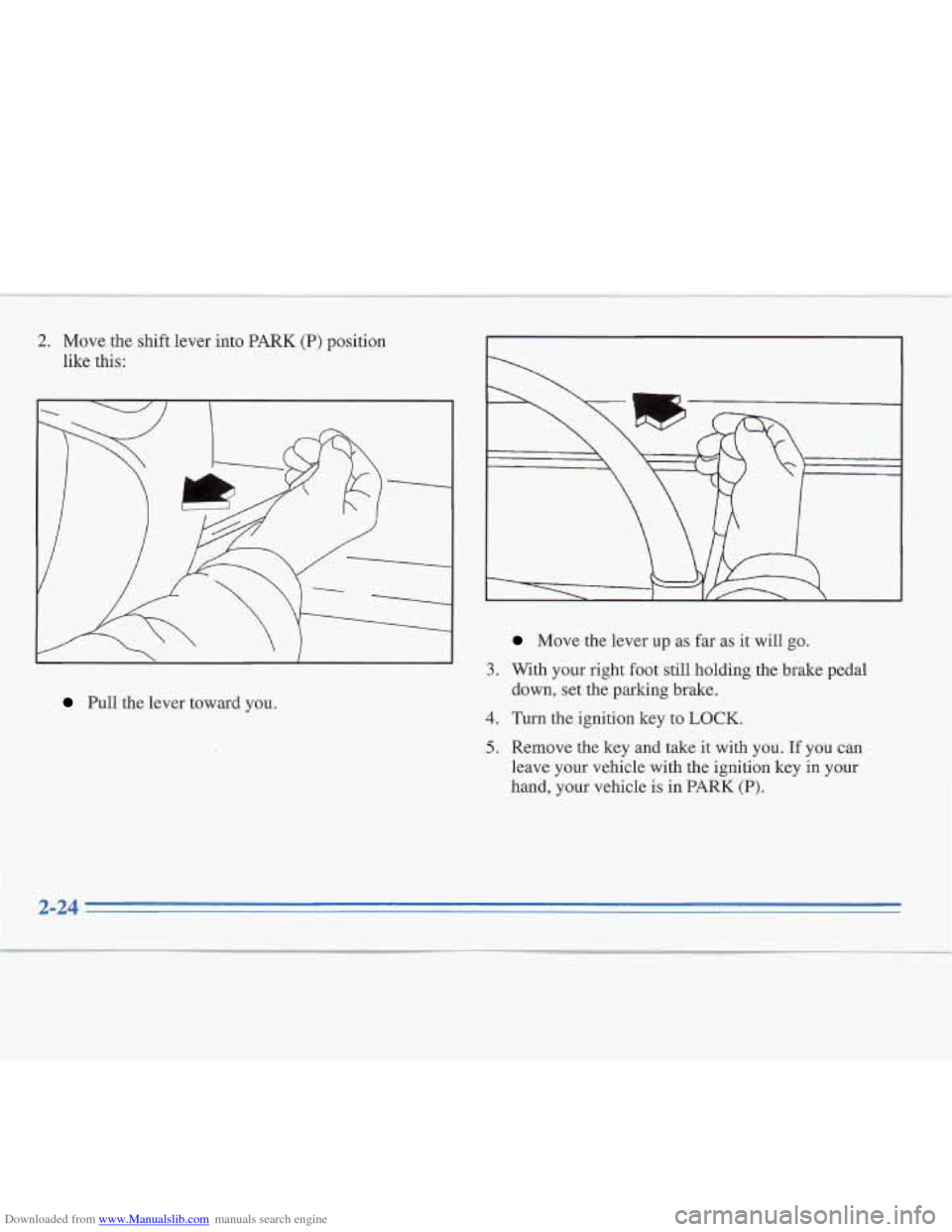
2. Move the shift lever into PARK (P) position
like this:
Pull the lever toward you.
3.
4.
5.
Move the lever up as far as it will go.
With your right foot still holding the brake pedal
down, set the parking brake.
Turn the ignition key to
LOCK.
Remove the key and take it with you. If you can
leave your vehicle with the ignition key in your
hand, your vehicle is
in PARK (P).
2-24
Page 84 of 306
Downloaded from www.Manualslib.com manuals search engine Leaving Your Vehicle With the
Engine Running
I I
It can be dangerous to leave your vehicle with the
engine running. Your vehicle could move
suddenly
if the shift lever is not fully in PARK (P)
with the parking brake firmly set. And, if you
leave the vehicle with the engine running,
it could
overheat and even catch fire. You or others could
be injured. Don’t leave your vehicle with the
~ engine running unless you have to.
I
If you have to leave your vehicle with the engine
running, be sure your vehicle is in PARK (P) and your
parking brake is firmly set before you leave it. After
you’ve moved the shift lever into the PARK
(P)
position, hold the regular brake pedal down. Then, see if
you can move the shift lever away from PARK
(P)
without first pulling it toward you. If you can, it means
that
the shift lever wasn’t fully locked into PARK (P).
2-25