tires CADILLAC LYRIC 2023 User Guide
[x] Cancel search | Manufacturer: CADILLAC, Model Year: 2023, Model line: LYRIC, Model: CADILLAC LYRIC 2023Pages: 424, PDF Size: 4.76 MB
Page 202 of 424
Cadillac Lyriq Owner Manual (GMNA-Localizing-U.S./Canada-15644413) -
2023 - CRC - 2/23/22
Driving and Operating 201
Winter Driving
Driving on Snow or IceCaution
To avoid damage to the
wheels and brake
components, always clear
snow and ice from inside the
wheels and underneath the
vehicle before driving.
Snow or ice between the tires
and the road creates less
traction or grip, so drive
carefully. Wet ice can occur at
about 0°C (32°F) when
freezing rain begins to fall.
Avoid driving on wet ice or in
freezing rain until roads can be
treated.
For Slippery Road Driving:
.Turn off cruise control.
.If enabled, turn off
One-Pedal Driving. See
One-Pedal Driving 0214
.If turned off, turn on the
Traction Control and the
Electronic Stability Control systems. See Traction
Control/Electronic Stability
Control
0221.
.Select the Snow/Ice driver
mode. See Driver Mode
Control 0223.
.Accelerate gently.
Accelerating too quickly
causes the wheels to spin
and makes the surface under
the tires slick.
.Allow greater following
distance and watch for
slippery spots. Icy patches
can occur on otherwise clear
roads in shaded areas. The
surface of a curve or an
overpass can remain icy
when the surrounding roads
are clear. Avoid sudden
steering maneuvers and
braking while on ice.
.Antilock Brake System (ABS)
improves vehicle stability
during hard stops, but the
brakes should be applied
sooner than when on dry
pavement. See Antilock
Brake System (ABS) 0216.
Blizzard Conditions
If you become stranded or
cannot continue driving due to
winter storm conditions, stop
the vehicle in a safe place and
signal for help. Stay with the
vehicle unless there is help
nearby.
If you stay in your vehicle
while waiting, signal for help
and keep everyone in the
vehicle safe by turning on the
hazard warning flashers and
tying a red cloth to an outside
mirror.
To conserve battery energy
while waiting for help, run the
vehicle for only short periods
as needed to warm the vehicle
and then shut the vehicle off
and partially close the window.
Moving about to keep warm
also helps. For additional tips
to help conserve battery
energy in cold weather, see
Driving for Better Energy
Efficiency 0193.
Page 203 of 424
Cadillac Lyriq Owner Manual (GMNA-Localizing-U.S./Canada-15644413) -
2023 - CRC - 2/23/22
202 Driving and Operating
If the Vehicle Is Stuck
Slowly and cautiously spin the
wheels to free the vehicle
when stuck in sand, mud, ice,
or snow. See "Rocking the
Vehicle to Get It Out" later in
this section.
The Traction Control System
(TCS) can often help to free a
stuck vehicle. See Traction
Control/Electronic Stability
Control0221. If stuck too
severely for the TCS to free
the vehicle, turn off the TCS
and use the rocking method.
See "Rocking the Vehicle to
Get It Out" later in this section.
{Warning
If the vehicle’s tires spin at
high speed, they can
explode, and you or others
could be injured. Spin the
wheels as little as possible
and avoid going above
56 km/h (35 mph).
Rocking the Vehicle to Get
it Out
Turn the steering wheel left
and right to clear the area
around the front wheels. Turn
off the TCS. Shift back and
forth between R (Reverse) and
a forward gear, spinning the
wheels as little as possible. To
prevent electric drive unit
wear, wait until the wheels
stop spinning before shifting
gears. Slowly spinning the
wheels in the forward and
reverse directions causes a
rocking motion that could free
the vehicle. If that does not
get the vehicle out after a few
tries, it might need to be
towed out. See Transporting a
Disabled Vehicle 0359.
Vehicle Load Limits
It is very important to know
how much weight the
vehicle can carry. This
weight is called the vehicle
capacity weight and
includes the weight of all occupants, cargo, and all
nonfactory-installed
options. Two labels on the
vehicle may show how
much weight it may
properly carry, the Tire and
Loading Information label
and the Certification/Tire
label.
{Warning
Do not load the vehicle
any heavier than the
Gross Vehicle Weight
Rating (GVWR), or either
the maximum front or
rear Gross Axle Weight
Rating (GAWR). This can
cause systems to break
and change the way the
vehicle handles. This
could cause loss of
control and a crash.
Overloading can also
reduce stopping
(Continued)
Page 204 of 424
Cadillac Lyriq Owner Manual (GMNA-Localizing-U.S./Canada-15644413) -
2023 - CRC - 2/23/22
Driving and Operating 203
Warning (Continued)
performance, damage the
tires, and shorten the life
of the vehicle.
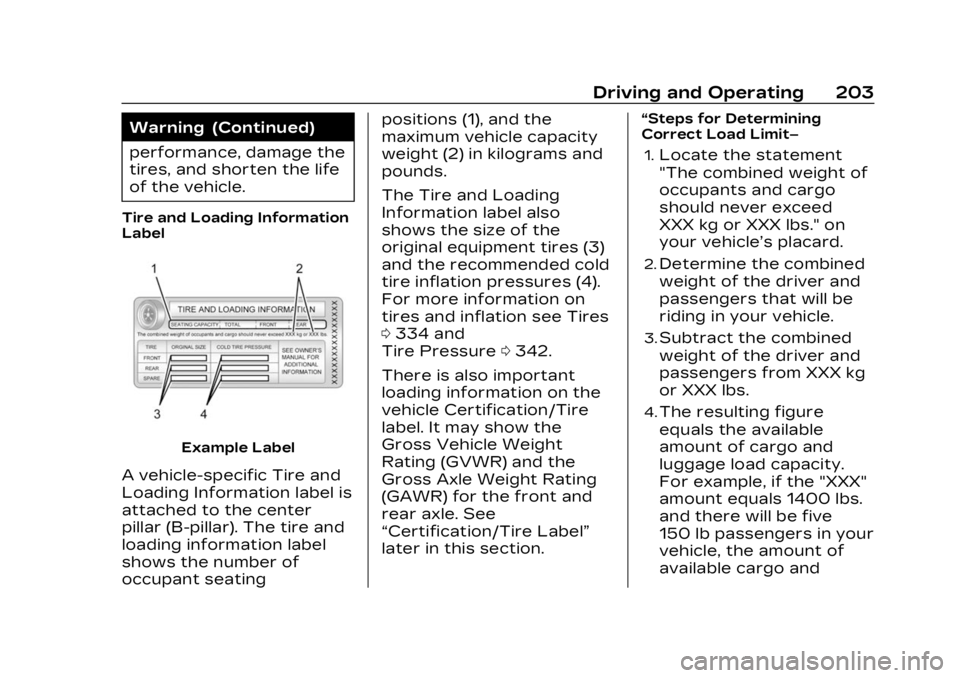
Tire and Loading Information
Label
Example Label
A vehicle-specific Tire and
Loading Information label is
attached to the center
pillar (B-pillar). The tire and
loading information label
shows the number of
occupant seatingpositions (1), and the
maximum vehicle capacity
weight (2) in kilograms and
pounds.
The Tire and Loading
Information label also
shows the size of the
original equipment tires (3)
and the recommended cold
tire inflation pressures (4).
For more information on
tires and inflation see Tires
0
334 and
Tire Pressure 0342.
There is also important
loading information on the
vehicle Certification/Tire
label. It may show the
Gross Vehicle Weight
Rating (GVWR) and the
Gross Axle Weight Rating
(GAWR) for the front and
rear axle. See
“Certification/Tire Label”
later in this section.
“Steps for Determining
Correct Load Limit– 1.
Locate the statement
"The combined weight of
occupants and cargo
should never exceed
XXX kg or XXX lbs." on
your vehicle’s placard.
2.Determine the combined
weight of the driver and
passengers that will be
riding in your vehicle.
3.Subtract the combined
weight of the driver and
passengers from XXX kg
or XXX lbs.
4.The resulting figure
equals the available
amount of cargo and
luggage load capacity.
For example, if the "XXX"
amount equals 1400 lbs.
and there will be five
150 lb passengers in your
vehicle, the amount of
available cargo and
Page 206 of 424
Cadillac Lyriq Owner Manual (GMNA-Localizing-U.S./Canada-15644413) -
2023 - CRC - 2/23/22
Driving and Operating 205
Example 3
1.Vehicle Capacity
Weight for Example 3 =
453 kg (1,000 lbs).
2.Subtract Occupant
Weight @ 91 kg
(200 lbs) × 5 = 453 kg
(1,000 lbs).
3.Available Cargo Weight
= 0 kg (0 lbs).
Refer to the vehicle's tire
and loading information
label for specific
information about the
vehicle's capacity weight and seating positions. The
combined weight of the
driver, passengers, and
cargo should never exceed
the vehicle's capacity
weight.
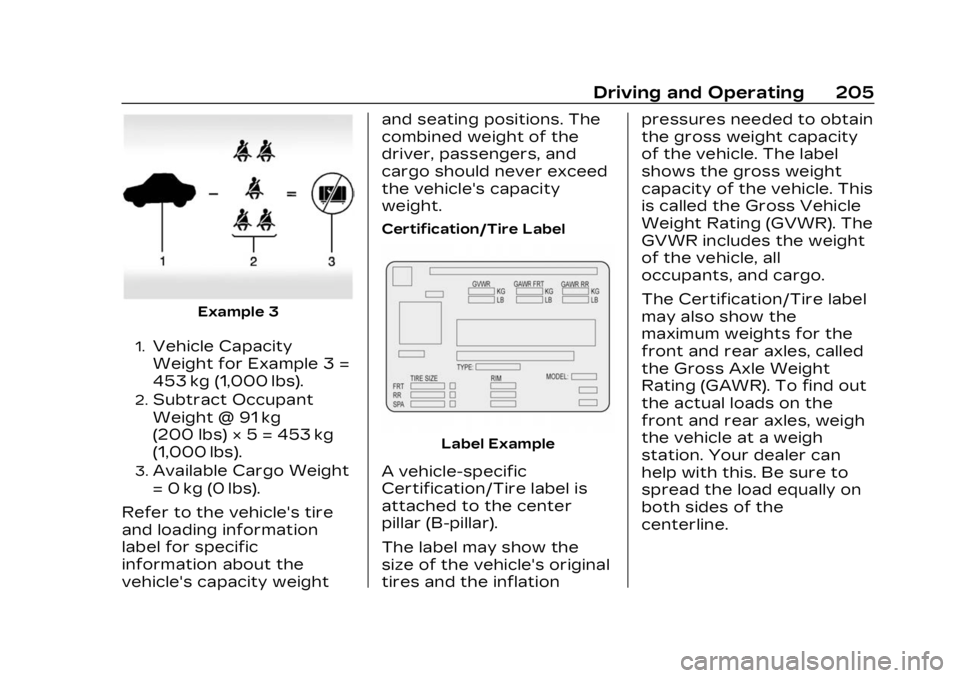
Certification/Tire Label
Label Example
A vehicle-specific
Certification/Tire label is
attached to the center
pillar (B-pillar).
The label may show the
size of the vehicle's original
tires and the inflationpressures needed to obtain
the gross weight capacity
of the vehicle. The label
shows the gross weight
capacity of the vehicle. This
is called the Gross Vehicle
Weight Rating (GVWR). The
GVWR includes the weight
of the vehicle, all
occupants, and cargo.
The Certification/Tire label
may also show the
maximum weights for the
front and rear axles, called
the Gross Axle Weight
Rating (GAWR). To find out
the actual loads on the
front and rear axles, weigh
the vehicle at a weigh
station. Your dealer can
help with this. Be sure to
spread the load equally on
both sides of the
centerline.
Page 215 of 424
Cadillac Lyriq Owner Manual (GMNA-Localizing-U.S./Canada-15644413) -
2023 - CRC - 2/23/22
214 Driving and Operating
Caution
Spinning the tires
excessively may damage the
electric drive unit. The repair
will not be covered by the
vehicle warranty. If you are
stuck, do not spin the tires.
When stopping on a steep hill,
use the brakes to hold the
vehicle in place.
When shifting to P (Park) on a
hill, use the brakes to hold the
vehicle then shift to P (Park).
One-Pedal Driving
One-Pedal Driving allows the
use of the accelerator pedal to
control the deceleration of the
vehicle to a complete stop.
Completely releasing the
accelerator pedal will result in
aggressive deceleration. Partially lifting off the
accelerator pedal allows the
deceleration of the vehicle to
be adjusted as desired.
Use the brake pedal if
emergency braking is required.
To view and configure
One-Pedal Driving, from the
infotainment display home
screen, Select Virtual Controls
> Drive & Park > One-Pedal
Driving.
Select Off to disable
One-Pedal Driving for
traditional two-pedal driving,
similar to a gasoline vehicle.
Select On to enable one-pedal
driving where a moderate level
of braking is applied when the
accelerator pedal is released
while driving.
Select High to enable
one-pedal driving where a
strong level of braking is
applied when the accelerator
pedal is released while driving.
When enabled, One-Pedal
Driving applies in R (Reverse),
D (Drive). This feature remains
enabled until manually disabled
by the driver. Press the
accelerator pedal to the
desired speed. The brake
lamps will come on during
substantial deceleration and
when the vehicle is stopped.
If One-Pedal Driving is turned
off while stopped, the vehicle
will stay stopped. Press the
brake pedal or accelerator
pedal to return to two-pedal
driving.
Page 298 of 424
Cadillac Lyriq Owner Manual (GMNA-Localizing-U.S./Canada-15644413) -
2023 - CRC - 2/23/22
Driving and Operating 297
.Automatic Emergency
Braking (AEB)
.Front Pedestrian
Braking (FPB)
If equipped with Lane Change
Alert (LCA), the LCA detection
zones that extend back from
the side of the vehicle do not
move further back when a
trailer is towed. Use caution
while changing lanes when
towing a trailer.
If equipped with Rear Cross
Traffic Alert (RCTA), use
caution while backing up when
towing a trailer, as the RCTA
detection zones that extend
out from the back of the
vehicle do not move further
back when a trailer is towed.
Towing a trailer requires
experience. The combination
of the vehicle and trailer is
longer and not as responsive
as the vehicle itself. Become
familiar with handling and
braking of the combination by
driving on a level road surface
before driving on public roads. The trailer structure, the tires,
and the brakes must be all be
rated to carry the intended
cargo. Inadequate trailer
equipment can cause the
combination to operate in an
unexpected or unsafe manner.
Before driving, inspect all
trailer hitch parts and
attachments, safety chains,
electrical connectors, lamps,
tires, and mirrors. See Towing
Equipment
0303. If the trailer
has electric brakes, start the
combination moving and then
manually apply the trailer
brake controller to check the
trailer brakes work. During the
trip, occasionally check that
the cargo and trailer are
secure and that the lamps and
any trailer brakes are working.
Towing with a Stability
Control System
When towing, the stability
control system might be
heard. The system reacts to
vehicle movement caused by
the trailer, which mainly occurs during cornering. This is
normal when towing heavier
trailers.
Following Distance
Stay at least twice as far
behind the vehicle ahead as
you would when driving
without a trailer to help to
avoid heavy braking and
sudden turns.
Passing
More passing distance is
needed when towing a trailer.
The combination of the vehicle
and trailer will not accelerate
as quickly and is much longer
than the vehicle alone. It is
necessary to go much farther
beyond the passed vehicle
before returning to the lane.
Pass on level roadways. Avoid
passing on hills if possible.
Backing Up
Hold the bottom of the
steering wheel with one hand.
To move the trailer to the left,
move that hand to the left. To
Page 304 of 424
Cadillac Lyriq Owner Manual (GMNA-Localizing-U.S./Canada-15644413) -
2023 - CRC - 2/23/22
Driving and Operating 303
weight, including the carrier, is
no more than half of the
maximum allowable tongue
weight for the vehicle or
227 kg (500 lb), whichever
is less.
Rear Gross Axle Weight
Rating (GAWR-RR)
The GAWR-RR is the total
weight that can be supported
by the rear axle of the vehicle.
Do not exceed the GAWR-RR
for the vehicle, with the tow
vehicle and trailer fully loaded
for the trip including the
weight of the trailer tongue.
If using a weight-distributing
hitch, do not exceed the
GAWR-RR before applying the
weight distribution
spring bars.
For additional assistance with
trailering or additional
information, see your dealer.
Towing Equipment
Always use the correct hitch
equipment for your vehicle.
Crosswinds, large trucks going
by, and rough roads can affect
the trailer and the hitch.
Proper hitch equipment for
your vehicle helps maintain
control of the vehicle-trailer
combination. Many trailers can
be towed using a
weight-carrying hitch with a
coupler latched to the hitch
ball, or a tow eye latched to a
pintle hook. Other trailers may
require a weight-distributing
hitch that uses spring bars to
distribute the trailer tongue
weight between your vehicle
and trailer axles. See
“Maximum Trailer Tongue
Weight Rating”under Trailer
Towing 0299 for weight limits
with various hitch types.
Never attach rental hitches or
other bumper-type hitches.
Only use frame-mounted
hitches that do not attach to
the bumper. Consider using mechanical
sway controls with any trailer.
Ask a trailering professional
about sway controls or refer
to the trailer manufacturer's
recommendations and
instructions.
Tires
.Do not tow a trailer while
using a compact spare tire
on the vehicle.
.Tires must be properly
inflated to support loads
while towing a trailer. See
Tires
0334 for instructions
on proper tire inflation.
Safety Chains
Always attach chains between
the vehicle and the trailer, and
attach the chains to the holes
on the trailer hitch platform.
Instructions about safety
chains may be provided by the
hitch manufacturer or by the
trailer manufacturer.
Cross the safety chains under
the tongue of the trailer to
help prevent the tongue from
Page 306 of 424
Cadillac Lyriq Owner Manual (GMNA-Localizing-U.S./Canada-15644413) -
2023 - CRC - 2/23/22
Driving and Operating 305
If TSC is enabled, the Traction
Control System (TCS)/
StabiliTrak warning light will
flash on the instrument
cluster. Reduce vehicle speed
by gradually removing your
foot from the accelerator.
If trailer sway continues,
StabiliTrak can help slow the
vehicle down. TSC will not
function if StabiliTrak is turned
off. See Traction Control/
Electronic Stability Control
0221.
{Warning
Trailer sway can result in a
crash and in serious injury or
death, even if the vehicle is
equipped with TSC.
If the trailer begins to sway,
reduce vehicle speed by
gradually removing your foot
from the accelerator. Then
pull over to check the trailer
and vehicle to help correct
possible causes, including an
improperly or overloaded
(Continued)
Warning (Continued)
trailer, unrestrained cargo,
improper trailer hitch
configuration, or improperly
inflated or incorrect vehicle
or trailer tires. See Towing
Equipment0303 for trailer
ratings and hitch setup
recommendations.
Trailer Tires
Special Trailer (ST) tires differ
from vehicle tires. Trailer tires
are designed with stiff
sidewalls to help prevent sway
and to support heavy loads.
These features can make it
difficult to determine if the
trailer tire pressures are low
only based on a visual
inspection.
Always check all trailer tire
pressures before each trip
when the tires are cool. Low
trailer tire pressure is a
leading cause of trailer tire
blow-outs. Trailer tires deteriorate over
time. The trailer tire sidewall
will show the week and year
the tire was manufactured.
Many trailer tire
manufacturers recommend
replacing tires more than six
years old.
Overloading is another leading
cause of trailer tire blow-outs.
Never load your trailer with
more weight than the tires are
designed to support. The load
rating is located on the trailer
tire sidewall.
Always know the maximum
speed rating for the trailer
tires before driving. This may
be significantly lower than the
vehicle tire speed rating. The
speed rating may be on the
trailer tire sidewall. If the
speed rating is not shown, the
default trailer tire speed rating
is 105 km/h (65 mph).
Page 308 of 424
Cadillac Lyriq Owner Manual (GMNA-Localizing-U.S./Canada-15644413) -
2023 - CRC - 2/23/22
Vehicle Care 307
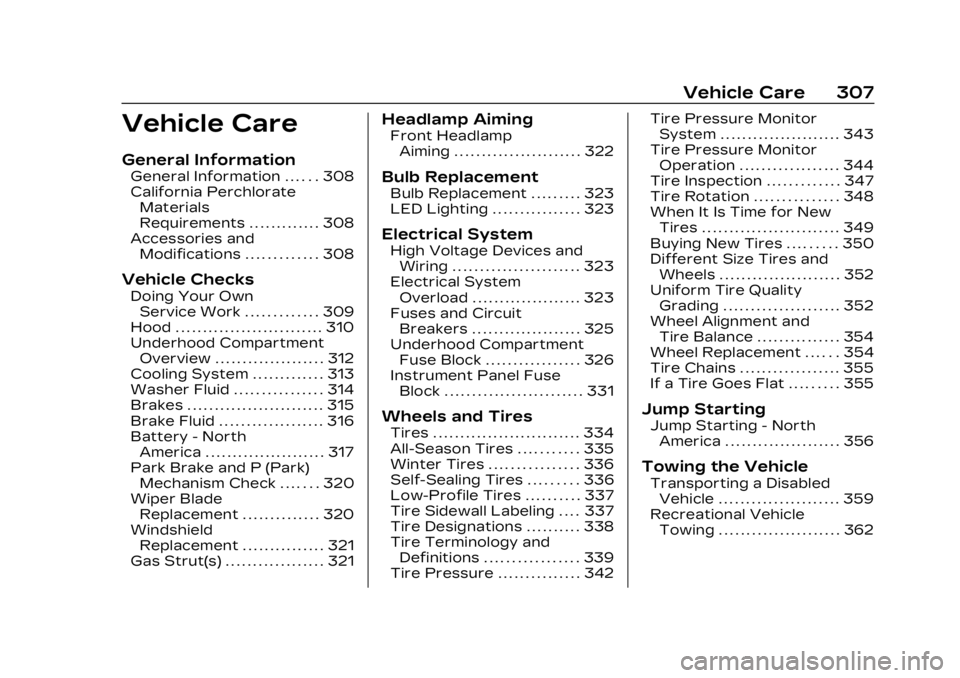
Vehicle Care
General Information
General Information . . . . . . 308
California PerchlorateMaterials
Requirements . . . . . . . . . . . . . 308
Accessories and Modifications . . . . . . . . . . . . . 308
Vehicle Checks
Doing Your OwnService Work . . . . . . . . . . . . . 309
Hood . . . . . . . . . . . . . . . . . . . . . . . . . . . 310
Underhood Compartment Overview . . . . . . . . . . . . . . . . . . . . 312
Cooling System . . . . . . . . . . . . . 313
Washer Fluid . . . . . . . . . . . . . . . . 314
Brakes . . . . . . . . . . . . . . . . . . . . . . . . . 315
Brake Fluid . . . . . . . . . . . . . . . . . . . 316
Battery - North America . . . . . . . . . . . . . . . . . . . . . . 317
Park Brake and P (Park) Mechanism Check . . . . . . . 320
Wiper Blade Replacement . . . . . . . . . . . . . . 320
Windshield Replacement . . . . . . . . . . . . . . . 321
Gas Strut(s) . . . . . . . . . . . . . . . . . . 321
Headlamp Aiming
Front Headlamp Aiming . . . . . . . . . . . . . . . . . . . . . . . 322
Bulb Replacement
Bulb Replacement . . . . . . . . . 323
LED Lighting . . . . . . . . . . . . . . . . 323
Electrical System
High Voltage Devices andWiring . . . . . . . . . . . . . . . . . . . . . . . 323
Electrical System Overload . . . . . . . . . . . . . . . . . . . . 323
Fuses and Circuit Breakers . . . . . . . . . . . . . . . . . . . . 325
Underhood Compartment Fuse Block . . . . . . . . . . . . . . . . . 326
Instrument Panel Fuse Block . . . . . . . . . . . . . . . . . . . . . . . . . 331
Wheels and Tires
Tires . . . . . . . . . . . . . . . . . . . . . . . . . . . 334
All-Season Tires . . . . . . . . . . . 335
Winter Tires . . . . . . . . . . . . . . . . 336
Self-Sealing Tires . . . . . . . . . 336
Low-Profile Tires . . . . . . . . . . 337
Tire Sidewall Labeling . . . . 337
Tire Designations . . . . . . . . . . 338
Tire Terminology andDefinitions . . . . . . . . . . . . . . . . . 339
Tire Pressure . . . . . . . . . . . . . . . 342 Tire Pressure Monitor
System . . . . . . . . . . . . . . . . . . . . . . 343
Tire Pressure Monitor Operation . . . . . . . . . . . . . . . . . . 344
Tire Inspection . . . . . . . . . . . . . 347
Tire Rotation . . . . . . . . . . . . . . . 348
When It Is Time for New
Tires . . . . . . . . . . . . . . . . . . . . . . . . . 349
Buying New Tires . . . . . . . . . 350
Different Size Tires and Wheels . . . . . . . . . . . . . . . . . . . . . . 352
Uniform Tire Quality Grading . . . . . . . . . . . . . . . . . . . . . 352
Wheel Alignment and Tire Balance . . . . . . . . . . . . . . . 354
Wheel Replacement . . . . . . 354
Tire Chains . . . . . . . . . . . . . . . . . . 355
If a Tire Goes Flat . . . . . . . . . 355
Jump Starting
Jump Starting - North America . . . . . . . . . . . . . . . . . . . . . 356
Towing the Vehicle
Transporting a DisabledVehicle . . . . . . . . . . . . . . . . . . . . . . 359
Recreational Vehicle Towing . . . . . . . . . . . . . . . . . . . . . . 362
Page 316 of 424

Cadillac Lyriq Owner Manual (GMNA-Localizing-U.S./Canada-15644413) -
2023 - CRC - 2/23/22
Vehicle Care 315
Caution (Continued)
damage the washer fluid
tank and other parts of
the washer system.
.When using concentrated
washer fluid, follow the
manufacturer instructions
for adding water.
.Fill the washer fluid tank
only three-quarters full
when it is very cold. This
allows for fluid expansion
if freezing occurs, which
could damage the tank if it
is completely full.
Brakes
Disc brake linings have built-in
wear indicators that make a
high-pitched warning sound
when the brake linings are
worn and new linings are
needed. The sound can come
and go or can be heard all the
time when the vehicle is
moving, except when applying
the brake pedal firmly.
{Warning
The brake wear warning
sound means that soon the
brakes will not work well.
That could lead to a crash.
When the brake wear
warning sound is heard,
have the vehicle serviced.
Caution
Continuing to drive with
worn-out brake linings could
result in costly brake repairs.
Some driving conditions or
climates can cause a brake
squeal when the brakes are
first applied, clearing up
following several applications.
This does not mean something
is wrong with the brakes.
Properly torqued wheel nuts
are necessary to help prevent
brake pulsation. When tires
are rotated, inspect brake
linings for wear and evenly
tighten wheel nuts in the proper sequence to torque
specifications. See Capacities
and Specifications
0383.
Brake pads should be replaced
as complete axle sets.
Brake Pedal Travel
See your dealer if the brake
pedal does not return to
normal height, or if there is a
rapid increase in pedal travel.
This could be a sign that brake
service may be required.
Replacing Brake System
Parts
Always replace brake system
parts with new, approved
replacement parts. If this is
not done, the brakes may not
work properly. The braking
performance can change in
many ways if the wrong brake
parts are installed or if parts
are improperly installed.