flat tire CADILLAC LYRIC 2023 Owners Manual
[x] Cancel search | Manufacturer: CADILLAC, Model Year: 2023, Model line: LYRIC, Model: CADILLAC LYRIC 2023Pages: 424, PDF Size: 4.76 MB
Page 121 of 424
Cadillac Lyriq Owner Manual (GMNA-Localizing-U.S./Canada-15644413) -
2023 - CRC - 2/23/22
120 Instruments and Controls
system are not fully
operational and may not assist
in maintaining control. Adjust
driving accordingly. If the
condition persists, see your
dealer as soon as possible.
A Driver Information Center
(DIC) message may display.
The light flashes when the
TCS and/or the StabiliTrak/
ESC system is actively
working.
See Traction Control/
Electronic Stability Control
0221.
Driver Mode Control
Light
This light comes on when
Normal Mode is selected.
This light comes on when
Sport Mode is selected.
This light comes on when
Snow/Ice Mode is selected.
This light comes on when My
Mode is selected. See Driver
Mode Control 0223.
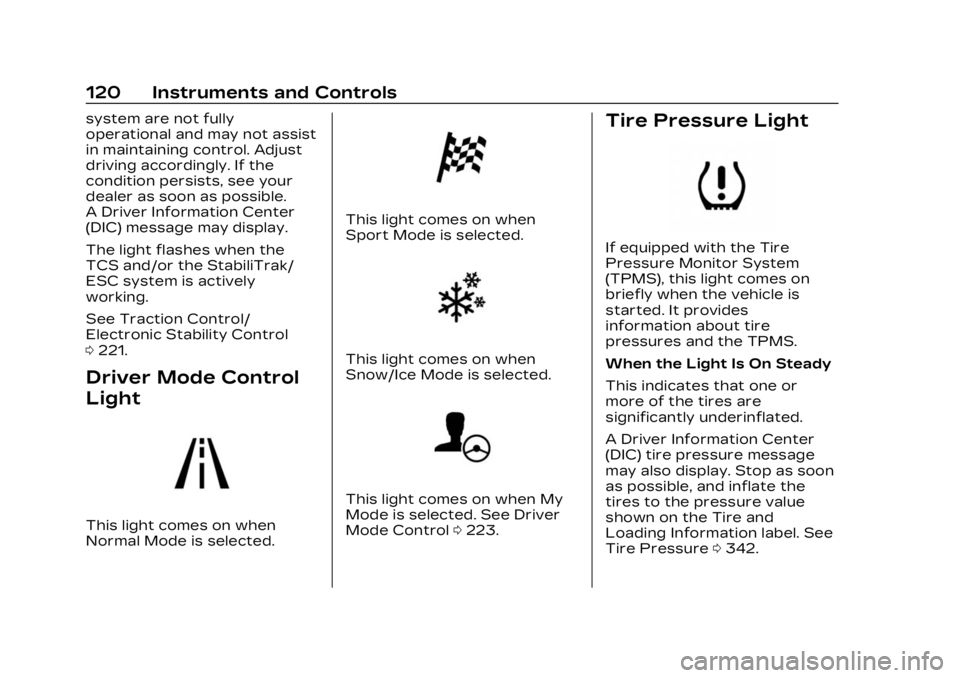
Tire Pressure Light
If equipped with the Tire
Pressure Monitor System
(TPMS), this light comes on
briefly when the vehicle is
started. It provides
information about tire
pressures and the TPMS.
When the Light Is On Steady
This indicates that one or
more of the tires are
significantly underinflated.
A Driver Information Center
(DIC) tire pressure message
may also display. Stop as soon
as possible, and inflate the
tires to the pressure value
shown on the Tire and
Loading Information label. See
Tire Pressure 0342.
Page 196 of 424
Cadillac Lyriq Owner Manual (GMNA-Localizing-U.S./Canada-15644413) -
2023 - CRC - 2/23/22
Driving and Operating 195
Allow the vehicle to warm up
for 20 minutes before driving.
Vehicle Charging/
Maintenance
Charging
Keep the vehicle plugged in,
even when fully charged, to
keep the battery temperature
ready for the next drive. This
is important when outside
temperatures are extremely
hot or cold.
If possible, use a level 2
(240 volt) high power charge
station for best results. This
allows the interior of the
vehicle and high voltage
battery to warm to optimal
temperature.
Maintenance
Always keep the tires properly
inflated and the vehicle
properly aligned.
The weight of excess cargo in
the vehicle affects efficiency
and range. Avoid carrying
more than is needed.Avoid unnecessary use of
electrical accessories. Power
used for functions other than
propelling the vehicle will
reduce the available range.
Using a rooftop carrier will
reduce efficiency due to
additional weight and drag.
Distracted Driving
Distraction comes in many
forms and can take your focus
from the task of driving.
Exercise good judgment and
do not let other activities
divert your attention away
from the road. Many local
governments have enacted
laws regarding driver
distraction. Become familiar
with the local laws in
your area.
To avoid distracted driving,
keep your eyes on the road,
keep your hands on the
steering wheel, and focus your
attention on driving.
.Do not use a mobile phone in
demanding driving situations.
Use a hands-free method to
place or receive necessary
phone calls.
.Watch the road. Do not read,
take notes, or look up
information on mobile
phones or other electronic
devices.
.Designate a front seat
passenger to handle
potential distractions.
.Become familiar with vehicle
features before driving, such
as programming favorite
radio stations and adjusting
climate control and seat
settings. Program all trip
information into any
navigation device prior to
driving.
.Wait until the vehicle is
parked to retrieve items that
have fallen to the floor.
.Stop or park the vehicle to
tend to children.
.Keep pets in an appropriate
carrier or restraint.
Page 201 of 424
Cadillac Lyriq Owner Manual (GMNA-Localizing-U.S./Canada-15644413) -
2023 - CRC - 2/23/22
200 Driving and Operating
.Turn off cruise control.
Hill and Mountain
Roads
{Warning
Do not charge your vehicle’s
battery above an 80%
charge if you are going to
drive down long, steep
grades such as mountain
passes. This provides room
in the battery for
regenerative braking to
supplement your
conventional brakes during
the descent. This is
especially important when
towing a trailer, which puts
additional stress on your
vehicle’s braking system.
If the battery becomes full,
regenerative braking will be
limited or unavailable. The
brakes will have to do all the
work of slowing down the
vehicle and could become(Continued)
Warning (Continued)
too hot. Hot brakes may not
be able to slow the vehicle
enough to maintain speed
and control. To help avoid
the risk of a crash, limit the
battery’s charge and, if you
experience brake fade or
receive a brake warning,
stop the vehicle and allow
the brakes to cool.
See“Charge Now” under
Charging 0123 for
information on setting
charge limits.
Driving on steep hills or
through mountains is different
than driving on flat or rolling
terrain. Be sure to:
.Use regenerative braking to
help slow the vehicle or
maintain speed by keeping
the vehicle in gear and
limiting the initial battery
charge to 80% or less.
.When braking is necessary,
use frequent, light taps of
the brake pedal. This
maximizes regenerative
braking and minimizes the
load on the vehicle brake
system.
.Keep the vehicle serviced
and in good shape.
.Check all fluid levels, brakes,
tires and cooling system.
.Drive at speeds that keep
the vehicle in its own lane.
Do not swing wide or cross
the center line.
.Be alert on top of hills;
something could be in your
lane (e.g., stalled car, crash).
.Pay attention to special road
signs (e.g., falling rocks area,
winding roads, long grades,
passing or no-passing zones)
and take appropriate action.
Page 204 of 424
Cadillac Lyriq Owner Manual (GMNA-Localizing-U.S./Canada-15644413) -
2023 - CRC - 2/23/22
Driving and Operating 203
Warning (Continued)
performance, damage the
tires, and shorten the life
of the vehicle.
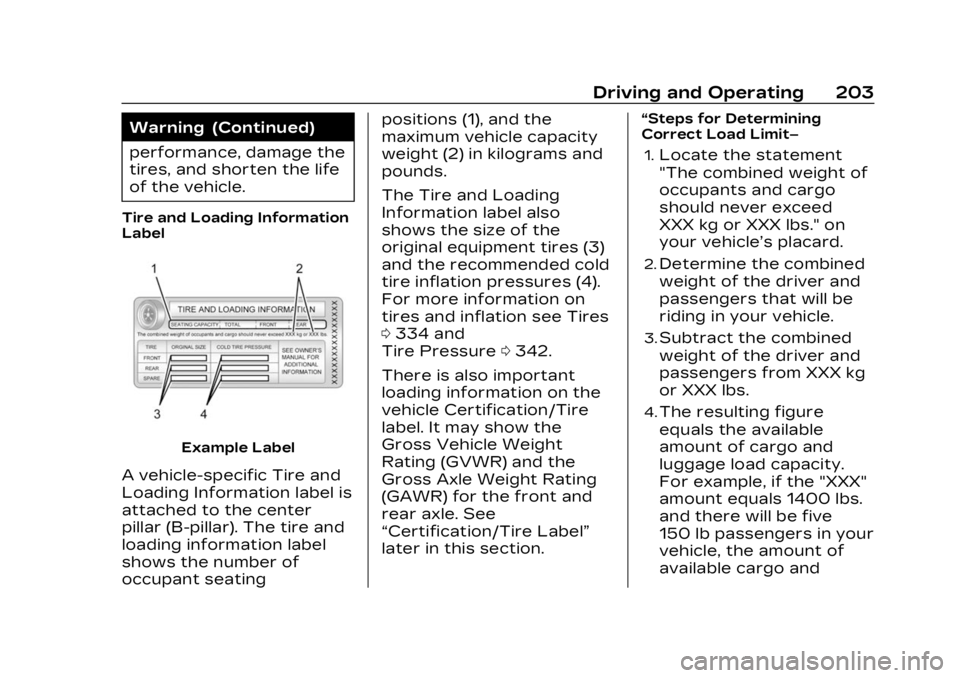
Tire and Loading Information
Label
Example Label
A vehicle-specific Tire and
Loading Information label is
attached to the center
pillar (B-pillar). The tire and
loading information label
shows the number of
occupant seatingpositions (1), and the
maximum vehicle capacity
weight (2) in kilograms and
pounds.
The Tire and Loading
Information label also
shows the size of the
original equipment tires (3)
and the recommended cold
tire inflation pressures (4).
For more information on
tires and inflation see Tires
0
334 and
Tire Pressure 0342.
There is also important
loading information on the
vehicle Certification/Tire
label. It may show the
Gross Vehicle Weight
Rating (GVWR) and the
Gross Axle Weight Rating
(GAWR) for the front and
rear axle. See
“Certification/Tire Label”
later in this section.
“Steps for Determining
Correct Load Limit– 1.
Locate the statement
"The combined weight of
occupants and cargo
should never exceed
XXX kg or XXX lbs." on
your vehicle’s placard.
2.Determine the combined
weight of the driver and
passengers that will be
riding in your vehicle.
3.Subtract the combined
weight of the driver and
passengers from XXX kg
or XXX lbs.
4.The resulting figure
equals the available
amount of cargo and
luggage load capacity.
For example, if the "XXX"
amount equals 1400 lbs.
and there will be five
150 lb passengers in your
vehicle, the amount of
available cargo and
Page 206 of 424
Cadillac Lyriq Owner Manual (GMNA-Localizing-U.S./Canada-15644413) -
2023 - CRC - 2/23/22
Driving and Operating 205
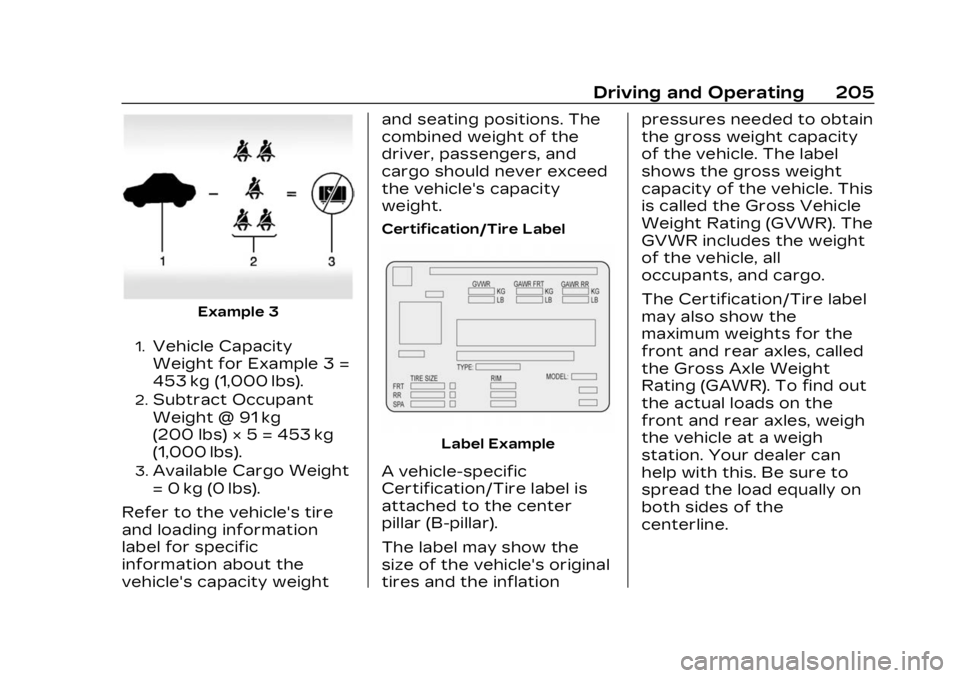
Example 3
1.Vehicle Capacity
Weight for Example 3 =
453 kg (1,000 lbs).
2.Subtract Occupant
Weight @ 91 kg
(200 lbs) × 5 = 453 kg
(1,000 lbs).
3.Available Cargo Weight
= 0 kg (0 lbs).
Refer to the vehicle's tire
and loading information
label for specific
information about the
vehicle's capacity weight and seating positions. The
combined weight of the
driver, passengers, and
cargo should never exceed
the vehicle's capacity
weight.
Certification/Tire Label
Label Example
A vehicle-specific
Certification/Tire label is
attached to the center
pillar (B-pillar).
The label may show the
size of the vehicle's original
tires and the inflationpressures needed to obtain
the gross weight capacity
of the vehicle. The label
shows the gross weight
capacity of the vehicle. This
is called the Gross Vehicle
Weight Rating (GVWR). The
GVWR includes the weight
of the vehicle, all
occupants, and cargo.
The Certification/Tire label
may also show the
maximum weights for the
front and rear axles, called
the Gross Axle Weight
Rating (GAWR). To find out
the actual loads on the
front and rear axles, weigh
the vehicle at a weigh
station. Your dealer can
help with this. Be sure to
spread the load equally on
both sides of the
centerline.
Page 304 of 424
Cadillac Lyriq Owner Manual (GMNA-Localizing-U.S./Canada-15644413) -
2023 - CRC - 2/23/22
Driving and Operating 303
weight, including the carrier, is
no more than half of the
maximum allowable tongue
weight for the vehicle or
227 kg (500 lb), whichever
is less.
Rear Gross Axle Weight
Rating (GAWR-RR)
The GAWR-RR is the total
weight that can be supported
by the rear axle of the vehicle.
Do not exceed the GAWR-RR
for the vehicle, with the tow
vehicle and trailer fully loaded
for the trip including the
weight of the trailer tongue.
If using a weight-distributing
hitch, do not exceed the
GAWR-RR before applying the
weight distribution
spring bars.
For additional assistance with
trailering or additional
information, see your dealer.
Towing Equipment
Always use the correct hitch
equipment for your vehicle.
Crosswinds, large trucks going
by, and rough roads can affect
the trailer and the hitch.
Proper hitch equipment for
your vehicle helps maintain
control of the vehicle-trailer
combination. Many trailers can
be towed using a
weight-carrying hitch with a
coupler latched to the hitch
ball, or a tow eye latched to a
pintle hook. Other trailers may
require a weight-distributing
hitch that uses spring bars to
distribute the trailer tongue
weight between your vehicle
and trailer axles. See
“Maximum Trailer Tongue
Weight Rating”under Trailer
Towing 0299 for weight limits
with various hitch types.
Never attach rental hitches or
other bumper-type hitches.
Only use frame-mounted
hitches that do not attach to
the bumper. Consider using mechanical
sway controls with any trailer.
Ask a trailering professional
about sway controls or refer
to the trailer manufacturer's
recommendations and
instructions.
Tires
.Do not tow a trailer while
using a compact spare tire
on the vehicle.
.Tires must be properly
inflated to support loads
while towing a trailer. See
Tires
0334 for instructions
on proper tire inflation.
Safety Chains
Always attach chains between
the vehicle and the trailer, and
attach the chains to the holes
on the trailer hitch platform.
Instructions about safety
chains may be provided by the
hitch manufacturer or by the
trailer manufacturer.
Cross the safety chains under
the tongue of the trailer to
help prevent the tongue from
Page 306 of 424
Cadillac Lyriq Owner Manual (GMNA-Localizing-U.S./Canada-15644413) -
2023 - CRC - 2/23/22
Driving and Operating 305
If TSC is enabled, the Traction
Control System (TCS)/
StabiliTrak warning light will
flash on the instrument
cluster. Reduce vehicle speed
by gradually removing your
foot from the accelerator.
If trailer sway continues,
StabiliTrak can help slow the
vehicle down. TSC will not
function if StabiliTrak is turned
off. See Traction Control/
Electronic Stability Control
0221.
{Warning
Trailer sway can result in a
crash and in serious injury or
death, even if the vehicle is
equipped with TSC.
If the trailer begins to sway,
reduce vehicle speed by
gradually removing your foot
from the accelerator. Then
pull over to check the trailer
and vehicle to help correct
possible causes, including an
improperly or overloaded
(Continued)
Warning (Continued)
trailer, unrestrained cargo,
improper trailer hitch
configuration, or improperly
inflated or incorrect vehicle
or trailer tires. See Towing
Equipment0303 for trailer
ratings and hitch setup
recommendations.
Trailer Tires
Special Trailer (ST) tires differ
from vehicle tires. Trailer tires
are designed with stiff
sidewalls to help prevent sway
and to support heavy loads.
These features can make it
difficult to determine if the
trailer tire pressures are low
only based on a visual
inspection.
Always check all trailer tire
pressures before each trip
when the tires are cool. Low
trailer tire pressure is a
leading cause of trailer tire
blow-outs. Trailer tires deteriorate over
time. The trailer tire sidewall
will show the week and year
the tire was manufactured.
Many trailer tire
manufacturers recommend
replacing tires more than six
years old.
Overloading is another leading
cause of trailer tire blow-outs.
Never load your trailer with
more weight than the tires are
designed to support. The load
rating is located on the trailer
tire sidewall.
Always know the maximum
speed rating for the trailer
tires before driving. This may
be significantly lower than the
vehicle tire speed rating. The
speed rating may be on the
trailer tire sidewall. If the
speed rating is not shown, the
default trailer tire speed rating
is 105 km/h (65 mph).
Page 308 of 424
Cadillac Lyriq Owner Manual (GMNA-Localizing-U.S./Canada-15644413) -
2023 - CRC - 2/23/22
Vehicle Care 307
Vehicle Care
General Information
General Information . . . . . . 308
California PerchlorateMaterials
Requirements . . . . . . . . . . . . . 308
Accessories and Modifications . . . . . . . . . . . . . 308
Vehicle Checks
Doing Your OwnService Work . . . . . . . . . . . . . 309
Hood . . . . . . . . . . . . . . . . . . . . . . . . . . . 310
Underhood Compartment Overview . . . . . . . . . . . . . . . . . . . . 312
Cooling System . . . . . . . . . . . . . 313
Washer Fluid . . . . . . . . . . . . . . . . 314
Brakes . . . . . . . . . . . . . . . . . . . . . . . . . 315
Brake Fluid . . . . . . . . . . . . . . . . . . . 316
Battery - North America . . . . . . . . . . . . . . . . . . . . . . 317
Park Brake and P (Park) Mechanism Check . . . . . . . 320
Wiper Blade Replacement . . . . . . . . . . . . . . 320
Windshield Replacement . . . . . . . . . . . . . . . 321
Gas Strut(s) . . . . . . . . . . . . . . . . . . 321
Headlamp Aiming
Front Headlamp Aiming . . . . . . . . . . . . . . . . . . . . . . . 322
Bulb Replacement
Bulb Replacement . . . . . . . . . 323
LED Lighting . . . . . . . . . . . . . . . . 323
Electrical System
High Voltage Devices andWiring . . . . . . . . . . . . . . . . . . . . . . . 323
Electrical System Overload . . . . . . . . . . . . . . . . . . . . 323
Fuses and Circuit Breakers . . . . . . . . . . . . . . . . . . . . 325
Underhood Compartment Fuse Block . . . . . . . . . . . . . . . . . 326
Instrument Panel Fuse Block . . . . . . . . . . . . . . . . . . . . . . . . . 331
Wheels and Tires
Tires . . . . . . . . . . . . . . . . . . . . . . . . . . . 334
All-Season Tires . . . . . . . . . . . 335
Winter Tires . . . . . . . . . . . . . . . . 336
Self-Sealing Tires . . . . . . . . . 336
Low-Profile Tires . . . . . . . . . . 337
Tire Sidewall Labeling . . . . 337
Tire Designations . . . . . . . . . . 338
Tire Terminology andDefinitions . . . . . . . . . . . . . . . . . 339
Tire Pressure . . . . . . . . . . . . . . . 342 Tire Pressure Monitor
System . . . . . . . . . . . . . . . . . . . . . . 343
Tire Pressure Monitor Operation . . . . . . . . . . . . . . . . . . 344
Tire Inspection . . . . . . . . . . . . . 347
Tire Rotation . . . . . . . . . . . . . . . 348
When It Is Time for New
Tires . . . . . . . . . . . . . . . . . . . . . . . . . 349
Buying New Tires . . . . . . . . . 350
Different Size Tires and Wheels . . . . . . . . . . . . . . . . . . . . . . 352
Uniform Tire Quality Grading . . . . . . . . . . . . . . . . . . . . . 352
Wheel Alignment and Tire Balance . . . . . . . . . . . . . . . 354
Wheel Replacement . . . . . . 354
Tire Chains . . . . . . . . . . . . . . . . . . 355
If a Tire Goes Flat . . . . . . . . . 355
Jump Starting
Jump Starting - North America . . . . . . . . . . . . . . . . . . . . . 356
Towing the Vehicle
Transporting a DisabledVehicle . . . . . . . . . . . . . . . . . . . . . . 359
Recreational Vehicle Towing . . . . . . . . . . . . . . . . . . . . . . 362
Page 336 of 424
Cadillac Lyriq Owner Manual (GMNA-Localizing-U.S./Canada-15644413) -
2023 - CRC - 2/23/22
Vehicle Care 335
{Warning
.Poorly maintained and
improperly used tires
are dangerous.
.Overloading the tires
can cause overheating
as a result of too much
flexing. There could be
a blowout and a serious
crash. See Vehicle Load
Limits0202.
.Underinflated tires
pose the same danger
as overloaded tires. The
resulting crash could
cause serious injury.
Check all tires
frequently to maintain
the recommended
pressure. Tire pressure
should be checked
when the tires are cold.
(Continued)
Warning (Continued)
.Overinflated tires are
more likely to be cut,
punctured, or broken by
a sudden impact —such
as when hitting a
pothole. Keep tires at
the recommended
pressure.
.Worn or old tires can
cause a crash. If the
tread is badly worn,
replace them.
.Replace any tires that
have been damaged by
impacts with potholes,
curbs, etc.
.Improperly repaired
tires can cause a crash.
Only your dealer or an
authorized tire service
center should repair,
replace, dismount, and
mount the tires.
(Continued)
Warning (Continued)
.Do not spin the tires in
excess of 56 km/h
(35 mph) on slippery
surfaces such as snow,
mud, ice, etc. Excessive
spinning may cause the
tires to explode.
All-Season Tires
This vehicle may come with
all-season tires. These tires
are designed to provide good
overall performance on most
road surfaces and weather
conditions. Original equipment
tires designed to GM's specific
tire performance criteria have
a TPC specification code
molded onto the sidewall.
Original equipment all-season
tires can be identified by the
last two characters of this
TPC code, which will be “MS.”
Consider installing winter tires
on the vehicle if frequent
driving on snow or ice-covered
Page 337 of 424
Cadillac Lyriq Owner Manual (GMNA-Localizing-U.S./Canada-15644413) -
2023 - CRC - 2/23/22
336 Vehicle Care
roads is expected. All-season
tires provide adequate
performance for most winter
driving conditions, but they
may not offer the same level
of traction or performance as
winter tires on snow or
ice-covered roads. See Winter
Tires0336.
Winter Tires
This vehicle was not originally
equipped with winter tires.
Winter tires are designed for
increased traction on snow
and ice-covered roads.
Consider installing winter tires
on the vehicle if frequent
driving on ice or snow covered
roads is expected. See your
dealer for details regarding
winter tire availability and
proper tire selection. Also, see
Buying New Tires 0350.
With winter tires, there may
be decreased dry road
traction, increased road noise,
and shorter tread life. After changing to winter tires, be
alert for changes in vehicle
handling and braking.
If using winter tires:
.Use tires of the same brand
and tread type on all four
wheel positions.
.Use only radial ply tires of
the same size, load range,
and speed rating as the
original equipment tires.
Winter tires with the same
speed rating as the original
equipment tires may not be
available for H, V, W, Y, and ZR
speed rated tires. If winter
tires with a lower speed rating
are chosen, never exceed the
tire's maximum speed
capability.
Self-Sealing Tires
This vehicle may have
self-sealing tires. These tires
have a material inside that can
seal punctures from common
road hazards, such as nails
and screws, in the tread area.
The tire may lose air pressure if the sidewall is damaged or
the tread puncture is too
large. If the Tire Pressure
Monitor System indicates the
tire pressure is low, inspect
the tire for damage and inflate
it to the recommended
pressure. If the tire is unable
to maintain the recommended
pressure, contact the nearest
authorized GM servicing
facility immediately for
inspection and repair or
replacement. To locate the
nearest GM servicing facility,
call GM Customer Assistance.
Caution
Do not drive on a deflated
self-sealing tire as this could
damage the tire. Make sure
the tire is inflated to the
recommended pressure or
have it immediately repaired
or replaced.
When tire replacement is
needed replace with a
self-sealing tire, because the