change time CADILLAC SEVILLE 1993 4.G User Guide
[x] Cancel search | Manufacturer: CADILLAC, Model Year: 1993, Model line: SEVILLE, Model: CADILLAC SEVILLE 1993 4.GPages: 407, PDF Size: 22.28 MB
Page 197 of 407
Downloaded from www.Manualslib.com manuals search engine P
P
c
P
F
F
A CAUTION
Anti-lock doesn’t change the time you need to get your foot up to
the brake pedal.
If you get too close to the vehicle in fkont of
you, you won’t have time to apply your brakes if that vehicle
suddenly slows
or stops. Always leave enough room up ahead to
stop, even though you have anti-lock brakes.
To Use Anti-Lock:
Don’t pump the brakes. Just hold the brake pedal down and let anti-lock
work for
you. You may hear the anti-lock pump or motor operate, and
feel the brake pedal pulsate, but this is normal.
Disc Brake Wear Indicators
Your Cadillac has four-wheel disc brakes.
Disc brake pads have built-in wear indicators that make a high-pitched
warning sound when the brake pads are worn and new pads are needed.
The
sound may come and go or be heard all the time your vehicle is
moving (except when you are pushing on the brake pedal firmly).
The brake wear warning sound means that sooner or later your
brakes won’t work well. That could lead
to an accident, When
you hear the brake wear warning sound, have your vehicle
serviced.
183
r
Page 199 of 407

Downloaded from www.Manualslib.com manuals search engine A lot of the “driver lost control” accidents mentioned on the news
happen on curves. Here’s
why:
Experienced driver or beginner, each of us is subject to the same laws of
physics when driving on curves. The traction of the tires against the road
surface makes it possible for the vehicle to change its path
when you turn
the front wheels.
If there’s no traction, inertia will keep the vehicle going
in the same direction. If you’ve ever tried to steer a vehicle on wet ice,
you’ll understand this.
The traction
you can get in a curve depends on the condition of your tires
and the road surface, the angle at which the curve is banked, and your
speed. While you’re in a curve, speed is the one factor you can control.
Suppose you’re steering through a sharp curve. Then you suddenly
accelerate.
Those
two control systems -- steering and acceleration -- can overwhelm
those places where the tires meet the road and make you lose control.
What should you do
if this ever happens? Let up on the accelerator
pedal, steer the vehicle the
way you want it to go, and slow down.
Speed
limit signs near curves warn that you should adjust your speed. Of
course, the posted speeds are based on good weather and road
conditions. Under less favorable conditions you’ll want to
go slower.
If you need to reduce your speed as you approach a curve, do it before
you enter the curve, while your front wheels are straight ahead.
Try to adjust your speed so you can “drive” through the curve. Maintain a
reasonable, steady speed. Wait to accelerate
until you are out of the
curve, and then accelerate gently into the straightaway.
When you drive into a curve at night, it’s harder to see the road ahead of
you because
it bends away from the straight beams of your lights. This is
one good reason to drive slower.
Steering in Emergencies
There are times when steering can be more effective than braking. For
example, you come over a
hill and find a truck stopped in your lane, or a
car suddenly pulls out from nowhere,
or a child darts out from between
parked cars and stops right
in front of you. You can avoid these problems
185
Page 202 of 407
Downloaded from www.Manualslib.com manuals search engine lane as oncoming traffic for several seconds. A miscalculation, an error in
judgment, or a brief surrender to frustration or anger can suddenly put
the passing driver face to face
with the worst of all traffic accidents -- the
head-on collision.
So here are some tips for passing:
0
0
0
0
a
“Drive ahead.” Look down the road, to the sides, and to crossroads
for situations that might affect your passing patterns.
If you have any
doubt whatsoever about making
a successful pass, wait for a better
time.
Watch
for traffic signs, pavement markings, and lines. If you can see a
sign up ahead that might indicate a turn or an intersection, delay your
pass.
A broken center line usually indicates it’s all right to pass
(providing the road ahead is clear). Never cross a solid line on your
side of the lane or a double solid line, even
if the road seems empty of
approaching traffic.
If you suspect that the driver of the vehicle you want
to pass isn’t
aware
of your presence, tap the horn a couple of times before passing.
Do not get too close to the vehicle you want to pass while you’re
awaiting an opportunity.
For one thing, following too closely reduces
your area of vision, especially
if you’re following a larger vehicle. Also,
you won’t have adequate space if the vehicle ahead suddenly slows or
stops. Keep back a reasonable distance.
When it looks like a chance to pass
is coming up, start to accelerate
but stay in the right lane and don’t get too close. Time your move so
you will be increasing speed as the time comes to move into the other
lane.
If the way is clear to pass, you will have a “running start” that
more than makes up for the distance you would
lose by dropping back.
And if something happens to cause you to cancel your pass, you need
only slow down and drop back again and wait for another opportunity.
If other cars are lined up to pass a slow vehicle, wait your turn. But
take care that someone isn’t trying to pass
you as you pull out to pass
the
slow vehicle. Remember to glance over your shoulder and check
the blind spot.
Check your mirrors
, glance over your shoulder, and start your left
lane change signal before moving out of the right lane to pass. When
you are far enough ahead of the passed vehicle to see its front in your
188
H
-.-
rc
Page 203 of 407
Downloaded from www.Manualslib.com manuals search engine inside mirror, activate your right lane change signal and move back
into the right lane. (Remember that your right outside mirror is
convex. The vehicle you just passed may seem
to be farther away from
you than it really is.)
0 Try not to pass more than one vehicle at a time on two-lane roads.
Reconsider before passing
the next vehicle.
0 Don’t overtake a slowly moving vehicle too rapidly. Even though the
brake lights are not flashing,
it may be slowing down or starting to
turn.
If you’re being passed, make it easy for the following driver to get
ahead
of you. Perhaps you can ease a little to the right.
LOSS OF CONTROL
Let’s review what driving experts say about what happens when the three
control systems (brakes, steering and acceleration) don’t have enough
friction where the tires
meet the road to do what the driver has asked.
In any emergency, don’t give up. Keep trying to steer and constantly
seek
an escape route or area of less danger.
Skidding
In a skid, a driver can lose control of the vehicle. Defensive drivers avoid
most skids by taking reasonable care suited to existing conditions, and by
not “overdriving” those conditions. But skids are always possible.
The three types of skids correspond to your Cadillac’s three control
systems. In the braking skid your
wheels aren’t rolling. In the steering or
cornering skid, too much speed or steering
in a curve causes tires to slip
and lose cornering force. And
in the acceleration skid too much throttle
causes
the driving wheels to spin.
A cornering skid and an acceleration skid are best handled by easing your
foot
off the accelerator pedal.
If your vehicle starts to slide (as when you turn a corner on a wet, snow-
or ice-covered road), ease your foot
off the accelerator pedal as soon as
you feel
the vehicle start to slide. Quickly steer the way you want to go. If
you start steering quickly enough, your vehicle will straighten out. As it
does, straighten the front wheels.
189
Page 204 of 407
Downloaded from www.Manualslib.com manuals search engine
Of course, traction is reduced when water, snow, ice, gravel, or other
material
is on the road. For safety, you’ll want to slow down and adjust
your driving to these conditions. It is important to slow down on slippery
surfaces because stopping distance
will be longer and vehicle control
more limited.
While driving on
a surface with reduced traction, try your best to avoid
sudden steering, acceleration, or braking (including engine braking by
shifting to a lower gear).
Any sudden changes could cause the tires to
slide. You
may not realize the surface is slippery until your vehicle is
skidding. Learn to recognize warning clues
-- such as enough water, ice 01
packed snow on the road to make a “mirrored surface” -- and slow down
when
you have any doubt.
Remember: Any anti-lock braking system
(ABS) helps avoid only the
braking skid. Steer the way
you want to go.
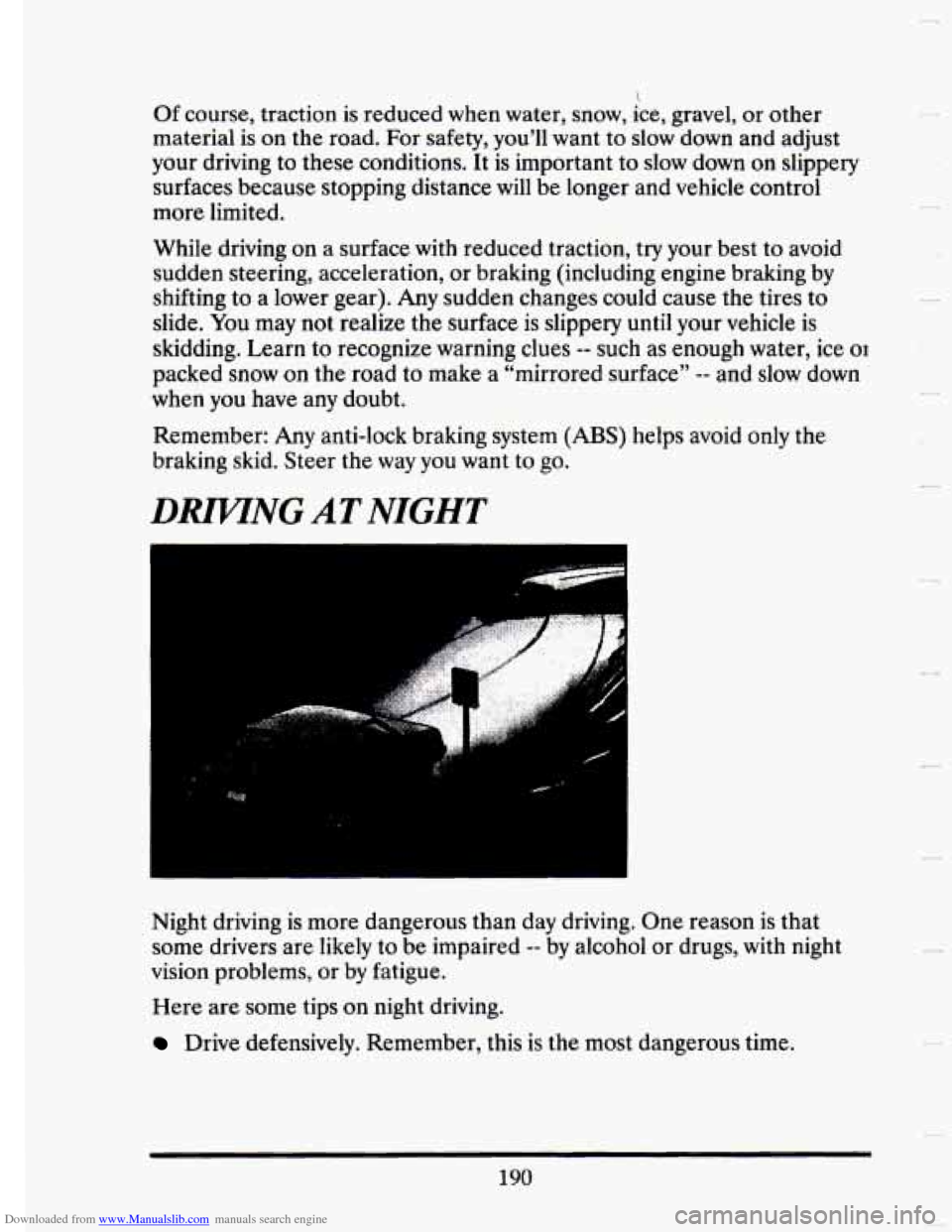
DRM.NG AT NIGHT
Night driving is more dangerous than day driving. One reason is that
some drivers are
likely to be impaired -- by alcohol or drugs, with night
vision problems, or
by fatigue.
Here
are some tips on night driving.
Drive defensively. Remember, this is the most dangerous time.
190
I
Page 216 of 407
Downloaded from www.Manualslib.com manuals search engine 0 Lights: Are they all working? Are the lenses clean?
0 Tires: They are vitally important to a safe, trouble-free trip. Is the
tread good enough for long-distance driving? Are the tires all inflated
to the recommended pressure?
Weather Forecasts: What’s the weather outlook along your route?
Should you delay your trip a short time to avoid a major storm
system?
0 Maps: Do you have up-to-date maps?
ON THE ROAD
Unless you are the only driver, it is good to share the driving task with
others. Limit turns behind the wheel
to about 100 miles (160 km) or two
hours at
a sitting. Then, either change drivers or stop for some
refreshment like coffee, tea or soft drinks and some limbering up. But
do
stop and move around. Eat lightly along the way. Heavier meals tend to
make some people sleepy.
On two-lane highways or
undivided multilane highways that do not have
controlled access, you’ll want to watch for some situations not usually
found
on freeways. Examples are: stop signs and signals, shopping centers
with direct access
to the highway, no passing zones and school zones,
vehicles turning left and right off the road, pedestrians, cyclists, parked
vehicles, and
even animals.
I
HIGWAY HypNosIS
Is there actually such a condition as “highway hypnosis”? Or is it just
plain falling asleep at the wheel? Call it highway hypnosis, lack of
awareness, or whatever.
There is something about an easy stretch
of road with the same scenery,
along with the hum
of the tires on the road, the drone of the engine, and
the rush
of the wind against the vehicle that can make you sleepy. Don’t
let it happen
to you! If it does, your vehicle can leave the road in less than
a second. and you could crash and be injured.
What can you do about highway hypnosis? First, be aware that it can
happen.
202
-*
Page 269 of 407
Downloaded from www.Manualslib.com manuals search engine F
pl
P
P
P
F
c
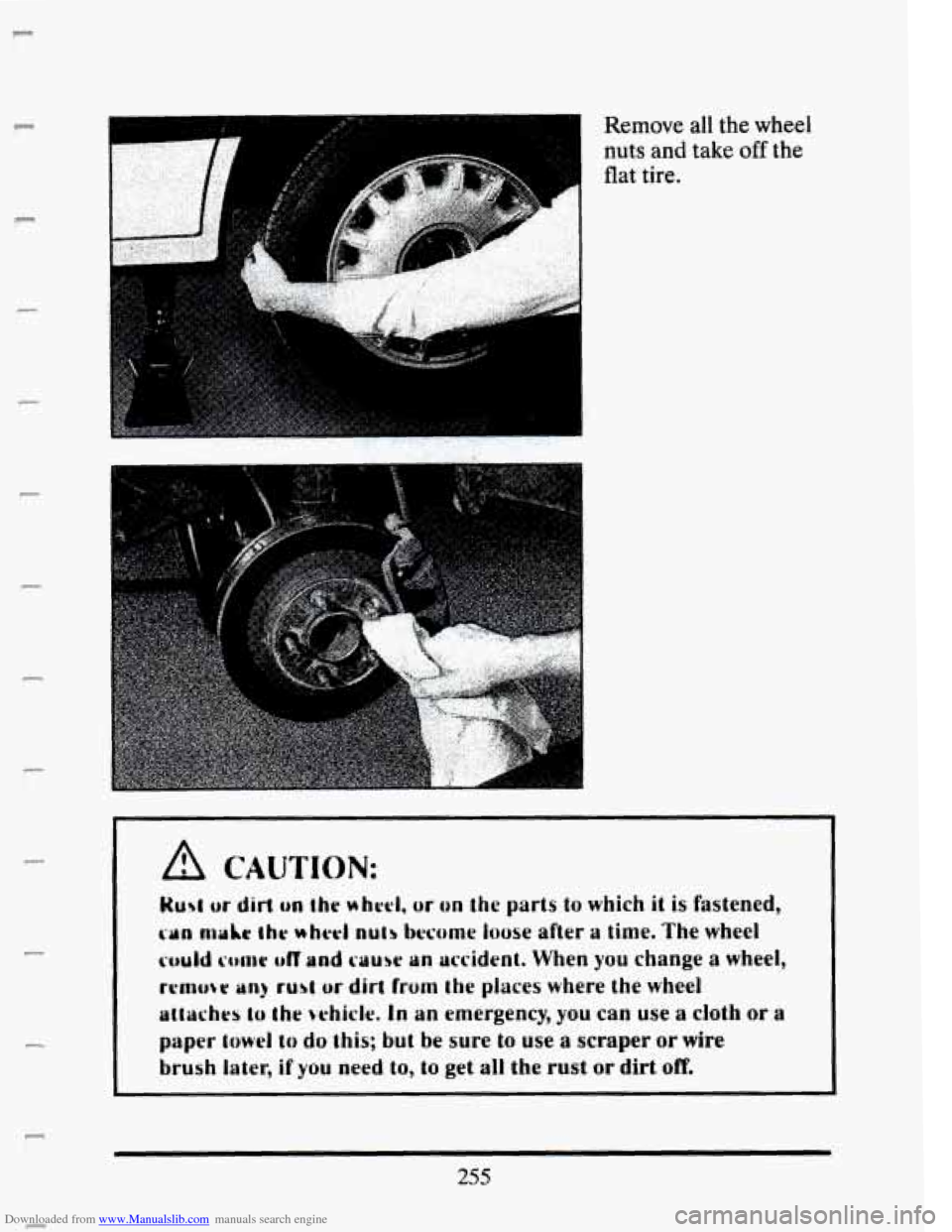
Remove all the wheel
nuts and take
off the
flat tire.
A CAUTION: I
Rust or dirt on !he whd, or on the parts to which it is fastened,
can mahe the uhed nuts become loose after a time. The wheel
cuuld conw oll and c~use an accident. When you change a wheel,
remote un) rust or dirt from the places where the wheel
attaches
to the vehicle. In an emergency, you can use a cloth or a
paper towel to do this; but be sure to use a scraper or wire
brush later, if you need to, to get all the rust or dirt off.
255
Page 289 of 407
Downloaded from www.Manualslib.com manuals search engine This doughnut-shaped logo (symbol) is used on most oil containers to
help you select the correct oil.
You should look for this on the oil container, and use
only those oils that
display the logo.
GM Goodwrench@ oil
(in Canada, GM Engine Oil) meets all the
requirements for your vehicle.
Engine Oil Additives: Don’t add anything to your oil. Your Cadillac
dealer
is ready to advise if you think something should be added.
When to Change Engine Oil: Your vehicle is equipped with an engine oil
life index (EOLI) feature as part of the Driver Information Center
display (DIC). Oil change intervals are determined
by the EOLI and will
usually fall at, or between, the two recommended alternative intervals of
3,000 miles (5,000 kilometers) and 7,500 miles (12,500 kilometers), but
could
be shorter than 3,000 miles (5,000 kilometers) under some very
severe driving conditions shown in Schedule I. The system will also
indicate the need for an
oil change if 7,500 miles (12,500 kilometers) or
one year has passed.
Engine oil life remaining
is displayed through engine data as the ‘OIL
LIFE INDEX’ and as a
‘CHANGE ENGINE OIL message. The ‘OIL
LIFE INDEX’ display includes a number between
0 and 100. This is the
percentage
of oil life REMAINING based on driving conditions and
mileage driven since the last time
of the oil life indicator was reset. When
the remaining oil life is less than
lo%, a ‘CHANGE OIL SOON’ message
will appear. This is a reminder to schedule an engine oil change. When
the oil life index reaches
0, the ‘CHANGE ENGINE OIL: message will
appear. This indicates that no oil life remains and the oil should be
changed as soon as possible, but certainly within the next 200 miles (320
km).
The EOLI will not detect excessively dusty conditions or engine
malfunctions which may effect the oil.
If you drive in dusty areas, change
the engine
oil after every 3,000 miles (5,000 kilometers) or 3 months
(whichever comes first), unless instructed
to do so sooner by the DIC.
On Northstar 4.6 Liter engine equipped vehicles a ‘CHECK OIL LEVEE
message will appear whenever the oil level’s approximately one quart low.
275
Page 290 of 407
Downloaded from www.Manualslib.com manuals search engine How To Reset the Oil Life Indicator: After the oil has been changed,
display the ‘OIL LIFE INDEX’ message by pressing the
‘INFORMATION’ button. Then press and hold the
‘STORE/RECALL
button until the display shows ‘100’. This will reset the oil life index. The
message will remain
OFF until the next oil change is needed. The
percentage
of oil life remaining may be check at any item by pressing the
INFORMATION button several times until the ‘OIL LIFE INDEX
message appears.
Engine Block Heater: An engine block heater can be a big help if you
have to park outside in very cold weather, -20” F (-29 “C) or colder. If
your vehicle
has this option, see “Engine Block Heater” in the Index.
What to Do with Used Oil:
A CAUTION
Used engine oil contains things that have caused skin cancer in
laboratory animals. Don’t let used oil stay on your skin for very
long. Clean your skin and nails with soap and water, or a good
hand cleaner. Wash or properlv throw away clothing or rags
containing used engine
oil.
Used oil can be a real threat to the environment. If you change your own
oil, be sure to drain all free-flowing oil from the filter before disposal.
Don’t ever dispose
of oil by pouring it on the ground, into sewers, or into
streams or bodies
of water. Instead, recycle it by taking it to a place that
collects used oil.
If you have a problem properly disposing of your used
oil, ask your dealer, a service station or a local recycling center for help.
3
I
276
Page 292 of 407
Downloaded from www.Manualslib.com manuals search engine A CAUTION
Operating the engine with the air cleaner off can cause you or
others
to be burned. The air cleaner not only cleans the air, it
stops flame if the engine backfires.
If it isn’t there, and the
engine backfires, you could be burned. Don’t drive
with it off,
and be careful working on the engine with the air cleaner off.
J
NOTICE:
If the air cleaner is off, a backflre can cause a damaging tngine
fire, And, dirt can easily get into your engine, which will drmagc
it, Always have the air cleaner io place when you’rt ddvlng.
AUTOMTIC TRANSAXLE FLUID
When to Check and Change:
A good time to check your automatic transaxle fluid level is when the
engine oil is changed. Refer to the Maintenance Schedule to determine
when to change your
fluid. See “Scheduled Maintenance Services” in the
Index.
How to Check
Because this operation can
be a little difficult, you may choose to have
this done at a Cadillac dealership Service
Department.
If you do it yourself, be sure to follow all the instructions here, or you
could get a false reading on the dipstick.
278