wheel CADILLAC SEVILLE 1993 4.G Service Manual
[x] Cancel search | Manufacturer: CADILLAC, Model Year: 1993, Model line: SEVILLE, Model: CADILLAC SEVILLE 1993 4.GPages: 407, PDF Size: 22.28 MB
Page 268 of 407

Downloaded from www.Manualslib.com manuals search engine I A CAUTION:
Getting under a vehicle when it is jacked up is dangerous. If the
vehicle
slips off the jack, you could be badly injured or killed.
Never get under
a vehicle when it is supported only by a jack.
NOTICE:
Raising your vehicle with the jack improperly positioned will
damage the vehicle or may allow the vehicle la Id1 OR the Jack.
Be sure to fit the jack lift head into the proper location btfntv
raising your vehicle,
Raise the vehicle by
rotating the wheel
wrench clockwise.
Raise the vehicle far
enough off the
ground
so there is
enough room
for the
spare tire
to fit.
254
-
. .*
Page 269 of 407

Downloaded from www.Manualslib.com manuals search engine F
pl
P
P
P
F
c
Remove all the wheel
nuts and take
off the
flat tire.
A CAUTION: I
Rust or dirt on !he whd, or on the parts to which it is fastened,
can mahe the uhed nuts become loose after a time. The wheel
cuuld conw oll and c~use an accident. When you change a wheel,
remote un) rust or dirt from the places where the wheel
attaches
to the vehicle. In an emergency, you can use a cloth or a
paper towel to do this; but be sure to use a scraper or wire
brush later, if you need to, to get all the rust or dirt off.
255
Page 270 of 407
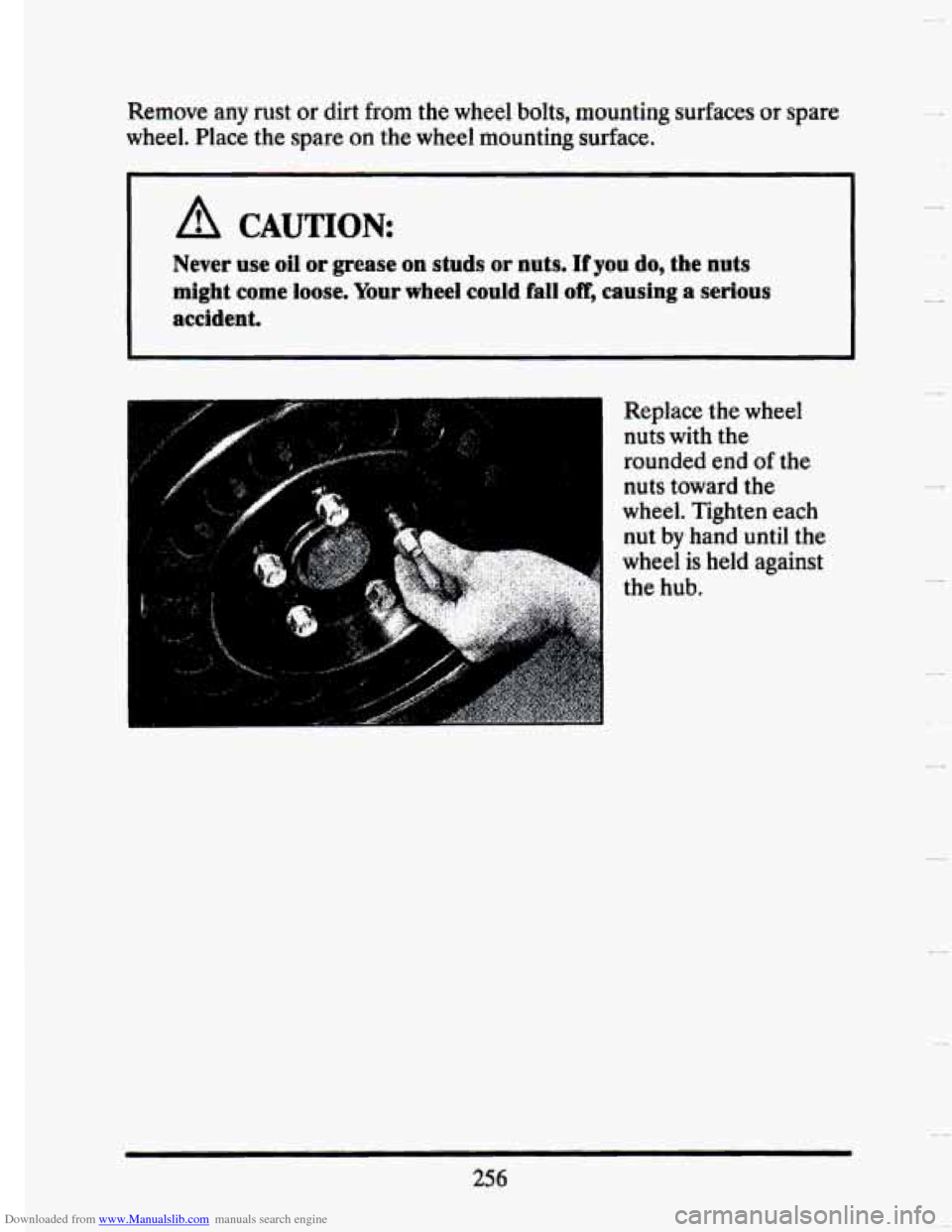
Downloaded from www.Manualslib.com manuals search engine Remove any rust or dirt from the wheel bolts, mounting surfaces or spare
wheel. Place the spare
on the wheel mounting surface.
A CAUTION
Never use oil or grease on studs or nuts. If you do, the nuts
might come loose. Your wheel could fall
off, causing a serious
accident.
Replace the wheel
nuts with the
rounded end
of the
nuts toward the
wheel. Tighten each
nut
by hand until the
256
Page 271 of 407
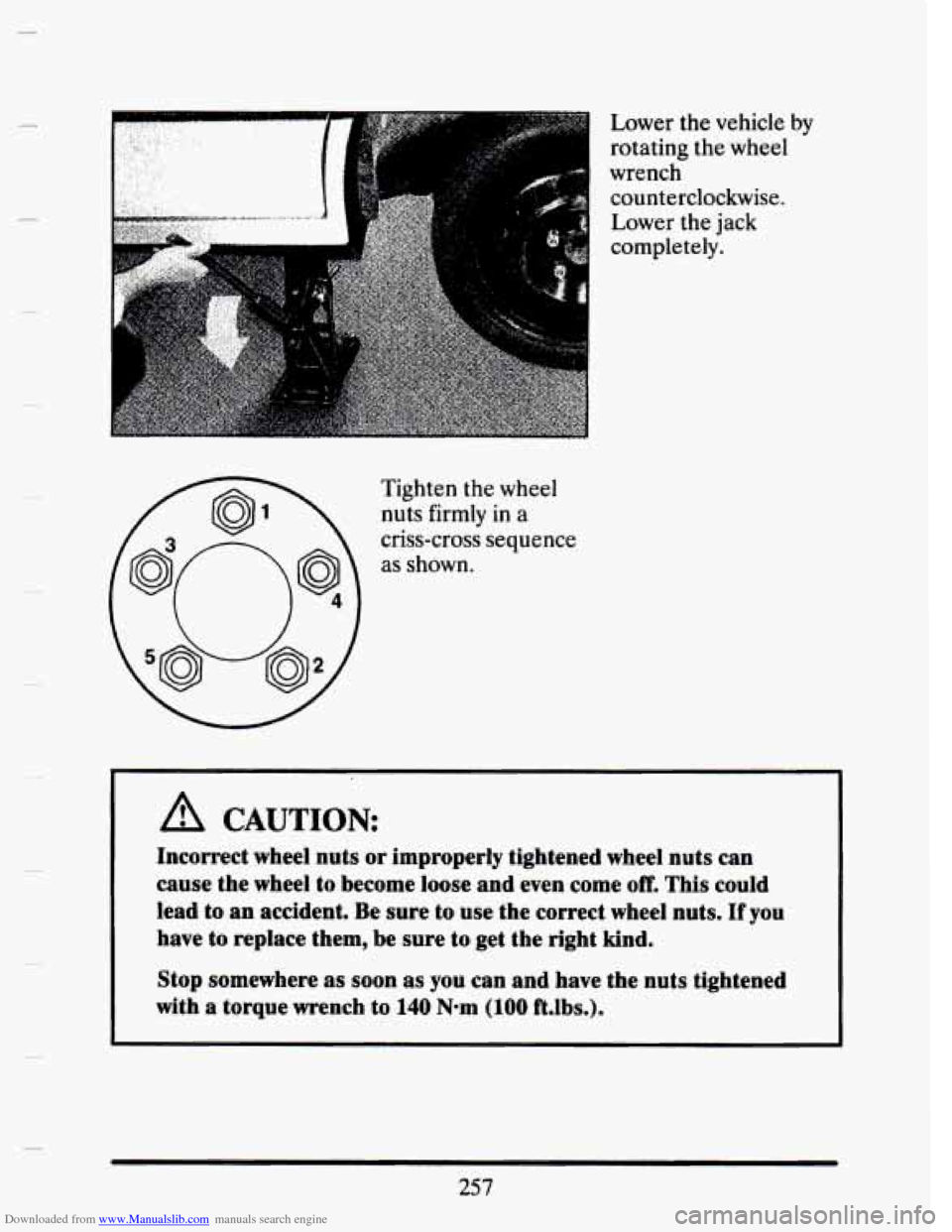
Downloaded from www.Manualslib.com manuals search engine Lower the vehicle by
rotating the wheel
wrench
counterclockwise.
Tighten the wheel nuts
firmly in a
criss-cross sequence as shown. Lower the jack
completely.
1 A CAUTION:
Incorrect wheel nuts or improperly tightened wheel nuts can
cause the wheel to become loose and even come
off. This could
lead to an accident. Be sure to use the correct wheel nuts.
If you
have to replace them, be sure to get the right kind.
Stop somewhere
as soon as you can and have the nuts tightened
with a torque wrench to 140 Nm (100 ft.lbs.).
257
Page 273 of 407

Downloaded from www.Manualslib.com manuals search engine I!
Don’t use your compact spare on some other vehicle.
P
And don’t mix your compact spare or wheel with other wheels or tires.
They won’t
fit. Keep your spare and its wheel together.
i
P
r 1 I
I I
A CAUTION
Storing a jack, a tire, or oth’er equipment in the pagsenger
compartment
of the vehicle could cause iqjury. In a sudden stop
or collision, loose equipment could strike someone. Store all
these in the proper place.
The flat tire should be placed in the spare tire well.
259
Page 274 of 407

Downloaded from www.Manualslib.com manuals search engine IF YOU’RE STUCK: IN SAND, MUD, ICE OR
SNOW
What you don’t want to do when your vehicle is stuck is to spin your
wheels.
The method known as “rocking” can help you get out when
you’re stuck,
but you must use caution.
I A CAUTION
If you let your tires spin at high speed, they can explode and you
or others could be injured.
And, the transaxle or other parts of
the vehicle can overheat. That could cause an engine
compartment
fire or other damage. When you’re stuck, spin the
wheels
as little as possible. Don’t spin the wheels above 35 mph
(55 km/h) as shown on the speedometer.
Rocking your vehicle to get it
out:
First, turn your steering wheel left and right. That will clear the area
around your front wheels. Then shift back and forth between “R”
(Reverse) and
a forward gear, spinning the wheels as little as possible.
Release the accelerator pedal while
you shift, and press lightly on the
accelerator pedal when the transaxle
is in gear. If that doesn’t get you out
after a few tries, you may need to be towed out. If you do need to be
towed out,
see “Towing Your Vehicle” in the Index.
260
i
Y
-
c--
..
Page 308 of 407

Downloaded from www.Manualslib.com manuals search engine ‘vehicle Storage
If you’re not going to drive your vehicle for 25 days or more, take off the
black, negative
(-) cable from the battery. This will help keep your battery
from running down.
I
A CAUTION:
Batteries have acid that can burn you and gas that can explode.
You can be badly hurt
if you aren’t careful. See “Jump Starting”
in the Index for tips on working around a battery without
getting hurt.
Contact your dealer to learn how to prepare your vehicle for longer
storage periods.
Battery Power Loss
If you lose battery power or the battery is disconnected, your car’s
computer must be programmed. It takes just over’20 minutes to
do it. If
you want to
do it yourself, here’s how:
0 Apply the parking brake.
Make sure the front wheels are straight.
0 Turn off the Electronic Climate Control.
Start the engine in “P” (Park) and let it idle for 15 minutes. Then:
Put your foot on the brake pedal, shift the transaxle to @ and let it
idle for
3 minutes or more. Do not accelerate the engine. Then:
With the car in @ (Drive), turn the Electronic Climate Control to
“Auto” and let the engine
idle for 3 minutes or more.
Turn your engine off.
Now your computer
is programmed.
294
c
c
Page 323 of 407
Downloaded from www.Manualslib.com manuals search engine STS recommended tire size is:
GA Performance Blackwall (P225/60ZR 16)
Don’t forget your compact spare tire. It should be at 60 psi (420 kPa).
How to Check Use a good quality pocket-type gage to check tire
pressure. Simply looking at the tires
will not tell you the pressure,
especially if you have radial tires
-- which may look properly inflated even
if they’re underinflated.
If your tires have valve caps, be sure to put them back on. They help
prevent leaks
by keeping out dirt and moisture.
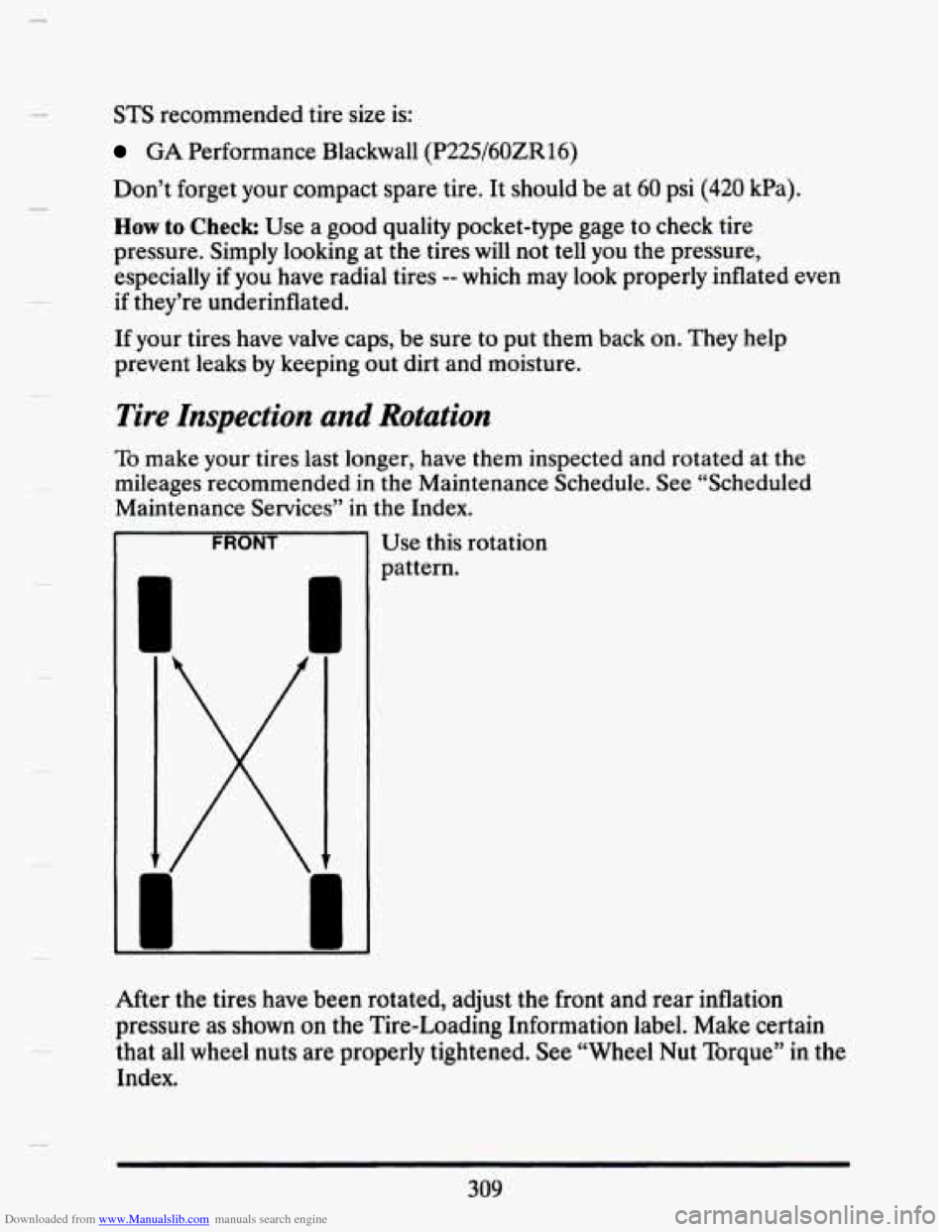
Tire Inspection and Rotation
To make your tires last longer, have them inspected and rotated at the
mileages recommended
in the Maintenance Schedule. See “Scheduled
Maintenance Services”
in the Index.
FRONT Use this rotation
pattern.
After the tires have been rotated, adjust the front and rear inflation
pressure as
shown on the Tire-Loading Information label. Make certain
that
all wheel nuts are properly tightened. See “Wheel Nut Torque’’ in the
Index.
309
Page 324 of 407

Downloaded from www.Manualslib.com manuals search engine A CAUTION:
Rust or dirt on a wheel, or on the parts to which it is fastened,
can make wheel nuts become loose after a time. The wheel could
come
off and cause an accident. When you change a wheel,
remove any rust or
dirt from places where the wheel attaches to
the vehicle. In an emergency, you can use a cloth or a paper
towel to do this; but be sure to use a scraper or wire brush later,
if you need to, to get all the rust or dirt off. (See “Changing a
Flat Tire” in the Index.)
When It3 Time for New Tires
One way to tell when
it’s time for
new tires is
to check the treadwear
indicators, which
will
appear when your tires
have only
2/32 inch
(1.6 mm) or less of
tread remaining.
You need a new tire
if
0 You can see the indicators at three places around the tire.
You can see cord or fabric showing through the tire’s rubber.
The tread or sidewall is cracked, cut or snagged deep enough to show
cord or fabric.
The tire has a bump, bulge or split.
The tire has a puncture, cut, or other damage that can’t be repaired
well because of the size or location of the damage.
L
c
310
Page 325 of 407

Downloaded from www.Manualslib.com manuals search engine -
Buying New Tires
To find out what kind and size of tires you need, look at the Tire-Loading
Information label.
The tires installed
on your vehicle when it was new had a Tire
Performance Criteria Specification
(TPC Spec) number on each tire’s
sidewall. When you get new tires, get ones with that same
TPC Spec
number. That way, your vehicle will continue to have tires that are
designed to give proper endurance, handling, speed rating, traction, ride
and other things during normal service
on your vehicle. If your tires have
an all-season tread design, the
TPC number will be followed by a “MS”
(for mud and snow).
If you ever replace your tires with
those not having a TPC Spec number,
make sure they are the same size, load range, speed rating and
construction type
(bias, bias-belted or radial) as your original tires.
A CAUTION:
Mixing tires could cause you to lose control while driving. If you
mix tires of different sizes or types (radial and bias-belted
tires), the vehicle
may not handle properly, and you could have a
crash. Be sure to use the same size and type tires on all four
wheels.
It’s
all right to drive with your compact spare, though. It was
developed for use
on your vehicle.
Uniform Tire Quality Grading
The following information relates to the system developed by the United
States National Highway Traffic Safety Administration which grades tires
by treadwear, traction and temperature performance. (This applies only
to vehicles sold
in the United States.)
311