run flat CADILLAC SEVILLE 1993 4.G Owners Manual
[x] Cancel search | Manufacturer: CADILLAC, Model Year: 1993, Model line: SEVILLE, Model: CADILLAC SEVILLE 1993 4.GPages: 407, PDF Size: 22.28 MB
Page 13 of 407
Downloaded from www.Manualslib.com manuals search engine This Cadillac Manual is divided into major sections.
Introduction - How to use this Manual .....................
This section tells you how to use your Manual and includes
Safety and Vehicle Damage Warnings and Symbols
11
Section 1 - Seats and Safety Belts .........................
This section tells you how to use your seats and safety
belts properly.
61
Section 2 - Features and Controls ........................
This section explains how. to start and operate your Cadillac.
63 I
Section 3 - Comfort Controls and Audio Systems .......... 146 I
This section tells you how to adjust the ventilation and
comfort controls
and how to operate your Sound System.
Section 4 - Your Driving and the Road ................... 165 I
Here you’ll find helpful information and tips about the
road and how
to drive under different conditions.
Section 5 - Problems on the Road ....................... 220 I
This section tells you what to do if you have a problem
while driving, such as a flat tire,
or engine overheating.
Section 6 - Service and Appearance Care ................. 261 I
Here the manual tells you how to keep your Cadillac
running properly and looking good.
For more information on “Reporting Safety Defects”, see Owner
Assistance,
Page 7.
First Edition
Page 45 of 407
Downloaded from www.Manualslib.com manuals search engine CAUTION: (Continued)
Air bags inflate with great force, faster than the blink of an eye.
If you’re too close to an inflating air bag, it could seriously
injure
you. Safety belts help keep you in position for an air bag
inflation in a crash. Always wear your safety belt, even with an
air bag, and the driver
should sit as far back as possible while
still maintaining control of the vehicle.
A CAUTION:
An inflating air bag can seriously injure small chiIdren. Always
secure children properly in your vehicle. Tu read how, see the
“Children
and Safety Belts’’ section of this manual, and read
the caution
label on the front-passenger% safety belt.
Air Bag System Light
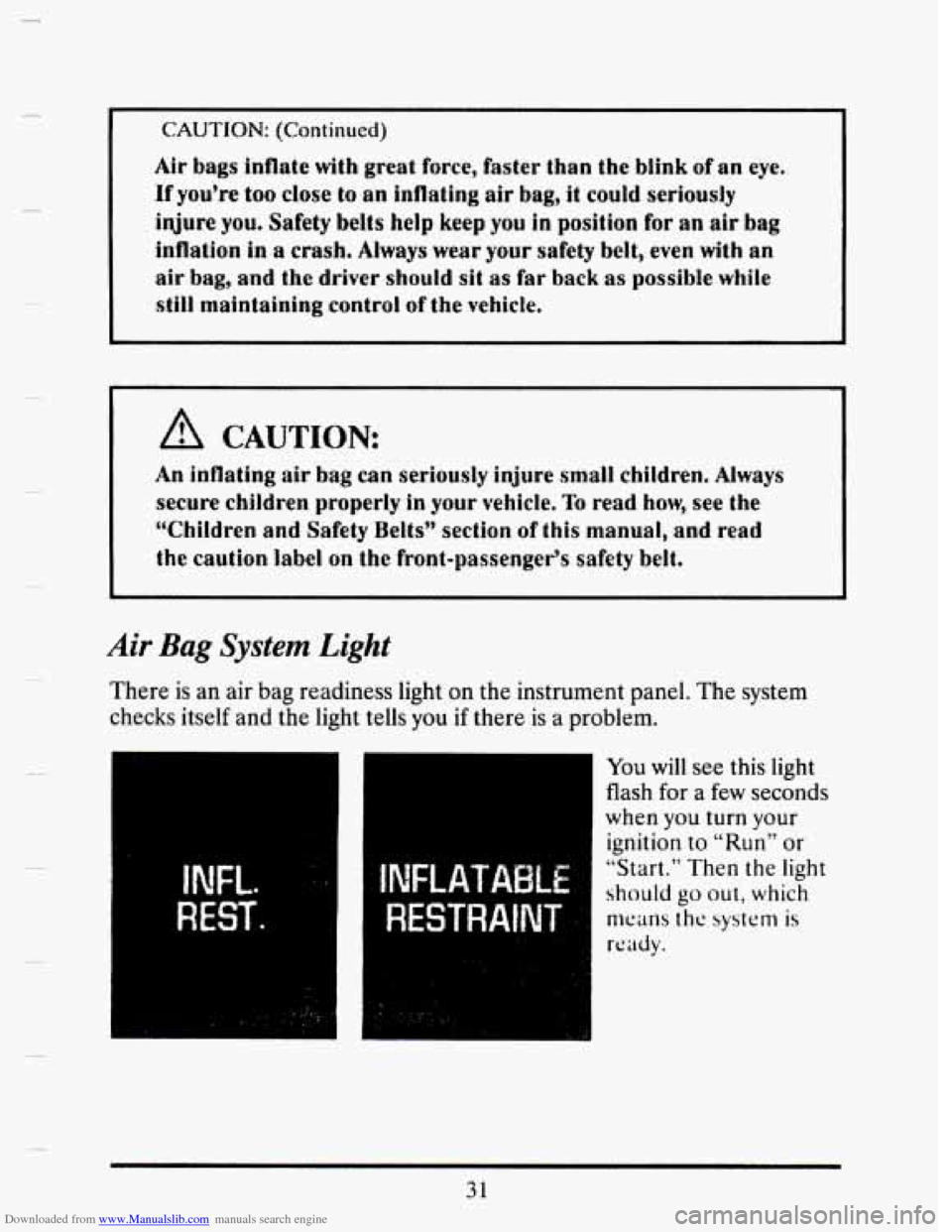
There is an air bag readiness light on the instrument panel. The system
checks itself
and the light tells you if there is a problem.
INFL. ..
REST.
You will see this light
flash
for a few seconds
when you turn your
ignition to “Run” or
“Start.” Then the light
should go out, which
means the system is
ready.
INFLATABLE
RESTRAINT
..
31
Page 60 of 407
Downloaded from www.Manualslib.com manuals search engine CHILD RESTMNTS
Be sure to follow the instructions for the restraint. You may find these
instructions
on the restraint itself or in a booklet, or both. These
restraints use the belt system in your vehicle, but the child also has to be
secured within the restraint to help reduce the chance
of personal injury.
The instructions that come with the infant or child restraint will show you
how to do that.
?+%ere to Put the Restraint
Accident statistics show that children are safer if they are restrained in
the rear rather than the front seat. We at General Motors therefore
recommend that
you put your child restraint in the rear seat. NEVER put
a rear-facing child restraint in the front passenger seat. Here’s
why:
A CAUTION:
A child in a rear-facing child restraint can be seriously injured
if the right-front passenger’s air bag inflates, This is because
the back of a rear-facing child restraint would be very close to
the
inflating air bag. If your vehicle has a right-frunt
passenger’s air bag, always secure a rear-facing child restraint
in the rear seat,
You may secure a fonvard-facing child restraint in the right
front seat, However, before securing a forward-facing chitd
restraint, ALWAYS move the frornt passenger seat as far back
as it will go. Or, secure the child restraint in the rear seat.
CAUTION:
A child in B child restraint in the frontenter seat can be
badly injured by the passenger air bag if it inflates. NWEK
use a child restraint in the fmnt-center seat. It’s ahvays better
to secure a child restmint in the rcar seat, You may, howeiq
secure a forward-facing child restraint in the right-front
passenger seat unty with the seat moved all the way back
c
Page 155 of 407
Downloaded from www.Manualslib.com manuals search engine SERVICE RIDE CONTROL
This message is displayed to indicate that the Suspension System is not
operating properly.
To correct this problem have your vehicle serviced at
your Cadillac dealership at your earliest convenience.
STOP ENGINE ENGINE OVERHEATING
This message will appear when your engine has overheated. Stop and
turn your engine
off immediately to avoid severe engine damage. See
“Engine Overheating”
in the Index.
SERVICE VEHICLE SOON
This message will appear if there is a problem with your Emission
Control System.
If the “SERVICE ENGINE SOON” light on the
instrument panel and this message appear and then turns off, it is an
indication that a temporary problem has cleared itself. Have your vehicle
checked at your earliest convenience.
STOP ENGINE LOW OIL PRESSURE
If this message appears while the engine is running, stop the engine and
do not operate it until the cause
of low oil pressure is corrected. Severe
damage to the engine can result.
SERVICE SUPPLEMENTAL INFLATABLE RESTRAINT
If this message appears, there is a problem with your Supplemental
Inflatable Restraint (Air Bag) system. Let only a qualified technician
work on your vehicle.
See your Cadillac dealer for service at once.
THEFT SYSTEM PROBLEWCAR MAY NOT RESTART
This message means there is atroblem in the Personalized Automotive
Security System (PASS
Key I1 ). PASS Key I1 TM will prevent the vehicle
from restarting
if it is turned off, so you should take the vehicle to a
proper service center before turning the engine off. Never leave
an
unattended vehicle with the engine running. Once you are where you can
get service, turn
the engine off and then try to restart it. If the vehicle
does not restart, the PASS
Key I1 TM system will need servicing.
TRACTION ACTIVE
If your vehicle is equipped with Traction Control, this message will be
displayed
if Traction Control is being used to reduce wheel slippage.
141
Page 263 of 407
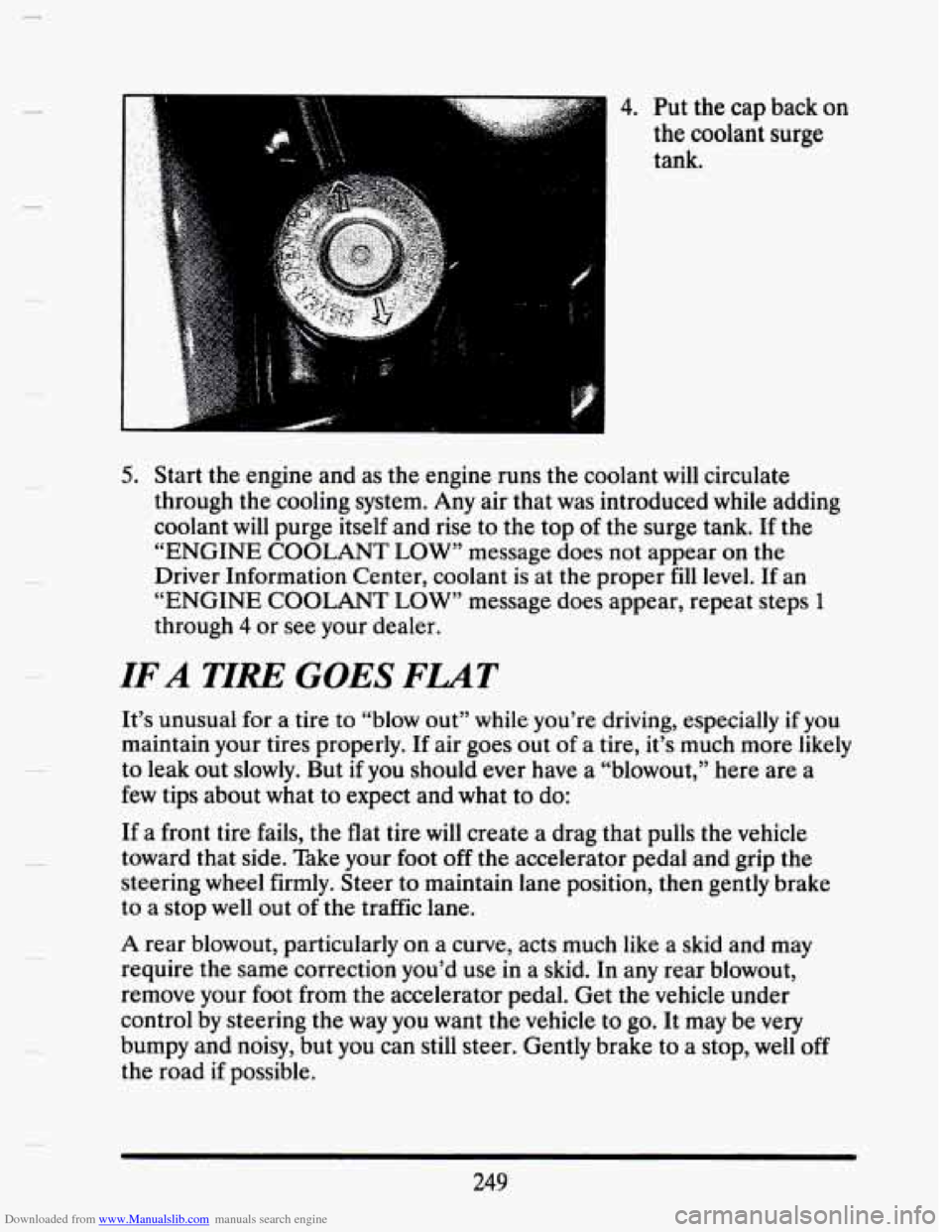
Downloaded from www.Manualslib.com manuals search engine . : 4. Put the cap back on
the coolant
surge
tank.
5. Start the engine and as the engine runs the coolant will circulate
through the cooling system. Any air that was introduced while adding
coolant
will purge itself and rise to the top of the surge tank. If the
“ENGINE COOLANT
LOW” message does not appear on the
Driver Information Center, coolant is at the proper
fill level. If an
“ENGINE
COOLANT LOW” message does appear, repeat steps 1
through 4 or see your dealer.
IFA TIRE GOES FLAT
It’s unusual for a tire to “blow out” while you’re driving, especially if you
maintain your tires properly. If air goes out of a tire, it’s much more likely
to leak out slowly. But if you should ever have a “blowout,” here are a
few tips about what to expect and what
to do:
If a front tire fails, the flat tire will create a drag that pulls the vehicle
toward that side. Take your foot off the accelerator pedal and grip the
steering
wheel firmly. Steer to maintain lane position, then gently brake
to a stop
well out of the traffic lane.
A rear blowout, particularly on a curve, acts much like a skid and may
require the same correction you’d use in a skid. In any rear blowout,
remove your foot from the accelerator pedal. Get the
vehicle under
control by steering the way you want the vehicle to
go. It may be very
bumpy and noisy, but you can still steer. Gently brake to a stop,
well off
the road if possible.
3
249
Page 404 of 407
Downloaded from www.Manualslib.com manuals search engine b
p' I
r I
i
f
!
6
I:
r ..
Third Gear. When To Use ............................ 87
Tilt Steering Wheel .................................. 98
Time. Setting The .................................. 162
Tire Chains ........................................ 314
Tire. Flat .......................................... 249
Tire Pressure Inflation .............................. 307
Tire Inspection and Rotation ......................... 309
Tires .. Loading .................................... 306
Tire Quality Grading ................................ 311
Tires ............................................. 306
Tires. When It's Time For New Tires .................. 310
Torn Safety Belts .................................... 62
Torque Lock (Auto Transaxle) ........................ 207
Towing A Qailer ................................... 213
Towing Your Vehicle ................................ 229
Traction Control System (STS) ....................... 123
Trademarks. GM ................................... 261
Traffic Lights ...................................... 172
Traffic Officer ..................................... 174
nailer Towing ..................................... 213
Tkansaxle. Automatic ................................. 83
'Ransaxle Fluid .................................... 278
Transaxle Gear Positions ............................. 83
Travel. Brake Pedal ................................. 184
Trip Odometer ..................................... 126
Trunk Release. Remote .............................. 74
Turn Signal and Lane Change Indicator ................ 100
Tbrn Signalmeadlight Beam ......................... 101
milight Sentinel ................................... 111
'Ilvisted Safety Belts .................................. 29
Two Children Wearing The Same Safety Belt ............. 59
Transaxle Service ................... See Maint . Book. p.22
U
r i
e
r
15
ti