belt CADILLAC SEVILLE 1995 4.G Service Manual
[x] Cancel search | Manufacturer: CADILLAC, Model Year: 1995, Model line: SEVILLE, Model: CADILLAC SEVILLE 1995 4.GPages: 410, PDF Size: 19.98 MB
Page 70 of 410
Downloaded from www.Manualslib.com manuals search engine SAFETYBELT EXTENDER
If the vehicle’s safety belt will fasten around you, you should use it.
But if a safety belt isn’t long enough to fasten, your dealer
will order you
an extender. It’s free. When you go
in to order it, take the heaviest coat
you will wear,
so the extender will be long enough for you. The extender
will be just for you, and just for the seat in your vehicle that you choose.
Don’t let someone else use it, and use it only for the seat it is made to fit.
To wear it, just attach it to the regular safety belt.
--
CHECKING YOUR RESTUNT SYSTEMS
Now and then, make sure all your belts, buckles, latch plates, retractors,
anchorages and reminder systems are working properly. Look for any
other loose or damaged restraint system parts. If you see anything that
might keep a restraint system from doing its job, have it repaired.
Torn or frayed belts may not protect you
in a crash. They can rip apart
under impact forces. If a belt is torn or frayed, get a new one right away.
REPLACING SEATAND RESTMNT
SYSTEM PARTS AFTER A CRASH
If you’ve had a crash, do you need new belts?
After a very minor collision, nothing may be necessary. But if the belts
were stretched,
as they would be if worn during a more severe crash, then
you need new belts.
If belts are cut or damaged, replace them. Collision damage also may
mean you will need to have safety belt or seat parts repaired or replaced.
New parts and repairs may be necessary even
if the belt wasn’t being used
at the time
of the collision.
1-5 1
Page 148 of 410
Downloaded from www.Manualslib.com manuals search engine .F* Safety Belt Reminder Light
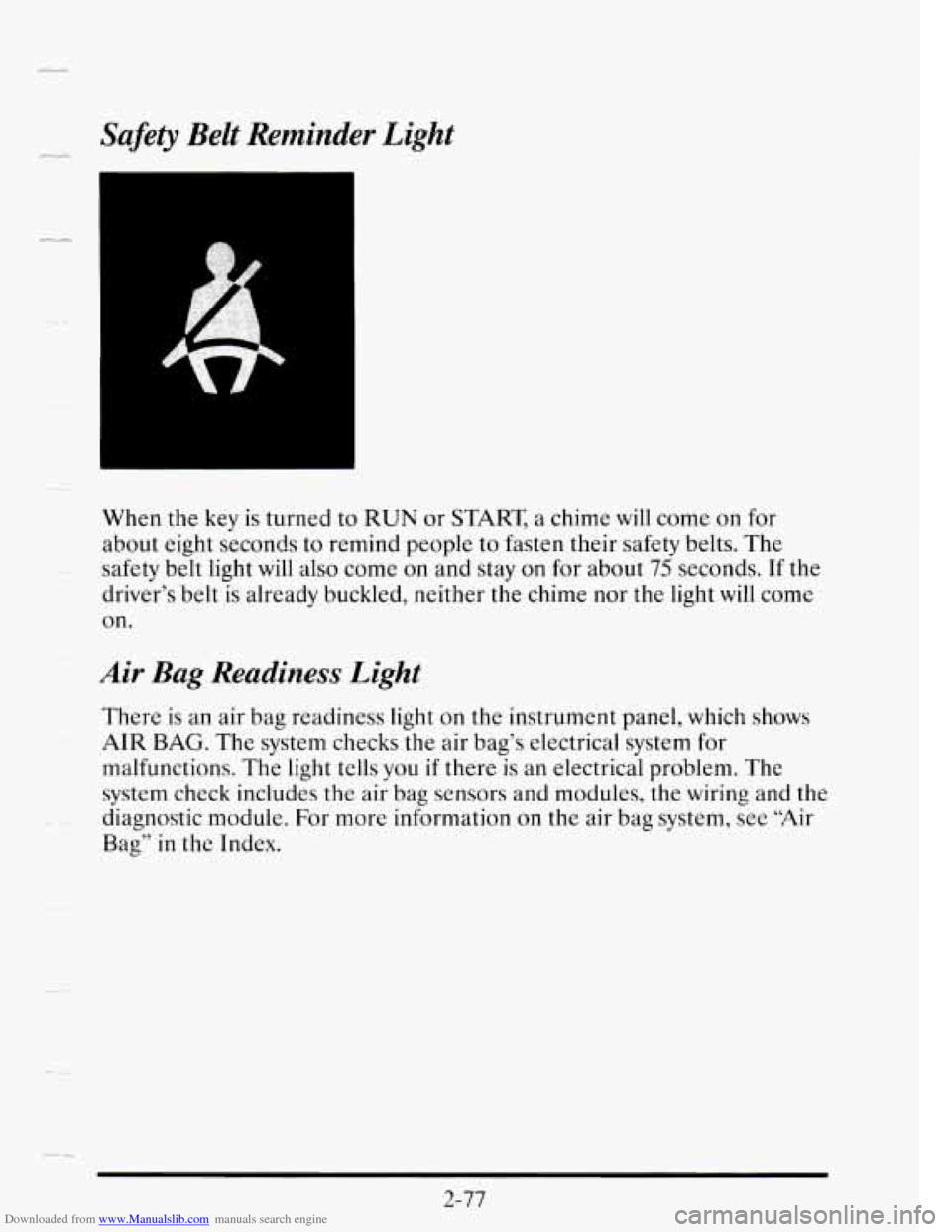
When the key is turned to RUN or START a chime will come on for
about eight seconds to remind people to fasten their safety belts. The
safety belt light will also come on and stay on
for about 75 seconds. If the
driver’s belt
is already buckled, neither the chime nor the light will come
on.
Air Bag Readiness Light
There is an air bag readiness light on the instrument panel, which shows
AIR BAG.
The system checks the air bag’s electrical system for
malfunctions. The light tells you
if there is an electrical problem. The
system check includes the air bag sensors and modules, the wiring and the
.~ diagnostic module. For more information on the air bag system, see “Air
Bag” in the Index.
2-77
Page 189 of 410
Downloaded from www.Manualslib.com manuals search engine Care of Your Cassette Tape Pkyer
A tape player that is not cleaned regularly can cause reduced sound
quality, ruined cassettes or a damaged mechanism. Cassette tapes should
be stored in their cases away from contaminants, direct sunlight and
extreme heat.
If they aren’t, they may not operate properly or cause
failure of the tape player.
Your tape player should be cleaned regularly each month or after every
50 hours of use. If you notice a reduction in sound quality, try a known
good cassette to see
if the tape or the tape player is at fault. If this other
cassette has no improvement in sound quality, clean the tape player.
Cleaning may be done
with a scrubbing action, non-abrasive cleaning
cassette. This system uses a cleaning cassette with pads which scrub the
tape head as the hubs of the cleaner cassette turn. It is normal for the
cartridge to eject
while cleaning. Insert the cassette at least three times to
ensure thorough cleaning. A scrubbing action cleaning cassette is
available through your Cadillac dealership.
You may also choose a non-scrubbing action, wet-type cleaner which uses
a cassette with a fabric belt to clean the tape head. This type of cleaning
cassette
will not eject. It may not clean as thoroughly as the scrubbing type
cleaner.
Cassette tapes are subject to wear and the sound quality may degrade
over time. Always make sure that the cassette tape is in good condition
before you have your tape player serviced.
Care of Your Compact Discs
Handle discs carefully. Store them in their original cases or other
protective cases and away from direct sunlight and dust. If the surface of a
disc is soiled, dampen a clean, soft cloth in a mild, neutral detergent
solution and clean it, wiping from the center to the edge.
Be sure never to touch the signal surface when handling discs. Pick up discs
by grasping the outer edges or the edge
of the hole and the outer edge.
3 -20
LI...
L- J
Page 193 of 410
Downloaded from www.Manualslib.com manuals search engine DEFENSIVE DRWTNG
The best advice anyone can give about driving is: Drive defensively.
Please start with a very important safety device in your Cadillac: Buckle
up. (See “Safety Belts”
in the Index.)
Defensive driving really means “be ready for anything.”
On city streets,
rural roads, or freeways,
it means “always expect the unexpected.”
Assume that pedestrians or other drivers are going
to be careless and
make mistakes. Anticipate what they might do. Be ready for their
mistakes.
Rear-end collisions are about the most preventable of accidents. Yet they
are common. Allow enough following distance. It’s the best defensive
driving maneuver, in both city and rural driving. You never know when
the vehicle in front of you is going to brake
or turn suddenly.
DRUNICEN DMNG
Death and injury associated with drinking and driving is a national
tragedy. It’s the number one contributor to the highway death toll,
claiming thousands
of victims every year.
Alcohol affects four things that anyone needs to drive a vehicle:
0 Judgment
Muscular Coordination
Vision
0 Attentiveness
L-i
c
Police records show that almost half of all motor vehicle-related deaths
involve alcohol.
In most cases, these deaths are the result of someone who -
was drinking and driving. In recent years, some 18,000 annual motor
vehicle-related deaths have been associated with the use of alcohol, with
more than
300,000 people injured.
Page 204 of 410
Downloaded from www.Manualslib.com manuals search engine Steering in Emergencies
There are times when steering can be more effective than braking. For
example, you come over a hill and find a truck stopped in your lane, or a
car suddenly pulls out from nowhere, or a child darts out from between
parked cars and stops right in front of you. You can avoid these problems
by braking
-- if you can stop in time. But sometimes you can’t; there isn’t
room. That’s the time for evasive action
-- steering around the problem.
Your Cadillac can perform very well in emergencies like these. First apply
your brakes. It is better to remove as much speed as you can from a
possible collision.
Then steer around the problem, to the left or right
depending on the space available.
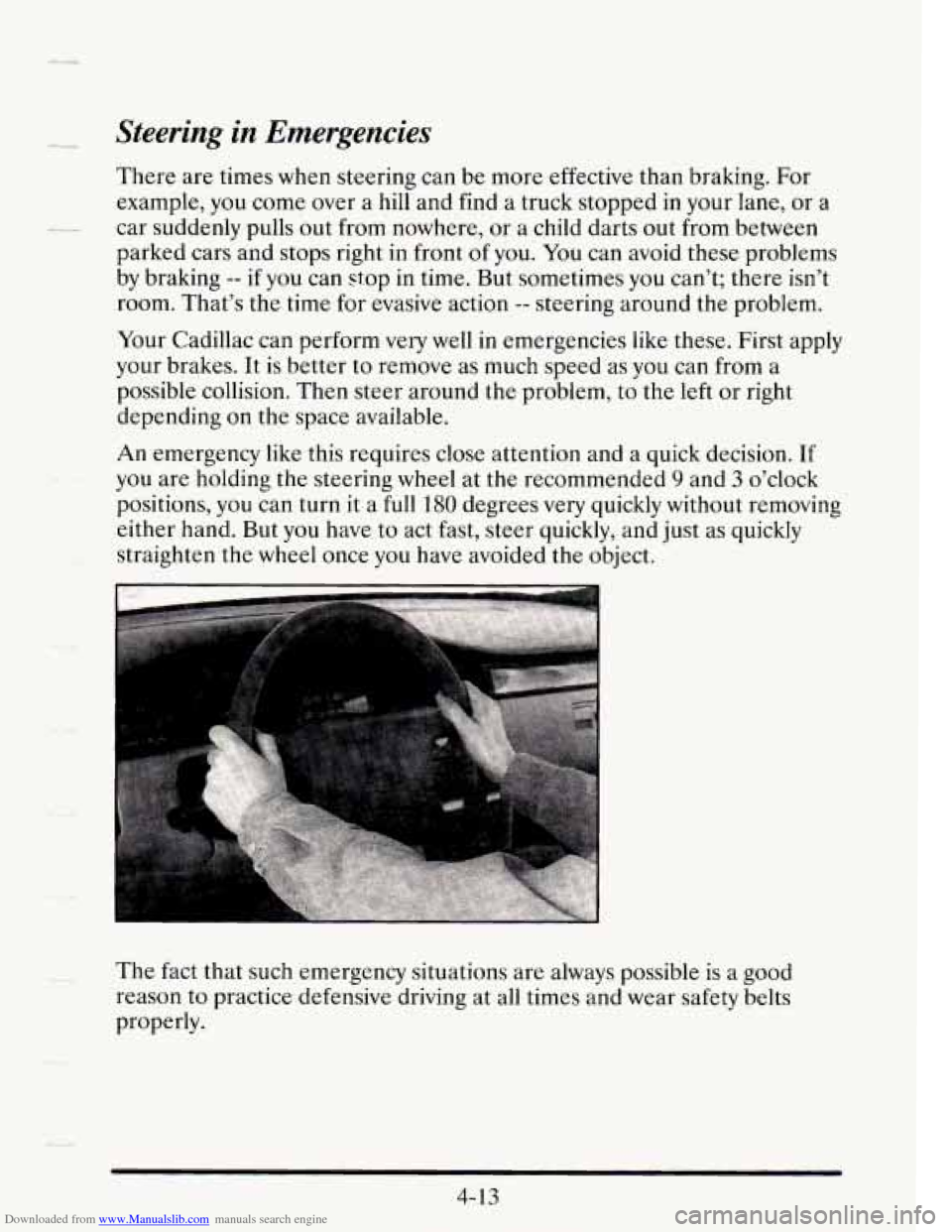
An emergency like this requires close attention and a quick decision. If
you are holding the steering wheel at the recommended 9 and 3 o’clock
positions, you can turn it a
full 180 degrees very quickly without removing
either hand. But
you have to act fast, steer quickly, and just as quickly
straighten the wheel once you have avoided the object.
: . .
The fact that such emergency situations are always possible is a good
reason to practice defensive driving at all times and wear safety belts
properly.
4- 13
Page 239 of 410
Downloaded from www.Manualslib.com manuals search engine Adahtenance When Trailer Towing
Your vehicle will need service more often when you're pulling a trailer.
See the Maintenance Schedule for more
on this. Things that are especially
important in trailer operation are automatic transaxle fluid (don't
overfill), engine oil, belt, cooling system, and brake adjustment. Each
of
these is covered in this manual, and the Index will help you find them
quickly. If you're trailering, it's a good idea to review these sections before
you start your trip.
--
Check periodically to see that all hitch nuts and bolts are tight.
Engine Coding When Trailering
Your cooling system may temporarily overheat during severe operating
conditions such as:
Climbing grades steeper than 4% at ambient temperatures above
90°F (32" C) with a loaded vehicle and trailer.
Stopping after high-speed driving.
Idling for long periods in stop-and-go traffic.
If the ENGINE HOT-A/C COMPRESSOR OFF message appears on the
Driver Information Center, do
not be alarmed. This is a normal function
designed to reduce the load on the engine and cooling system. You can
continue to drive your vehicle.
If the ENGINE COOLANT HOT-IDLE ENGINE message appears on
the Driver Information Center, pull
off to the side of the road as soon as
it is safe to do
so. When the vehicle is at a complete stop, shift the
transaxle selector to PARK
(P) and allow the engine to idle. Do not turn
off the engine or increase engine speed above a normal idle. After several
minutes, resume driving at a reduced speed. Return
to normal driving
after
10 minutes if the ENGINE COOLANT HOT-IDLE ENGINE
message is not displayed.
4-48
Page 318 of 410
Downloaded from www.Manualslib.com manuals search engine 0 The tire has a bump, bulge or split.
The tire has a puncture, cut, or other damage that can’t be repaired
well because
of the size or location of the damage.
Buying New Tires
To find out what kind and size of tires you need, look at the Tire-Loading
Information label.
The tires installed on your vehicle when it was new had a Tire
Performance Criteria Specification (TPC Spec) number on each tire’s
sidewall. When you get new tires, get ones with that same TPC Spec
number. That way, your vehicle
will continue to have tires that are
designed to give proper endurance, handling, speed rating, traction, ride
and other things during normal service on your vehicle. If your tires have
an all-season tread design, the TPC number
will be followed by an MS
(for mud and snow).
If
you ever replace your tires with those not having a TPC Spec number,
make sure they are the same size, load range, speed rating and
construction type (bias, bias-belted
or radial) as your original tires.
6-47
Page 327 of 410
Downloaded from www.Manualslib.com manuals search engine Cleaning the Top of the Instrument Panel
Use only mild soap and water to clean the top surfaces of the instrument
panel. Sprays containing silicones
or waxes may cause annoying
reflections in the windshield and even make it difficult to see through the
windshield under certain conditions.
Cleaning Speaker Covers
Vacuum around a speaker cover gently, so that the speaker won’t be
damaged.
If something gets on one of them, follow the steps earlier under
“Using Solvent-Type Cleaner
on Fabric.” Use as little solvent as you can.
Care of Wood Panels
Use a clean cloth moistened in warm soapy water (use mild dish washing
soap). Dry the wood immediately with a clean cloth.
CARE OF SAFETYBELTS
Keep belts clean and dry.
GLASS
Glass should be cleaned often. GM Glass Cleaner (GM Part No. 1050427)
or a liquid household glass cleaner will remove normal tobacco smoke and
dust films.
Don’t use abrasive cleaners on glass, becgug‘ they may cause scratches.
Avoid placing decals on the inside rear window, since they may have to be
scraped
off later. If abrasive cleaners are used on the inside of the rear
window,
an electric defogger element may be damaged. Any temporary
license should not be attached across the defogger grid.
6-56
Page 333 of 410
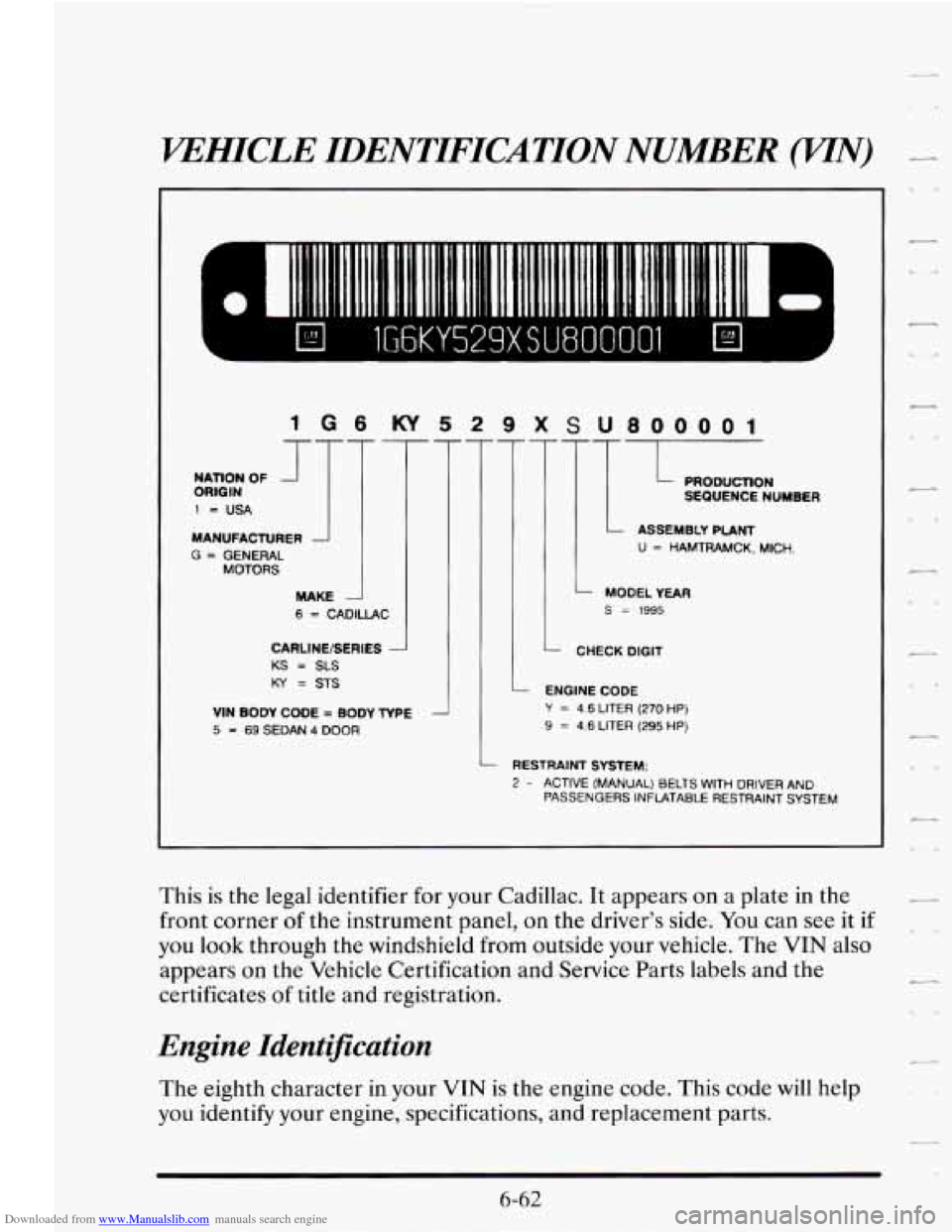
Downloaded from www.Manualslib.com manuals search engine W3HICLE IDENTIFICATION NUMBER (WN)
lG6KY529XSU800001 A
1 G 6 KY 5 2 9 X S U800001
7
-
NATION OF ORIGIN
1 E. USA
MANUFACTURER
G = GENERAL MOTORS MAKE
-
6 = CADILLAC
CARLINEISERIES -
KS = SLS
KY = STS
VIN BODY CODE = BODY TVPE -
5 = 69 SEDAN 4 DOOR
r -TI PRODUCTION
SEQUENCE NUYBCR
ASSEMBLY PLANT
U = HAMTRAMCK. MlCH
- MODELYEAR S = 1995
- CHECK DIGIT
- ENGINE CODE
Y = 4.6 LITER (270 HP)
9 = 4.6 LITER (295 HP)
RESTRAINT SYSTEM:
2 - ACTIVE (MANUAL) BELTS WITH DRIVER AND
PASSENGERS INFLATABLE RESTRAINT SYSTEM
This is the legal identifier for your Cadillac. It appears on a plate in the
front corner
of the instrument panel, on the driver’s side. You can see it if
you
look through the windshield from outside your vehicle. The VIN also
appears on the Vehicle Certification and Service Parts labels and the
certificates
of title and registration.
Engine Identiflcation
The eighth character in your VIN is the engine code. This code will help
you identify your engine, specifications, and replacement parts.
Page 345 of 410
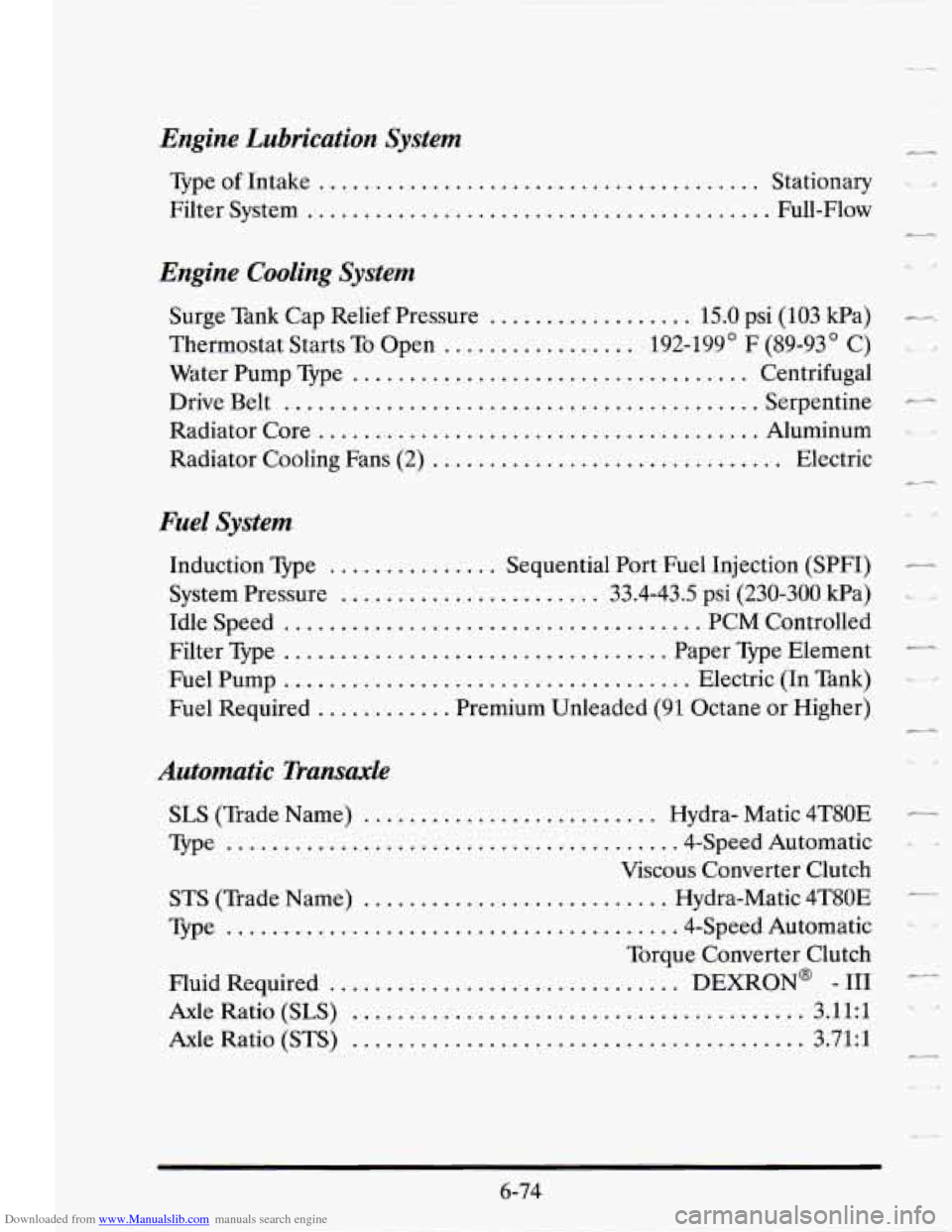
Downloaded from www.Manualslib.com manuals search engine Engine Lubrication System
Type of Intake ....................................... Stationary
Filter System
......................................... Full-Flow
Engine Cooling System
Surge Tank Cap Relief Pressure .................. 15.0 psi (103 kPa)
Thermostat Starts
To Open ................. 192-199" F (89-93' C)
Water Pump Type ................................... Centrifugal
Drive Belt
.......................................... Serpentine
Radiator Core
....................................... Aluminum
Radiator Cooling Fans
(2) ............................... Electric
Fuel System
Induction Type ............... Sequential Port Fuel Injection (SPFI)
System Pressure
....................... 33.4-43.5 psi (230-300 kPa)
Idle Speed
..................................... PCM Controlled
Filter Type
.................................. Paper Type Element
Fuel Pump
.................................... Electric (In Tank)
Fuel Required
............ Premium Unleaded (91 Octane or Higher)
Automatic Transaxle
SLS (Trade Name)
Type ............
STS (Trade Name)
Type
............
Fluid Required ...
Axle Ratio (SLS) .
Axle Ratio (STS) .
.......................... Hydra- Matic 4T80E
........................... .4-Speed Automatic
Viscous Converter Clutch
........................... Hydra-Matic 4T80E
........................... .4-Speed Automatic
Torque Converter Clutch
....................................... 3.11:l
....................................... 3.71:l
............................ DEXRON~ - 111
6-74
1
r