climate control CADILLAC SEVILLE 2000 5.G User Guide
[x] Cancel search | Manufacturer: CADILLAC, Model Year: 2000, Model line: SEVILLE, Model: CADILLAC SEVILLE 2000 5.GPages: 359, PDF Size: 2.59 MB
Page 160 of 359
3-6 Electronic Solar Sensor
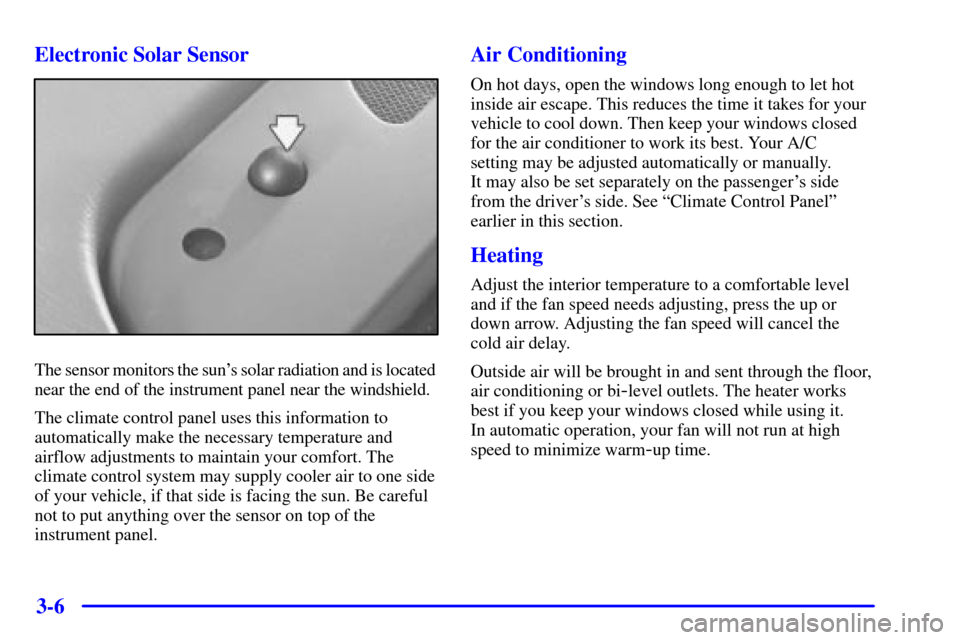
The sensor monitors the sun's solar radiation and is located
near the end of the instrument panel near the windshield.
The climate control panel uses this information to
automatically make the necessary temperature and
airflow adjustments to maintain your comfort. The
climate control system may supply cooler air to one side
of your vehicle, if that side is facing the sun. Be careful
not to put anything over the sensor on top of the
instrument panel.
Air Conditioning
On hot days, open the windows long enough to let hot
inside air escape. This reduces the time it takes for your
vehicle to cool down. Then keep your windows closed
for the air conditioner to work its best. Your A/C
setting may be adjusted automatically or manually.
It may also be set separately on the passenger's side
from the driver's side. See ªClimate Control Panelº
earlier in this section.
Heating
Adjust the interior temperature to a comfortable level
and if the fan speed needs adjusting, press the up or
down arrow. Adjusting the fan speed will cancel the
cold air delay.
Outside air will be brought in and sent through the floor,
air conditioning or bi
-level outlets. The heater works
best if you keep your windows closed while using it.
In automatic operation, your fan will not run at high
speed to minimize warm
-up time.
Page 164 of 359
3-10 HVAC Steering Wheel Controls
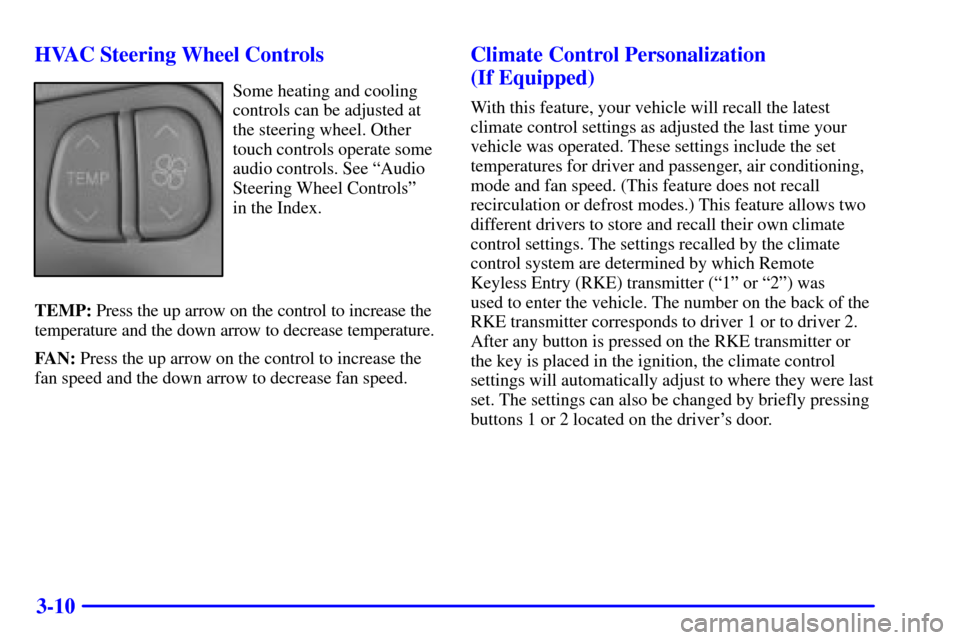
Some heating and cooling
controls can be adjusted at
the steering wheel. Other
touch controls operate some
audio controls. See ªAudio
Steering Wheel Controlsº
in the Index.
TEMP: Press the up arrow on the control to increase the
temperature and the down arrow to decrease temperature.
FAN: Press the up arrow on the control to increase the
fan speed and the down arrow to decrease fan speed.
Climate Control Personalization
(If Equipped)
With this feature, your vehicle will recall the latest
climate control settings as adjusted the last time your
vehicle was operated. These settings include the set
temperatures for driver and passenger, air conditioning,
mode and fan speed. (This feature does not recall
recirculation or defrost modes.) This feature allows two
different drivers to store and recall their own climate
control settings. The settings recalled by the climate
control system are determined by which Remote
Keyless Entry (RKE) transmitter (ª1º or ª2º) was
used to enter the vehicle. The number on the back of the
RKE transmitter corresponds to driver 1 or to driver 2.
After any button is pressed on the RKE transmitter or
the key is placed in the ignition, the climate control
settings will automatically adjust to where they were last
set. The settings can also be changed by briefly pressing
buttons 1 or 2 located on the driver's door.
Page 325 of 359

6-49 Uniform Tire Quality Grading
The following information relates to the system
developed by the United States National Highway
Traffic Safety Administration, which grades tires by
treadwear, traction and temperature performance.
(This applies only to vehicles sold in the United States.)
The grades are molded on the sidewalls of most
passenger car tires. The Uniform Tire Quality Grading
system does not apply to deep tread, winter
-type snow
tires, space
-saver or temporary use spare tires, tires with
nominal rim diameters of 10 to 12 inches (25 to 30 cm),
or to some limited
-production tires.
While the tires available on General Motors passenger
cars and light trucks may vary with respect to these
grades, they must also conform to Federal safety
requirements and additional General Motors Tire
Performance Criteria (TPC) standards.Treadwear
The treadwear grade is a comparative rating based on
the wear rate of the tire when tested under controlled
conditions on a specified government test course.
For example, a tire graded 150 would wear one and
a half (1 1/2) times as well on the government course
as a tire graded 100. The relative performance of
tires depends upon the actual conditions of their use,
however, and may depart significantly from the norm
due to variations in driving habits, service practices
and differences in road characteristics and climate.
Traction -- AA, A, B, C
The traction grades, from highest to lowest, are AA,
A, B, and C. Those grades represent the tire's ability
to stop on wet pavement as measured under controlled
conditions on specified government test surfaces of
asphalt and concrete. A tire marked C may have poor
traction performance. Warning: The traction grade
assigned to this tire is based on straight
-ahead braking
traction tests, and does not include acceleration,
cornering, hydroplaning, or peak traction characteristics.