low beam CADILLAC SRX 2004 1.G Owners Manual
[x] Cancel search | Manufacturer: CADILLAC, Model Year: 2004, Model line: SRX, Model: CADILLAC SRX 2004 1.GPages: 468, PDF Size: 2.92 MB
Page 130 of 468
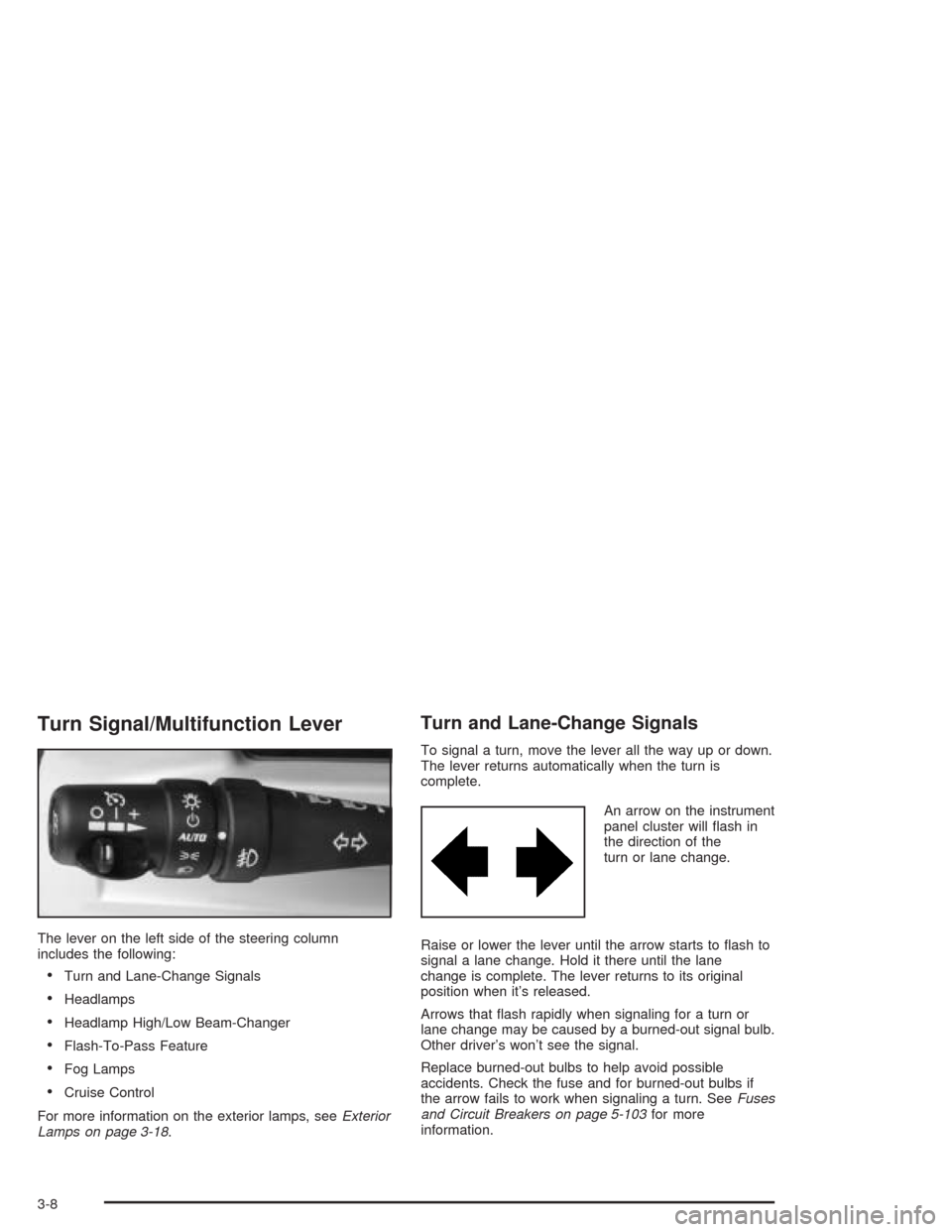
Turn Signal/Multifunction Lever
The lever on the left side of the steering column
includes the following:
Turn and Lane-Change Signals
Headlamps
Headlamp High/Low Beam-Changer
Flash-To-Pass Feature
Fog Lamps
Cruise Control
For more information on the exterior lamps, seeExterior
Lamps on page 3-18.
Turn and Lane-Change Signals
To signal a turn, move the lever all the way up or down.
The lever returns automatically when the turn is
complete.
An arrow on the instrument
panel cluster will ash in
the direction of the
turn or lane change.
Raise or lower the lever until the arrow starts to ash to
signal a lane change. Hold it there until the lane
change is complete. The lever returns to its original
position when it’s released.
Arrows that ash rapidly when signaling for a turn or
lane change may be caused by a burned-out signal bulb.
Other driver’s won’t see the signal.
Replace burned-out bulbs to help avoid possible
accidents. Check the fuse and for burned-out bulbs if
the arrow fails to work when signaling a turn. SeeFuses
and Circuit Breakers on page 5-103for more
information.
3-8
Page 131 of 468
Turn Signal On Chime
If the turn signal is left on for about 1 mile (1.6 km),
a warning chime will sound and the Turn Signal
On message will appear on the Driver Information
Center (DIC) display. See “Turn Signal On Message”
underDIC Warnings and Messages on page 3-64
for more information.
Headlamp High/Low-Beam Changer
Push forward on the turn signal/multifunction lever to
change the headlamps from low to high beam. Pull the
lever back and then release it to change from high
to low beam.
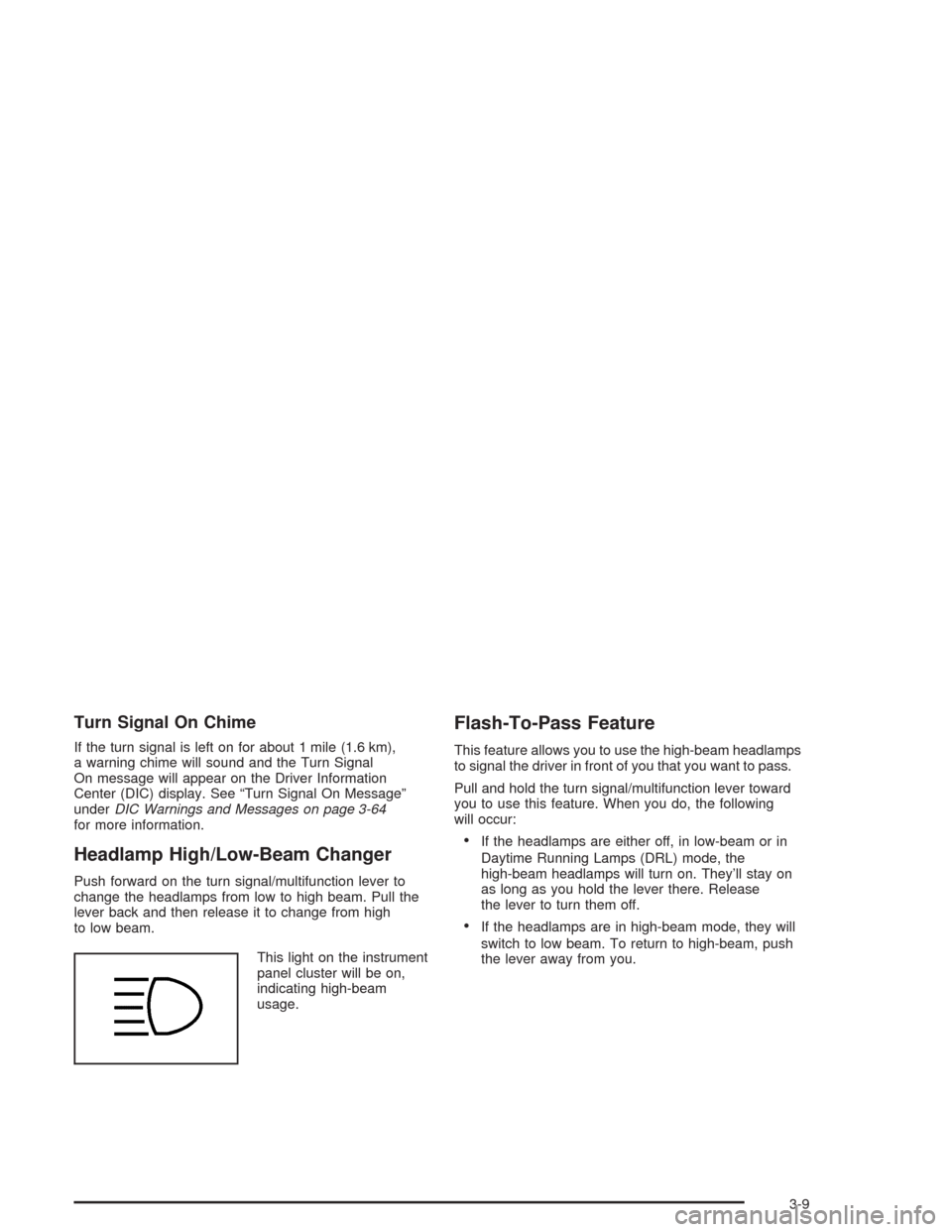
This light on the instrument
panel cluster will be on,
indicating high-beam
usage.
Flash-To-Pass Feature
This feature allows you to use the high-beam headlamps
to signal the driver in front of you that you want to pass.
Pull and hold the turn signal/multifunction lever toward
you to use this feature. When you do, the following
will occur:
If the headlamps are either off, in low-beam or in
Daytime Running Lamps (DRL) mode, the
high-beam headlamps will turn on. They’ll stay on
as long as you hold the lever there. Release
the lever to turn them off.
If the headlamps are in high-beam mode, they will
switch to low beam. To return to high-beam, push
the lever away from you.
3-9
Page 133 of 468
Fog Lamps
Use the fog lamps for better vision in foggy or misty
conditions.
The fog lamp control is located on the turn
signal/multifunction lever.
-:The band with this symbol is used to turn the
fog lamps on and off.
The parking lamps must be on for the fog lamps to
work.
To turn the fog lamps on, turn the fog lamp band on the
lever up to the dot and release it. The band will return
to its original position.
To turn the fog lamps off, turn the for lamp band up to
the dot and release it. The band will return to its original
position, and the fog lamps will turn off. If you turn on
the high-beam headlamps, the fog lamps will also
turn off. They’ll turn back on again when you switch back
to low-beam headlamps.
Cruise Control
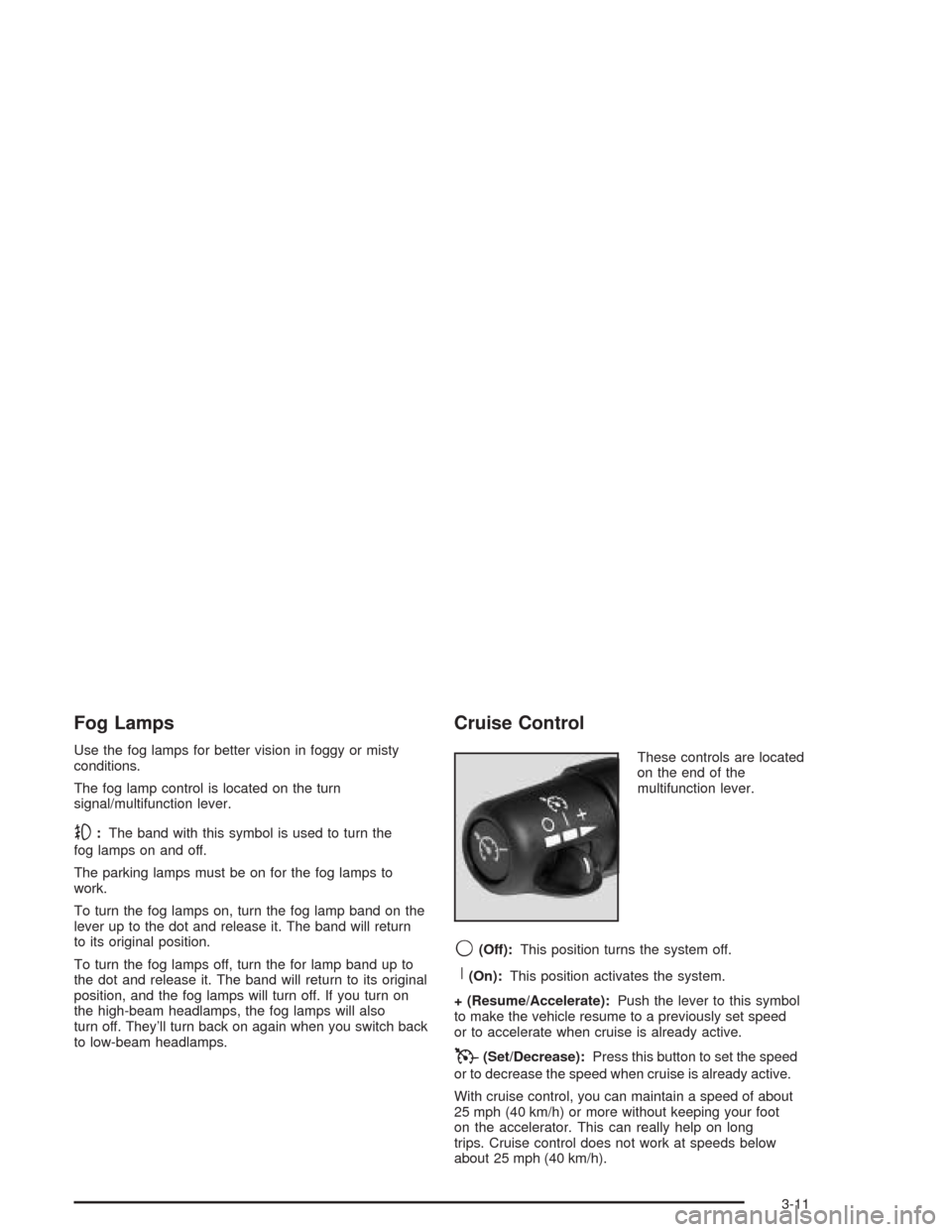
These controls are located
on the end of the
multifunction lever.
9(Off):This position turns the system off.
R(On):This position activates the system.
+ (Resume/Accelerate):Push the lever to this symbol
to make the vehicle resume to a previously set speed
or to accelerate when cruise is already active.
T(Set/Decrease):Press this button to set the speed
or to decrease the speed when cruise is already active.
With cruise control, you can maintain a speed of about
25 mph (40 km/h) or more without keeping your foot
on the accelerator. This can really help on long
trips. Cruise control does not work at speeds below
about 25 mph (40 km/h).
3-11
Page 140 of 468
Exterior Lamps
Headlamps
SeeTurn Signal/Multifunction Lever on page 3-8for
more information on the headlamps.
Daytime Running Lamps
Daytime Running Lamps (DRL) can make it easier for
others to see the front of your vehicle during the
day. DRL can be helpful in many different driving
conditions, but they can be especially helpful in the short
periods after dawn and before sunset. Fully functional
daytime running lamps are required on all vehicles
rst sold in Canada.
The DRL system will make the turn signal lamps come
on when the following conditions are met:
It is still daylight and the ignition is in ON or START,
the exterior lamp control is in OFF or AUTO with the
headlamps off, and
an automatic transmission is not in PARK (P) or the
parking brake is not set on a manual transmission.When DRL are on, only your front turn signal lamps will
be on. No other exterior lamps will be on when the
DRL are being used. Your instrument panel won’t be
lit up either.
When the exterior lamp control is in AUTO and it’s dark
enough outside, the DRL will turn off and the low-beam
headlamps will turn on. When it’s bright enough
outside, the low-beam headlamps will go off, and the
DRL will turn back on. If you start your vehicle in a dark
garage, the automatic headlamp system will come on
immediately. Once you leave the garage, it will take
about one minute for the automatic headlamp system to
change to DRL if it is light outside. During that delay,
your instrument panel cluster may not be as bright
as usual. Make sure your instrument panel brightness
lever is in the full bright position. See “Instrument Panel
Brightness” underInterior Lamps on page 3-20.
If it’s dark enough outside and the exterior lamp control
is off, a Headlamps Suggested message will appear
on the Driver’s Information Center (DIC) display.
This message informs the driver that turning on the
exterior lamps is recommended even though the DRL
3-18
Page 141 of 468

are still illuminated. Turning the exterior lamp control to
AUTO or to the low-beam headlamp position will
turn off the DRL and cancel the Headlamps Suggested
message. If the parking lamps or the fog lamps were
turned on instead, the DRL will still turn off and the
Headlamps Suggested message will be displayed.
You can turn it off by pressing the OK button if you have
the Navigation audio system or the CLR button if you
have the Base audio system.
To operate your vehicle with the DRL off, turn the
exterior lamp control off. Then turn on the fog lamps or
parking lamps, and the DRL will turn off. The
Headlamps Suggested message will appear on the DIC
display. This will work regardless of gear position
and whether or not the parking brake is set.
As with any vehicle, you should turn on the regular
headlamp system when you need it.Light Sensor
The light sensor for the DRL and AUTO headlamp
feature is located on top of the instrument panel. If you
cover the sensor, it will read dark, and the exterior
lamps or the Headlamps Suggested message will
appear on the DIC whenever the ignition is on.
3-19
Page 172 of 468
Cruise Control Light
This light comes on
whenever you set your
cruise control.
The light will go out when the cruise control is turned
off. See “Cruise Control” underTurn Signal/Multifunction
Lever on page 3-8for more information.
Highbeam On Light
This light comes on
whenever the high-beam
headlamps are on.
See “Headlamp High/Low-Beam Changer” under
Turn Signal/Multifunction Lever on page 3-8for more
information.
Fuel Gage
The fuel gage shows
approximately how much
fuel is in the tank. It
works only when the
ignition is in ON.
If the fuel supply gets low, the Fuel Level Low message
will appear on the DIC and a single chime will sound.
Here are a few concerns some owners have had about
the fuel gage. All of these situations are normal and
do not indicate that anything is wrong with the fuel gage:
At the gas station the gas pump shuts off before
the gage reads full.
The gage may change when you turn, stop quickly
or accelerate quickly.
It takes a little more or less fuel to ll the tank than
the gage indicated. For example, the gage may
have indicated that the tank was half full, but
it actually took a little more or less than half the
tank’s capacity to ll the tank.
3-50
Page 281 of 468
Here are some tips on night driving.
Drive defensively.
Do not drink and drive.
Since you can not see as well, you may need to
slow down and keep more space between you
and other vehicles.
Slow down, especially on higher speed roads.
Your headlamps can light up only so much
road ahead.
In remote areas, watch for animals.
If you are tired, pull off the road in a safe place
and rest.
No one can see as well at night as in the daytime.
But as we get older these differences increase.
A 50-year-old driver may require at least twice as much
light to see the same thing at night as a 20-year-old.
What you do in the daytime can also affect your night
vision. For example, if you spend the day in bright
sunshine you are wise to wear sunglasses. Your eyes
will have less trouble adjusting to night. But if you
are driving, do not wear sunglasses at night. They may
cut down on glare from headlamps, but they also
make a lot of things invisible.You can be temporarily blinded by approaching
headlamps. It can take a second or two, or even
several seconds, for your eyes to readjust to the dark.
When you are faced with severe glare (as from a
driver who does not lower the high beams, or a
vehicle with misaimed headlamps), slow down a little.
Avoid staring directly into the approaching headlamps.
Keep your windshield and all the glass on your
vehicle clean — inside and out. Glare at night is made
much worse by dirt on the glass. Even the inside of
the glass can build up a lm caused by dust. Dirty glass
makes lights dazzle and ash more than clean glass
would, making the pupils of your eyes contract
repeatedly.
Remember that your headlamps light up far less of a
roadway when you are in a turn or curve. Keep your
eyes moving; that way, it is easier to pick out dimly
lighted objects. Just as your headlamps should
be checked regularly for proper aim, so should your
eyes be examined regularly. Some drivers suffer from
night blindness — the inability to see in dim light — and
are not even aware of it.
4-31
Page 284 of 468
Driving Through Deep Standing Water
Notice:If you drive too quickly through deep
puddles or standing water, water can come in
through your engine’s air intake and badly damage
your engine. Never drive through water that is
slightly lower than the underbody of your vehicle.
If you can not avoid deep puddles or standing water,
drive through them very slowly.
Driving Through Flowing Water
{CAUTION:
Flowing or rushing water creates strong
forces. If you try to drive through owing
water, as you might at a low water crossing,
your vehicle can be carried away. As little as
six inches of owing water can carry away a
smaller vehicle. If this happens, you and
other vehicle occupants could drown.
CAUTION: (Continued)
CAUTION: (Continued)
Do not ignore police warning signs, and
otherwise be very cautious about trying to
drive through owing water.
Some Other Rainy Weather Tips
Turn on your low-beam headlamps – not just your
parking lamps – to help make you more visible to
others.
Besides slowing down, allow some extra following
distance. And be especially careful when you
pass another vehicle. Allow yourself more clear
room ahead, and be prepared to have your
view restricted by road spray.
Have good tires with proper tread depth.
SeeTires on page 5-61.
4-34
Page 362 of 468
Bulb Replacement
For the proper type of replacement bulb, see
Replacement Bulbs on page 5-58.
For any bulb changing procedure not listed in this
section, contact your dealer.
High Intensity Discharge (HID)
Lighting
{CAUTION:
The low beam high intensity discharge lighting
system operates at a very high voltage. If you
try to service any of the system components,
you could be seriously injured. Have your
dealer or a qualied technician service them.
Your vehicle may have HID headlamps. After your
vehicle’s HID headlamp bulb has been replaced, you
may notice that the beam is a slightly different
shade than it was originally. This is normal.
Halogen Bulbs
{CAUTION:
Halogen bulbs have pressurized gas inside
and can burst if you drop or scratch the bulb.
You or others could be injured. Be sure to read
and follow the instructions on the bulb
package.
5-54
Page 363 of 468
Headlamps, Sidemarker, and
Parking Lamps
If your vehicle has halogen headlamps, you can replace
the bulbs using the following procedure. Use this
procedure to replace the front sidemarker and parking
lamp bulbs also.
If you only need to change the sidemarker bulb, there is
an alternate procedure. SeeSidemarker Lamps on
page 5-57.
To remove the headlamp assembly from the vehicle and
access the bulbs, follow these steps:
1. Open the hood. SeeHood Release on page 5-11
for more information.
2. Use a tool to remove all of the fasteners along the
top surface of the front fascia.
3. Use a tool to remove the one screw and
one retainer on top of the headlamp assembly.
4. Gently pull the front fascia away from the headlamp
assembly and remove the screw attached to the
bracket located at the lower inboard side of
the headlamp assembly.5. Pull the headlamp assembly straight out to
disengage the snap in the retainer at the lower
outboard back surface of the assembly and then
turn the lamp so that the inboard corner clears the
front fascia and pull the lamp out
6. Remove the electrical harness connector from the
back side of the headlamp assembly access cap.
To replace the headlamp high and/or low beam bulb(s),
do the following:
1. Remove the three Torx
®screws on the back of the
access cap.
2. You can now access the low and high beam bulbs.
Turn the low beam (upper) bulb socket
one-eighth turn counterclockwise to remove it from
the assembly. Turn the high beam (lower) bulb
socket one-eighth turn clockwise to remove it from
the assembly.
3. Replace the bulb. SeeReplacement Bulbs on
page 5-58for the proper bulb number.
4. Reinstall the three Torx
®screws while making sure
the access cap seal gasket is located in the access
cap seal channel.
5-55