towing CADILLAC SRX 2007 1.G Owner's Manual
[x] Cancel search | Manufacturer: CADILLAC, Model Year: 2007, Model line: SRX, Model: CADILLAC SRX 2007 1.GPages: 522, PDF Size: 2.71 MB
Page 341 of 522
When You Are Ready to Leave After
Parking on a Hill
1. Apply your regular brakes and hold the pedal
down while you:
start your engine,
shift into a gear, and
release the parking brake.
2. Let up on the brake pedal.
3. Drive slowly until the trailer is clear of the
chocks.
4. Stop and have someone pick up and store the
chocks.
Maintenance When Trailer Towing
Your vehicle will need service more often when
you’re pulling a trailer. SeeScheduled
Maintenance on page 471for more information.
Things that are especially important in trailer
operation are automatic transmission uid (don’t
overll), engine oil, axle lubricant, drive belt,
cooling system and brake system. Each of these
is covered in this manual, and the Index will
help you nd them quickly. If you’re trailering, it’s
a good idea to review this information before
you start your trip.
Check periodically to see that all hitch nuts and
bolts are tight.
Engine Cooling When Trailer Towing
Your cooling system may temporarily overheat
during severe operating conditions. SeeEngine
Overheating on page 372.
341
Page 349 of 522
Fuel
Use of the recommended fuel is an important part
of the proper maintenance of your vehicle. To
help keep your engine clean and maintain optimum
vehicle performance, GM recommends the use
of gasoline advertised as TOP TIER Detergent
Gasoline.
The 8th digit of your Vehicle Identication Number
(VIN) shows the code letter or number that
identies your engine. You will nd the VIN at the
top left of the instrument panel. SeeVehicle
Identication Number (VIN) on page 453.
Gasoline Octane
If your vehicle has the 3.6L V6 engine
(VIN Code 7), use regular unleaded gasoline
with a posted octane rating of 87 or higher. For best
performance or trailer towing, you may choose to
use middle grade 89 octane unleaded gasoline.If the octane rating is less than 87, you may notice
an audible knocking noise when you drive,
commonly referred to as spark knock. If this occurs,
use a gasoline rated at 87 octane or higher as soon
as possible. If you are using gasoline rated at
87 octane or higher and you hear heavy knocking,
your engine needs service.
If your vehicle has the 4.6L V8 engine (VIN Code
A), use premium unleaded gasoline with a posted
octane rating of 91 or higher. You may also use
regular unleaded gasoline rated at 87 octane or
higher, but your vehicle’s acceleration may be
slightly reduced, and you may notice a slight
audible knocking noise, commonly referred to as
spark knock. If the octane is less than 87, you may
notice a heavy knocking noise when you drive. If
this occurs, use a gasoline rated at 87 octane or
higher as soon as possible. Otherwise, you might
damage your engine. If you are using gasoline
rated at 87 octane or higher and you hear heavy
knocking, your engine needs service.
349
Page 374 of 522
Overheated Engine Protection
Operating Mode
This operating mode allows your vehicle to be
driven to a safe place in an emergency. Should an
hot engine condition exist, an overheat protection
mode which alternates ring groups of cylinders
helps prevent engine damage. In this mode, there is
a loss in power and engine performance. Driving
extended miles (km) and/or towing a trailer in the
overheat protection mode should be avoided.
Notice:After driving in the overheated engine
protection operating mode, to avoid engine
damage, allow the engine to cool before
attempting any repair. The engine oil will be
severely degraded. Repair the cause of coolant
loss and change the oil. SeeEngine Oil on
page 360.
Cooling System
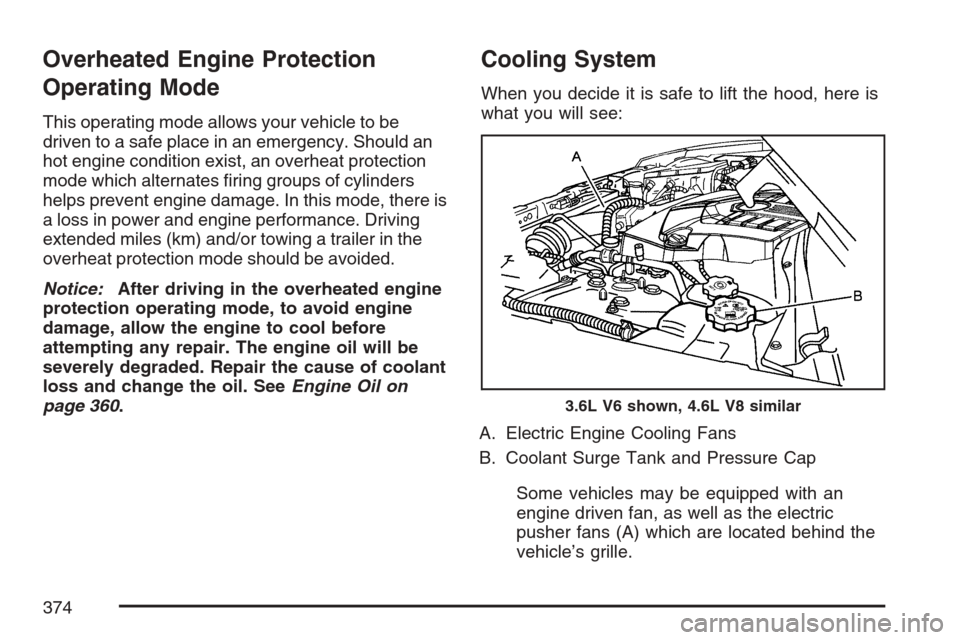
When you decide it is safe to lift the hood, here is
what you will see:
A. Electric Engine Cooling Fans
B. Coolant Surge Tank and Pressure Cap
Some vehicles may be equipped with an
engine driven fan, as well as the electric
pusher fans (A) which are located behind the
vehicle’s grille.
3.6L V6 shown, 4.6L V8 similar
374
Page 473 of 522
Additional Required Services
The following services should be performed at the rst maintenance service (IorII) after the indicated
miles (kilometers) shown for each item.
Additional Required Services
Service and Miles (Kilometers)25,000
(40 000)50,000
(80 000)75,000
(120 000)100,000
(160 000)125,000
(200 000)150,000
(240 000)
Inspect fuel system for damage or
leaks.• •••••
Inspect exhaust system for loose or
damaged components.• •••••
Replace engine air cleaner lter. See
Engine Air Cleaner/Filter on page 365.•••
For vehicles used for trailer towing:
Change transfer case uid.•••
Change automatic transmission uid
and lter (severe service).
See footnote (h).•••
Change automatic transmission uid
and lter (normal service).•
Replace spark plugs.An Emission
Control Service.•
473
Page 475 of 522
(c)Visually inspect hoses and have them replaced
if they are cracked, swollen, or deteriorated.
Inspect all pipes, ttings and clamps; replace with
genuine GM parts as needed. To help ensure
proper operation, a pressure test of the cooling
system and pressure cap and cleaning the outside
of the radiator and air conditioning condenser is
recommended at least once a year.
(d)Visually inspect wiper blades for wear or
cracking. Replace wiper blades that appear worn
or damaged or that streak or miss areas of
the windshield.
(e)Make sure the safety belt reminder light and all
your belts, buckles, latch plates, retractors, and
anchorages are working properly. Look for
any other loose or damaged safety belt system
parts. If you see anything that might keep a safety
belt system from doing its job, have it repaired.
Have any torn or frayed safety belts replaced. Also
look for any opened or broken airbag coverings,
and have them repaired or replaced. The
airbag system does not need regular maintenance.(f)Lubricate all key lock cylinders, hood latch
assemblies, secondary latch, pivots, spring anchor,
release pawl, hood hinges, body door hinges,
rear compartment hinges, sunroof tracks, and any
folding seat hardware. More frequent lubrication
could be required when exposed to a corrosive
environment. Applying silicone grease on
weatherstrips with a clean cloth will make them
last longer, seal better, and not stick or squeak.
See Weatherstrips on page 447.
(g)A uid loss in any vehicle system could
indicate a problem. Have the system inspected
and repaired and the uid level checked. Add uid
if needed.
(h)Change automatic transmission uid and lter
if the vehicle is mainly driven under one or
more of these conditions:
In heavy city traffic where the outside
temperature regularly reaches 90°F (32°C) or
higher.
In hilly or mountainous terrain.
When doing frequent trailer towing.
Uses such as found in taxi, police, or delivery
service.
475
Page 493 of 522
Roadside Service
In the United States or Canada, call
1-800-882-1112. Service is available 24 hours a
day, 365 days a year.
Who Is Covered?
Roadside Assistance coverage is for the vehicle
operator, regardless of ownership. A person driving
this vehicle without the consent of the owner is
not eligible for coverage.
The following services are provided in the United
States during the Bumper-to-Bumper warranty
period and in Canada, during the Base Warranty
coverage period of the New Vehicle Limited
Warranty, up to a maximum coverage of $100.
These services are provided at a nominal charge
if the Cadillac is no longer covered by the
warranties listed previously. Roadside Service is
available only in the United States and Canada.
Cadillac Owner Privileges™
Roadside Service provides several Cadillac Owner
Privileges™ at “no charge,” throughout your
Cadillac Warranty Period — 48 months/
50,000 miles (80 000 km).Emergency Road Service is performed on site for
the following situations:
Towing Service:Emergency towing from a
public roadway or highway to the nearest
dealership for warranty service or in the event
of a vehicle-disabling accident. Winch-out
assistance when the vehicle is mired in sand,
mud, or snow.
Battery Jump Starting:No-start occurrences
which require a battery jump start will be
covered at no charge.
Lock Out Assistance:To ensure security,
the driver must present the vehicle registration
and personal ID before lock-out service is
provided. Lock-out service will be covered at
no charge if you are unable to gain entry
into your vehicle. If your vehicle will not start,
Roadside Service will arrange to have
your vehicle towed to the nearest authorized
dealership. In the United States, replacement
keys made at the customer’s expense will
be delivered within 10 miles.
493
Page 495 of 522

Cadillac Technician Roadside Service
(U.S. only)
Cadillac’s exceptional Roadside Service is more
than an auto club or towing service. It provides
every Cadillac owner in the United States with the
advantage of contacting a Cadillac advisor and,
where available, a Cadillac trained dealer
technician who can provide on-site service.
A dealer technician will travel to your location
within a 30 mile (50 km) radius of a participating
Cadillac dealership. If beyond this radius, we
will arrange to have your car towed to the nearest
Cadillac dealership. Each technician travels
with a specially equipped service vehicle complete
with the necessary Cadillac parts and tools
required to handle most roadside repairs.
Calling for Assistance
For prompt and efficient assistance when calling,
please provide the following to the Roadside
Service Representative:
A description of the problem
Name, home address, home telephone
number
Location of your Cadillac and number you are
calling from
The model year, Vehicle Identication Number
(VIN), odometer reading, and date of delivery
While we hope you never have the occasion to use
our service, it is added security while traveling
for you and your family. Remember, we are only a
phone call away. In the United States or Canada,
customers call Roadside Service:1-800-882-1112.
Any customer who has access to a (TTY) or a
conventional teletypewriter can communicate with
Cadillac by dialing from the United States or
Canada1-888-889-2438— daily, 24 hours.
495
Page 496 of 522
Cadillac and General Motors of Canada Limited
reserve the right to limit services or reimbursement
to an owner or driver when, in their sole discretion,
the claims become excessive in frequency or type
of occurrence.
Roadside Service is not part of or included in the
coverage provided by the New Vehicle Limited
Warranty. Cadillac General Motors of Canada
Limited reserve the right to make any changes or
discontinue the Roadside Service program at
any time without notication.
Towing and Road Service Exclusions
Specically excluded from Roadside Service
coverage are towing or services for vehicles
operated on a non-public roadway or highway,
nes, impound towing caused by a violation
of local, Municipal, State, Provincial or Federal
law, and mounting, dismounting or changing
of snow tires, chains, or other traction devices.
Courtesy Transportation
To enhance your ownership experience, we and
our participating dealers are proud to offer
Courtesy Transportation, a customer support
program for new vehicles.The Courtesy Transportation program is offered to
customers in conjunction with the
Bumper-to-Bumper coverage provided by the New
Vehicle Limited Warranty. Several transportation
options are available when warranty repairs
are required. This will reduce your inconvenience
during warranty repairs.
Scheduling Service Appointments
When your vehicle requires warranty service, you
should contact your dealer and request an
appointment. By scheduling a service appointment
and advising your service consultant of your
transportation needs, your dealer can help
minimize your inconvenience.
If your vehicle cannot be scheduled into the service
department immediately, keep driving it until it can
be scheduled for service, unless, of course, the
problem is safety-related. If it is, please call your
dealership, let them know this, and ask for
instructions.
If the dealer requests that you simply drop the
vehicle off for service, you are urged to do so as
early in the work day as possible to allow for
the same day repair.
496
Page 502 of 522
If your vehicle cannot be driven, know where
the towing service will be taking it. Get a
card from the tow truck operator or write down
the driver’s name, the service’s name, and
the phone number.
Remove any valuables from your vehicle
before it is towed away. Make sure this
includes your insurance information and
registration if you keep these items in your
vehicle.
Gather the important information you will need
from the other driver. Things like name,
address, phone number, driver’s license
number, vehicle license plate, vehicle make,
model and model year, Vehicle Identication
Number (VIN), insurance company and
policy number, and a general description of
the damage to the other vehicle.
If possible, call your insurance company from
the scene of the accident. They will walk you
through the information they will need. If
they ask for a police report, phone or go to
the police department headquarters the
next day and you can get a copy of the report
for a nominal fee. In some states/provinces
with “no fault” insurance laws, a report may not
be necessary. This is especially true if there
are no injuries and both vehicles are driveable.
Choose a reputable collision repair facility
for your vehicle. Whether you select a
GM dealer or a private collision repair facility
to x the damage, make sure you are
comfortable with them. Remember, you will
have to feel comfortable with their work
for a long time.
Once you have an estimate, read it carefully
and make sure you understand what work
will be performed on your vehicle. If you have
a question, ask for an explanation. Reputable
shops welcome this opportunity.
502
Page 518 of 522
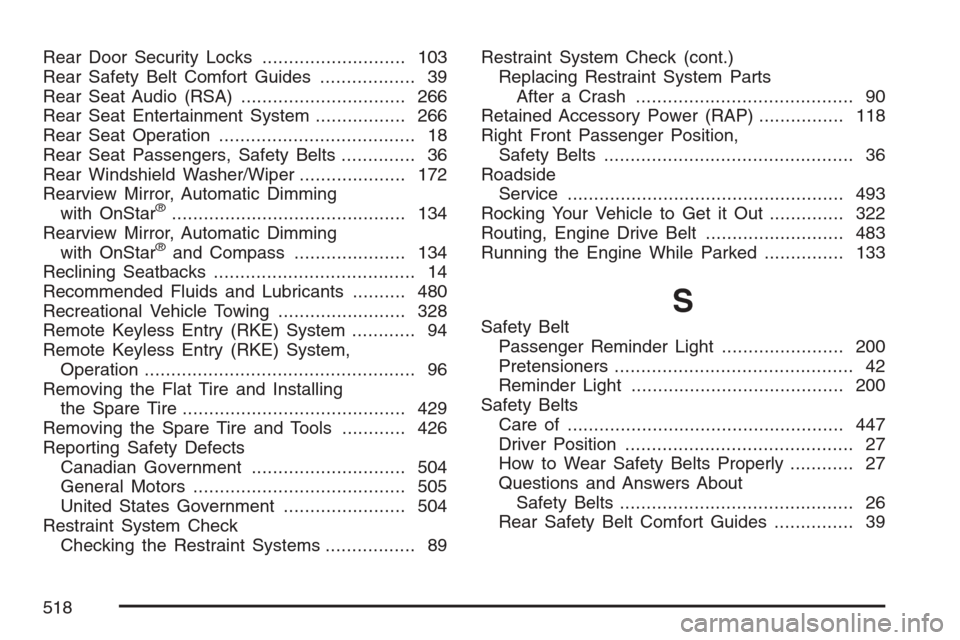
Rear Door Security Locks........................... 103
Rear Safety Belt Comfort Guides.................. 39
Rear Seat Audio (RSA)............................... 266
Rear Seat Entertainment System................. 266
Rear Seat Operation..................................... 18
Rear Seat Passengers, Safety Belts.............. 36
Rear Windshield Washer/Wiper.................... 172
Rearview Mirror, Automatic Dimming
with OnStar
®............................................ 134
Rearview Mirror, Automatic Dimming
with OnStar
®and Compass..................... 134
Reclining Seatbacks...................................... 14
Recommended Fluids and Lubricants.......... 480
Recreational Vehicle Towing........................ 328
Remote Keyless Entry (RKE) System............ 94
Remote Keyless Entry (RKE) System,
Operation................................................... 96
Removing the Flat Tire and Installing
the Spare Tire.......................................... 429
Removing the Spare Tire and Tools............ 426
Reporting Safety Defects
Canadian Government............................. 504
General Motors........................................ 505
United States Government....................... 504
Restraint System Check
Checking the Restraint Systems................. 89Restraint System Check (cont.)
Replacing Restraint System Parts
After a Crash......................................... 90
Retained Accessory Power (RAP)................ 118
Right Front Passenger Position,
Safety Belts............................................... 36
Roadside
Service.................................................... 493
Rocking Your Vehicle to Get it Out.............. 322
Routing, Engine Drive Belt.......................... 483
Running the Engine While Parked............... 133
S
Safety Belt
Passenger Reminder Light....................... 200
Pretensioners............................................. 42
Reminder Light........................................ 200
Safety Belts
Care of.................................................... 447
Driver Position........................................... 27
How to Wear Safety Belts Properly............ 27
Questions and Answers About
Safety Belts............................................ 26
Rear Safety Belt Comfort Guides............... 39
518