warning light CADILLAC SRX 2007 1.G Owner's Manual
[x] Cancel search | Manufacturer: CADILLAC, Model Year: 2007, Model line: SRX, Model: CADILLAC SRX 2007 1.GPages: 522, PDF Size: 2.71 MB
Page 223 of 522
This message displays when the engine coolant
temperature is too hot. Stop and allow the vehicle
to idle until it cools down. SeeEngine Coolant
Temperature Warning Light on page 206.
SeeOverheated Engine Protection Operating
Mode on page 374for information on driving to a
safe place in an emergency.
ENGINE POWER REDUCED
This message displays when the engine power is
being reduced to protect the engine from damage.
There could be several malfunctions that might
cause this message. Reduced engine power can
affect the vehicle’s ability to accelerate. If this
message is on, but there is no reduction in
performance, proceed to your destination. The
performance may be reduced the next time the
vehicle is driven. The vehicle may be driven at a
reduced speed while this message is on, but
acceleration and speed may be reduced. Anytime
this message stays on, the vehicle should be taken
to your dealer for service as soon as possible.
FUEL LEVEL LOW
This symbol appears
with this message.
This message displays when your vehicle is low
on fuel. Rell the fuel tank as soon as possible. A
single chime sounds when this message is
displayed. SeeFilling the Tank on page 352.
ICE POSSIBLE DRIVE WITH CARE
This message displays when the outside
temperature is cold enough to create icy road
conditions. Adjust your driving accordingly.
LEFT REAR DOOR OPEN
This message displays when the driver’s side rear
door is not closed completely. Make sure that
the door is closed completely.
223
Page 224 of 522
OIL PRESSURE LOW STOP ENGINE
Notice:If you drive your vehicle while
the engine oil pressure is low, severe engine
damage may occur. If a low oil pressure
warning appears on the instrument panel
cluster and/or DIC, stop the vehicle as soon as
possible. Do not drive the vehicle until the
cause of the low oil pressure is corrected. See
Engine Oil on page 360for more information.
This message displays when the vehicle’s
engine oil pressure is low. The oil pressure light
may also appear on the instrument panel
cluster. SeeOil Pressure Light on page 211.
A multiple chime sounds when this message is
displayed. SeeEngine Oil on page 360for
more information.
Stop the vehicle immediately, as engine damage
can result from driving a vehicle with low oil
pressure. Have the vehicle serviced by your dealer
as soon as possible when this message is
displayed.
PARKING ASSIST OFF
If your vehicle has the Ultrasonic Rear Parking
Assist (URPA) system, after the vehicle has been
started, this message displays to reminder the
driver that the URPA system has been turned off.
Press the set/reset button to acknowledge this
message and clear it from the DIC display. To turn
the URPA system back on, see″PARKING
ASSIST″underDIC Controls and Displays on
page 215. SeeUltrasonic Rear Parking Assist
(URPA) on page 184for more information.
PASSENGER DOOR OPEN
This message displays when the passenger’s side
front door is not closed completely. Make sure
that the door is closed completely.
REAR ACCESS OPEN
This message displays when the liftgate is not
closed completely. Make sure that the liftgate is
closed completely.
224
Page 226 of 522
SERVICE BRAKE ASSIST
This message displays if there is a problem with
the brake system. The brake system warning
light and the anti-lock brake system warning light
may also display on the instrument panel
cluster. SeeBrake System Warning Light on
page 204andAnti-Lock Brake System Warning
Light on page 205for more information. If this
happens, stop as soon as possible and turn off the
vehicle. Restart the vehicle and check for the
message on the DIC display. If the message
displays or appears again when you begin driving,
the brake system needs service. See your
dealer as soon as possible. SeeBrakes on
page 381for more information.
SERVICE BRAKE SYSTEM
This message displays, while the ignition is on,
when the brake uid level is low. The brake system
warning light on the instrument panel cluster
also comes on. SeeBrake System Warning Light
on page 204for more information. Have the
brake system serviced by your dealer as soon as
possible.
SERVICE PARKING ASSIST
If your vehicle has the Ultrasonic Rear Parking
Assist (URPA) system, this message displays
if there is a problem with the URPA system. Do
not use this system to help you park. See
Ultrasonic Rear Parking Assist (URPA) on
page 184for more information. See your dealer
for service.
SERVICE POWER STEERING
Your vehicle may have a speed variable assist
steering system. SeeSteering on page 285.
This message displays if a problem is detected
with the speed variable assist steering system.
When this message is displayed, you may notice
that the effort required to steer the vehicle
decreases or feels lighter, but you will still be able
to steer the vehicle.
226
Page 228 of 522
SERVICE TRACTION CONTROL
This message displays when there is a problem
with the Traction Control System (TCS). When this
message displays, the system will not limit
wheel spin. Adjust your driving accordingly. See
your dealer for service. SeeTraction Control
System (TCS) on page 281for more information.
SERVICE TRANSMISSION
This message displays when there is a problem
with the vehicle’s transmission. Have your vehicle
serviced by your dealer.
SERVICE VEHICLE SOON
This message displays when a non-emissions
related malfunction occurs. Have your vehicle
serviced by your dealer as soon as possible.
SPEED LIMITED TO XXX MPH (km/h)
This message displays when your vehicle speed is
limited to 80 mph (128 km/h) because the
vehicle detects a problem in the speed variable
assist steering, magnetic ride control, or automatic
leveling control systems. Have your vehicle
serviced by your dealer.
STABILITRAK NOT READY
This message may display and the Traction
Control System and StabiliTrak®Warning Light on
the instrument panel cluster may be on after
rst driving the vehicle and exceeding 19 mph
(30 km/h) for 30 seconds. The StabiliTrak
®system
is not functional until the light has turned off.
SeeStabiliTrak
®System on page 283for more
information.
STABILITRAK OFF
This message displays when you turn off
StabiliTrak®, or when the stability control has been
automatically disabled. To limit wheel spin and
realize the full benets of the stability
enhancement system, you should normally leave
StabiliTrak
®on. However, you should turn
StabiliTrak®off if your vehicle gets stuck in sand,
mud, ice, or snow and you want to rock your
vehicle to attempt to free it, or if you are driving in
extreme off-road conditions and require more
wheel spin. SeeIf Your Vehicle is Stuck in Sand,
Mud, Ice, or Snow on page 321. To turn the
StabiliTrak
®system on or off, seeStabiliTrak®
System on page 283.
228
Page 229 of 522
There are several conditions that can cause this
message to appear.
One condition is overheating, which could
occur if StabiliTrak®activates continuously
for an extended period of time.
The message also displays if the brake
system warning light is on. SeeBrake System
Warning Light on page 204.
The message could display if the stability
system takes longer than usual to complete its
diagnostic checks due to driving conditions.
The message displays if an engine or vehicle
related problem has been detected and the
vehicle needs service. See your dealer.
The message turns off as soon as the conditions
that caused the message to be displayed are
no longer present.
STARTING DISABLED SERVICE
THROTTLE
This message displays when your vehicle’s throttle
system is not functioning properly. Have your
vehicle serviced by your dealer.
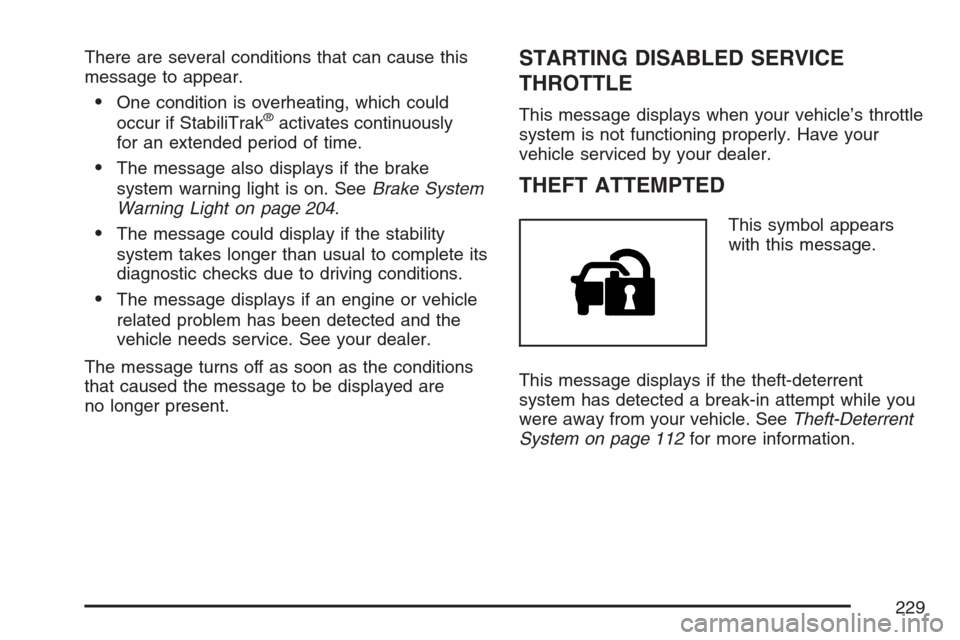
THEFT ATTEMPTED
This symbol appears
with this message.
This message displays if the theft-deterrent
system has detected a break-in attempt while you
were away from your vehicle. SeeTheft-Deterrent
System on page 112for more information.
229
Page 278 of 522
Control of a Vehicle
You have three systems that make your vehicle go
where you want it to go. They are the brakes, the
steering, and the accelerator. All three systems
have to do their work at the places where the tires
meet the road.
Sometimes, as when you are driving on snow or
ice, it is easy to ask more of those control systems
than the tires and road can provide. That means
you can lose control of your vehicle. See
StabiliTrak
®System on page 283.
Adding non-GM accessories can affect your
vehicle’s performance. SeeAccessories and
Modications on page 347.
Braking
SeeBrake System Warning Light on page 204.
Braking action involves perception time and
reaction time.
First, you have to decide to push on the brake
pedal. That is perception time. Then you have to
bring up your foot and do it. That is reaction time.
Average reaction time is about three-fourths of a
second. But that is only an average. It might
be less with one driver and as long as two or
three seconds or more with another. Age, physical
condition, alertness, coordination, and eyesight
all play a part. So do alcohol, drugs, and
frustration. But even in three-fourths of a second,
a vehicle moving at 60 mph (100 km/h) travels
66 feet (20 m). That could be a lot of distance in an
emergency, so keeping enough space between
your vehicle and others is important.
And, of course, actual stopping distances vary
greatly with the surface of the road, whether it is
pavement or gravel; the condition of the road,
whether it is wet, dry, or icy; tire tread; the
condition of the brakes; the weight of the vehicle;
and the amount of brake force applied.
278
Page 279 of 522
Avoid needless heavy braking. Some people drive
in spurts — heavy acceleration followed by
heavy braking — rather than keeping pace with
traffic. This is a mistake. The brakes may not have
time to cool between hard stops. The brakes
will wear out much faster if you do a lot of heavy
braking. If you keep pace with the traffic and
allow realistic following distances, you will
eliminate a lot of unnecessary braking. That means
better braking and longer brake life.
If your vehicle’s engine ever stops while you are
driving, brake normally but do not pump the
brakes. If you do, the pedal may get harder to
push down. If the engine stops, you will still have
some power brake assist. But you will use it
when you brake. Once the power assist is used
up, it may take longer to stop and the brake pedal
will be harder to push.
Adding non-GM accessories can affect your
vehicle’s performance. SeeAccessories and
Modications on page 347.Anti-Lock Brake System (ABS)
Your vehicle has the Anti-Lock Brake System
(ABS), an advanced electronic braking system that
will help prevent a braking skid.
When you start your engine and begin to drive
away, ABS will check itself. You may hear a
momentary motor or clicking noise while this test
is going on. This is normal.
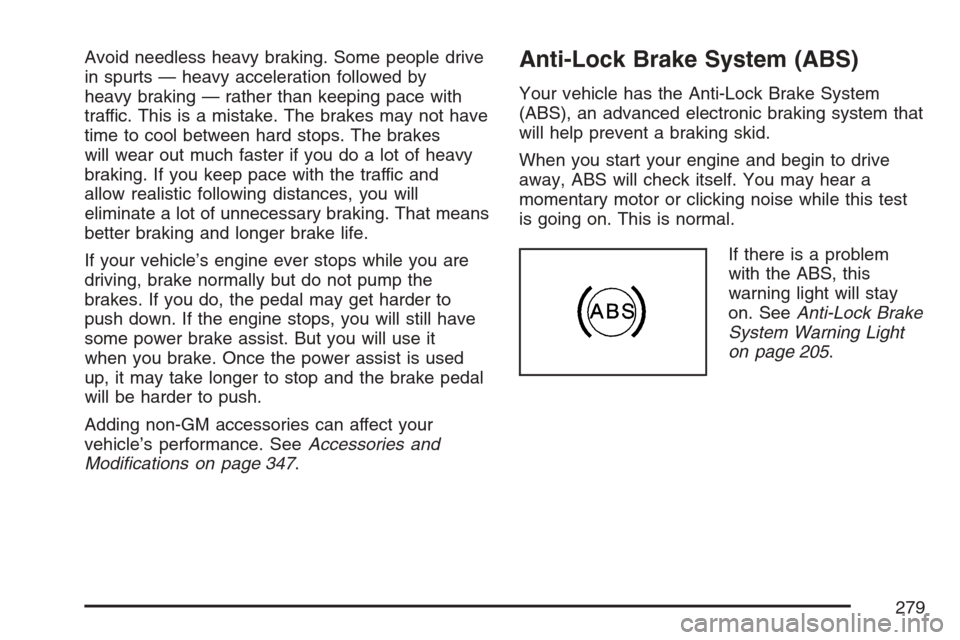
If there is a problem
with the ABS, this
warning light will stay
on. SeeAnti-Lock Brake
System Warning Light
on page 205.
279
Page 281 of 522
Remember: ABS does not change the time you
need to get your foot up to the brake pedal
or always decrease stopping distance. If you get
too close to the vehicle in front of you, you will not
have time to apply your brakes if that vehicle
suddenly slows or stops. Always leave enough
room up ahead to stop, even though you
have ABS.
Using ABS
Do not pump the brakes. Just hold the brake
pedal down rmly and let anti-lock work for you.
You may feel the brakes vibrate, or you may notice
some noise, but this is normal.
Braking in Emergencies
With ABS, you can steer and brake at the same
time. In many emergencies, steering can help you
more than even the very best braking.
Traction Control System (TCS)
Your vehicle has a traction control system that
limits wheel spin. This is especially useful in
slippery road conditions. On a rear-wheel-drive
vehicle, the system operates if it senses that
one or both of the rear wheels are spinning or
beginning to lose traction. On an All-Wheel-Drive
(AWD) vehicle, the system will operate if it
senses that any of the wheels are spinning or
beginning to lose traction. When this happens, the
system brakes the spinning wheel(s) and/or
reduces engine power to limit wheel spin.
You may feel or hear the system working, but this
is normal.
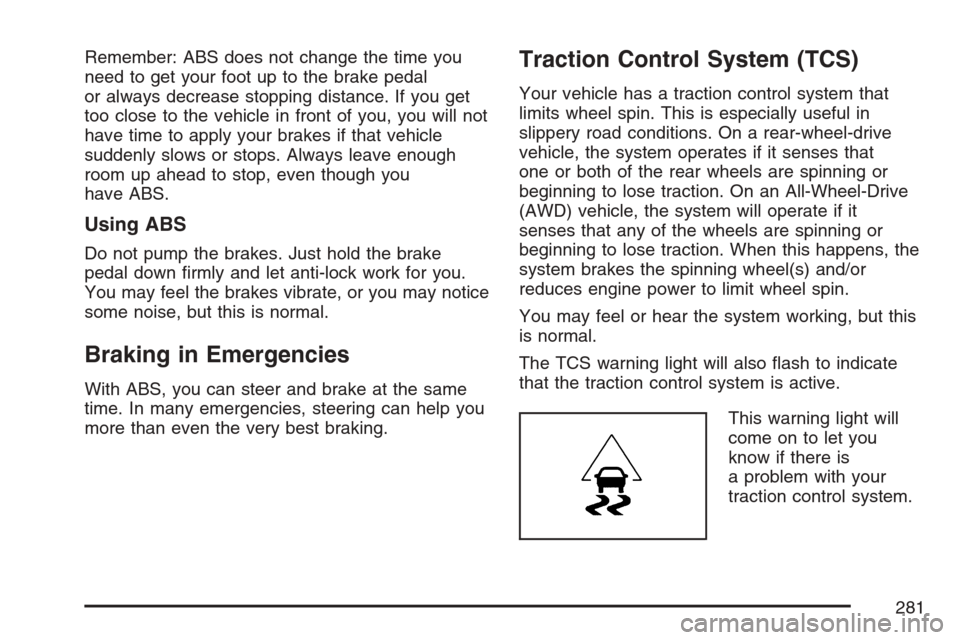
The TCS warning light will also ash to indicate
that the traction control system is active.
This warning light will
come on to let you
know if there is
a problem with your
traction control system.
281
Page 282 of 522
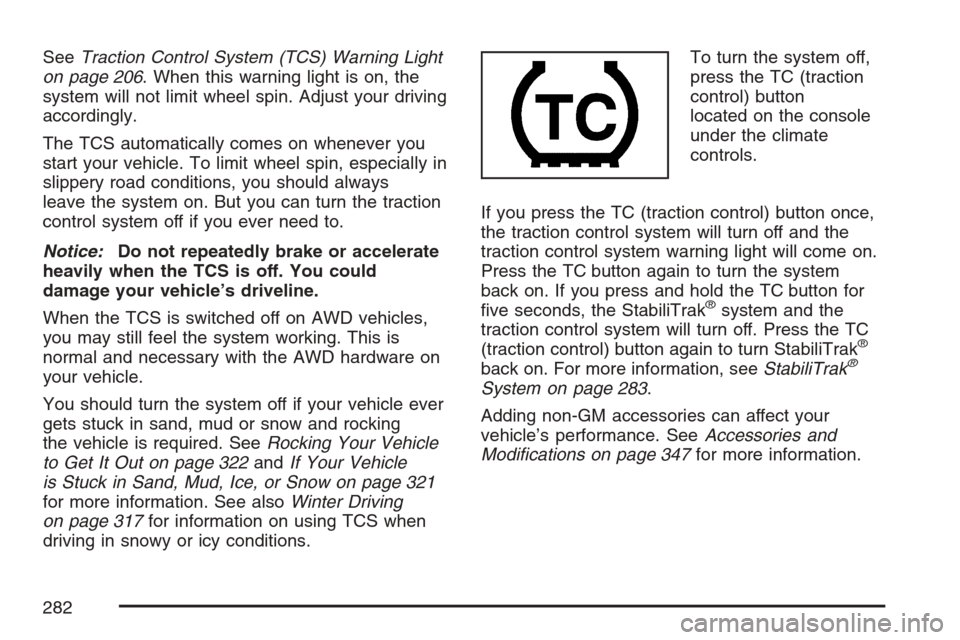
SeeTraction Control System (TCS) Warning Light
on page 206. When this warning light is on, the
system will not limit wheel spin. Adjust your driving
accordingly.
The TCS automatically comes on whenever you
start your vehicle. To limit wheel spin, especially in
slippery road conditions, you should always
leave the system on. But you can turn the traction
control system off if you ever need to.
Notice:Do not repeatedly brake or accelerate
heavily when the TCS is off. You could
damage your vehicle’s driveline.
When the TCS is switched off on AWD vehicles,
you may still feel the system working. This is
normal and necessary with the AWD hardware on
your vehicle.
You should turn the system off if your vehicle ever
gets stuck in sand, mud or snow and rocking
the vehicle is required. SeeRocking Your Vehicle
to Get It Out on page 322andIf Your Vehicle
is Stuck in Sand, Mud, Ice, or Snow on page 321
for more information. See alsoWinter Driving
on page 317for information on using TCS when
driving in snowy or icy conditions.To turn the system off,
press the TC (traction
control) button
located on the console
under the climate
controls.
If you press the TC (traction control) button once,
the traction control system will turn off and the
traction control system warning light will come on.
Press the TC button again to turn the system
back on. If you press and hold the TC button for
ve seconds, the StabiliTrak
®system and the
traction control system will turn off. Press the TC
(traction control) button again to turn StabiliTrak
®
back on. For more information, seeStabiliTrak®
System on page 283.
Adding non-GM accessories can affect your
vehicle’s performance. SeeAccessories and
Modications on page 347for more information.
282
Page 283 of 522
Magnetic Ride Control
Your vehicle may have Magnetic Ride Control
that automatically adjusts the ride of your vehicle.
Automatic ride control is achieved through a
computer used to control and monitor the
suspension system. The controller receives input
from various sensors to determine the proper
system response. If the controller detects a
problem within the system, the DIC will display a
SERVICE SUSPENSION SYS message. See
DIC Warnings and Messages on page 220
for more information. See your dealer for service.
Limited-Slip Rear Axle
Your vehicle may have this feature. A limited-slip
rear axle can give you additional traction on
snow, mud, ice, sand or gravel. It works like a
standard axle most of the time, but when one of
the rear wheels has no traction and the other does,
this feature will allow the wheel with traction to
move the vehicle.
StabiliTrak®System
Your vehicle is equipped with a vehicle stability
enhancement system called StabiliTrak®.It
is an advanced computer controlled system that
assists you with directional control of the vehicle in
difficult driving conditions.
StabiliTrak
®activates when the computer senses
a discrepancy between your intended path
and the direction the vehicle is actually traveling.
StabiliTrak
®selectively applies braking pressure
at any one of the vehicle’s brakes to help steer the
vehicle in the direction which you are steering.
When the stability control system activates,
the traction control system and StabiliTrak
®light
will ash on the instrument panel cluster. This also
occurs when traction control is activated. You
may also hear a noise or feel vibration in the brake
pedal. This is normal. Continue to steer the
vehicle in the direction you want it to go.
283