wheel CADILLAC SRX 2007 1.G Workshop Manual
[x] Cancel search | Manufacturer: CADILLAC, Model Year: 2007, Model line: SRX, Model: CADILLAC SRX 2007 1.GPages: 522, PDF Size: 2.71 MB
Page 299 of 522
As you are backing down the hill, put your left
hand on the steering wheel at the 12 o’clock
position. This way you will be able to tell if your
wheels are straight and maneuver as you
back down. It is best that you back down the
hill with your wheels straight rather than in
the left or right direction. Turning the wheel too
far to the left or right will increase the
possibility of a rollover.
Here are some things youmust notdo if you stall,
or are about to stall, when going up a hill.
Never attempt to prevent a stall by shifting
into NEUTRAL (N) to rev-up the engine
and regain forward momentum. This will not
work. Your vehicle will roll backwards
very quickly and you could go out of control.
Instead, apply the regular brake to stop
the vehicle. Then apply the parking brake.
Shift to REVERSE (R), release the parking
brake, and slowly back straight down.
Never attempt to turn around if you are about
to stall when going up a hill. If the hill is steep
enough to stall your vehicle, it is steep
enough to cause you to roll over if you turn
around. If you cannot make it up the hill, you
must back straight down the hill.
Q:Suppose, after stalling, I try to back down
the hill and decide I just cannot do it. What
should I do?
A:Set the parking brake, put the transmission in
PARK (P), and turn off the engine. Leave the
vehicle and go get some help. Exit on the
uphill side and stay clear of the path the
vehicle would take if it rolled downhill.
299
Page 300 of 522
Driving Downhill
When off-roading takes you downhill, you will want
to consider a number of things:
How steep is the downhill? Will I be able to
maintain vehicle control?
What is the surface like? Smooth? Rough?
Slippery? Hard-packed dirt? Gravel?
Are there hidden surface obstacles? Ruts?
Logs? Boulders?
What is at the bottom of the hill? Is there a
hidden creek bank or even a river bottom
with large rocks?
If you decide you can go down a hill safely, then
try to keep your vehicle headed straight down, and
use a low gear. This way, engine drag can help
the brakes and they will not have to do all
the work. Descend slowly, keeping your vehicle
under control at all times.
{CAUTION:
Heavy braking when going down a hill can
cause your brakes to overheat and fade.
This could cause loss of control and a
serious accident. Apply the brakes lightly
when descending a hill and use a low
gear to keep vehicle speed under control.
Q:Are there some things I should not do
when driving down a hill?
A:Yes! These are important because, if you
ignore them, you could lose control and have a
serious accident.
When driving downhill, avoid turns that take you
across the incline of the hill. A hill that is not too
steep to drive down may be too steep to drive
across. You could roll over if you do not drive
straight down.
Never go downhill with the transmission in
NEUTRAL (N). This is called “free wheeling.”
The brakes will have to do all the work and
could overheat and fade.
300
Page 301 of 522
Q:Am I likely to stall when going downhill?
A:It is much more likely to happen going
uphill. But if it happens going downhill, here is
what to do.
1. Stop your vehicle by applying the regular
brakes. Apply the parking brake.
2. Shift to PARK (P) and, while still braking,
restart the engine.
3. Shift back to a low gear, release the parking
brake, and drive straight down.
4. If the engine will not start, get out and
get help.
Driving Across an Incline
Sooner or later, an off-road trail will probably go
across the incline of a hill. If this happens,
you have to decide whether to try to drive across
the incline. Here are some things to consider:
A hill that can be driven straight up or down
may be too steep to drive across. When you go
straight up or down a hill, the length of the
wheel base — the distance from the front
wheels to the rear wheels — reduces the
likelihood the vehicle will tumble end over end.
But when you drive across an incline, the much
more narrow track width — the distance
between the left and right wheels — may not
prevent the vehicle from tilting and rolling over.
Also, driving across an incline puts more weight
on the downhill wheels. This could cause a
downhill slide or a rollover.
Surface conditions can be a problem when you
drive across a hill. Loose gravel, muddy spots,
or even wet grass can cause your tires to slip
sideways, downhill. If the vehicle slips
sideways, it can hit something that will
trip it — a rock, a rut, etc. — and roll over.
301
Page 302 of 522
Hidden obstacles can make the steepness of
the incline even worse. If you drive across a
rock with the uphill wheels, or if the downhill
wheels drop into a rut or depression, your
vehicle can tilt even more.
For reasons like these, you need to decide
carefully whether to try to drive across an incline.
Just because the trail goes across the incline
does not mean you have to drive it. The last
vehicle to try it might have rolled over.
{CAUTION:
Driving across an incline that is too steep
will make your vehicle roll over. You could
be seriously injured or killed. If you have
any doubt about the steepness of the
incline, do not drive across it. Find
another route instead.
Q:What if I am driving across an incline that
is not too steep, but I hit some loose
gravel and start to slide downhill. What
should I do?
A:If you feel your vehicle starting to slide
sideways, turn downhill. This should help
straighten out the vehicle and prevent the side
slipping. However, a much better way to
prevent this is to get out and “walk the course”
so you know what the surface is like before
you drive it.
302
Page 304 of 522
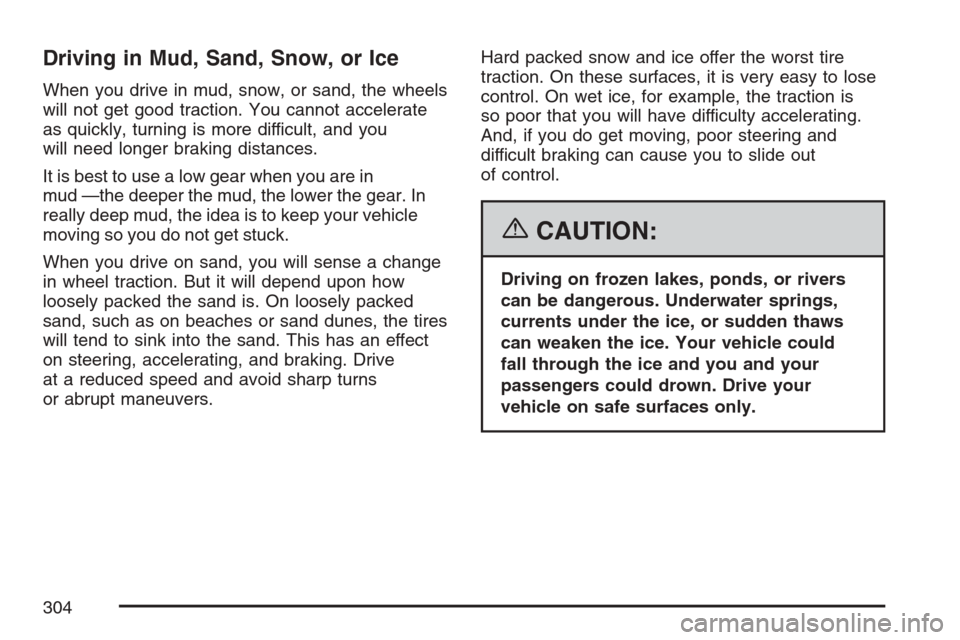
Driving in Mud, Sand, Snow, or Ice
When you drive in mud, snow, or sand, the wheels
will not get good traction. You cannot accelerate
as quickly, turning is more difficult, and you
will need longer braking distances.
It is best to use a low gear when you are in
mud —the deeper the mud, the lower the gear. In
really deep mud, the idea is to keep your vehicle
moving so you do not get stuck.
When you drive on sand, you will sense a change
in wheel traction. But it will depend upon how
loosely packed the sand is. On loosely packed
sand, such as on beaches or sand dunes, the tires
will tend to sink into the sand. This has an effect
on steering, accelerating, and braking. Drive
at a reduced speed and avoid sharp turns
or abrupt maneuvers.Hard packed snow and ice offer the worst tire
traction. On these surfaces, it is very easy to lose
control. On wet ice, for example, the traction is
so poor that you will have difficulty accelerating.
And, if you do get moving, poor steering and
difficult braking can cause you to slide out
of control.
{CAUTION:
Driving on frozen lakes, ponds, or rivers
can be dangerous. Underwater springs,
currents under the ice, or sudden thaws
can weaken the ice. Your vehicle could
fall through the ice and you and your
passengers could drown. Drive your
vehicle on safe surfaces only.
304
Page 305 of 522
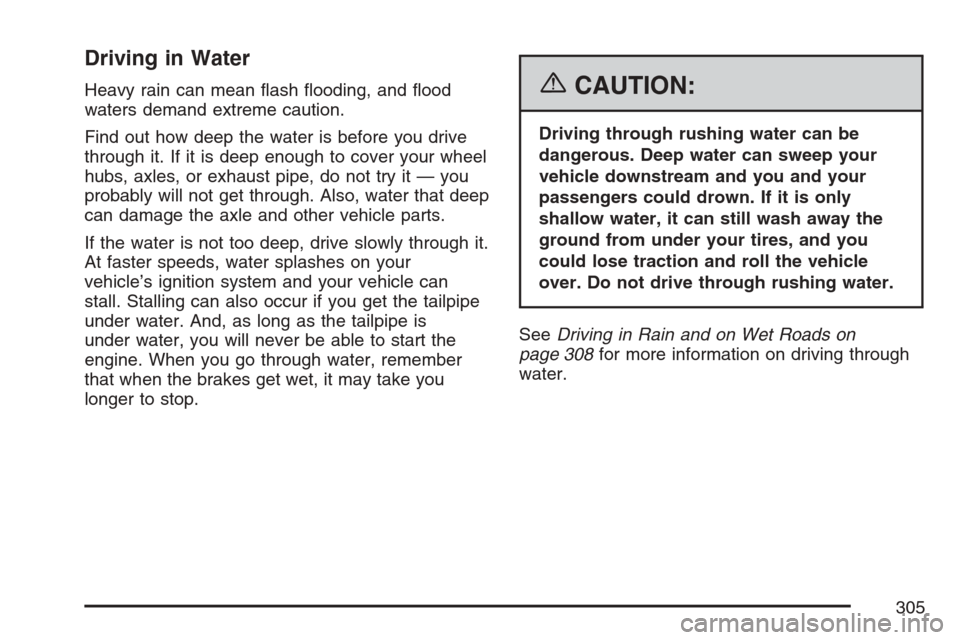
Driving in Water
Heavy rain can mean ash ooding, and ood
waters demand extreme caution.
Find out how deep the water is before you drive
through it. If it is deep enough to cover your wheel
hubs, axles, or exhaust pipe, do not try it — you
probably will not get through. Also, water that deep
can damage the axle and other vehicle parts.
If the water is not too deep, drive slowly through it.
At faster speeds, water splashes on your
vehicle’s ignition system and your vehicle can
stall. Stalling can also occur if you get the tailpipe
under water. And, as long as the tailpipe is
under water, you will never be able to start the
engine. When you go through water, remember
that when the brakes get wet, it may take you
longer to stop.{CAUTION:
Driving through rushing water can be
dangerous. Deep water can sweep your
vehicle downstream and you and your
passengers could drown. If it is only
shallow water, it can still wash away the
ground from under your tires, and you
could lose traction and roll the vehicle
over. Do not drive through rushing water.
SeeDriving in Rain and on Wet Roads on
page 308for more information on driving through
water.
305
Page 306 of 522

After Off-Road Driving
Remove any brush or debris that has collected on
the underbody, chassis, or under the hood.
These accumulations can be a re hazard.
After operation in mud or sand, have the brake
linings cleaned and checked. These substances
can cause glazing and uneven braking. Check the
body structure, steering, suspension, wheels,
tires, and exhaust system for damage. Also, check
the fuel lines and cooling system for any leakage.
Your vehicle will require more frequent service
due to off-road use. Refer to the Maintenance
Schedule for additional information.
Driving at Night
Night driving is more dangerous than day driving.
One reason is that some drivers are likely to
be impaired — by alcohol or drugs, with night
vision problems, or by fatigue.
Here are some tips on night driving.
Drive defensively.
Do not drink and drive.
Adjust the inside rearview mirror to reduce the
glare from headlamps behind you.
Since you cannot see as well, you may need
to slow down and keep more space between
you and other vehicles.
Slow down, especially on higher speed roads.
Your vehicle’s headlamps can light up only so
much road ahead.
In remote areas, watch for animals.
If you are tired, pull off the road in a safe
place and rest.
306
Page 314 of 522
Tires:They are vitally important to a safe,
trouble-free trip. Is the tread good enough
for long-distance driving? Are the tires
all inated to the recommended pressure?
Weather Forecasts:What is the weather
outlook along your route? Should you
delay your trip a short time to avoid a major
storm system?
Maps:Do you have up-to-date maps?
Highway Hypnosis
Is there actually such a condition as highway
hypnosis? Or is it just plain falling asleep at the
wheel? Call it highway hypnosis, lack of
awareness, or whatever.
There is something about an easy stretch of road
with the same scenery, along with the hum of
the tires on the road, the drone of the engine, and
the rush of the wind against the vehicle that
can make you sleepy. Do not let it happen to you!
If it does, your vehicle can leave the road in
less than a second, and you could crash and be
injured.What can you do about highway hypnosis? First,
be aware that it can happen.
Then here are some tips:
Make sure your vehicle is well ventilated, with
a comfortably cool interior.
Keep your eyes moving. Scan the road ahead
and to the sides. Check your vehicle’s mirrors
and instruments frequently.
If you get sleepy, pull off the road into a rest,
service, or parking area and take a nap, get
some exercise, or both. For safety, treat
drowsiness on the highway as an emergency.
314
Page 318 of 522
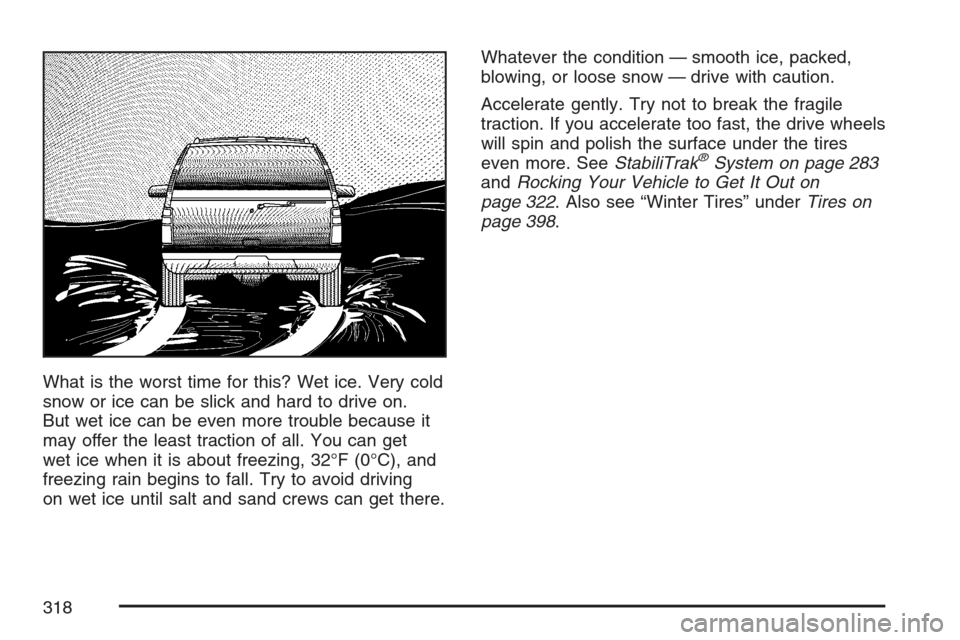
What is the worst time for this? Wet ice. Very cold
snow or ice can be slick and hard to drive on.
But wet ice can be even more trouble because it
may offer the least traction of all. You can get
wet ice when it is about freezing, 32°F (0°C), and
freezing rain begins to fall. Try to avoid driving
on wet ice until salt and sand crews can get there.Whatever the condition — smooth ice, packed,
blowing, or loose snow — drive with caution.
Accelerate gently. Try not to break the fragile
traction. If you accelerate too fast, the drive wheels
will spin and polish the surface under the tires
even more. SeeStabiliTrak
®System on page 283
andRocking Your Vehicle to Get It Out on
page 322. Also see “Winter Tires” underTires on
page 398.
318
Page 321 of 522
You will need a well-charged battery to restart the
vehicle, and possibly for signaling later on with
your headlamps. Let the heater run for a while.
Then, shut the engine off and close the window
almost all the way to preserve the heat. Start
the engine again and repeat this only when you
feel really uncomfortable from the cold. But do it as
little as possible. Preserve the fuel as long as
you can. To help keep warm, you can get out of
the vehicle and do some fairly vigorous exercises
every half hour or so until help comes.
If Your Vehicle is Stuck in Sand,
Mud, Ice, or Snow
In order to free your vehicle when it is stuck, you
need to spin the wheels, but you do not want to spin
the wheels too fast. The method known as rocking
can help you get out when you are stuck, but you
must use caution.
{CAUTION:
If you let your vehicle’s tires spin at high
speed, they can explode, and you or
others could be injured. And, the
transmission or other parts of the vehicle
can overheat. That could cause an engine
compartment re or other damage. When
you are stuck, spin the wheels as little as
possible. Do not spin the wheels above
35 mph (55 km/h) as shown on the
speedometer.
Notice:Spinning the wheels can destroy parts
of your vehicle as well as the tires. If you
spin the wheels too fast while shifting
the transmission back and forth, you can
destroy the transmission.
For information about using tire chains on your
vehicle, seeTire Chains on page 422.
321