engine coolant CADILLAC SRX 2008 1.G Owner's Manual
[x] Cancel search | Manufacturer: CADILLAC, Model Year: 2008, Model line: SRX, Model: CADILLAC SRX 2008 1.GPages: 448, PDF Size: 5.61 MB
Page 314 of 448
When the engine is cold, the coolant level should be at
or slightly above the FULL COLD/FROID line on the
side of the coolant surge tank. If it is not, you may have
a leak at the pressure cap or in the radiator hoses,
heater hoses, radiator, water pump or somewhere else
in the cooling system.
{CAUTION:
Heater and radiator hoses, and other engine
parts, can be very hot. Do not touch them.
If you do, you can be burned.
Do not run the engine if there is a leak. If you
run the engine, it could lose all coolant. That
could cause an engine re, and you could be
burned. Get any leak xed before you drive
the vehicle.
If there seems to be no leak, with the engine on, check
to see if the electric engine cooling fans are running.
If the engine is overheating, both fans should be
running. If they are not, your vehicle needs service.Notice:Engine damage from running your engine
without coolant is not covered by your warranty.
SeeOverheated Engine Protection Operating Mode
on page 5-28for information on driving to a safe
place in an emergency.
Notice:Using coolant other than DEX-COOL
®may
cause premature engine, heater core, or radiator
corrosion. In addition, the engine coolant could
require changing sooner, at 30,000 miles (50 000 km)
or 24 months, whichever occurs rst. Any repairs
would not be covered by the warranty. Always
use DEX-COOL
®(silicate-free) coolant in the vehicle.
How to Add Coolant to the Coolant
Surge Tank
If you have not found a problem yet, check to see if
coolant is visible in the surge tank. If coolant is visible
but the coolant level is not at the FULL COLD/FROID
line on the side of the coolant surge tank, add a
50/50 mixture ofclean, drinkable waterand DEX-COOL
®
coolant at the coolant surge tank, but be sure the
cooling system, including the coolant surge tank
pressure cap, is cool before you do it. SeeEngine
Coolant on page 5-23for more information.
5-30
Page 315 of 448
{CAUTION:
Steam and scalding liquids from a hot cooling
system can blow out and burn you badly. They
are under pressure, and if you turn the coolant
surge tank pressure cap — even a little — they
can come out at high speed. Never turn the
cap when the cooling system, including the
coolant surge tank pressure cap, is hot. Wait
for the cooling system and coolant surge tank
pressure cap to cool if you ever have to turn
the pressure cap.
{CAUTION:
Adding only plain water to the cooling system
can be dangerous. Plain water, or some other
liquid such as alcohol, can boil before the
proper coolant mixture will. The vehicle’s
CAUTION: (Continued)
CAUTION: (Continued)
coolant warning system is set for the proper
coolant mixture. With plain water or the wrong
mixture, the engine could get too hot but you
would not get the overheat warning. The
engine could catch re and you or others
could be burned. Use a 50/50 mixture of clean,
drinkable water and DEX-COOL
®coolant.
Notice:In cold weather, water can freeze and crack
the engine, radiator, heater core and other parts. Use
the recommended coolant and the proper coolant
mixture.
{CAUTION:
You can be burned if you spill coolant on hot
engine parts. Coolant contains ethylene glycol
and it will burn if the engine parts are hot
enough. Do not spill coolant on a hot engine.
5-31
Page 317 of 448
4. With the coolant surge tank pressure cap off, start
the engine and let it run until you can feel the upper
radiator hose getting hot. The upper radiator
hose is the largest of the hoses which comes out of
the radiator, on the passenger’s side of the
vehicle. Watch out for the engine cooling fans.
By this time, the coolant level inside the coolant
surge tank may be lower. If the level is lower, add
more of the proper mixture to the coolant surge tank
until the level reaches the FULL COLD/FROID
line on the side of the coolant surge tank.
5. Then replace the pressure cap. Be sure the
pressure cap is hand-tight and fully seated.
Recheck the coolant level in the bottle next time you
use your vehicle to insure the system is full when cold.
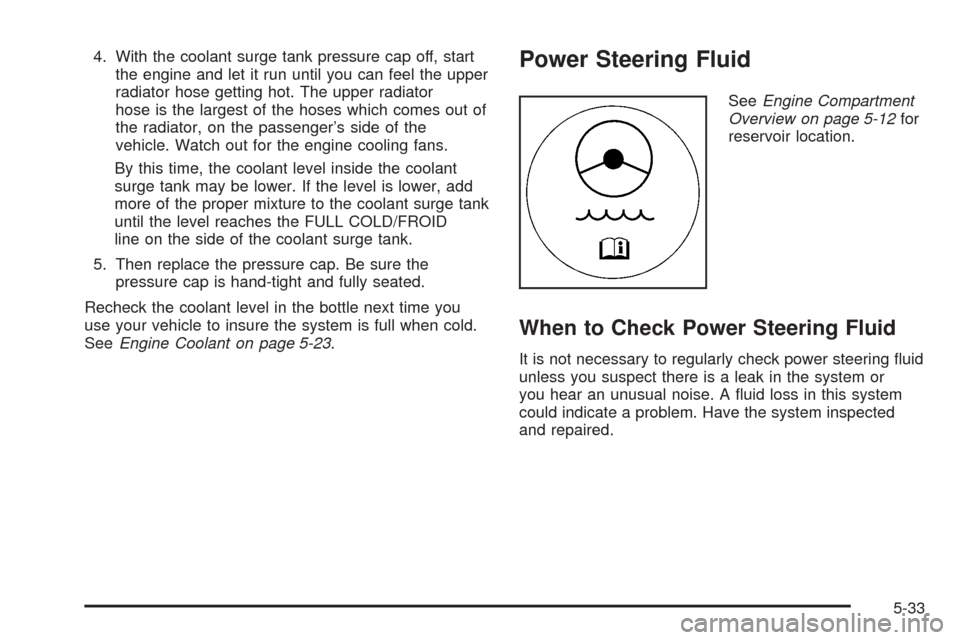
SeeEngine Coolant on page 5-23.Power Steering Fluid
SeeEngine Compartment
Overview on page 5-12for
reservoir location.
When to Check Power Steering Fluid
It is not necessary to regularly check power steering uid
unless you suspect there is a leak in the system or
you hear an unusual noise. A uid loss in this system
could indicate a problem. Have the system inspected
and repaired.
5-33
Page 319 of 448
Notice:
When using concentrated washer uid,
follow the manufacturer’s instructions for
adding water.
Do not mix water with ready-to-use washer uid.
Water can cause the solution to freeze and
damage your washer uid tank and other parts
of the washer system. Also, water does not
clean as well as washer uid.
Fill the washer uid tank only three-quarters
full when it is very cold. This allows for uid
expansion if freezing occurs, which could
damage the tank if it is completely full.
Do not use engine coolant (antifreeze) in your
windshield washer. It can damage the vehicle’s
windshield washer system and paint.
Brakes
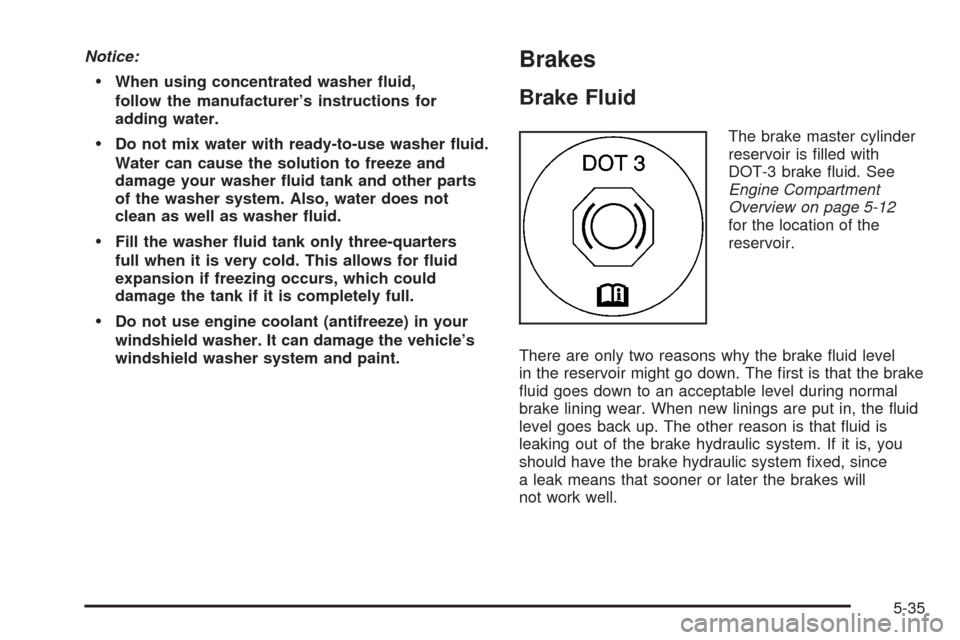
Brake Fluid
The brake master cylinder
reservoir is lled with
DOT-3 brake uid. See
Engine Compartment
Overview on page 5-12
for the location of the
reservoir.
There are only two reasons why the brake uid level
in the reservoir might go down. The rst is that the brake
uid goes down to an acceptable level during normal
brake lining wear. When new linings are put in, the uid
level goes back up. The other reason is that uid is
leaking out of the brake hydraulic system. If it is, you
should have the brake hydraulic system xed, since
a leak means that sooner or later the brakes will
not work well.
5-35
Page 401 of 448
If the engine oil life system is ever reset accidentally,
you must service your vehicle within 3,000 miles
(5 000 km) since your last service. Remember to reset
the oil life system whenever the oil is changed. See
Engine Oil Life System on page 5-19for information on
the Engine Oil Life System and resetting the system.
When the CHANGE ENGINE OIL SOON message
appears, the following services, checks, and inspections
are required:
❑Change engine oil and lter. SeeEngine Oil on
page 5-16. Reset oil life system. SeeEngine Oil Life
System on page 5-19.An Emission Control Service.
❑Lubricate chassis components.See footnote #.
❑Visually check for any leaks or damage.
See footnote (g).
❑Inspect engine air cleaner lter. If necessary, replace
lter. SeeEngine Air Cleaner/Filter on page 5-21.
See footnote (k).❑Check tires for ination pressures and wear. SeeTires
on page 5-51. If tire rotation is recommended for your
vehicle, rotate tires. SeeTire Inspection and Rotation
on page 5-66and “Tire Wear Inspection” inAt Least
Once a Month on page 6-9.
❑Inspect brake system.See footnote (a).
❑Check engine coolant and windshield washer uid
levels and add uid as needed.
❑Perform any needed additional services. See
“Additional Required Services” in this section.
❑Inspect suspension and steering components.
See footnote (b).
❑Inspect engine cooling system.See footnote (c).
❑Inspect wiper blades.See footnote (d).
❑Inspect restraint system components.
See footnote (e).
❑Lubricate body components.See footnote (f).
6-5
Page 404 of 448
(d)Inspect wiper blades for wear, cracking, or
contamination. Clean the windshield and wiper blades,
if contaminated. Replace wiper blades that are worn
or damaged. See Windshield Wiper Blade Replacement
on page 5-49 and Windshield and Wiper Blades on
page 5-95 for more information.
(e)Make sure the safety belt reminder light and safety
belt assemblies are working properly. Look for any
other loose or damaged safety belt system parts.
If you see anything that might keep a safety belt system
from doing its job, have it repaired. Have any torn
or frayed safety belts replaced. Also see Checking
the Restraint Systems on page 1-72.
(f)Lubricate all key lock cylinders, hood latch
assemblies, secondary latch, pivots, spring anchor,
release pawl, hood hinges, body door hinges, rear
compartment hinges, sunroof tracks, and any folding
seat hardware. More frequent lubrication could be
required when exposed to a corrosive environment.
Applying silicone grease on weatherstrips with a clean
cloth will make them last longer, seal better, and
not stick or squeak. See Weatherstrips on page 5-94.
(g)A fluid loss in any vehicle system could indicate
a problem. Have the system inspected and repaired
and the fluid level checked. Add fluid if needed.(h)Change automatic transmission fluid and filter if the
vehicle is mainly driven under one or more of these
conditions:
In heavy city traffic where the outside temperature
regularly reaches 90°F (32°C) or higher.
In hilly or mountainous terrain.
When doing frequent trailer towing.
Uses such as found in taxi, police, or delivery
service.
(i)Drain, flush, and refill cooling system. This service can
be complex; you should have your dealer/retailer perform
this service. See Engine Coolant on page 5-23 for what to
use. Inspect hoses. Clean radiator, condenser, pressure
cap, and filler neck. Pressure test the cooling system and
pressure cap.
(j)If you drive regularly under dusty conditions, the filter
could require replacement more often.
(k)If you drive regularly under dusty conditions, inspect
the filter at each engine oil change.
(l)Visually inspect belt for fraying, excessive cracks, or
obvious damage. Replace belt if necessary.
(m)If using DOT-4 brake fluid only: Drain, flush, and
refill brake hydraulic system at a regular maintenance
service every two years. This service can be complex;
you should have your dealer/retailer perform this service.
See Brakes on page 5-35.
6-8
Page 405 of 448
Owner Checks and Services
These owner checks and services should be performed
at the intervals specied to help ensure the safety,
dependability, and emission control performance of your
vehicle. Your dealer/retailer can assist you with these
checks and services.
Be sure any necessary repairs are completed at once.
Whenever any uids or lubricants are added to your
vehicle, make sure they are the proper ones, as shown
inRecommended Fluids and Lubricants on page 6-12.
At Each Fuel Fill
It is important to perform these underhood checks at
each fuel fill.
Engine Oil Level Check
Notice:It is important to check the engine oil
regularly and keep it at the proper level. Failure to
keep the engine oil at the proper level can cause
damage to the engine not covered by your warranty.
Check the engine oil level and add the proper oil if
necessary. SeeEngine Oil on page 5-16.
Engine Coolant Level Check
Check the engine coolant level and add DEX-COOL®
coolant mixture if necessary. SeeEngine Coolant
on page 5-23.
Windshield Washer Fluid Level Check
Check the windshield washer uid level in the windshield
washer uid reservoir and add the proper uid if
necessary.
At Least Once a Month
Tire Ination Check
Inspect your vehicle’s tires and make sure they are
inated to the correct pressures. Do not forget to
check the spare tire. SeeInflation - Tire Pressure on
page 5-59. Check to make sure the spare tire is stored
securely. SeeChanging a Flat Tire on page 5-76.
Tire Wear Inspection
Tire rotation is recommended if your vehicle has the
same size tires at all four wheel positions and may be
required for high mileage highway drivers prior to the
Engine Oil Life System service notication. Check the
tires for wear and, if necessary, rotate the tires.
SeeTire Inspection and Rotation on page 5-66.
6-9
Page 408 of 448
Recommended Fluids and
Lubricants
Fluids and lubricants identied below by name, part
number, or specication can be obtained from your
dealer/retailer.
Usage Fluid/Lubricant
Engine OilThe engine requires a special
engine oil meeting GM Standard
GM4718M. Oils meeting this
standard can be identied as
synthetic, and should also be
identied with the American
Petroleum Institute (API) Certied
for Gasoline Engines starburst
symbol. However, not all synthetic
API oils with the starburst symbol
will meet this GM standard. Look
for and use only an oil that meets
GM Standard GM4718M. For the
proper viscosity, seeEngine Oil on
page 5-16.
Engine Coolant50/50 mixture of clean, drinkable
water and use only DEX-COOL
®
Coolant. SeeEngine Coolant on
page 5-23.
Usage Fluid/Lubricant
Hydraulic Brake
SystemDelco
®Supreme 11 Brake Fluid or
equivalent DOT-3 brake uid.
Windshield
WasherOptikleen
®Washer Solvent.
Power Steering
SystemGM Power Steering Fluid
(GM Part No. U.S. 89021184,
in Canada 89021186).
Automatic
TransmissionDEXRON
®-VI Automatic
Transmission Fluid.
Key Lock
CylindersMulti-Purpose Lubricant, Superlube
(GM Part No. U.S. 12346241,
in Canada 10953474).
Chassis
LubricationChassis Lubricant
(GM Part No. U.S. 12377985, in
Canada 88901242) or lubricant
meeting requirements of NLGI #2,
Category LB or GC-LB.
Front and Rear
AxleSAE 75W-90 Synthetic
Axle Lubricant
(GM Part No. U.S. 89021677,
in Canada 89021678) meeting
GM Specication 9986115.
6-12
Page 437 of 448
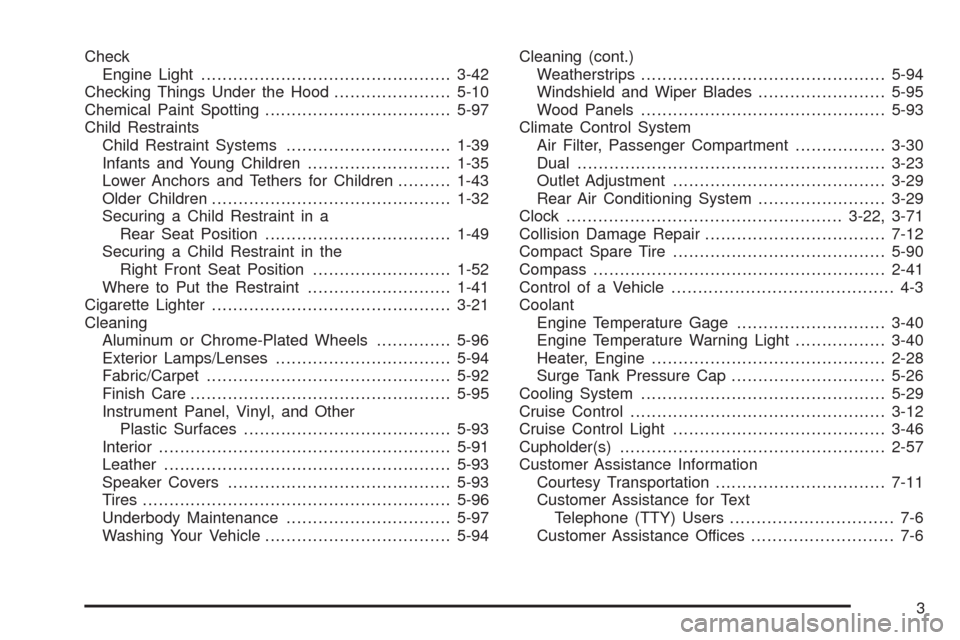
Check
Engine Light...............................................3-42
Checking Things Under the Hood......................5-10
Chemical Paint Spotting...................................5-97
Child Restraints
Child Restraint Systems...............................1-39
Infants and Young Children...........................1-35
Lower Anchors and Tethers for Children..........1-43
Older Children.............................................1-32
Securing a Child Restraint in a
Rear Seat Position...................................1-49
Securing a Child Restraint in the
Right Front Seat Position..........................1-52
Where to Put the Restraint...........................1-41
Cigarette Lighter.............................................3-21
Cleaning
Aluminum or Chrome-Plated Wheels..............5-96
Exterior Lamps/Lenses.................................5-94
Fabric/Carpet..............................................5-92
Finish Care.................................................5-95
Instrument Panel, Vinyl, and Other
Plastic Surfaces.......................................5-93
Interior.......................................................5-91
Leather......................................................5-93
Speaker Covers..........................................5-93
Tires..........................................................5-96
Underbody Maintenance...............................5-97
Washing Your Vehicle...................................5-94Cleaning (cont.)
Weatherstrips..............................................5-94
Windshield and Wiper Blades........................5-95
Wood Panels..............................................5-93
Climate Control System
Air Filter, Passenger Compartment.................3-30
Dual..........................................................3-23
Outlet Adjustment........................................3-29
Rear Air Conditioning System........................3-29
Clock....................................................3-22, 3-71
Collision Damage Repair..................................7-12
Compact Spare Tire........................................5-90
Compass.......................................................2-41
Control of a Vehicle.......................................... 4-3
Coolant
Engine Temperature Gage............................3-40
Engine Temperature Warning Light.................3-40
Heater, Engine............................................2-28
Surge Tank Pressure Cap.............................5-26
Cooling System..............................................5-29
Cruise Control................................................3-12
Cruise Control Light........................................3-46
Cupholder(s)..................................................2-57
Customer Assistance Information
Courtesy Transportation................................7-11
Customer Assistance for Text
Telephone (TTY) Users............................... 7-6
Customer Assistance Offices........................... 7-6
3
Page 439 of 448
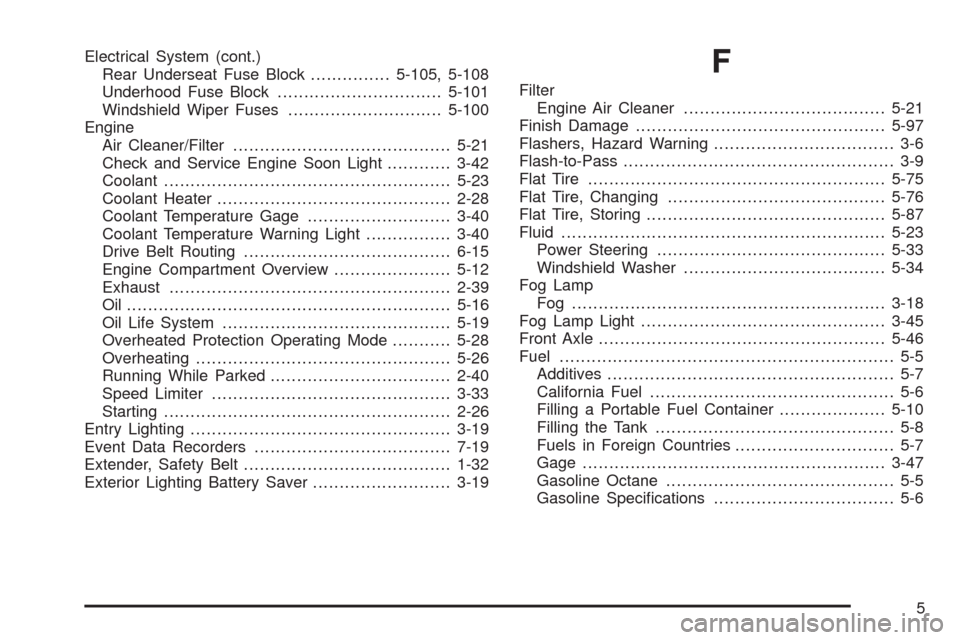
Electrical System (cont.)
Rear Underseat Fuse Block...............5-105, 5-108
Underhood Fuse Block...............................5-101
Windshield Wiper Fuses.............................5-100
Engine
Air Cleaner/Filter.........................................5-21
Check and Service Engine Soon Light............3-42
Coolant......................................................5-23
Coolant Heater............................................2-28
Coolant Temperature Gage...........................3-40
Coolant Temperature Warning Light................3-40
Drive Belt Routing.......................................6-15
Engine Compartment Overview......................5-12
Exhaust.....................................................2-39
Oil .............................................................5-16
Oil Life System...........................................5-19
Overheated Protection Operating Mode...........5-28
Overheating................................................5-26
Running While Parked..................................2-40
Speed Limiter.............................................3-33
Starting......................................................2-26
Entry Lighting.................................................3-19
Event Data Recorders.....................................7-19
Extender, Safety Belt.......................................1-32
Exterior Lighting Battery Saver..........................3-19F
Filter
Engine Air Cleaner......................................5-21
Finish Damage...............................................5-97
Flashers, Hazard Warning.................................. 3-6
Flash-to-Pass................................................... 3-9
Flat Tire........................................................5-75
Flat Tire, Changing.........................................5-76
Flat Tire, Storing.............................................5-87
Fluid.............................................................5-23
Power Steering...........................................5-33
Windshield Washer......................................5-34
Fog Lamp
Fog ...........................................................3-18
Fog Lamp Light..............................................3-45
Front Axle......................................................5-46
Fuel............................................................... 5-5
Additives...................................................... 5-7
California Fuel.............................................. 5-6
Filling a Portable Fuel Container....................5-10
Filling the Tank............................................. 5-8
Fuels in Foreign Countries.............................. 5-7
Gage.........................................................3-47
Gasoline Octane........................................... 5-5
Gasoline Specications.................................. 5-6
5