brake light CADILLAC SRX 2009 1.G Owner's Manual
[x] Cancel search | Manufacturer: CADILLAC, Model Year: 2009, Model line: SRX, Model: CADILLAC SRX 2009 1.GPages: 442, PDF Size: 2.42 MB
Page 255 of 442
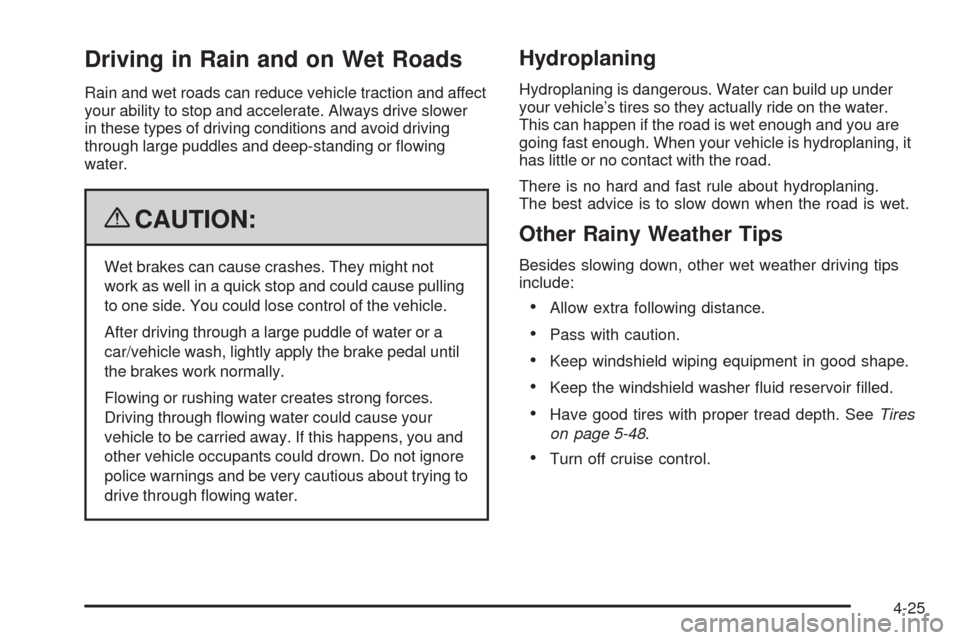
Driving in Rain and on Wet Roads
Rain and wet roads can reduce vehicle traction and affect
your ability to stop and accelerate. Always drive slower
in these types of driving conditions and avoid driving
through large puddles and deep-standing or owing
water.
{CAUTION:
Wet brakes can cause crashes. They might not
work as well in a quick stop and could cause pulling
to one side. You could lose control of the vehicle.
After driving through a large puddle of water or a
car/vehicle wash, lightly apply the brake pedal until
the brakes work normally.
Flowing or rushing water creates strong forces.
Driving through owing water could cause your
vehicle to be carried away. If this happens, you and
other vehicle occupants could drown. Do not ignore
police warnings and be very cautious about trying to
drive through owing water.
Hydroplaning
Hydroplaning is dangerous. Water can build up under
your vehicle’s tires so they actually ride on the water.
This can happen if the road is wet enough and you are
going fast enough. When your vehicle is hydroplaning, it
has little or no contact with the road.
There is no hard and fast rule about hydroplaning.
The best advice is to slow down when the road is wet.
Other Rainy Weather Tips
Besides slowing down, other wet weather driving tips
include:
Allow extra following distance.
Pass with caution.
Keep windshield wiping equipment in good shape.
Keep the windshield washer uid reservoir lled.
Have good tires with proper tread depth. SeeTires
on page 5-48.
Turn off cruise control.
4-25
Page 275 of 442
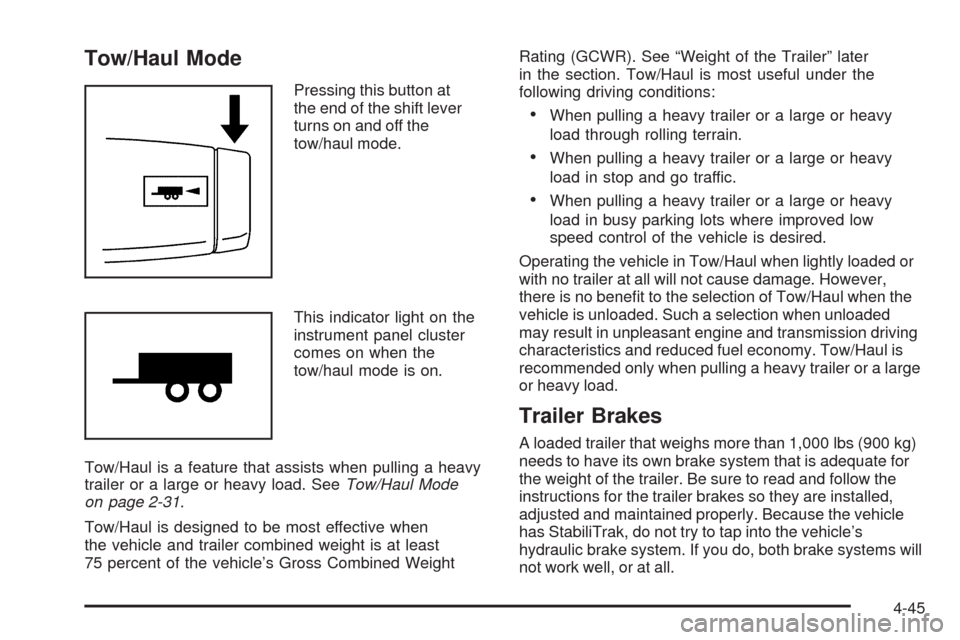
Tow/Haul Mode
Pressing this button at
the end of the shift lever
turns on and off the
tow/haul mode.
This indicator light on the
instrument panel cluster
comes on when the
tow/haul mode is on.
Tow/Haul is a feature that assists when pulling a heavy
trailer or a large or heavy load. SeeTow/Haul Mode
on page 2-31.
Tow/Haul is designed to be most effective when
the vehicle and trailer combined weight is at least
75 percent of the vehicle’s Gross Combined WeightRating (GCWR). See “Weight of the Trailer” later
in the section. Tow/Haul is most useful under the
following driving conditions:
When pulling a heavy trailer or a large or heavy
load through rolling terrain.
When pulling a heavy trailer or a large or heavy
load in stop and go traffic.
When pulling a heavy trailer or a large or heavy
load in busy parking lots where improved low
speed control of the vehicle is desired.
Operating the vehicle in Tow/Haul when lightly loaded or
with no trailer at all will not cause damage. However,
there is no benet to the selection of Tow/Haul when the
vehicle is unloaded. Such a selection when unloaded
may result in unpleasant engine and transmission driving
characteristics and reduced fuel economy. Tow/Haul is
recommended only when pulling a heavy trailer or a large
or heavy load.
Trailer Brakes
A loaded trailer that weighs more than 1,000 lbs (900 kg)
needs to have its own brake system that is adequate for
the weight of the trailer. Be sure to read and follow the
instructions for the trailer brakes so they are installed,
adjusted and maintained properly. Because the vehicle
has StabiliTrak, do not try to tap into the vehicle’s
hydraulic brake system. If you do, both brake systems will
not work well, or at all.
4-45
Page 281 of 442
Service............................................................5-3
Accessories and Modications..........................5-3
California Proposition 65 Warning.....................5-4
California Perchlorate Materials Requirements.....5-4
Doing Your Own Service Work.........................5-4
Adding Equipment to the Outside of
the Vehicle.................................................5-5
Fuel................................................................5-5
Gasoline Octane............................................5-5
Gasoline Specications....................................5-6
California Fuel...............................................5-6
Additives.......................................................5-7
Fuels in Foreign Countries...............................5-7
Filling the Tank..............................................5-8
Filling a Portable Fuel Container.....................5-10
Checking Things Under the Hood....................5-10
Hood Release..............................................5-11
Engine Compartment Overview.......................5-12
Engine Oil...................................................5-16
Engine Oil Life System..................................5-19
Engine Air Cleaner/Filter................................5-20
Automatic Transmission Fluid.........................5-22
Cooling System............................................5-22
Engine Coolant.............................................5-23
Coolant Surge Tank Pressure Cap..................5-29
Engine Overheating.......................................5-29Overheated Engine Protection
Operating Mode.........................................5-31
Power Steering Fluid.....................................5-31
Windshield Washer Fluid................................5-32
Brakes........................................................5-34
Battery........................................................5-37
Jump Starting...............................................5-38
All-Wheel Drive..............................................5-42
Rear Axle.......................................................5-43
Front Axle......................................................5-44
Headlamp Aiming...........................................5-45
Bulb Replacement..........................................5-45
High Intensity Discharge (HID) Lighting............5-46
Halogen Bulbs..............................................5-46
Windshield Wiper Blade Replacement..............5-46
Tires..............................................................5-48
Winter Tires.................................................5-49
Tire Sidewall Labeling...................................5-50
Tire Terminology and Denitions.....................5-53
Ination - Tire Pressure.................................5-56
High-Speed Operation...................................5-58
Tire Pressure Monitor System.........................5-59
Tire Pressure Monitor Operation.....................5-60
Tire Inspection and Rotation...........................5-64
When It Is Time for New Tires.......................5-65
Section 5 Service and Appearance Care
5-1
Page 314 of 442
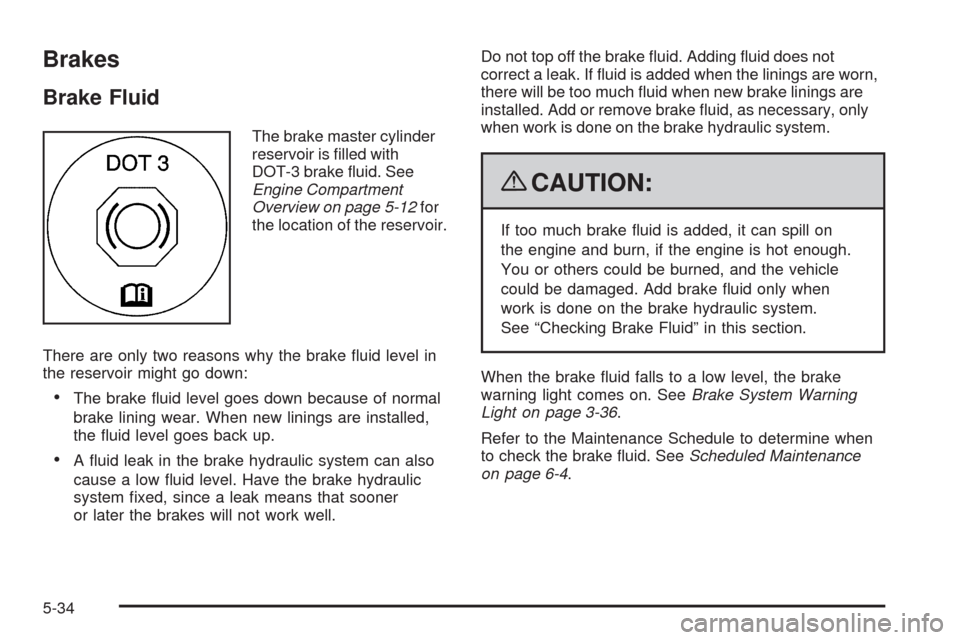
Brakes
Brake Fluid
The brake master cylinder
reservoir is lled with
DOT-3 brake uid. See
Engine Compartment
Overview on page 5-12for
the location of the reservoir.
There are only two reasons why the brake uid level in
the reservoir might go down:
The brake uid level goes down because of normal
brake lining wear. When new linings are installed,
the uid level goes back up.
A uid leak in the brake hydraulic system can also
cause a low uid level. Have the brake hydraulic
system xed, since a leak means that sooner
or later the brakes will not work well.Do not top off the brake uid. Adding uid does not
correct a leak. If uid is added when the linings are worn,
there will be too much uid when new brake linings are
installed. Add or remove brake uid, as necessary, only
when work is done on the brake hydraulic system.
{CAUTION:
If too much brake uid is added, it can spill on
the engine and burn, if the engine is hot enough.
You or others could be burned, and the vehicle
could be damaged. Add brake uid only when
work is done on the brake hydraulic system.
See “Checking Brake Fluid” in this section.
When the brake uid falls to a low level, the brake
warning light comes on. SeeBrake System Warning
Light on page 3-36.
Refer to the Maintenance Schedule to determine when
to check the brake uid. SeeScheduled Maintenance
on page 6-4.
5-34
Page 316 of 442
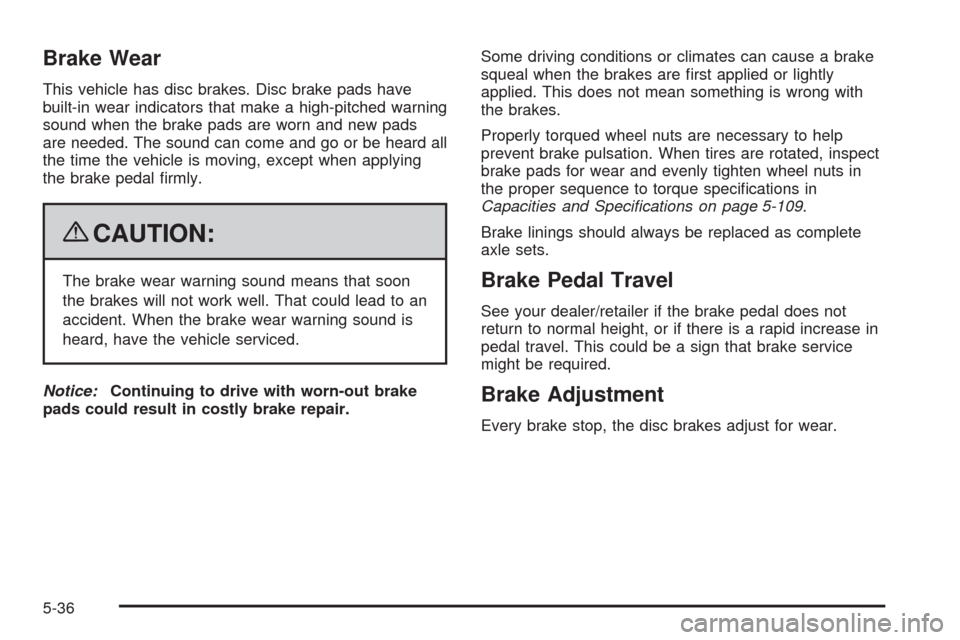
Brake Wear
This vehicle has disc brakes. Disc brake pads have
built-in wear indicators that make a high-pitched warning
sound when the brake pads are worn and new pads
are needed. The sound can come and go or be heard all
the time the vehicle is moving, except when applying
the brake pedal rmly.
{CAUTION:
The brake wear warning sound means that soon
the brakes will not work well. That could lead to an
accident. When the brake wear warning sound is
heard, have the vehicle serviced.
Notice:Continuing to drive with worn-out brake
pads could result in costly brake repair.Some driving conditions or climates can cause a brake
squeal when the brakes are rst applied or lightly
applied. This does not mean something is wrong with
the brakes.
Properly torqued wheel nuts are necessary to help
prevent brake pulsation. When tires are rotated, inspect
brake pads for wear and evenly tighten wheel nuts in
the proper sequence to torque specications in
Capacities and Specifications on page 5-109.
Brake linings should always be replaced as complete
axle sets.Brake Pedal Travel
See your dealer/retailer if the brake pedal does not
return to normal height, or if there is a rapid increase in
pedal travel. This could be a sign that brake service
might be required.
Brake Adjustment
Every brake stop, the disc brakes adjust for wear.
5-36
Page 318 of 442
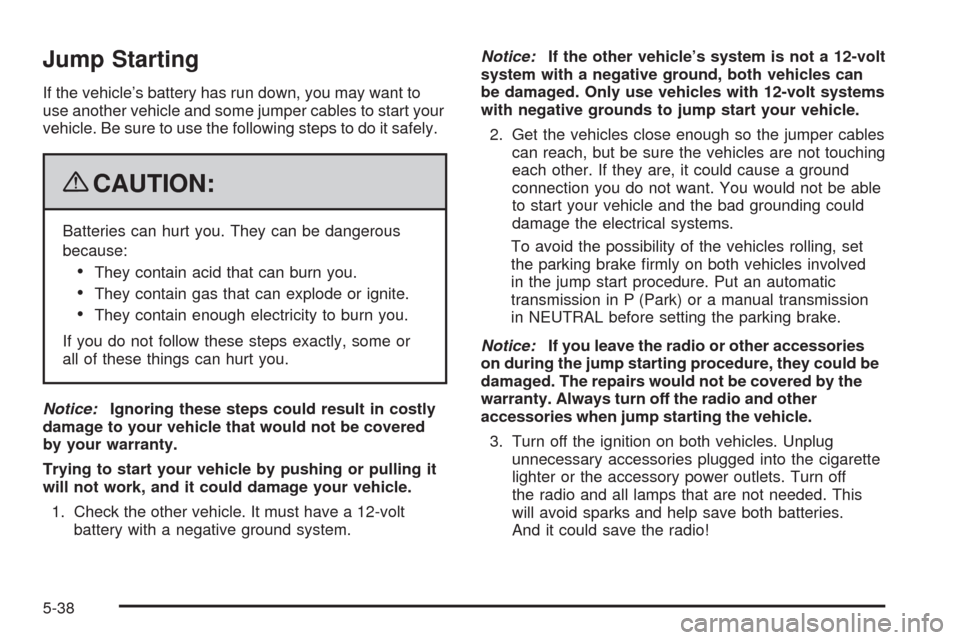
Jump Starting
If the vehicle’s battery has run down, you may want to
use another vehicle and some jumper cables to start your
vehicle. Be sure to use the following steps to do it safely.
{CAUTION:
Batteries can hurt you. They can be dangerous
because:
They contain acid that can burn you.
They contain gas that can explode or ignite.
They contain enough electricity to burn you.
If you do not follow these steps exactly, some or
all of these things can hurt you.
Notice:Ignoring these steps could result in costly
damage to your vehicle that would not be covered
by your warranty.
Trying to start your vehicle by pushing or pulling it
will not work, and it could damage your vehicle.
1. Check the other vehicle. It must have a 12-volt
battery with a negative ground system.Notice:If the other vehicle’s system is not a 12-volt
system with a negative ground, both vehicles can
be damaged. Only use vehicles with 12-volt systems
with negative grounds to jump start your vehicle.
2. Get the vehicles close enough so the jumper cables
can reach, but be sure the vehicles are not touching
each other. If they are, it could cause a ground
connection you do not want. You would not be able
to start your vehicle and the bad grounding could
damage the electrical systems.
To avoid the possibility of the vehicles rolling, set
the parking brake rmly on both vehicles involved
in the jump start procedure. Put an automatic
transmission in P (Park) or a manual transmission
in NEUTRAL before setting the parking brake.
Notice:If you leave the radio or other accessories
on during the jump starting procedure, they could be
damaged. The repairs would not be covered by the
warranty. Always turn off the radio and other
accessories when jump starting the vehicle.
3. Turn off the ignition on both vehicles. Unplug
unnecessary accessories plugged into the cigarette
lighter or the accessory power outlets. Turn off
the radio and all lamps that are not needed. This
will avoid sparks and help save both batteries.
And it could save the radio!
5-38
Page 398 of 442
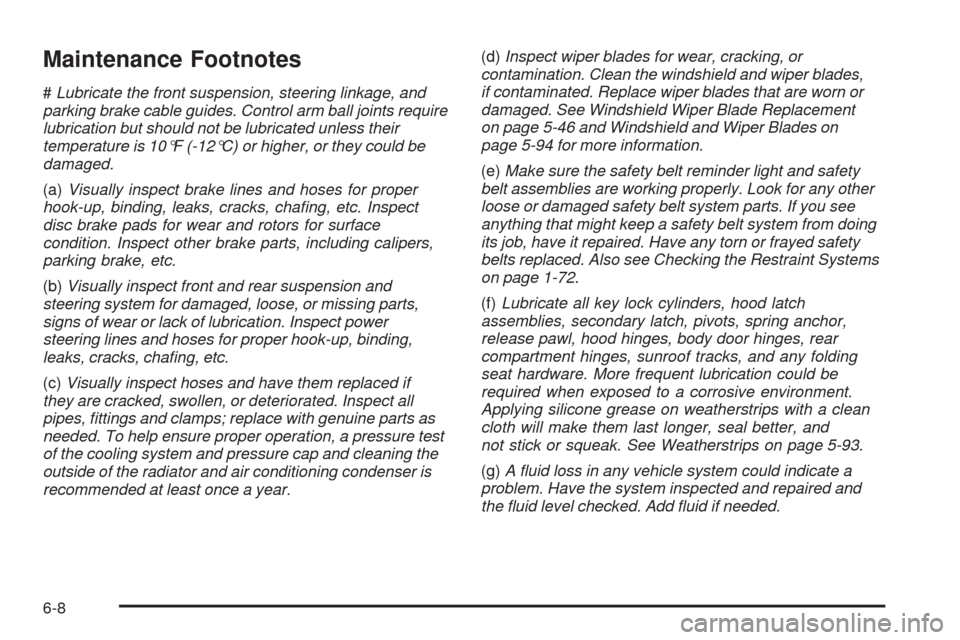
Maintenance Footnotes
#Lubricate the front suspension, steering linkage, and
parking brake cable guides. Control arm ball joints require
lubrication but should not be lubricated unless their
temperature is 10°F (-12°C) or higher, or they could be
damaged.
(a)Visually inspect brake lines and hoses for proper
hook-up, binding, leaks, cracks, chafing, etc. Inspect
disc brake pads for wear and rotors for surface
condition. Inspect other brake parts, including calipers,
parking brake, etc.
(b)Visually inspect front and rear suspension and
steering system for damaged, loose, or missing parts,
signs of wear or lack of lubrication. Inspect power
steering lines and hoses for proper hook-up, binding,
leaks, cracks, chafing, etc.
(c)Visually inspect hoses and have them replaced if
they are cracked, swollen, or deteriorated. Inspect all
pipes, fittings and clamps; replace with genuine parts as
needed. To help ensure proper operation, a pressure test
of the cooling system and pressure cap and cleaning the
outside of the radiator and air conditioning condenser is
recommended at least once a year.(d)Inspect wiper blades for wear, cracking, or
contamination. Clean the windshield and wiper blades,
if contaminated. Replace wiper blades that are worn or
damaged. See Windshield Wiper Blade Replacement
on page 5-46 and Windshield and Wiper Blades on
page 5-94 for more information.
(e)Make sure the safety belt reminder light and safety
belt assemblies are working properly. Look for any other
loose or damaged safety belt system parts. If you see
anything that might keep a safety belt system from doing
its job, have it repaired. Have any torn or frayed safety
belts replaced. Also see Checking the Restraint Systems
on page 1-72.
(f)Lubricate all key lock cylinders, hood latch
assemblies, secondary latch, pivots, spring anchor,
release pawl, hood hinges, body door hinges, rear
compartment hinges, sunroof tracks, and any folding
seat hardware. More frequent lubrication could be
required when exposed to a corrosive environment.
Applying silicone grease on weatherstrips with a clean
cloth will make them last longer, seal better, and
not stick or squeak. See Weatherstrips on page 5-93.
(g)A fluid loss in any vehicle system could indicate a
problem. Have the system inspected and repaired and
the fluid level checked. Add fluid if needed.
6-8
Page 429 of 442
A
Accessories and Modications............................ 5-3
Accessory Power Outlets.................................3-20
Adding Equipment to Your Airbag-Equipped
Vehicle.......................................................1-70
Additives, Fuel................................................. 5-7
Add-On Electrical Equipment............................5-98
Adjustable Throttle and Brake Pedal..................2-25
Air Cleaner/Filter, Engine.................................5-20
Air Conditioning..............................................3-22
Airbag
Passenger Status Indicator...........................3-33
Readiness Light..........................................3-32
Airbag System................................................1-56
Adding Equipment to Your Airbag-Equipped
Vehicle...................................................1-70
How Does an Airbag Restrain?......................1-63
Passenger Sensing System...........................1-65
Servicing Your Airbag-Equipped Vehicle..........1-70
What Makes an Airbag Inate?......................1-63
What Will You See After an Airbag Inates?........1-64
When Should an Airbag Inate?....................1-61
Where Are the Airbags?...............................1-58
All-Wheel Drive...............................................5-42
All-Wheel-Drive (AWD) System........................... 4-8
Analog Clock..................................................3-21Antenna, Rear Side Window.............................3-92
Antenna, XM™ Satellite Radio Antenna
System......................................................3-92
Antilock Brake System (ABS)............................. 4-4
Antilock Brake, System Warning Light................3-37
Appearance Care
Aluminum or Chrome-Plated Wheels..............5-95
Care of Safety Belts....................................5-92
Chemical Paint Spotting...............................5-96
Cleaning Exterior Lamps/Lenses....................5-93
Fabric/Carpet..............................................5-90
Finish Care.................................................5-94
Finish Damage............................................5-96
Instrument Panel, Vinyl, and Other
Plastic Surfaces.......................................5-92
Interior Cleaning..........................................5-89
Leather......................................................5-91
Sheet Metal Damage...................................5-96
Speaker Covers..........................................5-92
Tires..........................................................5-96
Underbody Maintenance...............................5-96
Washing Your Vehicle...................................5-93
Weatherstrips..............................................5-93
Windshield and Wiper Blades........................5-94
Wood Panels..............................................5-92
Appointments, Scheduling Service.....................7-10
Ashtray.........................................................3-20
1
Page 430 of 442
Audio System.................................................3-68
Audio Steering Wheel Controls......................3-90
Navigation/Radio System,
see Navigation Manual..............................3-88
Radio Reception..........................................3-91
Rear Seat Audio (RSA)................................3-88
Setting the Clock.........................................3-69
Theft-Deterrent Feature................................3-90
XM™ Satellite Radio Antenna System............3-92
Audio System(s).............................................3-72
Rear Side Window Antenna..........................3-92
Automatic Transmission
Fluid..........................................................5-22
Operation...................................................2-27
B
Battery..........................................................5-37
Electric Power Management..........................3-19
Exterior Lighting Battery Saver......................3-18
Brake
Emergencies................................................ 4-5
Brake Fluid....................................................5-34
Brakes..........................................................5-34
System Warning Light..................................3-36
Braking........................................................... 4-3
Braking in Emergencies..................................... 4-5Break-In, New Vehicle.....................................2-22
Bulb Replacement...........................................5-45
Halogen Bulbs............................................5-46
Headlamp Aiming........................................5-45
High Intensity Discharge (HID) Lighting...........5-46
Buying New Tires...........................................5-66
C
Calibration.....................................................2-38
California Fuel.................................................. 5-6
California Perchlorate Materials Requirements....... 5-4
California Proposition 65 Warning....................... 5-4
Canadian Owners............................................... iii
Capacities and Specications..........................5-109
Carbon Monoxide...........................2-12, 2-36, 4-27
Care of
Safety Belts................................................5-92
Cargo Cover..................................................2-55
Cargo Management System.............................2-55
CD, MP3 .......................................................3-81
Center Console Storage Area...........................2-54
Chains, Tire...................................................5-72
Charging System Light....................................3-35
Check
Engine Lamp..............................................3-39
Checking Things Under the Hood......................5-10
2
Page 435 of 442
J
Jump Starting.................................................5-38
K
Keyless Entry System....................................... 2-4
Keys............................................................... 2-3
L
Labeling, Tire Sidewall.....................................5-50
Lamp
Malfunction Indicator....................................3-39
Lamps
Exterior Lighting Battery Saver......................3-18
Reading.....................................................3-19
Lap-Shoulder Belt...........................................1-27
LATCH System for Child Restraints...................1-43
Level Control..................................................4-38
Liftgate, Power...............................................2-12
Light
Airbag Readiness........................................3-32
Antilock Brake System (ABS) Warning............3-37
Brake System Warning.................................3-36Light (cont.)
Charging System.........................................3-35
Cruise Control.............................................3-44
Engine Coolant Temperature Warning.............3-38
Fog Lamp ..................................................3-43
Highbeam On.............................................3-44
Lights On Reminder.....................................3-43
Oil Pressure...............................................3-42
Passenger Airbag Status Indicator..................3-33
Safety Belt Reminders..................................3-31
Security.....................................................3-43
TCS Warning Light......................................3-37
Tire Pressure..............................................3-39
Tow/Haul Mode...........................................3-44
Traction Control System (TCS) Warning..........3-37
Lighting
Entry.........................................................3-18
Parade Dimming..........................................3-18
Lights............................................................3-15
Flash-to-Pass............................................... 3-9
High/Low Beam Changer................................ 3-8
On Reminder..............................................3-16
Limited-Slip Rear Axle....................................... 4-8
Loading Your Vehicle.......................................4-30
Lockout Protection
..........................................2-11
7